At least nine MQ-9s are deployed to Puerto Rico’s Rafael Hernández Airport, each carrying between six and ten AGM-114 Hellfire missiles.
U.S. Air Force MQ-9A Reapers deployed to Puerto Rico’s Rafael Hernández Airport in support of counter-narcotics operations in the Caribbean are now routinely flying with up to ten AGM-114 Hellfire air-to-ground missiles each. Photos emerging online show varying loadouts, which include between six and ten AGM-114s, as well as external fuel tanks and pods for Intelligence, Surveillance and Reconnaissance (ISR).
Many of the photos available online show the Reapers armed with six Hellfires, as well as a pod. Notably, on Dec. 24, 2025, MQ-9s were photographed with eight AGM-114s, and on Dec. 27 an image by Reuters appears to show a Reaper carrying ten Hellfires.
And a few days later we have now beat that record with a total of 10x AGM-114 Hellfires on a single unit.
Armed with a pair of 4x racks and a single 2x rack. https://t.co/PaqNBxSzXf pic.twitter.com/L1YauZlk4u
— SA Defensa (@SA_Defensa) December 27, 2025
Five years ago, on Sep. 10, 2020, the Air Force had flown for the first time a Reaper with eight Hellfires at Creech AFB, Nevada, as part of an MQ-9 Operational Flight Program 2409 software upgrade. This was officially the largest number of missiles on the drone, at least until a few days ago, although this time the service repeated that feat in an operational scenario.
BQN morning updates 8:59am 12/24/2025. pic.twitter.com/CHznbgS7xH
— Michael Bonet 🇵🇷 (@MichaelBonet8) December 24, 2025
As of Dec. 25, flight tracker and aircraft spotter profile ‘LatAmMilMovements’ has counted nine Air Force Reapers that progressively reached Rafael Hernández Airport, located in the Aguadilla municipality of Puerto Rico. The aircraft arrived there over the previous days.
New publicly available images show that nine USAF MQ-9As have flown/are flying out of Aguadilla (BQN/TJBQ) 🇵🇷 in support of ongoing counternarcotics ops in the Caribbean.
The nine serials are: 14-4242, 14-4269, 14-4275, 17-4348, 17-4355, 17-4356, 19-4390, 19-4398, 20-4408. https://t.co/1vL60eEoG6 pic.twitter.com/1cUkfIfB2W
— LatAmMilMovements (@LatAmMilMVMTs) December 24, 2025
The airport, which now hosts a large contingent of U.S. forces, has been the focus of many spotters, with loads of photos and data emerging online. However, the military is now taking steps to maintain a degree of Operational Security (OPSEC), and is placing covers on fences near Special Operations Command’s (SOCOM) assets to block the view.
📍Rafael Hernandez Airport, #UnitedStates (🇺🇸)
Personnel have begun emplacing covers on fences blocking spotters from viewing SOCOM movements at Rafael Hernandez Airport in Aguadilla. pic.twitter.com/5JuMS6TPPU
— SA Defensa (@SA_Defensa) December 29, 2025
MQ-9A Reapers with six and eight Hellfire missiles
Prior to the Reaper with the ten Hellfires, photographer Michael Bonet had captured Reapers operating from Rafael Hernández Airport on Dec. 24, equipped with both six and eight Hellfires. The eight Hellfire payload however is not as clearly captured as the Reaper/s with the six Hellfires, and needs a discerning eye to see the length of the protrusions under the wings to identify the stores.
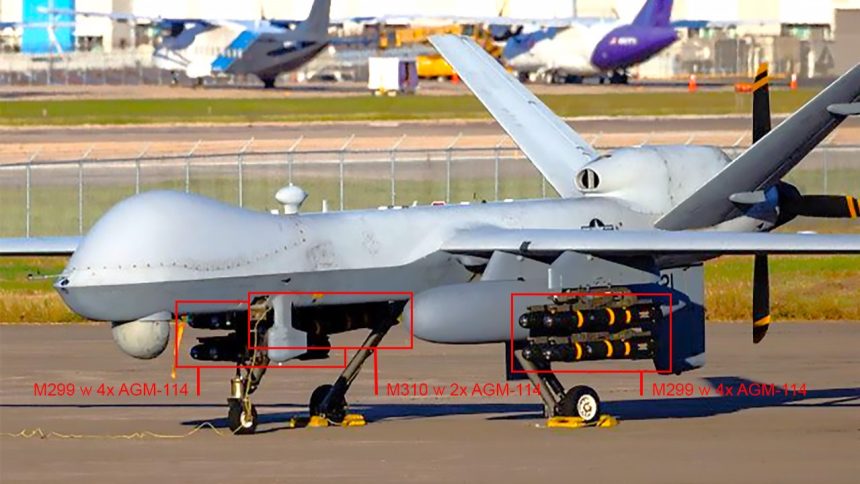
Similarly to the AH-64 Apache, Reapers use a M299 four-rail launcher to carry four Hellfires in sets of two, while the M310 twin-rail launcher has long been used by the MQ-9 to carry two Hellfires side-by-side. The Reaper/s with the six Hellfire loadout are equipped with three M310s on the inner-most and middle pylons of both wings,as seen in clear front and side shots of the Reaper on the runway and the flightline.

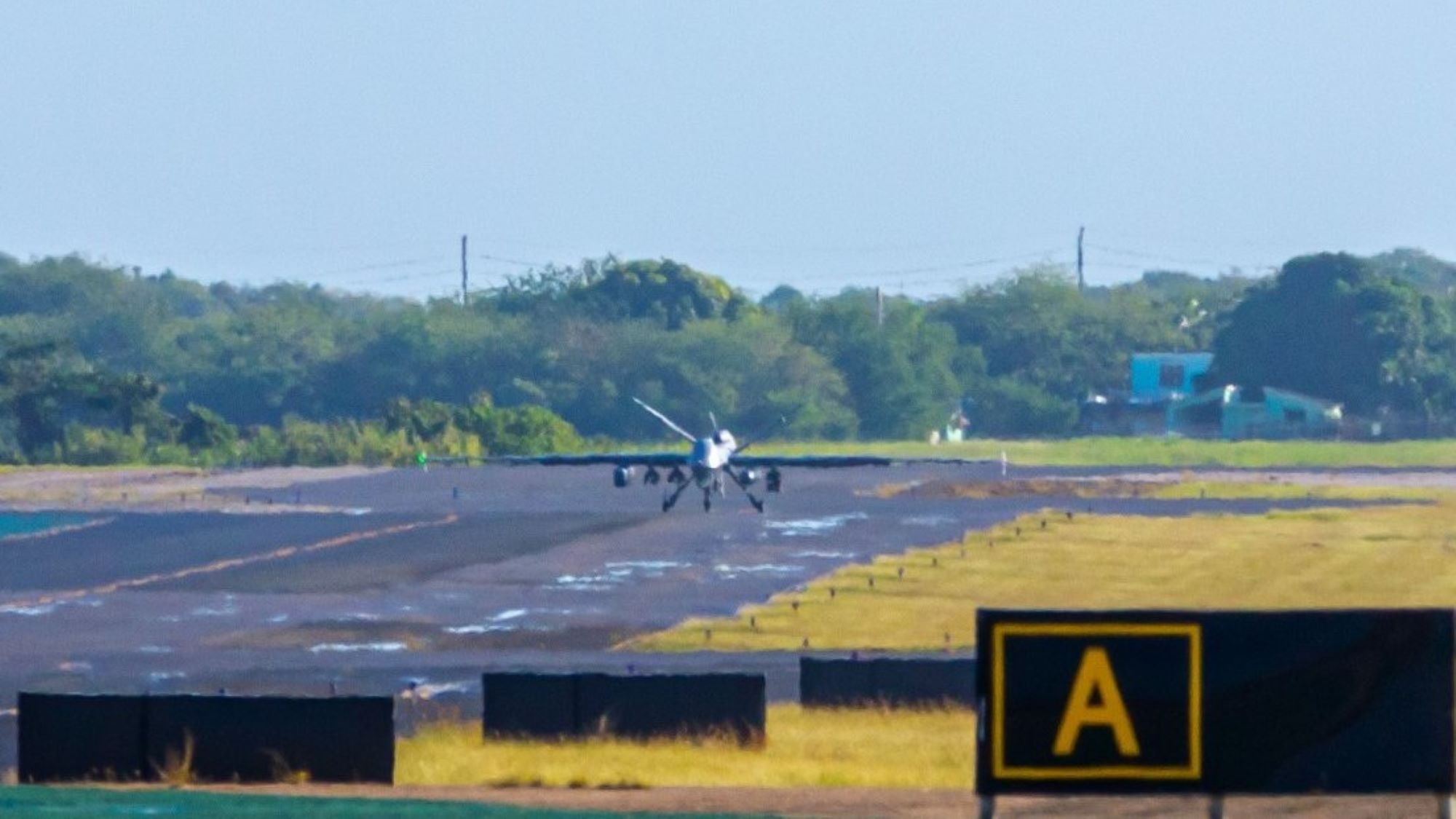
The Reaper/s with the eight-Hellfire loadout is seen while on final for landing (captured from the rear), as well as after landing (captured from the front). Indeed, we don’t know if this is the same Reaper or two different aircraft with the same loadout.
In the rear shot, the presence of an M299 on the left wing’s outer-most pylon can be confirmed from the tail-end outline of two Hellfires, one below the other, peeking out from behind the bottom vertical stabilizer. In the frontal shot of a Reaper on the runway, albeit at a distance, we can see the twin and quad-rack arrangement quite clearly.
BQN morning updates 10:38am 12/24/2025. pic.twitter.com/XZaJqtt6ii
— Michael Bonet 🇵🇷 (@MichaelBonet8) December 24, 2025
Conveniently, @MichaelBonet8 caught a MQ-9 with 6x Hellfires on board this morning. https://t.co/PaqNBxSzXf pic.twitter.com/RM5lW392AA
— SA Defensa (@SA_Defensa) December 24, 2025
Reaper with ten Hellfires
The image released by Reuters showing the MQ-9 armed with ten Hellfire missiles shows the aircraft parked on the flightline. The image was first shared by ‘SA Defensa’, noting the rare loadout.
We can clearly see a four-missile M299 launcher on the left wing, and the reflection of the seeker heads of the Hellfires installed on the right wing’s M299 launcher. However, upon close inspection, the body and the seeker heads of two more Hellfires on an M310 launcher can also be seen on the right wing.
All the Reapers are also carrying an unidentified sensor payload and an external fuel tank, one under each wing. Usually the Reaper’s 1,200 lb fuel tank is mounted on the inner-most station of either of the wings, while the pod is on the outermost station.
Regardless of the number of Hellfires and the required rail launchers, this seems to be the optimum loadout configuration chosen by the U.S. military while executing missions requiring both ISR and strike capabilities with extended range.
The unknown pod is often spotted installed on MQ-9s, but has never been officially identified. Two possibilities can be immediately excluded as it does not bear resemblance to either the RDESS/SOAR or SkyTower II pods now operated by the U.S. Marine Corps for electronic support and enhanced cross-domain communications.
The pod bears some resemblance, at least for the common shape, to the Sledgehammer electronic attack pod and the Standard Payload Interface Design and Integration (SPIDI) and NATO pods, although they all miss the aperture on the front. Another possibility could be a rumored system called “Outdragon,” reportedly used for Communications Intelligence (COMINT), but no details are available except for a Foreign Military Sale to the UK in 2019.
🇺🇸 Reaper ⚡☠️
Hoy en Puerto Rico se ha visto un UCAV Reaper armado hasta los dientes, que además incluye un depósito de combustible y un Pod especial, probablemente se trate de un Pod de inteligencia de comunicaciones (COMINT) denominado “Outdragon”.
Este Pod se ha usado… https://t.co/jcaM4FXlvP pic.twitter.com/lXjFMi1Lya
— Historias de aviación 🇪🇦 (@ReinaldoDMM) December 24, 2025
Increasing the Reaper’s payload
In the Sep. 10, 2020, MQ-9 Operational Flight Program 2409 test at Creech AFB, the 53rd Wing had announced that the 556th Test and Evaluation Squadron’s first flight of the Reaper with eight Hellfires reinforced the platform’s “persistent attack” role. Up until that trial, the Reaper was “limited to four AGM-114s across two stations,” explained the service, but the new software enabled the Hellfire to be loaded “on stations that previously were reserved for 500-pound class bombs or fuel tanks.”
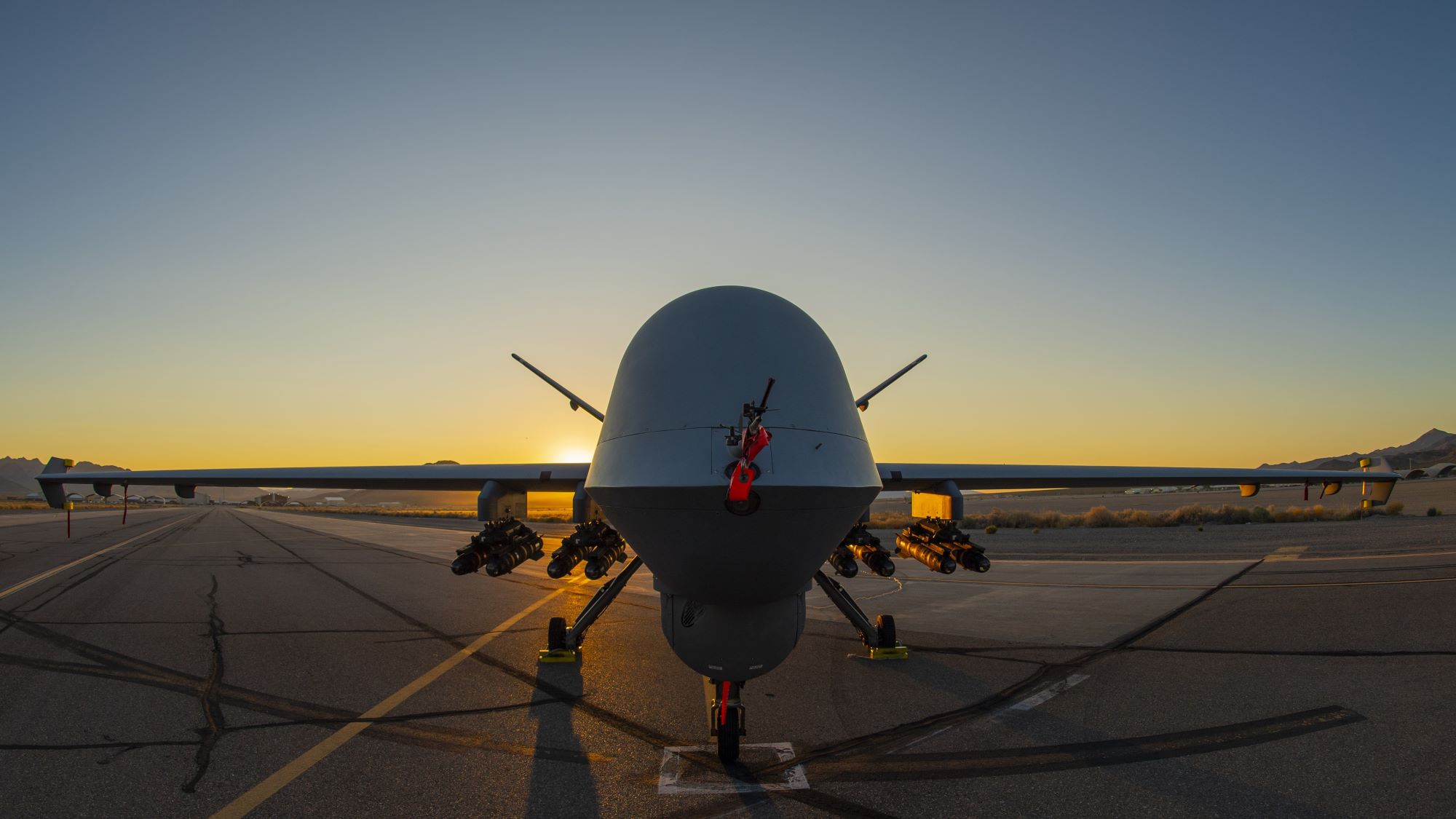
Test system configuration manager Master Sgt. Melvin French was quoted in the press release by the 53rd Wing, explaining that “the hardware/launcher is the same that we use on the outboard stations.” This was a reference to the M310 twin-rail launcher, of which four were installed on the Reaper shown in the images, two on each of the wings.
The M299 launcher meanwhile is usually seen on attack helicopters such as the U.S. Army’s AH-64 Apache, as well as other platforms such as the AC-130, AH-1 and MH-60. Manufacturer Marvin Group says on its product catalogue that the M299 and M310 are also used by the AH-1 Cobra, A-129 Mangusta, Eurocopter Tiger, OH-58D Kiowa Warrior and the C-130 Hercules.
Looks to be 10x MC-130s and 11x CV-22Bs in addition to the 10x MQ-9s. https://t.co/hUv4HnfbwM
— SA Defensa (@SA_Defensa) December 28, 2025
PSE morning updates 9:11am 12/28/2025. pic.twitter.com/msu83b5B71
— Michael Bonet 🇵🇷 (@MichaelBonet8) December 28, 2025
Pressure on Venezuela
Rafael Hernández Airport has become a hub of the U.S. Air Force Special Operations Command (AFSOC) assets. This adds to the considerable U.S. naval presence in the Caribbean Sea, led by the USS Gerald R. Ford Carrier Strike Group.
Recent images from Reuters show that at least five of the ten MC-130Js deployed to Puerto Rico are in full CR-2 configuration.
Capability Release 2 (CR-2) includes:
– AN/APQ-187 Silent Knight Radar
– Honeywell JetWave SATCOM
– AN/ALQ-251 Radio Frequency Countermeasures (RFCM) https://t.co/puF2NxdDRK pic.twitter.com/QkJEVSX6Ns
— LatAmMilMovements (@LatAmMilMVMTs) December 29, 2025
The U.S. continues to bolster its airpower in the Caribbean, with at least 10 MQ-9A Reaper drones, 11 CV-22B Ospreys, 10 MC-130J Commando IIs, and 36 fighter aircraft now forward deployed to Puerto Rico.
• BQN: Special ops + drone hub
• RVR: Strike assets + IWOARG ACE
• SJU:… pic.twitter.com/fIDqU7H0HC
— Ian Ellis (@ianellisjones) December 29, 2025
This is considered the largest U.S. naval deployment around Latin America in decades. Beside the nine to ten MQ-9s at Rafael Hernandez, at least ten MC-130J Commando IIs and eleven CV-22B Ospreys of the AFSOC have been tracked and photographed.
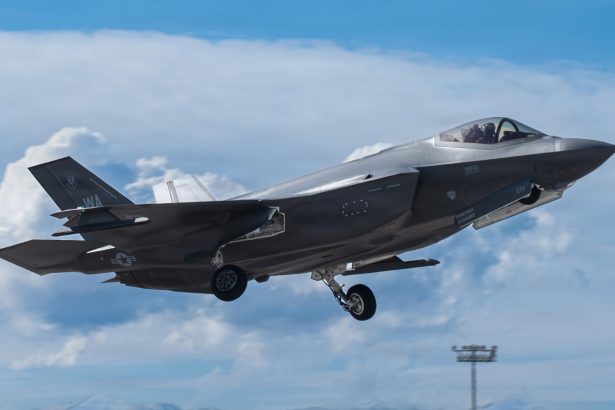
U.S. Marine Corps F-35Bs and U.S. Air Force F-35As also landed in Puerto Rico, with the former flying off Venezuela since October. B-52 bombers have flown routes skirting the country’s airspace too.
A special shout out to Michael Bonet for allowing us to use his images.