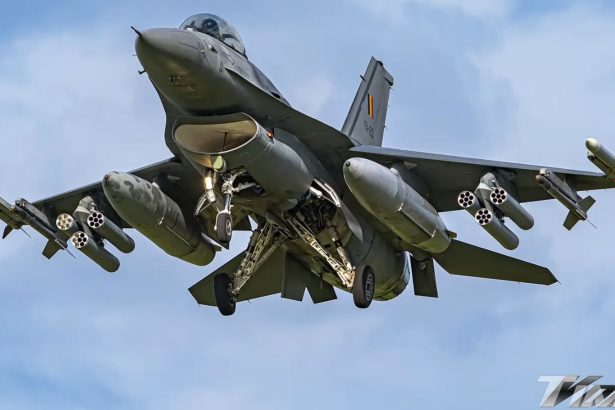
The 127th and, under current plans, last F-16 to be converted into an optionally-piloted QF-16 full-scale aerial target has been delivered to the U.S. Air Force.
Marking the transition from production to the sustainment phase, Boeing Defense has celebrated this milestone delivery by releasing short video featuring interviews with some of the personnel who have worked on the program through its 15 year history. The requirement to convert surplus F-16 Fighting Falcon aircraft into full-scale aerial targets (FSAT) was drawn up in the mid 2000s, with interested companies invited to submit their bids for the contract. In 2010, a $69.7 million production contract was then awarded to Boeing.
The QF-16, as it would be known, was to replace the U.S. Air Force’s stocks of QF-4s – converted F-4 Phantom IIs. A QF-16 took off for the first time in 2012, with further testing over the following years ramping up until the declaration of initial operating capability (IOC) in 2016. This coincided with the retirement of the QF-4 at the end of 2016, 19 years after its own IOC declaration. Using more modern technology as well as a more capable base platform, the QF-16 was designed to inherit as much functionality from the F-16 as possible, maintaining the ability to perform supersonic flight, pull 9G maneuvers, and fly up to an altitude of 55,000 feet.

Boeing expects to continue supporting the QF-16 fleet for at least 5-10 more years. Though considered expendable targets, sometimes being destroyed in live fire exercises, FSATs also perform non-destructive aerial target duties and can be re-used as many times as necessary. The QF-16 is the only FSAT in U.S. service, though the Department of Defense also has expansive stocks of smaller purpose-built target drones like the BQM-167A and BQM-177A.
Right on target.
The QF-16 makes its final delivery to the @USAirForce. Hear from #TeamBoeing employees how retired F-16s are transformed into advanced aerial targets for the U.S. military and allies, and what’s next for the program. pic.twitter.com/571fuVLBDR
— Boeing Defense (@BoeingDefense) December 4, 2025
The last aircraft to roll out of Boeing’s conversion facilities, sporting the code QF-127, was serial number 83-1079. Delivered in 1984 as an F-16A, the airframe is recorded as having arrived into the care of the 309th Aerospace Maintenance And Regeneration Group, or AMARG, at Davis-Monthan Air Force Base in January 2007. Its last unit as an operational fighter was the North Dakota Air National Guard’s 178th Fighter Squadron, also known as ‘the Happy Hooligans’. Even as a converted QF-16, ‘Roughrider Country’ and ‘North Dakota’ markings are still visible on the fuselage as fading references to its previous home.
309th AMARG celebrated the aircraft’s departure with a post on social media on Nov. 21, 2025.
Initial QF-16 conversions were completed at Cecil Airport in Jacksonville, Florida. Boeing subsequently opened a second conversion line at Davis-Monthan itself in 2020, meaning surplus aircraft from the AMARG ‘Boneyard’ storage facility could receive the necessary upgrades on site. The Florida line was then closed in 2022. Operational QF-16s are in service with the 82nd Aerial Targets Squadron, primarily headquartered at Tyndall AFB, Florida, with a detachment at Holloman AFB, New Mexico.
QF-16 Conversion
Conversion to QF-16 standard usually takes around six months to complete. The aircraft’s radar and cannon have usually already been removed during preparation for long term storage at AMARG. Ballast is added at the front to compensate for the missing radar, while the void left by the removal of the M61 Vulcan 20 mm cannon is used to house a smoke-generating Visual Augmentation System which can be activated to assist with sighting the aircraft at long distances or to mark its simulated destruction. The ACES II ejection seat system is retained to allow the aircraft to still be flown from the cockpit when required.
An Automatic Flight Control Computer (AFCC) is installed along with systems to allow remote control of the aircraft. New antennas are added to each wing, the nose, and the tail fin for the Vector Scoring System (VSS) which tracks incoming missiles and produces data regarding accuracy and probability of kill (Pk) based on the known performance of proximity-fused warheads.
Explosive charges are fitted near the centre of each QF-16’s fuselage, acting as a flight termination system (FTS) for use when flight control is lost either due to equipment malfunction or if an airframe is still maintaining flight after significant damage. The FTS was designed and tested on a real F-16 airframe to ensure complete functional destruction of the aircraft within a determinable range safety footprint.

Through the years, QF-16s have been targeted by an array of anti-aircraft missiles, including AIM-9 Sidewinders, AIM-120 AMRAAMs, FIM-92 Stingers, and even the latest AIM-260 JATMs. A number have been destroyed in the process.

Whether the long history of converting manned fighters into target drones continues into the future – perhaps with more, newer F-16s as they become available – remains to be seen. As drones become more advanced, capable and ever more prevalent, the requirement for aircraft conversions like the QF-16 is rapidly eroding away.