jump to navigation

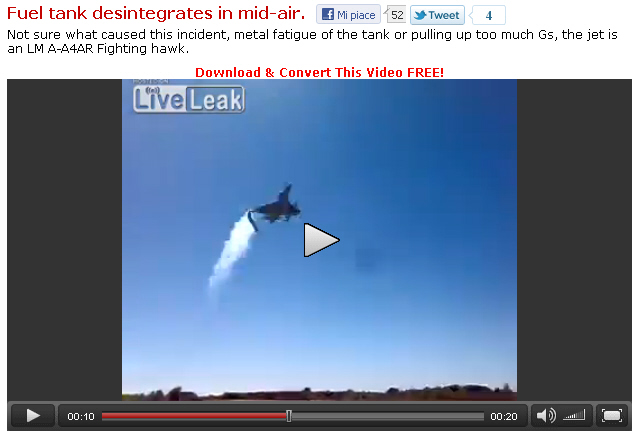
After the Argentine Air Force IA-63 Pampa crazy flyby the Argentine AF A-4AR’s fuel tank disintegrating after a high-G maneuver…. June 27, 2011

Posted by David Cenciotti in Aviation, Aviation Safety, Military Aviation.
Tags: , , , , , , , , ,
trackback

One of the recent most discussed topic on this blog was the one about the Argentine Air Force IA-63 Pampa performing a crazy low passage. If you read my post and the subsequent thread of comments, you’ll see that the video caused a debate between those (like me) who consider that flyby an example of poor airmanship and those (mainly Argentinean readers) who believe that the “low passage” showed the skill of Argentinean pilots.

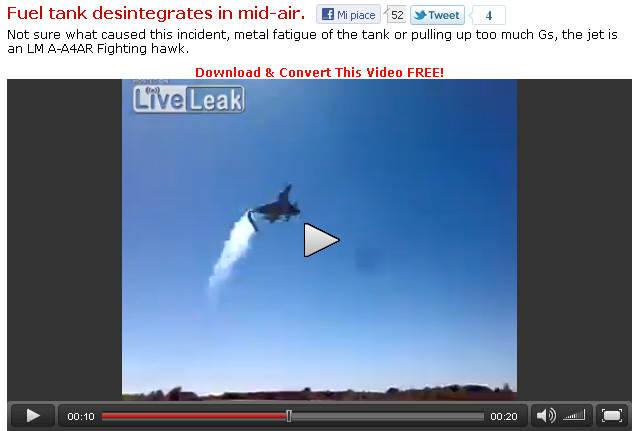
In the meanwhile, a new video shows how risky this performances can be. An amateur footage posted on Liveleak shows an Argentine AF A-4AR Fightinghawk performing a high-G climb from low level whose “collateral effect” is the collapse of the right fuel tank (with debris falling on the airport). Obviously, the maneuver which caused the fuel tank “disintegration” is not as dangerous as the Pampa one, but it demonstrates that flying at low altitudes at high speed (in this case with modernized planes built in the ’70s), when not strictly required for operational purposes, can stress the airframes to such an extent they could break apart, (potentially) causing loss of control of the aircraft or simply rendering an airport unserviceable because of debris and consequent FOD (Foreign Object Damage) risk. Don’t forget that the IA-63 Pampa pilot in the above mentioned video, pulled 5.3 G (the HUD signals “Max G”) in the zooming following the flyby. What if his fuel tank collapsed creating a weight unbalance at ultra-low level?
Comments»

1. An Argentinean reader who thinks like you. - June 27, 2011

The pampa’s pilot is now flying a desk.
His airmanship should not be considered as the same for all the Fuerza Aerea Argentina

2. bjørn holst jespersen - June 27, 2011

Flying a desk. LOL.

My guess is that the Pampa flyby demonstrated lack of skills, the reason being that I believe the now desk pilot flew lower than he intended.

3. David Cenciotti - June 27, 2011

Here’s an interesting update I received from a friend:

“That’s what happened after a take off from a Check-B. The wing tip was removed at least 20 cm. The pilot could land safe the airplane but the structure of the wing remained damaged”.

Hence, the accident occurred on departure (max weight) from a maintenance check. First of all I notice the aircraft flew with its tanks (usually test flights – not all ones, though – are flown by clean planes); second: was that high-G climb required by the test flight check list?

4. The same Argentinean - June 29, 2011

David,
Actually the A-4 was “saying” goodbye, works where done and it’s was going to his home base.
So this flight was after tests.

Bjørn
I was told that the pilot has been previously warned.


Leave a Reply

Fill in your details below or click an icon to log in:

WordPress.com Logo

You are commenting using your WordPress.com account. Log Out / Change )

Twitter picture

You are commenting using your Twitter account. Log Out / Change )

Facebook photo

You are commenting using your Facebook account. Log Out / Change )

Connecting to %s