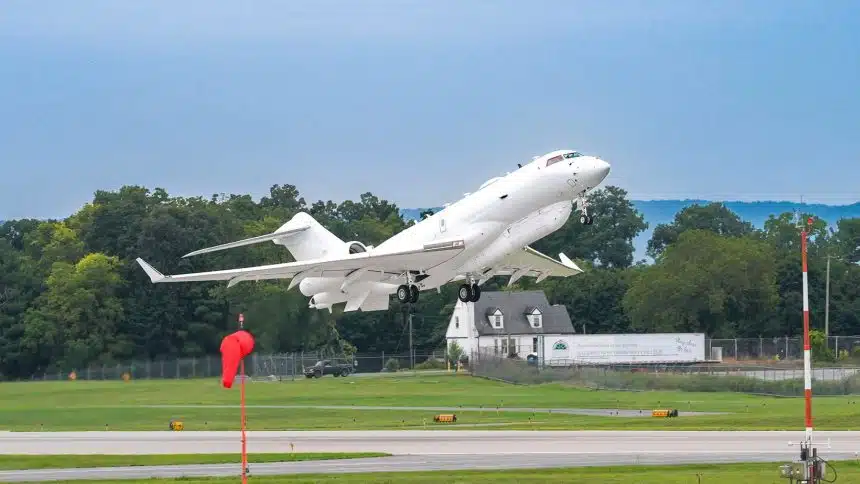
The U.S. Army announced that the HADES Prototype 1 made its first flight on Sept. 11, marking a major milestone in the transition from the turboprop ISR fleet to the new high-altitude business jet-based aircraft.
The U.S. Army’s High Accuracy Detection and Exploitation System (HADES) Prototype 1 aircraft, part of the service’s Multi-Domain Sensing System (MDSS) effort, completed its first flight on Sept. 11, 2026. The milestone marks the beginning of the developmental flight test campaign.
In its Oct. 30, 2026 announcement, the Fixed Wing Project Office (FWPO) said the first flight followed the completion of a flight readiness review with Sierra Nevada Corporation (SNC). The statement added the program is now moving into the next phase of mission systems integration and a developmental flight testing.
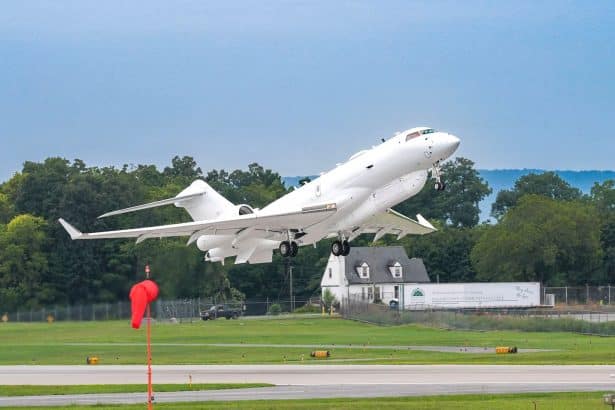
The image released by the Army, credited to Sierra Nevada Corporation, shows the modified Bombardier Global 6500 taking off, possibly from the company’s facility at Hagerstown, Maryland. SNC is the lead systems integrator for the HADES program.
The modern business jets will replace the now-retired turboprop aircraft in the Army’s Airborne-ISR (A-ISR) and Signals Intelligence (SIGINT) role. The company has bought and modified four aircraft for the final HADES configuration on the Rapidly Configurable to Any Mission-X (RAPCON-X)-configured Global 6500s.
[News]
HADES Prototype 1 completes first flight, advances Army deep sensing capability
https://t.co/QRbKc09fmI https://t.co/twhxZhEa58
— GS-59 (@GS5913) October 31, 2026
The company announced the acquisition of the fourth Global 6500 on Jan. 13, 2026, saying it was “intended as the first non-prototype aircraft in the A-ISR fleet.” SNC is responsible for the airframe modifications, installing the relevant systems on the aircraft and securing the Supplemental Type Certificate (STC).
The HADES aircraft have been designated ME-11B by the Army. The service is also relocating the 116th Military Intelligence Brigade to Fort Hood, Texas. According to Military Times, the new hangars will support the larger HADES jet aircraft.
HADES first flight
The FWPO said it collaborated with SNC to complete a flight-readiness review before the Sept. 11 first flight. Engineers, test pilots, and mission system architects “synchronized aircraft structural modifications, mission system hardware integration, and preliminary baseline airworthiness verification activities to prepare the aircraft for flight.”
The HADES Prototype 1 aircraft’s developmental flight testing will “validate the multi-domain sensing and signals intelligence (SIGINT) capabilities” of the HADES mission systems. This will test “their effectiveness, integration, and operational readiness in support of upcoming operational demonstrations.”
US Army Video of Integration of the High Accuracy Detection and Exploitation System (HADES) project.
HADES is the future US Army’s HALE platform for aerial ISR, SIGINT, ELINT, COMINT & deep sensing missions at altitudes of up to 70 kft using Bombardier Global 6500 aircraft. https://t.co/TjejvWYnLJ
— Mehdi H. (@mhmiranusa) April 16, 2026
The first flight was a collaborative effort between the FWPO, Project Director Sensors–Aerial Intelligence within the Portfolio Acquisition Executive Command & Control/Counter-Command & Control, and SNC. FWPO project manager Lt. Col. James Hickey said the HADES Prototype 1’s first flight transitioned the Army’s “vision for deep sensing from concept to reality.”
“This achievement reflects the dedication, technical precision, and shared mission focus of our military, civilian, and industry partners working to deliver transformational capabilities to the Army and joint force,” Hickey said in the release.
HADES aircraft fleet
The Army had previously said it expected the “first fully developed” HADES prototype in FY 2026 and the second one in FY27. On Jan. 22, 2026, the Army also issued a Request for Information (RFI) for 11 Government-Owned Government Operated (GOGO) Bombardier Global 6500 business jets for the HADES project, for an ultimate Acquisition Objective (AO) of 14 aircraft.
However, Breaking Defense reported in May that the Army halved its future HADES fleet from 12 to six airframes. The Army had previously said the HADES aircraft would have SIGINT/ELINT (Signals/Electronic Intelligence), SAR/MTI (Synthetic Aperture Radar/Moving Target Indicator) and additional capabilities.
The Army’s High Accuracy Detection and Exploitation System (HADES) program is the future of intelligence, surveillance and reconnaissance (ISR).
#TeamSNC #AerialISR
https://t.co/oSVL6f4zqZ https://t.co/LCM9QppTMX
— Sierra Nevada Corporation (@SierraNevCorp) September 25, 2026
Sierra Nevada Corporation (SNC) received the first Global 6500 for the HADES mission in November 2024. The company announced it received the second and the fourth aircraft from Bombardier in September 2025 and January 2026, respectively. The third 6500 was presumably delivered in the intervening time.
The arrival of the second HADES Bombardier Global 6500 aircraft at our Hagerstown, MD, facility is an important milestone in our continued work on this program, which will have the Army flying higher, faster and farther.
LEARN MORE: https://t.co/9CUmBsSemh https://t.co/sICGqvUnMi
— Sierra Nevada Corporation (@SierraNevCorp) September 9, 2025
Capabilities and role
The HADES aircraft modernizes the Army’s A-ISR mission “for large-scale, multi-domain operations,” the release said. The new commercial jet airframe offers greater speed, range, payload capacity, and operating altitude than legacy turboprop ISR platforms.
These capabilities are expected to enhance operational flexibility, widen reach, and support “situational understanding” and “decision making in contested environments.”
The Jan. 22, 2026 RFI stipulated kinematic requirements for the HADES carrier aircraft, including an ability to operate between 41,000 and 51,000 feet, while maintaining a ceiling of 41,000 feet. The requirements mandate a 6,500 pound ISR and SIGINT “Mission Equipment Package (MEP)” payload.
SNC’s jets for the ATHENA program are operational, helping to inform future capability for the HADES program for mission excellence.
#TeamSNC #AerialISR
https://t.co/hYLpVZrDEn https://t.co/QyLaV39Mt1
— Sierra Nevada Corporation (@SierraNevCorp) September 9, 2026
The aircraft should also have an unrefueled endurance of 12 hours while carrying a minimum payload of 14,000 pounds. Structural requirements barred the use of composite materials for the aircraft’s fuselage, empennage skin and structural components, while a limited use of composite materials has been permitted for the nose cones, tail cones, pylons, fairings and radome.
The HADES program’s new business jet carrier planes fly higher and faster, giving “the Army a modern, survivable, and responsive aerial sensing capability for “joint force operations in contested theaters,” the Army release said. Hickey added: “Deep sensing will help commanders see farther, understand faster, and act with greater precision across the multi-domain battlefield.”
SNC had previously stated the use of Artificial Intelligence/Machine Learning (AI/ML) in the HADES mission systems allows for rapid “mission processing, exploitation and dissemination,” while Modular Open Systems Architecture (MOSA) reduced “program risk” and “matured key technologies.” Lastly, model-based systems engineering (MBSE) significantly reduced the time required to integrate new and different systems and capabilities, the company said.
Every mission benefits from key intelligence and the Army’s High Accuracy Detection and Exploitation System (HADES) is able to fly higher, faster and farther for deep sensing in large-scale and multi-domain operations.
#TeamSNC #AerialISR https://t.co/rGe88WvISH
— Sierra Nevada Corporation (@SierraNevCorp) August 20, 2026
The Army also utilized the MOSA on the second HADES prototype when it integrated an existing Air Force sensor by using open payload bays and a digital backbone, Brig. Gen. Kevin Chaney, Deputy Portfolio Acquisition Executive for Maneuver Air, said during the 2026 MOSA Industry and Government Summit, Military Embedded Systems reported.
U.S. Army HADES program for the Airborne ISR role
The Government-Owned Government-Operated (GOGO) HADES aircraft replace the Army’s older turboprop aircraft fleet, which included the RC-12X Guardrail, MC-12S EMARSS-M (Enhanced Medium Altitude Reconnaissance and Surveillance System-Multiple Intelligence) and the EO-5C ARL-M (Airborne Reconnaissance Low-Multifunction).
The HADES aircraft configuration was informed by four feeder programs. These are the Army Theater level High Altitude Expeditionary Next Airborne ISR-Signals Intelligence (ATHENA-S), ATHENA-R (Radar), Airborne Reconnaissance and Targeting Multi-Mission System (ARTEMIS) and the Aerial Reconnaissance and Electronic Warfare System (ARES).
We’re thrilled to announce that contractor testing and government end-to-end testing for our RAPCON-X aircraft have been successfully completed as part of the U.S. Army’s ATHENA project!
https://t.co/eMgApUi4GR https://t.co/6pblvsvgGV
— Sierra Nevada Corporation (@SierraNevCorp) April 15, 2026
These Contractor-Owned Contractor-Operated (COCO) aircraft – with the ARTEMIS based on the Challenger 650 and the rest on the Global 6500 business jets – are “bridging strategies,” the Army said. The preparatory programs validated technologies, met interim operational needs, and also informed the performance parameters for the HADES project.