India selected in 2023 and ordered in 2025 the Rafale M as an interim carrier-based fighter capability while the indigenous Twin Engine Deck Based Fighter (TEDBF) is developed.
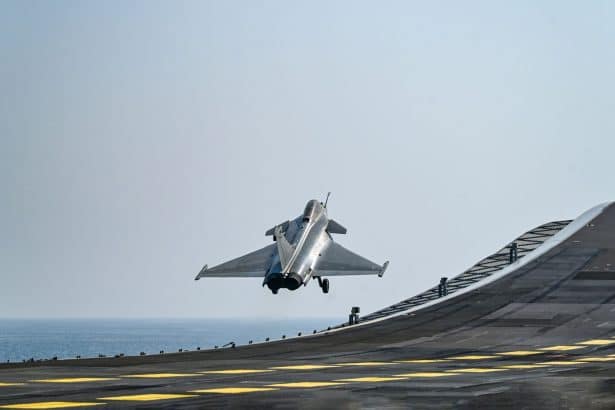
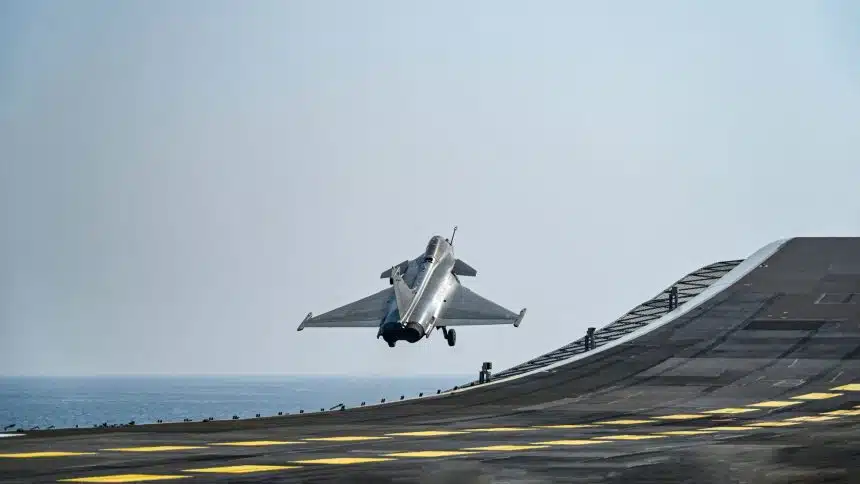
A Dassault Rafale M landed aboard the Indian Navy’s domestically built INS Vikrant aircraft carrier for the first time on Oct. 29, 2026, and subsequently took off from the ship. The service announced the milestone the following day, releasing footage of the aircraft’s arrested recovery on the Short Take-Off Barrier Arrested (STOBAR) carrier
Another image showed the Rafale M, reportedly piloted by a Dassault test pilot, taking off again from the carrier. Before the shipboard trials, the aircraft conducted carrier-compatibility testing from the Shore-Based Test Facility (SBTF) in Goa, on India’s western seaboard, with images of those trials emerging on social media on Oct. 22.
The Indian Navy said the landing was accomplished on the “maiden attempt.” The service further added in a post on X that “The ongoing trials mark the first steps towards operationalisation of the aircraft in the Indian Navy.”
India selected the Rafale M in July 2023 and signed an intergovernmental agreement with France in April 2025 for 26 aircraft: 22 single-seat fighters and four twin-seat trainers. The Navy’s existing carrier-based fighter fleet is built around the Russian MiG-29K/KUB, which operates from both INS Vikrant and INS Vikramaditya.
A Rafale Marine aircraft successfully landed onboard #IndianNavy’s indigenous Aircraft Carrier #INSVikrant on its maiden attempt on 29 Oct 26.
The ongoing trials mark the first steps towards operationalisation of the aircraft in the #IndianNavy. https://t.co/gIZ0h3nl80
— SpokespersonNavy (@indiannavy) October 30, 2026
The Rafale M is intended to provide the Indian Navy with an interim carrier-based fighter capability until the indigenous Twin Engine Deck Based Fighter (TEDBF) becomes available. The program’s delays have raised the possibility that India may need additional imported fighters to maintain its carrier air wing. The Rafale’s commonality with the land-based aircraft already operated by the Indian Air Force (IAF) is also expected to simplify training, maintenance, and logistics.
LCA Navy, MiG-29K and TEDBF
Both the Light Combat Aircraft (LCA) Navy and the MiG-29K had conducted their maiden tests from the INS Vikrant on Feb. 6, 2023, at a time when the Navy was struggling with both aircraft. The MiG-29K subsequently conducted a night-landing on the INS Vikrant on May 24, followed by a twin-carrier operation with the INS Vikramaditya.
🇮🇳 Rafale Marine Trials Underway in Goa — Carrier-Compatibility Testing for INS Vikrant
📌 WHAT: The Indian Navy is conducting trials of the Rafale Marine (Rafale M) fighter in Goa, testing modifications required for the aircraft to operate from India’s indigenous aircraft carrier, INS Vikrant.
🏢 WHO: Indian Navy; Dassault Aviation; confirmed by Defence Officials
📅 WHEN: Reported 22 Oct 2026; deliveries expected by end-2028/early-2029
🎯 WHAT IS THIS? (IN SIMPLE WORDS)
A fighter jet built to fly off land can’t simply be dropped onto an aircraft carrier — it needs a strengthened undercarriage to survive hard carrier landings, an arrestor hook to catch the carrier’s wires, a launch bar for catapult/ski-jump takeoff, and in some cases, modified wingtips to fit the ship’s deck elevators. These Goa trials are checking that the Rafale M, as modified for India, actually works the way it needs to before it starts flying off INS Vikrant.
⚙️ TECH SPECS / STATUS
Contract: 26 Rafale Marine aircraft — 22 single-seat, 4 twin-seat (per the April 2025 India-France IGA, ~₹63,000 crore / $7.5 billion)
Twin-seat (DH trainer) variants: shore-based only — no twin-seat carrier-capable Rafale M exists; the 22 single-seaters are expected aboard INS Vikrant
Known carrier-specific changes: reinforced landing gear, arrestor hook, launch bar; wingtip modifications reportedly needed to fit Vikrant’s elevators (not independently confirmed in detail)
Delivery: first aircraft expected by end-2028/early-2029, full delivery by 2030 (per Ministry of Defence)
Location: trials based around Goa, consistent with INS Hansa’s shore-based test facility, historically used for naval fighter carrier-compatibility testing (including earlier Rafale M demonstrations in 2022)
🧠 OUR ANALYSIS
This follows a Rafale-type jet being spotted over Goa a few days ago, which at the time was unconfirmed speculation — today’s statement from Defence Officials appears to confirm that sighting was indeed Rafale M trial activity.
Carrier trials like these are a routine, necessary step before any carrier-based fighter enters service — this doesn’t mean the aircraft is close to operational deployment, just that technical qualification work is underway well ahead of the 2028-29 delivery window.
❓ WHAT WE DON’T KNOW
Exact scope of the Goa trials (full carrier-landing simulation vs. ground/taxi tests)
Whether this is the first India-specific Rafale M airframe or a French test aircraft
Confirmed details on the wingtip modification
📷 Credit : @flanker_felon
#RafaleMarine #IndianNavy #INSVikrant #Dassault #CarrierAviation #DefencewithIndia
— DefenceWithIndia (@LuharQA) October 22, 2026
The Indian Navy had previously rejected the LCA Navy Mk1, primarily citing the limited capability and power offered by the single engine jet. A broader concern remains with the U.S.-made General Electric F404-IN20 engines, as delays in their deliveries had held back the LCA Mk1A program. This, in turn, led to repeated friction between the Indian Air Force (IAF) and the state-run Hindustan Aeronautics Limited (HAL).
The Indian Navy’s approximately 40 MiG-29K/KUBs of the Indian Naval Air Squadron (INAS) 303 “Black Panthers,” which fly from the STOBAR carrier INS Vikramaditya – a heavily modified ex-Russian Navy Gorshkov – have meanwhile long faced safety, maintainability and availability issues. The leading woe are their problematic Klimov RD-33 turbofans.
🇮🇳 Nice shot showing an Indian Naval Air Arm MiG-29K carrier-capable multirole fighter parked with its wings folded on the flight deck of the INS Vikrant off the coast of Visakhapatnam, India, during International Fleet Review (IFR) 2026.
(📸/Alex Winston) https://t.co/R83Mpm2eSl
— Guy Plopsky (@GuyPlopsky) February 22, 2026
Indian media reports that at least 40 engines, out of 65 received from Russia, had to be rejected or withdrawn due to technical problems. On other instances, components have also experienced damage and failure during landing, India’s Comptroller and Auditor General (CAG) has noted.
Rafale M after Mig29k n LCA Navy becomes third jet to land on INS Vikrant. https://t.co/nLAkFob0XG
— idrw (@idrwalerts) October 30, 2026
Expanded Rafale fleet in India
The future Twin-Engine Deck-Based Fighter (TEDBF), which is meant to replace the MiG-29s, has seen multiple deadline slippages. It was originally slated for a first flight in 2026, followed by serial production in 2029, however new projections have pushed the first flight to 2029-2030.
With the 26 Rafale Ms contracted for the Indian Navy in April 2025, a further delay in the TEDBF may force the government to acquire 31 more Rafale Ms, taking the Navy’s total Rafale fleet to 57 airframes, The Wire reported. Interestingly, this is the same figure for the earlier 2017 Multi-Role Carrier Borne Fighter (MRBCF) global Request for Information (RFI).
Here’s #TEDBF Twin Engine Deck Based Fighter at #AeroIndia2021, Just a bit more stealthier than #IndianAirForce #Dassault #RAFALE has twin DSI inlets, bubble canopy & fold-able wings, looks more mean than #TejasMK2 model. @Indrani1_Roy @sakthivel_cit93 @KesariDhwaj #AvGeek https://t.co/bPpX4o068J
— 𝐊𝐔𝐍𝐀𝐋 𝐁𝐈𝐒𝐖𝐀𝐒 (@Kunal_Biswas707) February 23, 2021
Combined with the 36 Rafales operated by the IAF, the combined fleet in India would reach 93 airframes. This figure would further increase to 207 if India goes ahead with the proposed procurement of 114 Rafales under the $40 billion Multi-Role Fighter Aircraft (MRFA) program that the government’s Defence Acquisition Council (DAC) cleared in February 2026.
The MRFA proposal envisages substantial domestic manufacturing, with most of the aircraft expected to be assembled in India. Reported indigenous-content targets have varied during negotiations, with figures ranging from approximately 40% to 60%, depending on the production batch.