The DIA report reviews the three missions flown between 2020 and 2023, highlighting reported rendezvous and proximity operations during the second and third flights, before China launched the spacecraft again in February 2026.
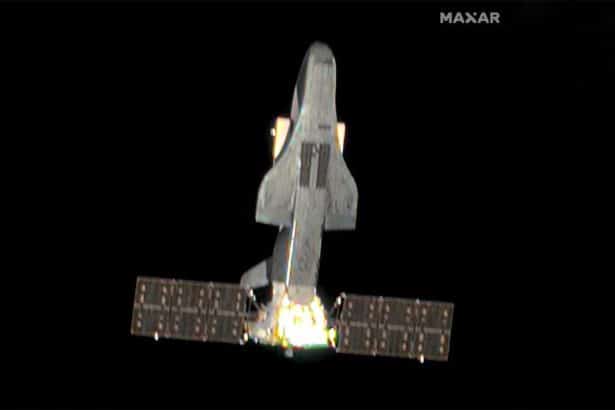
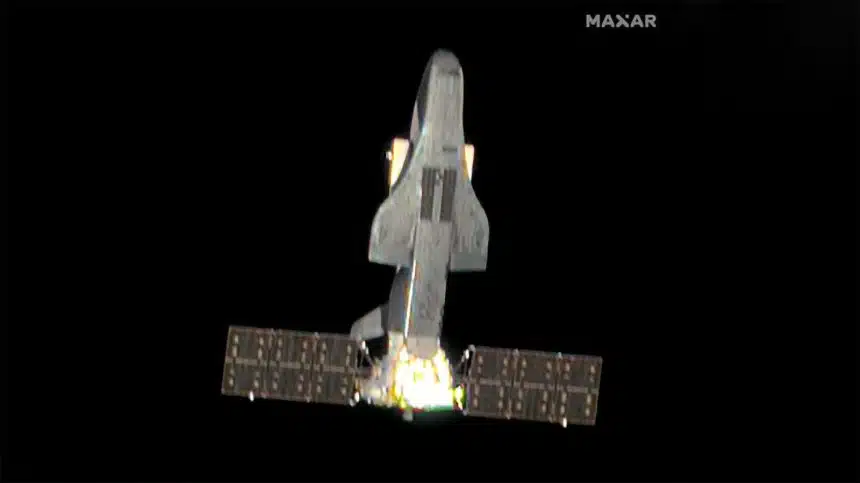
The U.S. Defense Intelligence Agency (DIA) has released a new image of China’s secretive reusable spaceplane, captured by a Maxar Technologies spacecraft in 2024. Published in the DIA’s “Challenges to Security in Space” report on Oct. 26, 2026, the photo provides a rare view of the spacecraft in orbit with its service module attached.
China’s reusable experimental spacecraft has flown four orbital missions since September 2020, launched aboard Long March 2F rockets. The first mission lasted two days; the second, launched in August 2022, remained in orbit for 276 days; and the third, launched in December 2023, lasted 268 days. A fourth mission began in February 2026.
Before the release of the Maxar image, public imagery was limited to grainy ground-based telescope observations and computer-generated illustrations with Chinese markings. Space tracking forums in early 2023 observed the Chinese spacecraft connecting with another object multiple times, but no image existed at the time.
The Maxar image used in the DIA report is dated to 2024, when the spacecraft launched in December 2023 was still in orbit during its third mission. The timing is therefore consistent with the photograph depicting the vehicle during that flight, although the exact date of capture has not been publicly disclosed.
Behold: The US Defense Intelligence Agency has released a report on challenges to security in space, including an NEI image of China’s spaceplane from Maxar, taken in 2024. https://t.co/F3msSwoFph
— Andrew Jones (@AJ_FI) October 27, 2026
The report identifies two Chinese space models, Shenlong and Tengyun, but it is not known which of those is in the image. The Chinese spacecraft is often compared with the U.S. Space Force’s X-37B because both are uncrewed reusable orbital vehicles designed to return to Earth.
However, the Chinese vehicle’s design, payload, and mission objectives remain largely undisclosed. Tracking data indicate that it has deployed objects and performed rendezvous and proximity operations, but these observations do not establish the spacecraft’s intended military role.
The spaceplane appears in the DIA’s broader assessment of space-related capabilities and threats, whose goal is to cover the capabilities of strategic rivals. “The updated report details the space defense and military goals, including strategies, plans and intentions, of China, Russia and the emerging space powers of Iran and North Korea,” says the press release.
Chinese spacecraft
The image provides a view of the underside of China’s reusable spaceplane, with its service module attached and solar arrays deployed. The module is understood to provide electrical power and propulsion during the orbital mission before separating from the spaceplane ahead of reentry, similarly to the X-37B’s service module.
The image also appears to show the spacecraft’s payload-bay doors, although the precise configuration and function of the visible features have not been publicly detailed. Among the possibilities are systems like robotic arms, small satellites or specimens for in-orbit testing.
Now then — this could be something exceptional. The rumours are that inside this exceptional payload fairing atop a CZ-2F is a CASC spaceplane, launching from Jiuquan Friday. Source: 俊了个锅 via 林晓弈。 https://t.co/qs6VRfzQoP https://t.co/ZPnpwAIfyO
— Andrew Jones (@AJ_FI) September 3, 2020
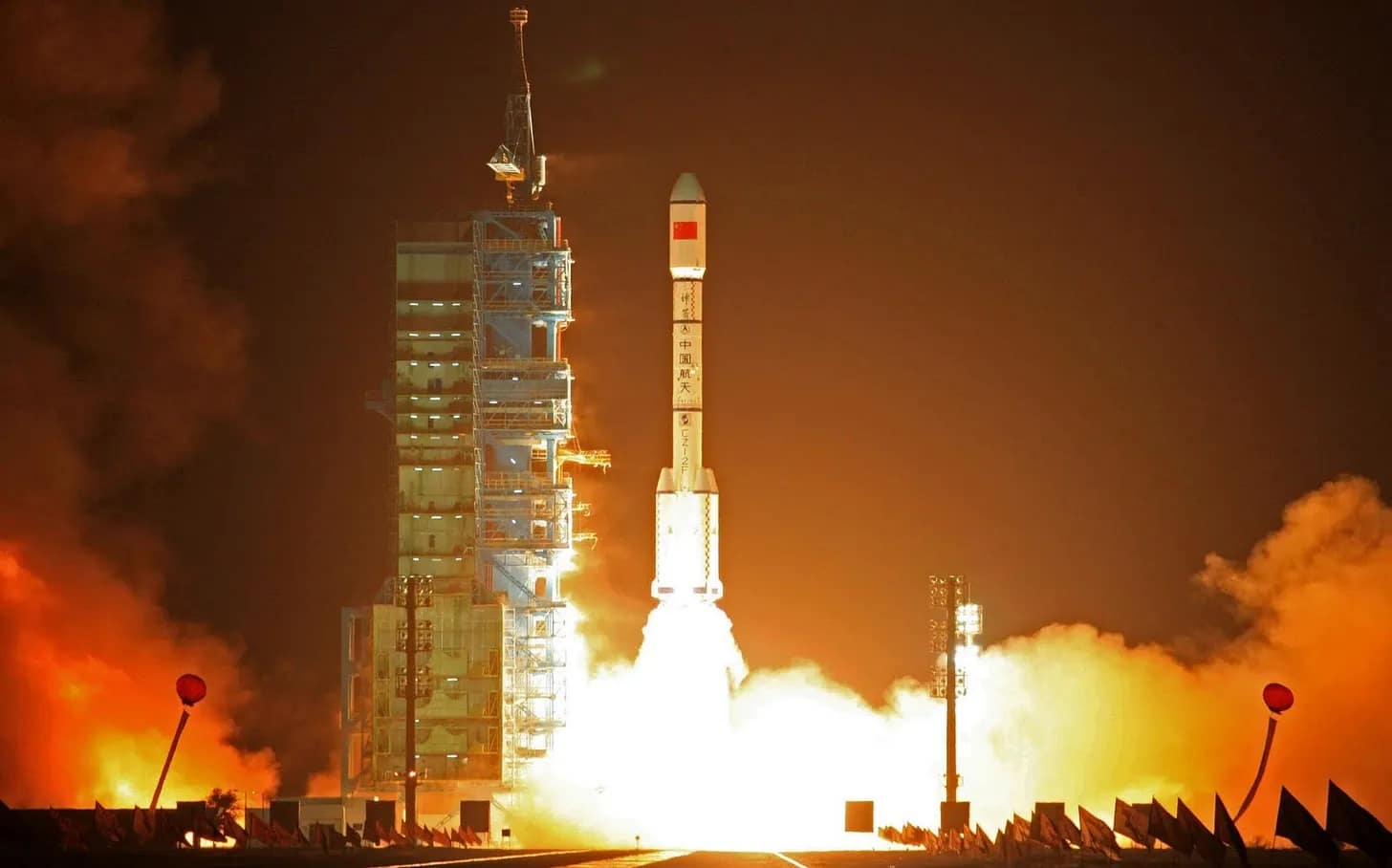
Beijing launched its first ever reusable spaceplane prototype on Sep. 4, 2020 aboard a Long March 2F carrier rocket from the Jiuquan Satellite Launch Center in northwestern China’s Gobi desert. The spacecraft remained in orbit for two days before returning to Earth.
Although Chinese authorities did not initially disclose the landing site in detail, open-source analysis of satellite imagery associated the landing with a runway near the Lop Nur nuclear test site in northwestern China.
Since its launch on 4 August 2022, we observed multiple large maneuvers raising the object’s altitude — as well as repeated deployments, formation flying, and docking of a sub-satellite Object J (NORAD ID 54218). https://t.co/ORVgSXYKmJ
— LeoLabs (@LeoLabs_Space) May 8, 2023
The second launch of the space plane took place on Aug. 4, 2022, this time spending 276 days in orbit until May 8, 2023. According to the DIA, the vehicle appeared to “maneuver with a companion satellite and conduct station-keeping at around 1 km separation.”
“At one point, the two objects appeared within 100 meters of one another. The spaceplane and satellite possibly rendezvoused before the satellite was re-released,” the DIA report said.
This event tested our object tracking and maneuver detection and characterization capabilities, proving that we can provide critical intelligence on the behaviors and activities of objects in #LEO thanks to our continuous, real-time operations. https://t.co/WDP06ffBSv
— LeoLabs (@LeoLabs_Space) May 8, 2023
On May 8, 2023, commercial space-tracking company LeoLabs reported that its observations indicated repeated deployments, formation flying, and apparent docking or capture operations involving ‘Object J’:
“Since its launch on 4 August 2022, we observed multiple large maneuvers raising the object’s altitude – as well as repeated deployments, formation flying, and docking of a sub-satellite Object J (NORAD ID 54218). We’ve determined that the Test Spacecraft2 has propulsive capability and engaged in proximity operations with Object J, including what appeared to be at least two and possibly three capture/docking operations.”
China launched the spacecraft on its third orbital mission on Dec. 14, 2023. It remained in orbit for 268 days, returning on Sept. 6, 2024, according to the DIA report.

During that flight, the spacecraft again “released and interacted with an object,”according to the DIA. Considering that the Maxar image was captured in 2024, we can presume the vehicle was photographed during this third mission.
Although this was not covered by the report, the spacecraft’s fourth mission began in February 2026. Orbital-tracking data analyzed by astronomer Jonathan McDowell indicated that the vehicle released and subsequently recaptured the same object, whose precise identity and purpose remain unknown, with similar operations reportedly repeated later in the flight.
then executed a rerendezvous with the subsat on Sep 10 and a recapture on Sep 13. This analysis is based on USSF GP data. USSF also cataloged an additional object 24J on about Sep 10, but with no orbit data; I think this was a mistake and is a duplicate of object 24H.
— Jonathan McDowell (@planet4589) September 23, 2026
Future and purpose
The spacecraft’s proximity operations have raised questions about potential counterspace applications, with some theories assigning more exotic kinetic ‘anti-satellite’ capabilities to the Chinese spacecraft.
While there is no evidence yet the vehicle is designed as a kinetic anti-satellite weapon, and the spaceplane’s intended mission remains undisclosed, space is becoming a contested domain. The observed rendezvous and capture capabilities can support satellite inspection and servicing, but could also enable interference with other spacecraft.
The spacecraft’s potential military applications remain uncertain. While there is no public evidence confirming that the vehicle carries military payloads, such a platform could be used for space-based reconnaissance, intelligence-gathering, and monitoring of other space objects, as well as kinetic missions possibly involving the use of directed energy weapons, offensive weapons or electronic warfare.
America’s X37B compared to China’s orbital Spaceplane. https://t.co/DPC4W3euTW
— David Willis (@ThePrimalDino) October 27, 2026
China has however maintained a non-military purpose for this spacecraft. A machine translation of a Xinhua report of the Aug. 5, 2022 launch said:
“The test spacecraft will be in orbit for a period of time before returning to the scheduled landing site in China, during which reusable and in-orbit service technology verification will be carried out as planned to provide technical support for the peaceful use of space.”