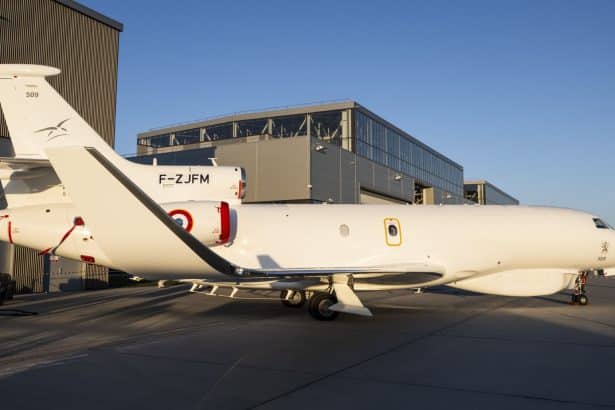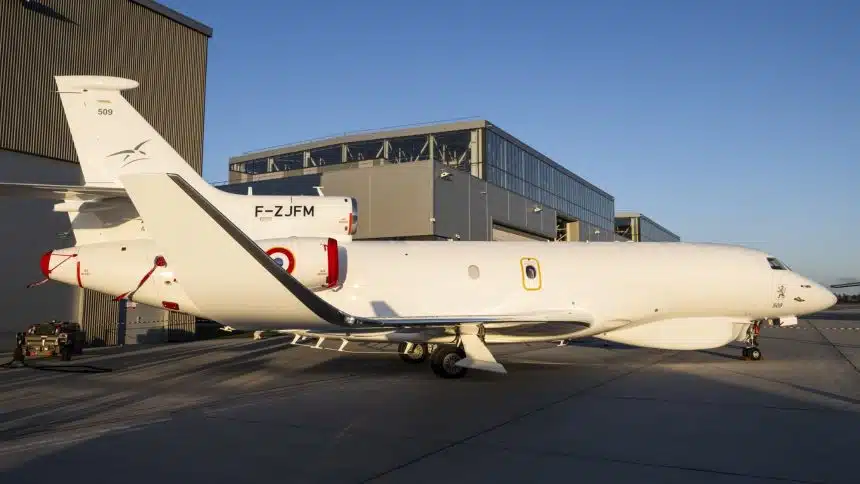
The first Archange arrived at Évreux in early October, where France’s Military Air Expertise Center is participating in trials ahead of the aircraft’s planned entry into service.
France’s Archange (Archangel) Signals Intelligence (SIGINT) and Electronic Warfare (EW) aircraft landed at its future operating base, Base Aérienne 105 (BA 105) in Évreux, for the first time, the Armée de l’Air et de l’Espace (French Air and Space Force – FASF) reported on Oct. 23, 2026. Air Base 105 is home to the Airborne Electronic Squadron (Escadron électronique aéroporté) 5/64 “Dunkerque,” which is slated to operate the aircraft.
The aircraft landed in Évreux, Normandy, on Oct. 7, 2026. The French Air and Space Force, however, only announced the milestone on Oct. 23, saying that the Military Air Expertise Center (CEAM) is participating in technical-operational experimentation to prepare the aircraft for future service.
The FASF’s two Transall C-160G Gabriel SIGINT aircraft were retired prematurely in May 2022, leaving a gap in the country’s dedicated airborne signals-intelligence capability. An interim Saab 340 leased under the SOLAR contract provides some replacement capacity, but it does not fully replicate the Gabriel’s capabilities.
The C-160G Gabriel’s successor, the Dassault Falcon 8X-based Archange, will restore the service’s Electronic Warfare (EW) capabilities with a total fleet of three aircraft to be delivered by 2030. The first airframe made its first flight on July 25, 2025, from Dassault Aviation’s facility in Bordeaux-Mérignac.
The aircraft, now bearing registration F-ZJFM, was also captured by aviation photographers in FASF colors and markings on June 2, 2026 at Bordeaux-Mérignac. The aircraft is also sporting the Dunkerque squadron’s insignia – a lion in a coat of arms right under the cockpit.
The French Air and Space Force described Archange as “the Future pillar of electromagnetic origin intelligence for the AAE,” adding that it is now preparing to enter service. The system can “broadcast the enemy electronic order of battle in real time, illuminate planning, and better protect our forces.”
✈️ Premier posé à Évreux pour ARCHANGE !
Futur pilier du renseignement d’origine électromagnétique de l’AAE, le Falcon 8X prépare son entrée en service.
🎯 Diffuser en temps réel l’ordre de bataille électronique ennemi, éclairer la planification et mieux protéger nos forces. https://t.co/TCwwuHHjlA
— Armée de l’Air et de l’Espace (@Armee_de_lair) October 23, 2026
Archange aircraft at Évreux
According to Opex360, when reporting on the Archange sporting FASF colors in June, the F-ZJFM registration suggests the aircraft is assigned to the Direction Générale de l’Armement Essais en Vol (Directorate General of Armaments Flight Testing – DGA EV) division. The Air and Space Force subsequently confirmed that CEAM is participating in technical-operational experimentation at Évreux to prepare Archange for future service, although this has not been publicly detailed.
The program has already been delayed a few years, with deliveries originally slated to begin by 2025. The manufacturing of the first airframe was held back, according to Chief of Defence Staff General Fabien Mandon’s recent testimony to the Senate, due to Dassault Aviation facing “difficulty in fitting an electronic computing bay into an aircraft which has limited space.”
Dassault is responsible for the airframe modification on the trijet Falcon 8X, integration, flight testing, and supplemental certification, while Thales has developed the EW payloads, mission systems and sensors, including the CUGE (Capacité Universelle de Guerre Électronique / Universal Electronic Warfare Capability) system. This is carried in a large ventral fairing under the aircraft’s chin.
The first @Dassault_OnAir F8X Archange in French air force colors spotted at Bordeaux-Mérignac airport.
The Falcon 8X Archange is France’s future airborne #SIGINT platform. Equipped with @thalesgroup CUGE electronic warfare system, it will collect and analyze radar and communications emissions, enhancing the French Air Force’s strategic intelligence capabilities.
📸 by Alexis Thocaven
— Tom Antonov (@Tom_Antonov) June 2, 2026
CUGE is designed to detect and analyze communications and radar emissions, strengthening France’s signals-intelligence capability. Thales has previously said CUGE leverages technologies like multi-polarization antennas, Artificial Intelligence (AI) to automate data processing, and advanced sensors to simultaneously detect, analyze and classify electromagnetic emissions.
Archange is now undergoing technical-operational experimentation intended to prepare it for future service. Such work is expected to evaluate the aircraft’s mission systems and establish how the new capability will be employed and supported, although the detailed test plan has not been publicly disclosed.
France retains several complementary means of collecting electromagnetic intelligence, but these do not fully replace the capability previously provided by the Transall C-160G Gabriel. The Mirage 2000D RMV can carry the ASTAC (Tactical Signal Analyzer/Analyseur de signaux tactiques) pod, while the three (Capacité de Renseignement Electromagnétique Spatial/Space Electromagnetic Intelligence Capability) satellites provide space-based electromagnetic intelligence.
Other capabilities include the Beechcraft 350 ALSR (Light Surveillance and Intelligence Aircraft) aircraft used for VADOR (Vector Airborne Designation Observation and Reconnaissance) missions and the Saab 340 leased under the SOLAR contract, which provides an interim platform equipped with radar, electromagnetic-intelligence sensors, and electro-optical equipment. The latter only partially compensates for the Gabriel’s retirement.
L’Archange a réalisé son premier vol.
Construit sur la base d’un Falcon 8X de @Dassault_OnAir, modifié pour y intégrer des systèmes de pointes développés par @thalesgroup, notre futur avion de renseignement sera doté de capacités au plus haut standard pour la détection de signaux de communication et d’émissions radar.
D’ici la fin de la loi de programmation militaire 2024-2030, trois d’entre eux seront livrés à l’@Armee_de_lair et stationnés sur la Base aérienne 105 d’Evreux.
— Sébastien Lecornu (@SebLecornu) July 25, 2025
The DGA had previously said that the Archange aircraft “will strengthen France’s signals intelligence capabilities. In particular, they offer unprecedented complementarity in the detection of communication signals and radar emissions.”