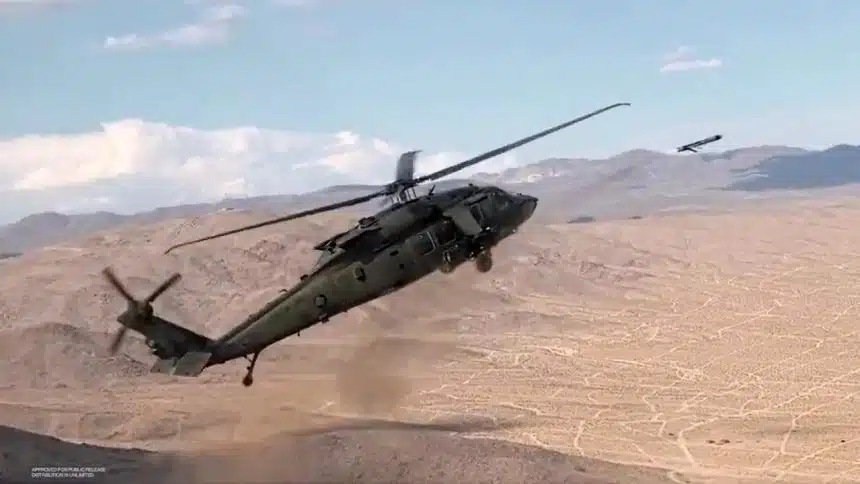
During the recent Project Convergence Capstone 6, an H-60M Black Hawk crew employed an Altius-700 Air-Launched Effect to autonomously find the target, pass data across the formation, and strike.
As explained by Sikorsky in an interview at Farnborugh International Airshow last month, a major focus of Armed Black Hawk’s development is on air-launched effects (A-LE): the integration of such capability allows aircrews to command unmanned A-LE systems (small uncrewed systems deployed from aircraft to provide capabilities such as surveillance, targeting, electronic warfare, communications relay, deception, or strike) from a position of relative safety, extending the reach, lethality and survivability of the platform.
The U.S. Army put the H-60M Black Hawk Air-Launched Effects (A-LE) capabilities to test last month, during Project Convergence Capstone 6. The activity added to the three-day flight tests conducted at Fort A.P. Hill’s test range, Virginia, in June, when H-60M aircrews successfully launched and controlled multiple medium-range launched effects.
According to the U.S. Army, Increment 1 of the A-LE capability is a fully government owned and designed system, developed in partnership with the Utility Helicopters Project Office (UHPO) and the U.S. Army Combat Capabilities Development Command (DEVCOM) Aviation and Missile Center (AvMC).
Over the course of the three-day exercise, a joint effort involving the military and commercial industry partners, aircrews of an H-60 in a fully networked system configuration launched and controlled multiple launched effects (LEs) over the Mojave Desert. The extreme heat of the area allowed the team to validate also the system’s environmental resilience.
Interestingly, as part of the capstone event, the H-60M also employed the Anduril Altius-700 A-LE. The Altius-700 is a modular launched-effect air vehicle that can carry ISR, electronic-warfare, communications and other payloads; the Altius-700M is its weaponized loitering-munition variant, equipped with a warhead of up to 33 lb for strikes against vehicles, vessels and infrastructure, and a range of 160 km.
Footage of the test was shared online by Anduril:
New Test Footage: Black Hawk executes rocket-powered launch of Altius-700.
At Project Convergence Capstone 6, an H-60M Black Hawk crew employed an Altius-700 hunter-killer team to autonomously find the target, pass data across the formation, and strike.
Another successful step… pic.twitter.com/Jpq1OtU4FR
— Anduril Industries (@anduriltech) August 31, 2026
Noteworthy, while Anduril refers to the vehicles in the newly released footage simply as Altius-700, the video shows one of the launched effects striking what appears to be an armored ground vehicle. Ahead of Project Convergence Capstone 6, the U.S. Army had specifically identified the armed Altius-700M loitering munition as the Long-Range Precision Munition (LRPM) scheduled to be launched from a Black Hawk during the event, suggesting that the kinetic vehicle seen in the footage is indeed a 700M.
Managed by the Capability Program Executive (CPE) for Offensive Fires, LRPM is a U.S. Army effort to provide helicopters with a stand-off precision-strike weapon capable of engaging targets at ranges significantly greater than traditional weapons such as the AGM-114 Hellfire (11 km reach).
“Successfully launching Air-Launched Effects from a Black Hawk is more than a milestone, it is a leap forward,” said Brig. Gen. Kevin Chaney, Deputy Portfolio Acquisition Executive for Maneuver Air.“ By extending their reach and increasing lethality, we are changing the battlefield geometry and delivering a decisive advantage to our Soldiers.”
Traditionally, if you think of an Army helicopter conducting anti-armor or precision attack, you think of the AH-64 Apache gunship. A Black Hawk is primarily a utility/assault helicopter; giving an H-60 the ability to launch autonomous sensors and long-range precision effects means the Army is effectively allowing a utility helicopter to act as a launch platform or mothership, rather than requiring it to become a conventional gunship.
Responding to one of our questions at FIA 2026 airshow, Jason Wrigley, Director of Business Development for Army and Air Force Systems at Sikorsky, said about A-LE: “[…] we do not envision employing just one at a time. We expect multiple systems to be operating simultaneously, and the future battlespace will include large numbers of drones that need to communicate back to a mothership or another control node. The Black Hawk will be capable of performing that role.”
Anyway, regardless of the actual type, it is worth highlighting that launched effects allow the helicopter to move both sensing and strike far beyond the range of its traditional onboard weapons. A non-kinetic A-LE can scout hundreds of kilometers ahead of the formation, while the weaponized variant can strike targets at stand-off range, allowing the crewed aircraft to remain well outside the threat envelope.
BTW, even the fully unmanned U-Hawk is being integrated with an internal A-LE launching system, which provides a way to carry launched effects inside the aircraft. On the manned Black Hawk, they are carried externally on the wings, while on the unmanned variant they can be housed internally.
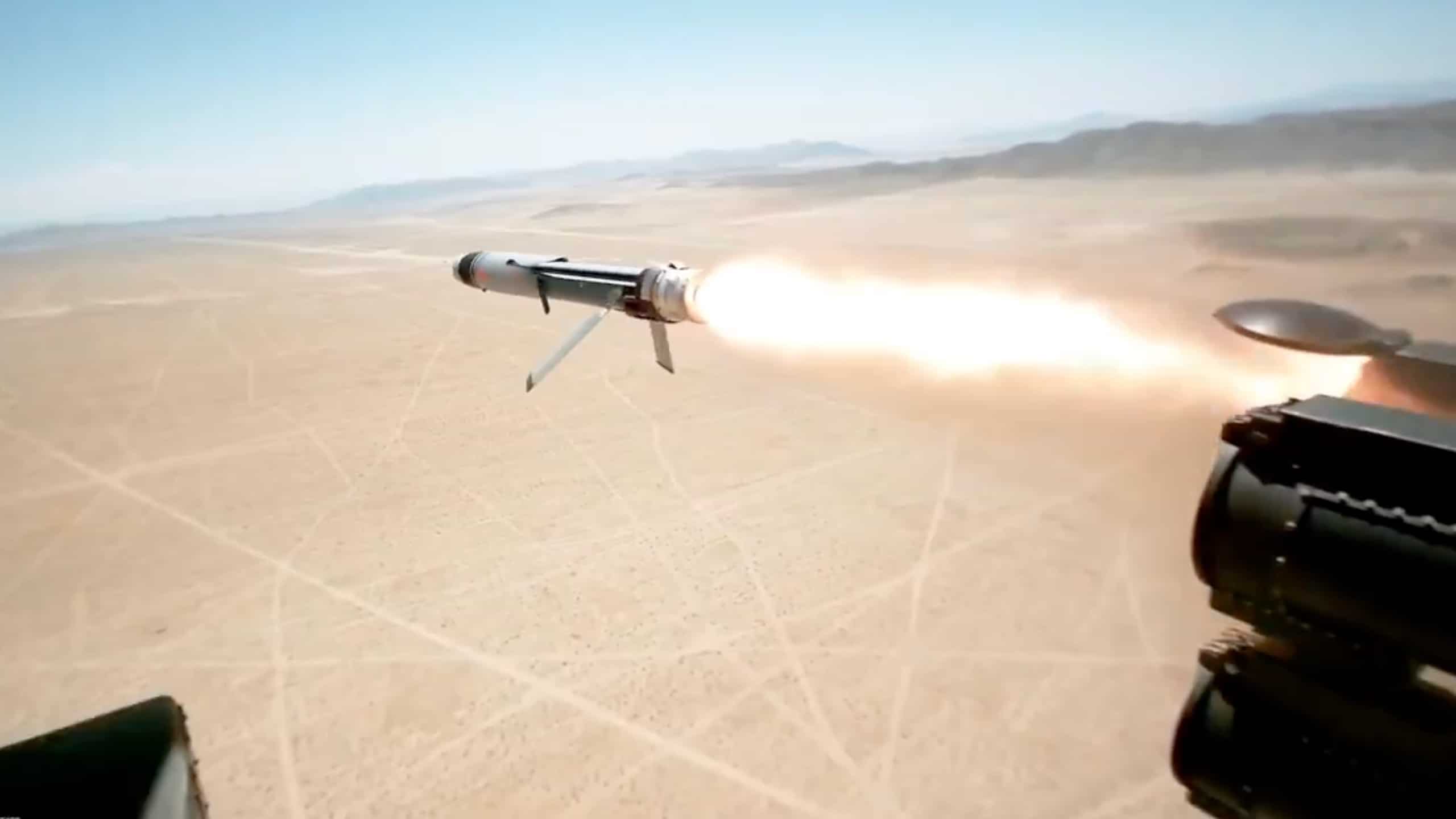
Dealing with Project Convergence Capstone 6, the Army demonstrated a broader H-60M Air-Launched Effects architecture capable of launching and controlling multiple types of effects. The exercise paired reconnaissance-oriented infrared-sensing LEs with a lethal Long-Range Precision Munition for the terminal strike, while also evaluating additional medium-range launched-effect technology demonstrators. Thanks to the footage release by Anduril we know that the Altius-700 family was among the A-LE systems involved in the tests, but the Army has not publicly identified every launched effect used during the event.