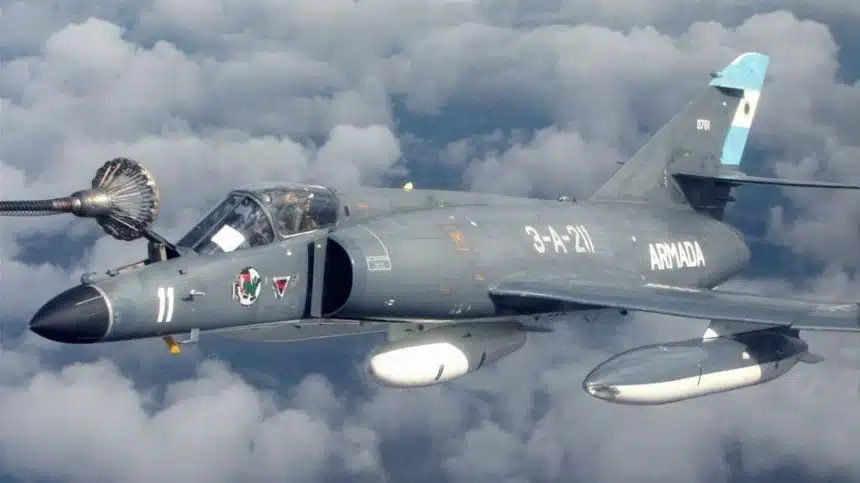
The decision comes as Argentina restructures its Naval Aviation fleet, retires legacy aircraft and introduces new capabilities.
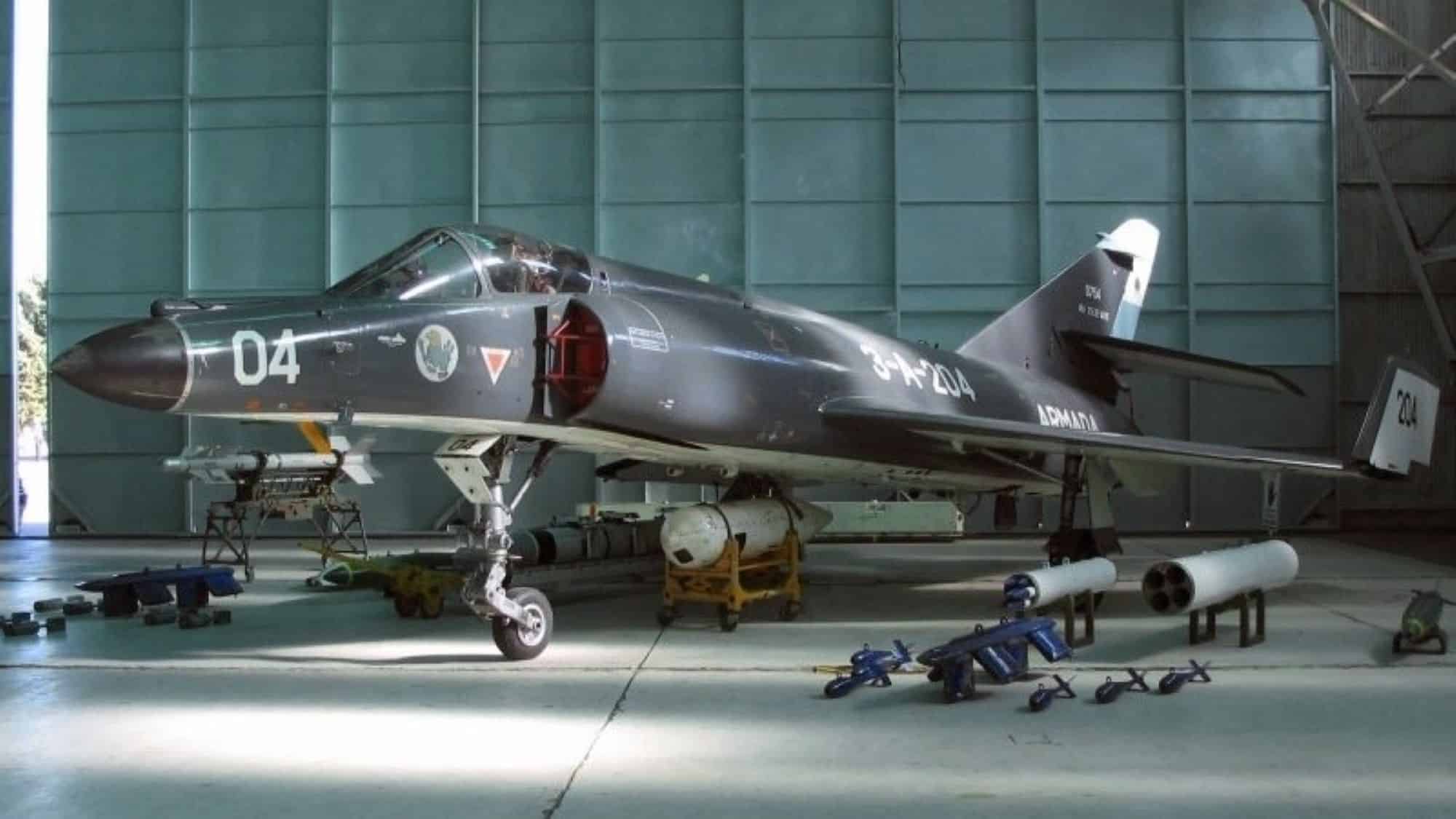
After nearly forty years of service, including combat operations during the 1982 Falklands (Malvinas) war, the Argentine Navy (Armada de la República Argentina – ARA) will retire its French-built Dassault-Breguet Super Étendard naval fighter. The decision was announced on Aug. 20, 2026, as part of Plan Dédalo.
The five-year restructuring and modernization program sees the service restructuring its forces with the redesignation, relocation and reassignment of aircraft, units, personnel and bases, while also phasing out several other fixed- and rotary-wing aircraft. The plan was laid out at the Punta Indio Naval Air Base by the ARA’s naval aviation chief Rear Admiral Román Enrique Olivero.
The Argentine government’s press release announced the retirement saying: “This year will see the final retirement from active service of the Super Étendard, closing more than four decades of glorious historical trajectory and outstanding performance in the Falklands.”
📍Buenos Aires, #Argentina (🇦🇷)
The @Armada_Arg announced yesterday that they have abandoned the attempt to recover the Super Étendard once again.
Plan Dédalo, a 5-year plan for modernization, announced that the type will be retired after abandoning attempts to recover units. https://t.co/jjuiNLpJp3 pic.twitter.com/2EM3FBTwmQ
— SA Defensa (@SA_Defensa) August 21, 2026
The statement provided a description of Plan Dédalo:
“The plan represents the closing of a historical cycle marked by the exhaustion of the previous operating model and marks the beginning of a new stage adapted to technological advances, doctrinal updating and the optimization of available human and material resources. The operational redesign seeks to optimize functional efficiency through strategic relocations and a new operational structure.”
Super Étendards in Argentine service
Argentina originally ordered 14 Super Étendards from France in 1979. Five aircraft were delivered before the Falklands War and the remaining nine were delivered after the conflict.
Between 1980 and 1981, ARA pilots trained in France, including operations on the carrier Clemenceau, before the Falklands War (or Guerra de Malvinas as known in Argentina) with the United Kingdom broke out in 1982. The training program was then cut short.
🇦🇷 | El adiós a una leyenda de la Aviación Naval
La Armada Argentina anunció que durante el presente año se efectuará el retiro definitivo del servicio activo de los Super Étendard, poniendo fin a más de cuatro décadas de trayectoria de uno de los sistemas de armas más… pic.twitter.com/mHuVUG1Fdp
— Fuerzas Armadas Argentinas 🇦🇷🇦🇷🇦🇷 (@FAArgentinas) August 21, 2026
Argentine Super Étendards were employed in the war, sinking the destroyer HMS Sheffield on May 4, 1982, and the merchant ship Atlantic Conveyor on May 25, 1982, using the AM39 Exocet Ant-Ship Missile (AShM).
🇫🇷🇦🇷𝐋’𝐚𝐯𝐢𝐨𝐧 𝐟𝐫𝐚𝐧𝐜̧𝐚𝐢𝐬 𝐪𝐮𝐢 𝐚 𝐟𝐚𝐢𝐭 𝐭𝐫𝐞𝐦𝐛𝐥𝐞𝐫 𝐥𝐚 𝐑𝐨𝐲𝐚𝐥 𝐍𝐚𝐯𝐲 𝐯𝐢𝐞𝐧𝐭 𝐝𝐞 𝐯𝐨𝐥𝐞𝐫 𝐩𝐨𝐮𝐫 𝐥𝐚 𝐝𝐞𝐫𝐧𝐢𝐞̀𝐫𝐞 𝐟𝐨𝐢𝐬
Plus de 40 ans après la guerre des Malouines, l’Argentine vient d’annoncer le retrait définitif de ses Super… pic.twitter.com/arejlgVBJq
— Forum Militaire (@forummilitairef) August 21, 2026
In 2018, a year after the initial agreement, Argentina purchased five ex-French Navy Super Étendard Modernisés (SEM). The deal, worth €14 million, also included spares and a simulator.
The aircraft were delivered in 2019 but never returned to operational service. This was in part because the Argentine Navy could not obtain the required components, including the cartridges, for their Martin-Baker Mk 6 ejection seats amid British export restrictions.
Attempts to address the technical issue domestically, involving the company MBA Argentina SA, faced regulatory hurdles from the Joint Military Airworthiness Directorate (DIGAMC). Reports said the ground tests were deemed unsatisfactory.
Hoy se anunció la desprogramación de otro avión emblemático de nuestra aviación de combate, en este caso, de la Aviación Naval Argentina: el Super Étendard. Se ha ganado su lugar en la historia. pic.twitter.com/sUtBAY5wmL
— PegasusA4 (@A4KikeLippi) August 20, 2026
Then Argentine Defense Minister Jorge Taiana formally announced the end of the effort to make the five SEMs operational:
“We had planned to recover them, so I went to speak with the [French] defense minister, who told me that they cannot be recovered, for two reasons. Because of the seats, which the British did not give up, and because of a series of parts of the Super Étendard Modernisés that are now retired. Therefore they, who had initially seen the possibility of manufacturing the parts, say that they cannot make them.”
Super Étendards in the Falklands (Malvinas) War
A notable action took place on May 4, 1982, when the Royal Navy Type 42 destroyer HMS Sheffield was sunk following an Exocet missile strike from ARA Super Étendards. The jets were assigned to the 2nd Naval Fighter/Strike Squadron (2da Escuadrilla Aeronaval de Caza y Ataque), operating from Río Grande. Although designed for carrier operations, the Argentine Super Étendards operated from the Río Grande naval air base during the war because ARA 25 de Mayo was unable to deploy them operationally.
Another action was on May 30, 1982. Two Super Étendards, one reported to be carrying an Exocet anti-ship missile (AShM), escorted by four A-4C Skyhawks each with two 500 pound bombs, made an attempt on the HMS Invincible aircraft carrier.
According to ‘The Official History of the Falklands Campaign: War and Diplomacy – Volume 2’, two of the Skyhawks and the Exocet missile were shot down by anti-air missiles and 4.5 inch guns from the HMS Exeter and HMS Avenger, respectively. The attack did not succeed, and the Argentine claim that the carrier was damaged remains disputed to this day.
Other platforms retired and new acquisitions
The Super Étendards are not the only aircraft being retired as part of Plan Dédalo. In fact, the Argentine Navy’s Beechcraft B-200 patrol aircraft will also be replaced by two Beechcraft B350s by 2027.
Additionally, the single AS-555 light helicopter will be decommissioned by 2027. In October of the same year, the country is expected to receive two of its four Leonardo AW-109s.
Four Shield V-BAT unmanned aerial vehicles will also be inducted by 2028-2029 “for exploration operations from the decks of surface units.” This would be a reference to surveillance and reconnaissance operations at sea.
Rear Admiral Olivero further said the remaining two of P-3C Orion maritime patrol and anti-submarine warfare aircraft acquired from Norway are expected to arrive between June and October 2027.
Speaking about Plan Dédalo, Olivero explained that the wide-ranging decisions followed a rigorous study in 2025 by the Naval Air Council and the ARA chief, Admiral Juan Carlos Romay.