After decades of using overseas production lines in Romania, Britten-Norman has resumed manufacturing of the STOL stalwart Islander aircraft at its historic UK home of Bembridge on the Isle of Wight.
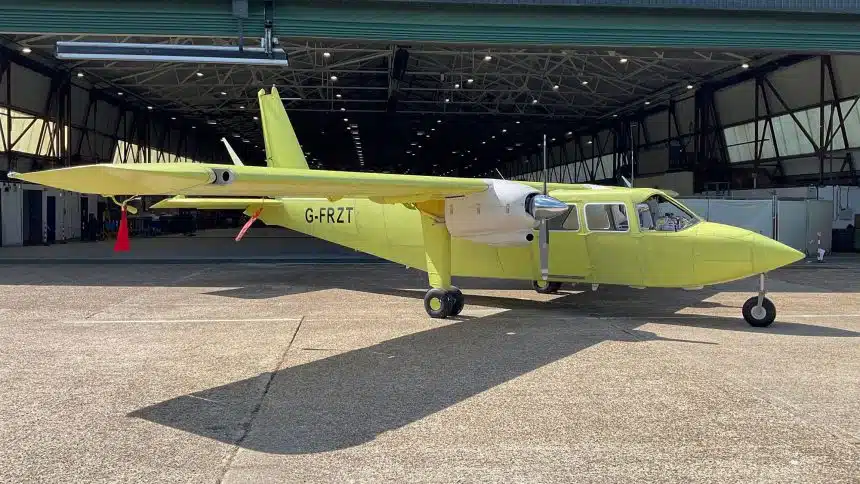
The first Islander to be built in the UK since 1968, serial number 2317 (registered as G-FRZT), has left the Britten-Norman factory and is now being prepared for ground testing.

Britten-Norman flew the first of its BN-2 Islander aircraft in 1968, the second aircraft type produced by founders John Britten and Desmond Norman and the first to enter serial production.
A militarised variant known as the Defender followed in 1970, although standard Islanders also became common sights in military markings around the world. In the same year, a lengthened variant was released as the Trislander, incorporating an additional Lycoming piston engine mounted on the tail.
On 11 September 1970, the BN2A Mk III Trislander took its maiden flight with John Britten, Desmond Norman and test pilot Andy Coombe on board, arriving at Farnborough Air Show the same day for a bold public debut. pic.twitter.com/c8eQEUaQwD
— Britten-Norman (@BrittenNorman) September 11, 2025
Orders came in fast, soon outpacing the production capability of the small company’s line in Bembridge. Contracts were arranged with Romanian firm IRMA, today known as Romaero, to produce the aircraft on a larger scale. This eventually became the sole manufacturing site for the Islander family.
Well over 1,200 Islanders, Defenders, and Trislanders have been produced to date, according to essentially the same design as the one originally developed in the 1960s. The piston engines have given way to turboprops in many applications, with turboprop equipped Islanders designated BN-2T.
The new Islander comes with full IFR glass cockpit, all window seating, enlarged baggage access and a higher All Up Mass than earlier variants. The aircraft can have a variety of engines including Lycoming 260hp and 300hp piston and Rolls Royce 320hp or 400hp turboprop. pic.twitter.com/wIDRPGkm5g
— JamesFennell MBE (@FennellJW) July 31, 2026
The return of manufacturing to the UK was confirmed in 2023, and since then the company has invested significantly in its facilities to provide modern computer numerical control (CNC) machine tools along with a more than 40% increase in its workforce.
With ground roll distances for both takeoff and landing far below 1,000ft, the Islander is an industry leading short takeoff and landing (STOL) performer and this has led to popularity among small airlines serving rural and coastal communities. In the UK, the Islander is notably used on the service between Westray and Papa Westray in the Orkney Islands, which covers just 1.7 miles and takes approximately 90 seconds.
On the other side of the country, the Islander is one of two aircraft types used by the Isles of Scilly Skybus to fly between the Isles of Scilly and the UK mainland alongside the larger DHC-6 Twin Otter.

The British military used the Islander/Defender for decades, with the last example retiring from service in 2021. Used in a liaison and intelligence, surveillance, and reconnaissance (ISR) role, the type saw extensive use in Northern Ireland as well as with the RAF Northolt Station Flight in London. Some airframes saw overseas service supporting UK military operations in Eastern Europe, Iraq, and Afghanistan. Some ISR configured Islanders – often nicknamed ‘Spylanders’ – continue to operate today under civilian contracts over the UK.
Two different Islanders spotted at Belfast International today
G-CGTC BN-2A Defender 4000 AL.2 operated by the PSNI
G-BLNT BN-2T Islander AL1 operated by Draken Europe (ex-Army ZG845)#avgeek #planespotting pic.twitter.com/xUEjBW78D7
— qooᴎꙄʏqooᴎꙄɘʜT (@TheSnoopySnoop) September 12, 2023
Despite its age, the Islander’s simple, effective design has enabled it to stay involved with cutting edge aviation technology. The UK’s battlefield surveillance program that culminated in the Sentinel R1 began with a modified Islander under the Corps Airborne Stand-Off Radar (CASTOR) project. The same aircraft, and others, would also be used to advertise an airborne early warning (AEW) configured variant, though no orders for this were secured.
Pilatus Britten-Norman BN-2T Islander ASTOR G-DLRA landing at RAF Fairford https://t.co/OiMzTHjuYv pic.twitter.com/zdbOTnJ6sT
— NYCAviation Forum (@NYCAForum) December 12, 2017
In the modern day, the Islander has been used as a testbed for new communications technologies as well as for sustainable aircraft propulsion.
Last week we unveiled our newly refurbished hangar & R&D facility at the heart of @CranfieldUni. The more sustainable hangar will be used to modify our @BrittenNorman Islander, bound for conversion to hydrogen-electric propulsion ✈ 💚https://t.co/MY7sDT0YAE#cranfield pic.twitter.com/mZMK60HMMD
— Cranfield Aerospace Solutions (@CAeS_UK) August 3, 2023
Britten-Norman’s investment into the regenerated Bembridge production line indicates a high degree of confidence in the future of the Islander platform, and there undoubtedly continues to be widespread civilian and military applications for such an aircraft type.