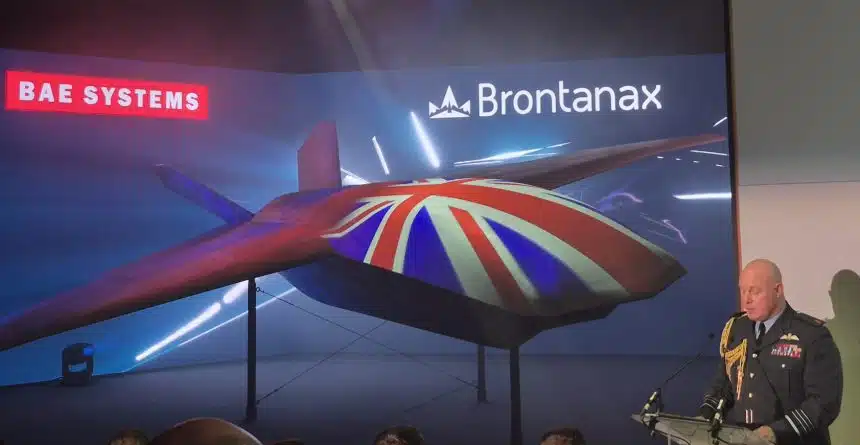
BAE Systems has already built a prototype for the Brontanax CCA, which is set to fly alongside a Typhoon by the end of 2027.
BAE Systems has unveiled during the Farnborough International Airshow its latest development program, the Brontanax Collaborative Combat Aircraft (CCA). The aircraft, whose name is derived from Ancient Greek and means ‘Thunder King’, has been defined as the first British-designed CCA.
The company says that more than 500 of its employees have been involved in the aircraft’s development to date, working with over 75 large companies and SMEs from across the UK’s aerospace sector. The development, led by the FalconWorks division, was self-funded by BAE Systems.
The future of combat air is here.
Today we unveiled the UK’s first British-designed Collaborative Combat Aircraft at @FIAFarnborough.
Built in Britain. Ready for the fight 🔗 https://t.co/6ERLuSAUep pic.twitter.com/KBMbb4Yd82
— BAE Systems (@BAESystemsplc) July 22, 2026
“The unveiling of Brontanax, the UK’s first uncrewed autonomous Collaborative Combat Aircraft, is a testament to the extraordinary talent and innovation across our sovereign defence industry,” said Wes Streeting, recently appointed as the new Defence Secretary.
The announcement comes after the UK Government recently published its Defence Investment Plan, which confirmed a £300m commitment to the Storm Fighter sovereign autonomous CCA program. Storm Fighter will provide the Royal Air Force with Europe’s first sixth generation capability, according to the company.
“We’re investing £300 million in our StormFighter programme to develop an autonomous combat aircraft here in the UK,” added Streeting. “This launch shows the depth of industrial capability we have here in Britain to help deliver our ambition to become Europe’s first sixth generation air force.”
“The Royal Air Force will become Europe’s first sixth generation air force” – Wes Streeting, new UK Secretary of State for Defence pic.twitter.com/mP78N8wSte
— The Aviationist (@TheAviationist) July 22, 2026
Although it has been shown cooperating with a Typhoon in concept videos, the company described Brontanax as a “stepping stone towards GCAP.” The trinational program will in fact include CCAs which will fly alongside the crewed sixth-generation fighter jet.
“The RAF is determined to become Europe’s first 6th Generation Air Force, driving innovation and accelerating the adoption of cutting-edge technology to stay ahead in an increasingly complex and contested battlespace,” said Chief Of The Air Staff Air Marshal Sir Harv Smyth. “Working alongside BAE Systems, we are taking a major step towards that ambition, with a prototype expected to fly next year.”
Brontanax
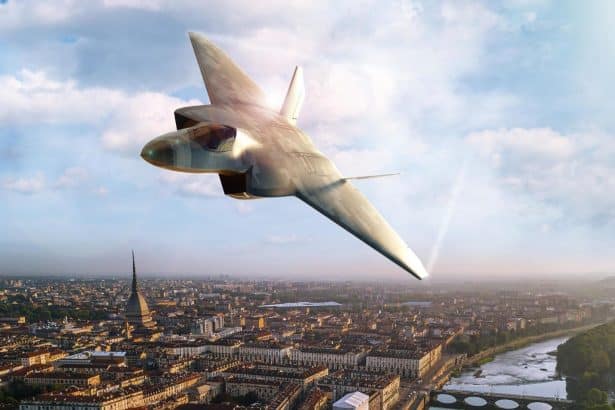
The Brontanax CCA is intended to provide electronic warfare and precision strike capabilities against airborne and ground targets. BAE Systems did not release specifics about the dimensions, although it said it is similar in size to a Hawk trainer jet. A full scale model was also on exhibit at Farnborough.
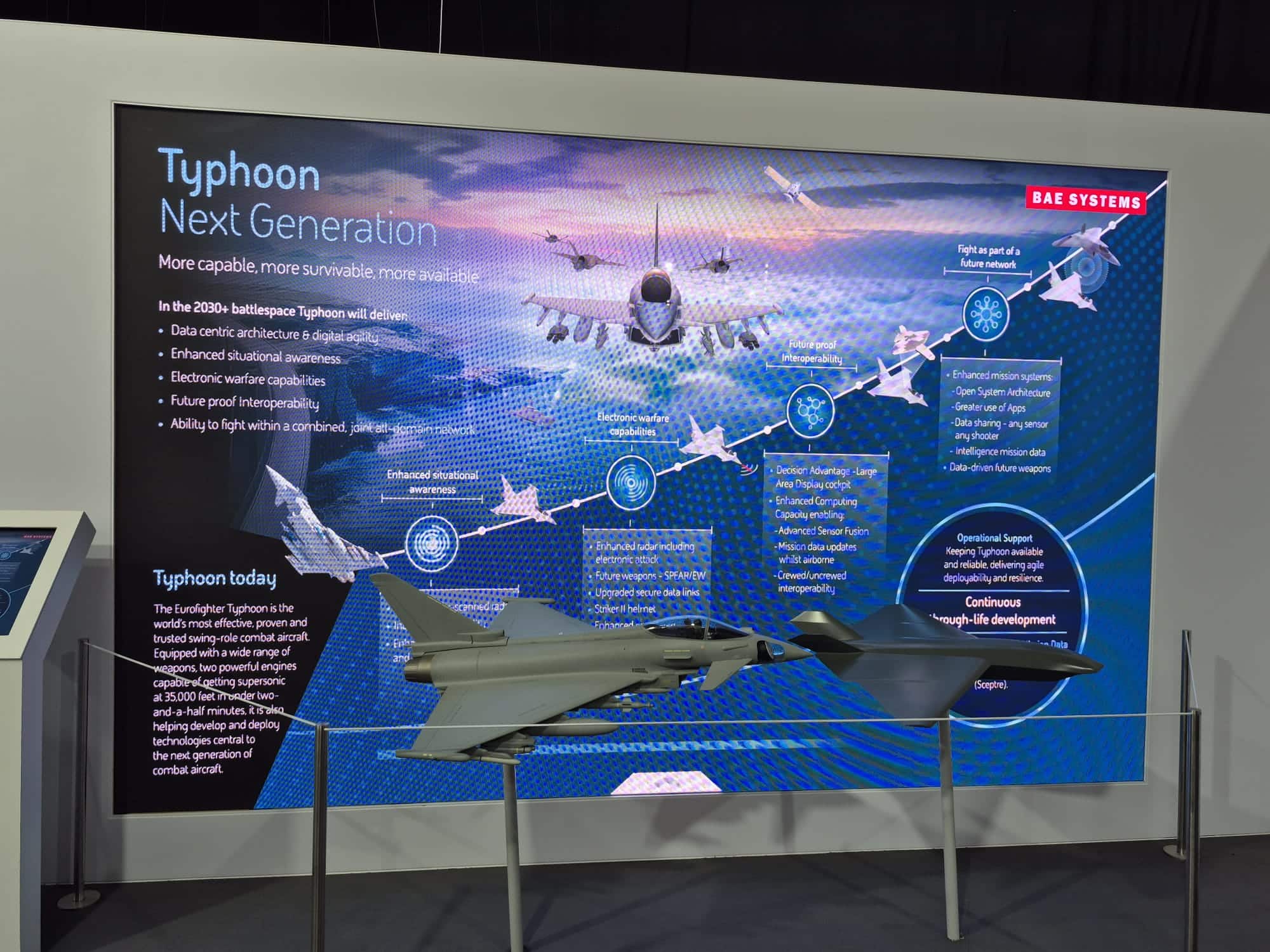
Brontanax features a low-observable delta-wing configuration with canted tails. Details about the powerplant are not available, although the models appears to be a single-engined aircraft with the air inlet positioned below the nose.
“We recognise armed forces are being challenged to meet the demands of speed, adaptability and scale,” says Simon Barnes, Group Managing Director, BAE Systems Air sector. “Our Collaborative Combat Aircraft will provide the ability to extend the reach of crewed aircraft, generating greater combat mass at lower cost, while keeping pilots out of harm’s way.”
The CCA is designed to be operated by a Typhoon pilot or any mission commander for Crewed-Uncrewed Teaming operations. The end goal is to enhance combat mass and operational effectiveness at a lower cost than traditional combat aircraft.
Similarly to other recent drone programs, the Brontanax CCA was developed with an open architecture and modular design. This allows the aircraft to be easily adapted to stay ahead of evolving threats, maintaining operational relevance and adaptability for years to come.
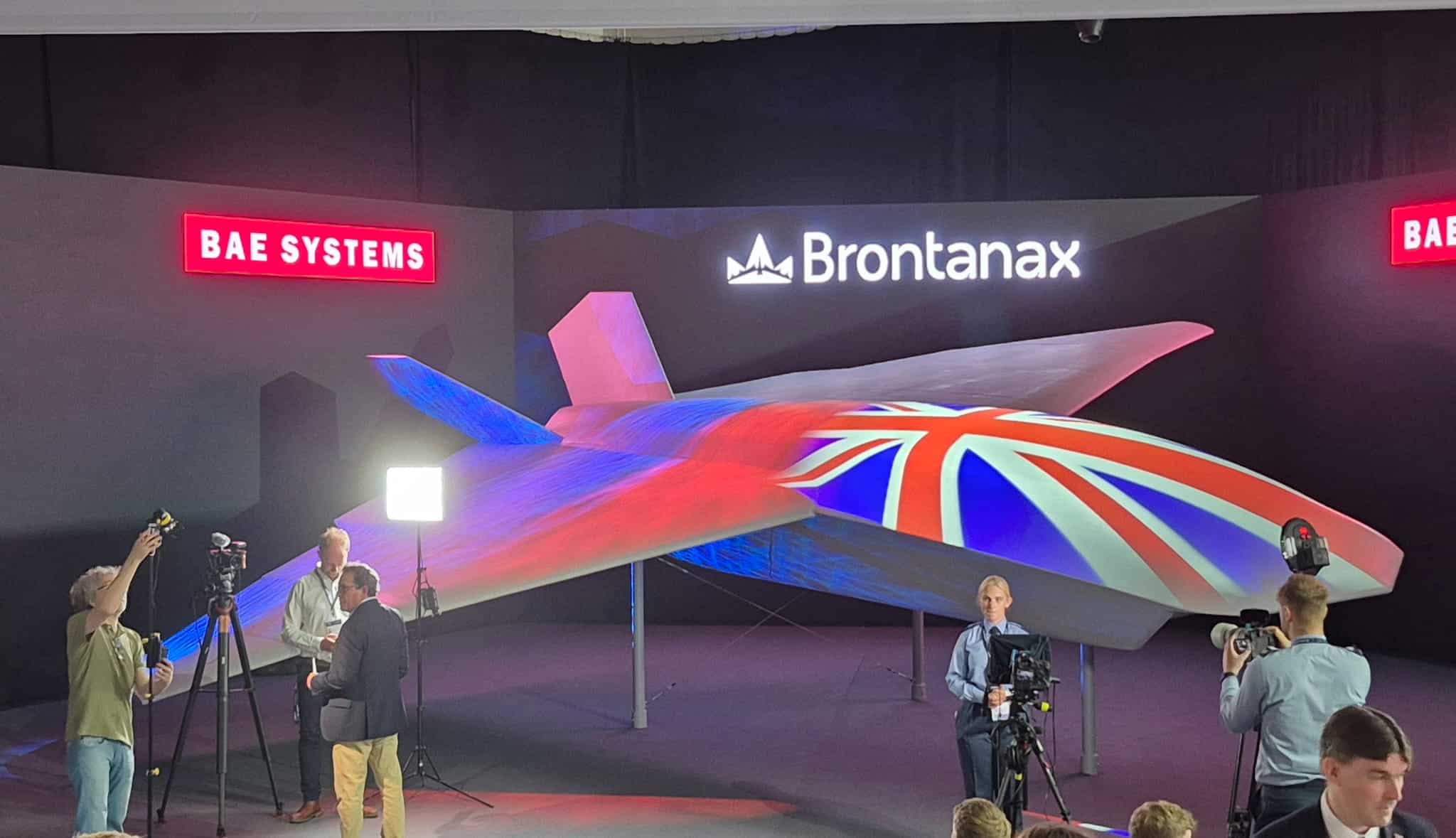
Speaking at Farnborough, FalconWorks Director Dave Holmes described the aircraft as a “pre-series, pre-production prototype” that will be used as “Operational Concept Demonstrator for CCA.” The company ultimately intends to manufacture the aircraft in quantity for both the United Kingdom and export customers.
BAE Systems, according to Holmes, is aiming at a CCA with 70- 80% of the Typhoon’s capabilities, but at 20-25% of the cost.
The company has already built the prototype at its facilities in Warton, Lancashire. The aircraft is now being prepared for ground-based testing, according to the statement, with the first flight expected next year.
By the end of 2027, BAE System is planning to have Brontanax flying together with a Typhoon. The current timeline sees the aircraft entering service before the end of the decade.
The Aviationist’s contributor and James Gray helped in the preparation of this article.