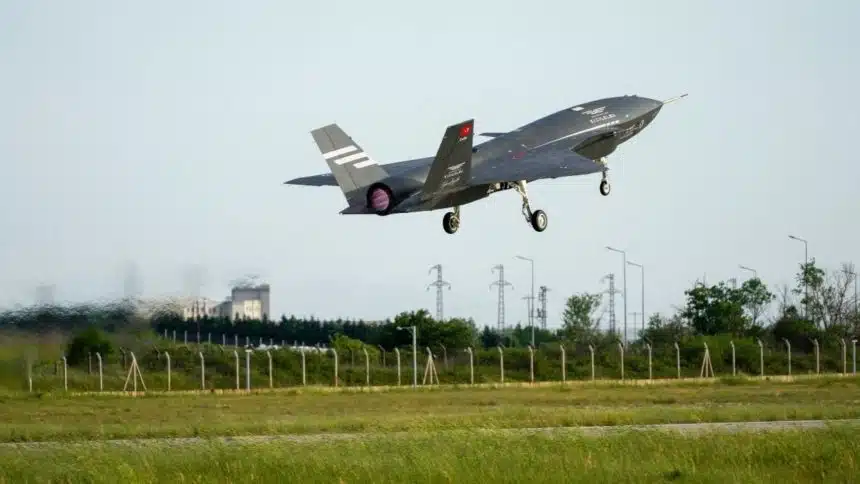
Project K-SWARM saw a Kizilelma UCAV working in a Crewed/UnCrewed Teaming scenario, responding to a series of commands sent from the M-346.
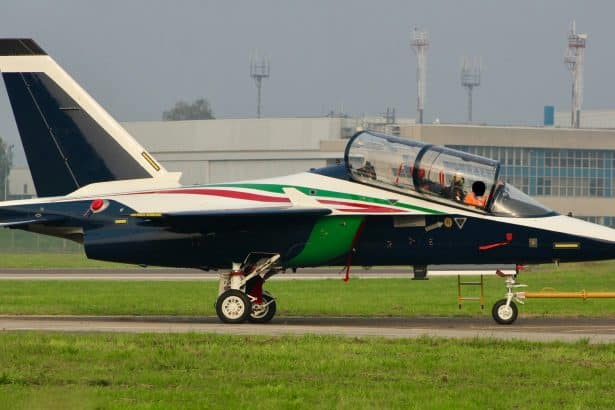
The Turkish-Italian collaboration over manufacturing Baykar’s unmanned combat aerial vehicles (UCAV) at Leonardo’s facilities for the European market with local mission systems and certifications has taken a major leap forward. The M-346 trainer aircraft and the Kizilelma performed the first collaborative Crewed/UnCrewed Teaming (CUC-T) test in what Leonardo called the K-SWARM series of “joint autonomous formation flights,” held in May at Baykar’s Çorlu test flight center.
A Jun. 22, 2026, joint statement by Leonardo and Baykar said the “autonomous formation flights” validated the engineering, software, hardware developed for autonomous combat. This test campaign has now laid the foundation for refining the operational, conceptual, industrial, logistical and doctrinal processes when the systems are mass produced for combat use.
The first of a trial campaign which will continue in the coming months, the test flight saw a Kizelelma prototype with Turkish flight autonomy hardware and software integrated with Italian unmanned control codes. Two Leonardo M-346s, a company-owned M-346FA (Fighter Attack) variant and an Italian Air Force (Aeronautica Militare – ItAF) T-346A acting as a chase aircraft, took part in the K-SWARM trials with the single Kizilelma, Leonardo’s release said.
🔴#LDO_PR #Leonardo and @BaykarTech set a major milestone for advanced Crewed/UnCrrewed capability development with successful first K-SWARM live trials. https://t.co/WKZtLHugbM pic.twitter.com/uomPsBc46N
— Leonardo (@Leonardo_live) June 22, 2026
The Artificial Intelligence (AI)-enabled Kizilelma took off and joined the M-346 formations autonomously, before being controlled and commanded by the M-346FA crew in a series of formation maneuvers.
Systems, hardware and software developed
The test flight was preceded by months of preparatory work and testing activities of other related systems that figured in both the ground testing and first flight trial. Teams had developed a radio frequency-based Leonardo GCC Tactical Platform data link that synchronized and fused all the data between the Kizilelma and M-346s that was employed in the flight.
Latest generation algorithms and relevant tactics and procedures developed by Leonardo at its Avionic Flight Control Innovation Labs and the Product Capability and Concept Laboratory (PC2LAB) in Turin were put to use. Parallely, Baykar integrated its “advanced smart fleet autonomy capabilities into the CUC-T algorithms.”
“Kizilelma’s advanced autonomy capabilities greatly simplified the integration process, allowing for seamless implementation and rapid deployment,” Leonardo’s release added.
SICAK GELİŞME | İTALYA VE TÜRKİYE’DEN STRATEJİK HAMLE!
K-SWARM programı kapsamında, Bayraktar KIZILELMA İnsansız Savaş Uçağı ile Leonardo M-346 uçakları Çorlu’da ilk kez ortak otonom formasyon uçuşu gerçekleştirdi.
İnsanlı ve insansız platformların koordinasyonunu sağlayan… pic.twitter.com/1xlttDQTaZ
— SavunmaSanayiST.com (@SavunmaSanayiST) June 22, 2026
These were first tested with an M-346 Full Mission Simulator based at Venegono, Italy. The release’s framing suggests the simulator was used to simulate and choreograph the CUC-T command tasking, formation flights and test the various autonomous flight, data linking and networking algorithms developed by Baykar and Leonardo.
The Leonardo release further explained that “these were brought into action during the M-346/KIZILELMA formation flights, supporting the validation of advanced collaboration and coordination of different high performance combat platforms and air systems, as the programme marked the transition from simulation to live operations.”
M-346 and Kizilelma teaming test flight
The final flight campaign saw the Kizilelma taxing and taking off autonomously, and then joining the M-346FA in a formation flight, enabled by Baykar’s Smart Fleet Autonomy algorithms. The SFA manned-unmanned autonomous flight code is developed by the Baykar’s Hardware-in-the-Loop (HIL) Laboratory that allowed the M-346 “to subsequently assume full control of the unmanned aircraft.”
Çorlu’daki K-SWARM canlı uçuş testlerinde, iki adet M-346 uçağı ile Bayraktar KIZILELMA insanlı/insansız kollaboratif yeteneklerini (CUC-T) başarıyla sergiledi.
Otonom kalkış yapan KIZILELMA, havada entegre aviyonik süit ve akıllı filo otonomisi algoritmalarıyla M-346… https://t.co/YRD4RvWmg2 pic.twitter.com/t40691rTZC
— SavunmaSanayiST.com (@SavunmaSanayiST) June 22, 2026
The M-346FA pilots employed a “fully integrated onboard avionic suite” and a “dedicated crewed/uncrewed computing system” to command the Kizilelma into “different formations,” which the Turkish aircraft “autonomously executed.”
“Different maneuvers and formations, including position changes, separations and rejoins were successfully tested with the Kizilelma accurately responding to the M-346 commands,” Leonardo’s release further said.
Technology effort and future
Leonardo said the Çorlu flight test was preceded by months of extensive and intense preparation work, which saw the involvement of pilots and technicians from both companies. With the required level of technical integration of the systems, and algorithms validation ensuring safe and effective tests, the next stage will analyze the data gathered during the K-SWARM programme.
Bayraktar #KIZILELMA✈️🚀🍎
✅ Test Flight with KARAT IRST#Baykar 🤝 @Aselsan#NationalTechnologyInitiative 🌍🇹🇷 pic.twitter.com/aB4FVm0wSA
— BAYKAR (@BaykarTech) April 3, 2026
In the coming months, the K-SWARM will progress “into more complex operations [and] additional functions […] requiring greater situational awareness and assets working together ‘as one’ towards mission objectives.” The AI technology and algorithms will now “incrementally shift from remote piloting to autonomy” to ultimately “reduce pilot workload […] while maintaining full control and decision-making.”
Leonardo’s press release concluded that “the first phase of trials demonstrates the solid partnership between Leonardo and Baykar, and their respective technology and industrial competences.” The company added that this “confirms the companies’ competitive advantage in the field and represents a concrete step towards the development of critical capabilities for modern combat air operations in multidomain operational scenarios.”