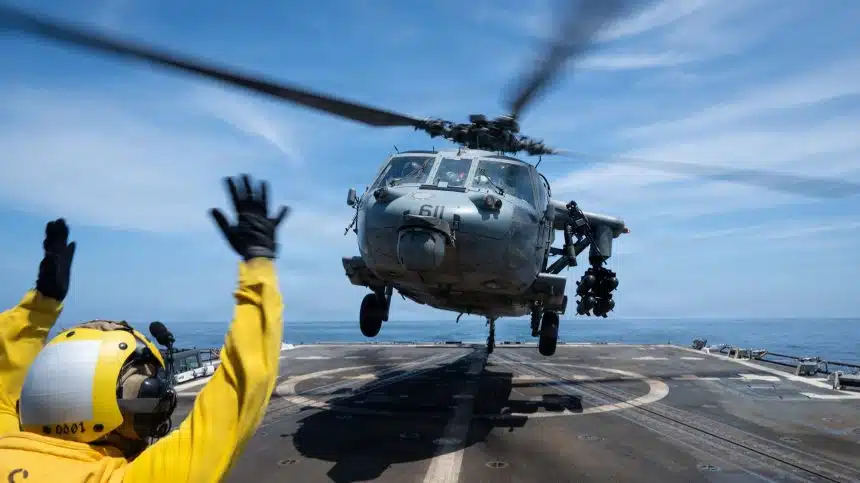
U.S. Navy MH-60S Sea Hawk and U.S. Army AH-64 Apache helicopters were used to sink six Iranian small attack boats which were threatening commercial shipping.
Adm. Brad Cooper, head of the U.S. Central Command (CENTCOM), said to media that U.S. Navy MH-60S Sea Hawk and U.S. Army AH-64 Apache helicopters were used on May 4, 2026, to sink six Iranian small attack boats. The boats were reportedly threatening commercial shipping in the Strait of Hormuz.
“We have an enormous amount of capability and firepower concentrated in and around the strait, including AH-64 Apache and MH-60 Seahawk helicopters used just this morning to eliminate six Iranian small boats threatening commercial shipping,” said the Admiral.
U.S. Navy MH-60 Sea Hawk helicopters are supporting Project Freedom in and near the Strait of Hormuz. Earlier today, Sea Hawk and U.S. Army AH-64 Apache helicopters were used to eliminate Iranian small boats threatening commercial shipping. pic.twitter.com/pt9eTWkhxZ
— U.S. Central Command (@CENTCOM) May 4, 2026
The helicopter attack happened after Iran launched multiple cruise missiles, drones and small boats trying to target U.S. ships in the area. Cooper said that no U.S. ship, either military or commercial, was hit by the Iranian fire.
“The cruise missiles were going after both U.S. Navy ships, but mostly after commercial shipping. We defended both ourselves and, consistent with our commitment, we defended all those commercial ships,” explained Cooper, according to The War Zone. “We had drone launches against commercial ships, all of which were defended against, consistent with our commitment, and then the small boats were all going against commercial ships, and all were sunk by Apaches and Seahawk helicopters.”
Adm. Brad Cooper, CENTCOM commander, flew over regional waters in and near the Strait of Hormuz in an AH-64 Apache helicopter, May 3, on the eve of U.S. military support for Project Freedom. He interacted with U.S. Army Soldiers after visiting with Sailors and Marines on Saturday… pic.twitter.com/NEc9YCFBPB
— U.S. Central Command (@CENTCOM) May 4, 2026
No other details were provided regarding the U.S. attack and it is unclear if the MH-60s and AH-64s were operating together or if they were involved in separate incidents. The Navy’s and Army’s helicopter are flying armed patrol missions over the area, and both types were seen carrying AGM-114 Hellfire missiles.
Project Freedom
Notably, just a day earlier, U.S. President Donald Trump launched a new initiative, called “Project Freedom,” to assist commercial vessels in transiting the Strait of Hormuz. According to Cooper, this will be a multi-domain operation focused on creating a defensive umbrella across the Strait of Hormuz to defend U.S. forces and commercial shipping in the area.
According to U.S. President Donald J. Trump, “Project Freedom,” a U.S. naval mission to escort vessels through the Strait of Hormuz, will begin on Monday. Per the statement on his Truth Social app, many seafarers are running low on food, store stuffs, and other supplies, and… pic.twitter.com/tChs7jz1wk
— OSINTdefender (@sentdefender) May 3, 2026
The Admiral said that they have reached out “to dozens of ships and shipping companies to encourage traffic flow through the Strait […] to help guide ships safely through the narrow trade corridor.” He further added that CENTCOM is “already beginning to see movement.”
Remarks to media today from Adm. Brad Cooper, CENTCOM commander, on Project Freedom: pic.twitter.com/68hSeZfGXO
— U.S. Central Command (@CENTCOM) May 4, 2026
Similar to previous instances, Iran has warned against efforts to forcefully reopen the navigation in the Strait of Hormuz. CENTCOM said that Iran has already interfered with the current operations under Project Freedom with today’s attack.
Cooper attributed to the attacks to the Islamic Revolutionary Guard Corps (IRGC), saying it has launched multiple cruise missiles, drones, and small boats at ships. “We have defeated each and every one of those threats through the clinical application of defensive munitions,” said the Admiral.
Remarks to media today from Adm. Brad Cooper, CENTCOM commander, on Project Freedom: pic.twitter.com/kIFFLf2vpd
— U.S. Central Command (@CENTCOM) May 4, 2026
Trump was not enthusiast about Iran’s comment, saying to Fox News that the country would be “blown off the face of the Earth” if it targeted U.S. ships. The President did not mention today’s attack in his statement and social media posts on May 4.
BREAKING: President Trump sends a new warning to the Iranian regime if it attacks any U.S. vessel working to implement Project Freedom:
“They’ll be blown off the face of the earth.”
Trump tells @TreyYingst that Iran has become “much more malleable” in talks.
“We have more… pic.twitter.com/bLqscDAgag
— Fox News (@FoxNews) May 4, 2026