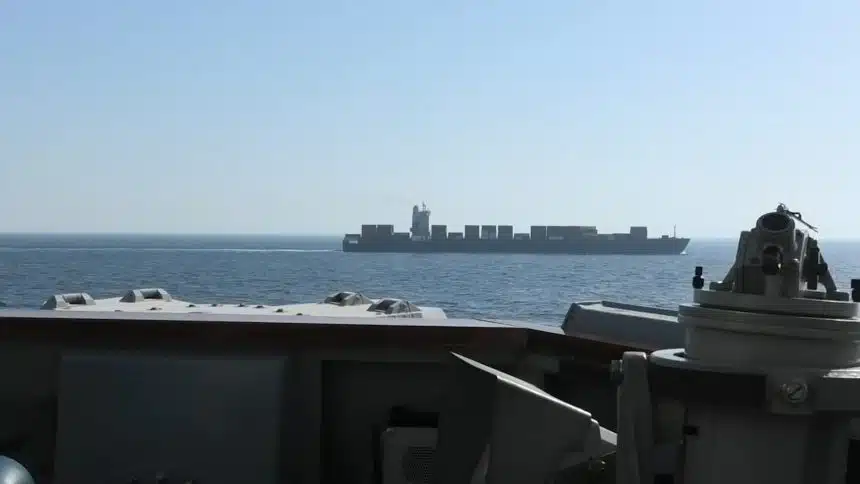
The U.S. has seized the Iranian-flagged cargo ship M/V Touska which was violating the naval blockade, with the USS Spruance opening fire with its 5-inch MK45 gun and Marines boarding the vessel.
The U.S. military has seized an Iranian-flagged cargo ship, the M/V Touska, which was attempting to sail towards an Iranian port on Apr. 19, 2026, violating the U.S.-imposed naval blockade. The operation was first announced in a post on social media by U.S. President Donald Trump, before being confirmed by the U.S. Central Command (CENTCOM) with a statement and media.
According to U.S. President Donald J. Trump, the Iranian cargo vessel, the TOUSKA, attempted to run the U.S. blockade of vessels originating from Iranian ports and offshore berthing areas and was intercepted by the USS Spruance (DDG-111) and given repeated warning to turn… pic.twitter.com/w8Kaitiotm
— OSINTdefender (@sentdefender) April 19, 2026
What happened
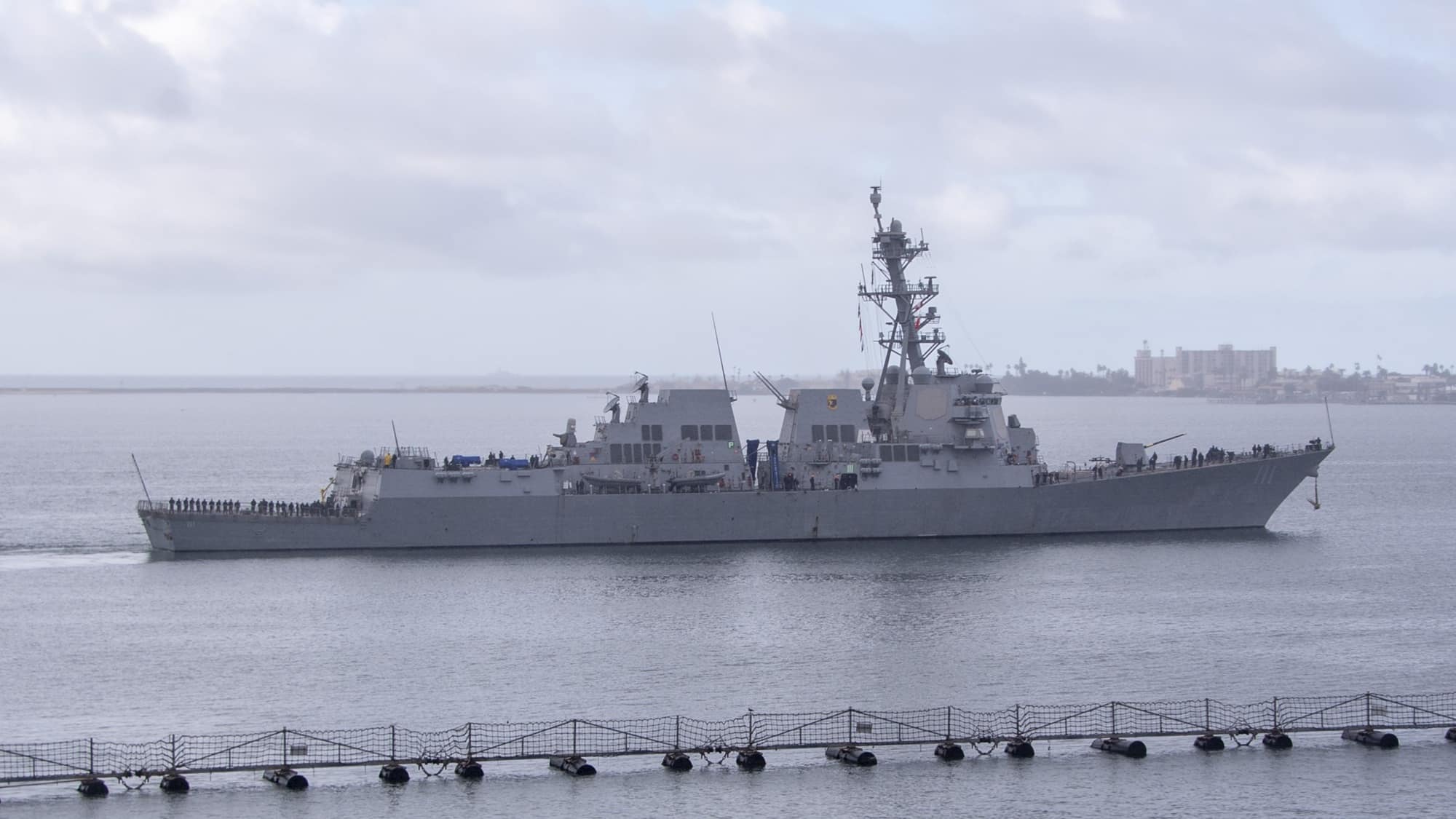
According to CENTCOM, the M/V Touska was transiting the north Arabian Sea at 17 knots enroute to Bandar Abbas, Iran. The Arleigh Burke-class guided-missile destroyer USS Spruance (DDG 111) was sent to intercept the vessel, with CENTCOM saying it “issued multiple warnings and informed the Iranian-flagged vessel it was in violation of the U.S. blockade.”
Trump says that US forces fired on an Iranian-flagged container ship attempting to run the blockade, with Marines then seizing the vessel in the Arabian Sea. pic.twitter.com/60TSqTvXlI
— OSINTtechnical (@Osinttechnical) April 19, 2026
The Command says the warnings were repeated over a six-hour period, with the Touska’s crew failing to comply. At the end of that period, the USS Spruance communicated again with the vessel, directing the crew to evacuate the engine room ahead of disabling fire.
— U.S. Central Command (@CENTCOM) April 19, 2026
This can be heard in the video released by CENTCOM: “Motor vessel Touska, motor vessel Touska, vacate your engine room, we are prepared to subject you to disabling fire.” The U.S. vessel once used again its horns to signal the Iranian ship while sailing alongside it.
U.S. forces operating in the Arabian Sea enforced naval blockade measures against an Iranian-flagged cargo vessel attempting to sail toward an Iranian port, April 19.
Guided-missile destroyer USS Spruance (DDG 111) intercepted M/V Touska as it transited the north Arabian Sea at… https://t.co/iyzOQd93C3 pic.twitter.com/HwU4XS48Oq
— DOW Rapid Response (@DOWResponse) April 19, 2026
The USS Spruance then opened fire with its 5-inch MK 45 gun, firing several rounds “into Touska’s engine room.” The firing section of the video shows the two vessels had a larger separation, and three rounds were fired, although it is unclear if more followed off-video.
Announcement from @POTUS that @US5thFleet destroyer USS Spruance has fired upon and boarded the Iranian containership Touska in the Gulf of Oman.
The ship was enroute from Port Klang, Malaysia. Previous, the ship loaded in Shanghai and Macau, China.
The ship is currently… pic.twitter.com/hhhO4PWQVB
— Sal Mercogliano (WGOW Shipping) 🚢⚓🐪🚒🏴☠️ (@mercoglianos) April 19, 2026
U.S. Marines assigned to the 31st Marine Expeditionary Unit later boarded the M/V Touska. A video later released by CENTCOM shows two MH-60S Seahawk helicopters from the USS Tripoli (LHA 7) were employed to transport Visit, Board, Search, and Seizure (VBSS) teams which fast-roped onto the Iranian ship in the night, with the ship now in U.S. custody.
U.S. Marines depart amphibious assault ship USS Tripoli (LHA 7) by helicopter and transit over the Arabian Sea to board and seize M/V Touska. The Marines rappelled onto the Iranian-flagged vessel, April 19, after guided-missile destroyer USS Spruance (DDG 111) disabled Touska’s… pic.twitter.com/mFxI5RzYCS
— U.S. Central Command (@CENTCOM) April 20, 2026
“American forces acted in a deliberate, professional, and proportional manner to ensure compliance,” says CENTCOM. “Since the blockade’s commencement, U.S. forces have directed 25 commercial vessels to turn around or return to an Iranian port.”
2/ US forces seized an Iranian-flagged container ship for the first time during the war. US President Donald Trump announced on April 19 that the US Navy’s USS Spruance, a guided missile destroyer, intercepted the Touska in the Gulf of Oman, disabled the vessel’s engines, and… pic.twitter.com/sI3SXeCy2E
— Institute for the Study of War (@TheStudyofWar) April 20, 2026
Ongoing negotiations
Following the ceasefire between the U.S. and Iran, negotiations have been ongoing to find a diplomatic solution to the conflict. These negotiations have been intermittent, with Pakistan serving as a mediator and hosting the delegations in Islamabad.
The Iranian delegation, according to Reuters, said that “the two sides had made progress but were still far apart on nuclear issues and the Strait [of Hormuz].” However, Iranian state media has now reported that Tehran rejected new talks.
The U.S. delegation is expected to participate in the new round of talks on Apr. 20. In addition to envoy Steve Witkoff and Jared Kushner, this time the delegation might also include Vice President JD Vance.
Meanwhile, Trump once again threatened Iran, saying the U.S. would destroy every bridge and power plant in the country if they were to reject again his terms. On the other hand, Iran threatened to respond by hitting power stations and desalination plants in the neighboring countries in the Gulf.
The naval blockade was imposed after the failure of the first round of negotiations on Apr. 11 and 12. A day later, CENTCOM started enforcing the blockade of all maritime traffic entering and exiting Iranian ports, in accordance with Trump’s statements.
Iran condemned the blockade describing it as illegal and as an act of piracy, later threatening that “no port in the Persian Gulf and the Arabian Sea will be safe” if the security of the Iranian ports is threatened. It is yet unclear how much the blockade will influence the talks.