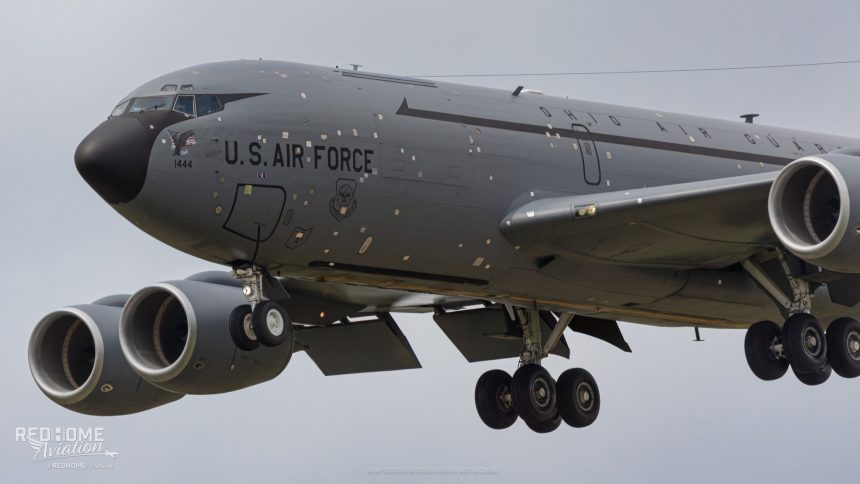
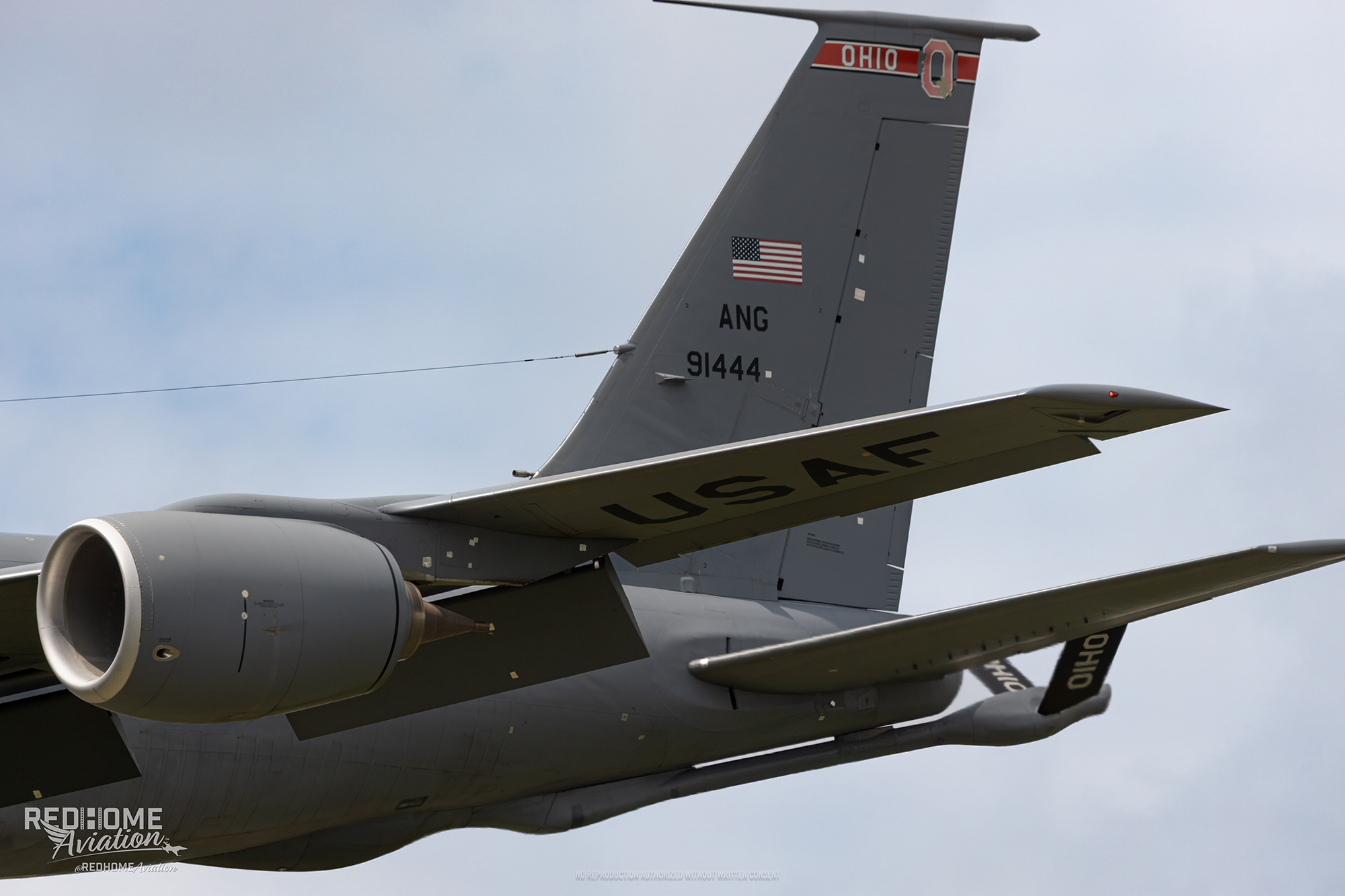
The battle-damaged KC-135R Stratotanker photographed transiting through RAF Mildenhall has safely arrived at Tinker AFB, the hub for depot-level KC-135 maintenance, bearing large and small patches across its fuselage, wings, engines, and tail.
As we reported previously, 59-1444, which currently sports a massive number of patch repairs across the airframe, was likely among the tankers damaged in the multiple Iranian attacks against Prince Sultan Air Base, Saudi Arabia, during March 2026. The attacks destroyed at least one E-3G Sentry, while at least five Stratotankers are reported to have been damaged. Damage to other types has been reported but not yet verified.
The aircraft landed at RAF Mildenhall, UK, on Apr. 12, 2026, with spotters at the fencelines immediately noticing the battle damage repairs (BDR) evident on the fuselage as well as on some of the engine cowlings. It had previously diverted into Chania International Airport, near Souda Bay, during its first attempt to fly from Prince Sultan to Mildenhall.
The squawk 7700 diversion to Souda Bay on Friday is a bit more interesting for KC-135R 59-1444 #AE0361. Seen arriving at RAF Mildenhall today, we can see repairs in patterns consistent w/ splinter damage from a high explosive detonation. Pic made possible thanks to @MarkLynham1. https://t.co/FhR9okg0sP pic.twitter.com/mibWbWAYRV
— Evergreen Intel (@vcdgf555) April 12, 2026
After departing Mildenhall on Apr. 13, the jet stopped over in Bangor, Maine, before completing its journey to Tinker Air Force Base, Oklahoma. Tinker is home to the Oklahoma City Air Logistics Complex, which oversees depot level maintenance for the KC-135 Stratotanker, KC-46 Pegasus, E-3 Sentry, E-6 Mercury, B-52 Stratofortress, and B-1B Lancer. With all of the facilities on site, Tinker was a natural destination for an airframe with such evident damage – and, as we mentioned previously, it would be ably equipped for any level of inspection, repair, and overhaul necessary for the aircraft.
View this post on Instagram
The aircraft is expected to be brought back to operational status, although this has not yet been confirmed. Other Stratotanker airframes, such as 58-0011, were reportedly flown from the “boneyard” – officially the 309th Aerospace Maintenance and Regeneration Group (AMARG) at Davis-Monthan AFB – to Tinker not to be restored but to be cannibalized for spares to sustain the surviving fleet, which has been depleted following the fatal incident over Iraq as well as the Iranian strikes on Prince Sultan.
KC-135 58-0011 being flown from the boneyard over to Tinker AFB to be restored into service. Explains why the landing gear was down for most of the flight. pic.twitter.com/IcRYCnsPpX
— CorreaPhotography (@CorreaPhtgphy) April 3, 2026
Calling upon AMARG’s stock of retired aircraft for refurbishment or further strip-down is an uncommon but not unheard of practice, and most notably in recent years the reserve been used to maintain numbers of high value out of production airframes like the B-1B Lancer.
Tanker Pressures
The U.S. Air Force, when including airframes operated by various Air National Guard (ANG) units, currently has over 350 KC-135s in service. This compared to just shy of 100 KC-46 tankers. While far exceeding any other tanker fleet worldwide, the global operations of the U.S. military can still leave the tanker force stretched.
As we have seen during Operation Epic Fury, hundreds of tankers have been flying at an extraordinarily high tempo supporting not only direct combat operations but also transit flights and logistics taskings. Increased use of contracted aerial refueling services can alleviate a small amount of this burden, particularly for training sorties.
An Omega KDC-10 refueled a US Air Force B-52H and MC-130J over Pacific Ocean on Mar. 10, making it first commercial aircraft to refuel both aircraft. The KDC-10 transited from South Korea to Guam completing four successful contacts with B-52H and MC-130J.https://t.co/jRhPKM1zQS pic.twitter.com/11CrphdvBW
— Ryan Chan 陳家翹 (@ryankakiuchan) April 10, 2024
Meanwhile, the use and employment of the KC-135 – even after sixty years in service – continues to evolve. Earlier in April, as part of a Total Force Integration initiative, the Alaska Air National Guard’s 168th Wing took delivery of four additional Stratotankers. The Eilson AFB unit, nicknamed the ‘Guardians of the Last Frontier’, is the only U.S. aerial refueling unit based in the Arctic, and primarily supports F-16s and F-35s from Eilson alongside F-22s from Elmendorf AFB both on training and real world sorties.
Alaska’s proximity to Russia means that intelligence and defence probing missions from the Russian Air Force and Russian Navy are far from uncommon, and the significant over-water distances involved in many sorties reinforce the need for reliable tanker support. The U.S. Air Force’s press release states that the additional tankers “increases sortie generation, operational flexibility and the ability to sustain long-duration missions in austere environments”.
Many thanks to Rob from Redhome Aviation for allowing the use of his images for this article. You can find him and see more of his work on Facebook and Instagram.