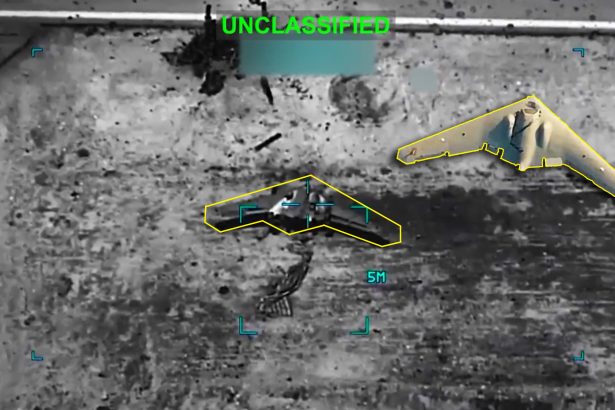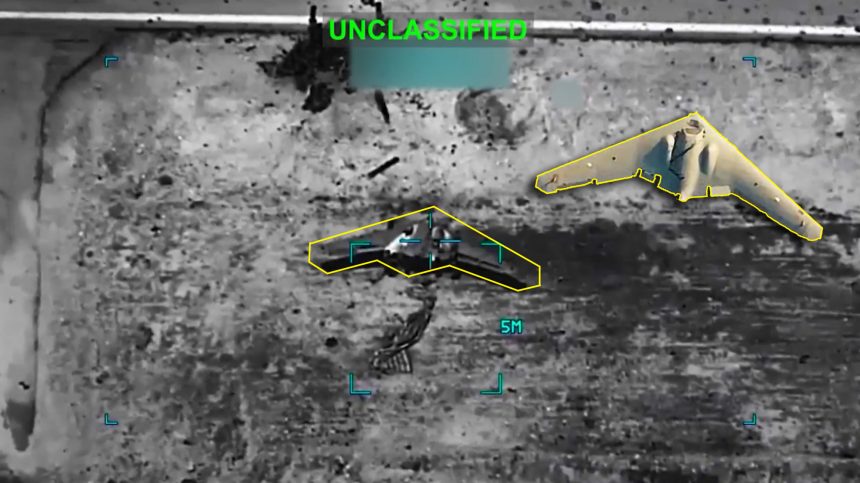
A video shared by CENTCOM shows the destruction of an Iranian clone of the RQ-170 Sentinel, which was reverse-engineered after crashing in Iran 15 years ago.
An Iranian clone of the secretive U.S. RQ-170 Sentinel ISR drone was apparently destroyed in an airstrike, an Apr. 2, 2026 video by the U.S. Central Command (CENTCOM) showed. The drone can be distinguished by its flying-wing design, small size similar to the RQ-170, and two ‘humps’ on the wings.
Iran has produced a few examples of the drone over the years, reverse engineered and modified from the RQ-170 that was recovered after a crash in the country 15 years ago. The derivatives of this design were also shown in promotional videos of the IRGC’s annual exercise in the Strait of Hormuz.
The video also shows the destruction of two other systems – a light tactical vehicle and a surface-to-air missile launcher, possibly a Servom Khordad or Ra’ad system. The latter is said to be an Iranian derivative of the Russian Buk-M2 medium-range SAM system.
US precision-guided strike hits an Iranian flying wing-type UAV.
Possibly Shahed 171 Simorgh or Shahed 191 Saeqeh. pic.twitter.com/kpCFQNI3Ji
— Status-6 (War & Military News) (@Archer83Able) April 2, 2026
CENTCOM chief Adm. Brad Cooper was quoted in the command’s X post: “Now in our 5th week of the campaign, it is my operational assessment that we are making undeniable progress. We don’t see their navy sailing. We don’t see their aircraft flying, and their air and missile defense systems have largely been destroyed.”
Strike video
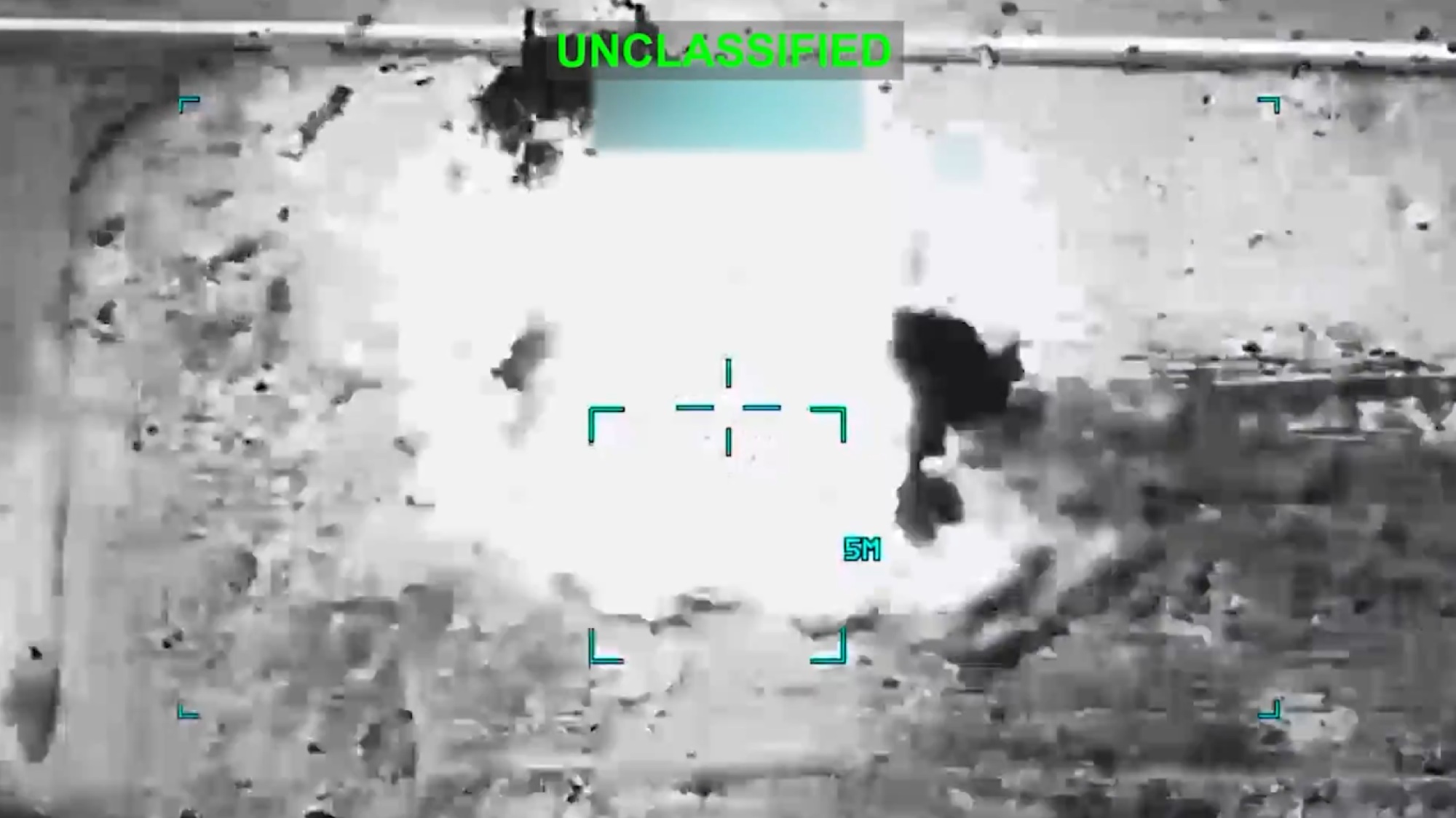
As is standard with all CENTCOM strike videos on Iranian ground targets, the Sentinel clone, the tactical vehicle and the SAM system are targeted by a laser, seen flashing on their bodies. The graphic appears to point toward the MQ-9 Reaper’s electrooptical/infrared sensor as the system used to record the video.
Munitions suitable for these kinds of targets and used by the MQ-9 are the GBU-12 and GBU-49 Paveway IIs, with a Semi-Active Laser (SAL) guidance and a dual-mode GPS/Inertial Navigation System (INS)-laser guidance, respectively, and the AGM-114 SAL-guided missile.
🇮🇷🇺🇸 The latest U.S. CENTCOM video documents the targeting of an Iranian flying wing uncrewed aircraft. There are several such Iranian uncrewed aircraft designs modeled on the American RQ-170, a specimen of which crashed in Iran in 2011. https://t.co/HGsrpRA4X2 pic.twitter.com/oQBNsTfnCX
— Shahryar Pasandideh (@shahpas) April 2, 2026
However, the explosions, especially of the SAM system, suggest the targets could be decoys. Specifically, the SAM system’s explosion doesn’t result in secondary explosions because of the combustion of the propellant or the warhead. The video also cuts before the debris and shrapnel are fully settled to assess the damage and the authenticity of the target.
Iran RQ-170 clone
Iran obtained an RQ-170 Sentinel after it crashed in Iran’s northeastern region on Dec. 5, 2011. An unidentified Iranian engineer claimed to the Christian Science Monitor ten days later that they employed electronic warfare (EW) and “spoofed” the satellite navigation (SATNAV) link from the GPS satellites.
This allegedly forced the drone to go into autopilot mode. However, it is also possible that the UAV may have simply experienced a snag, lost control and, fortunately for the Iranians, landed in their territory.
Iran revealed in February 2013 some of the footage it retrieved from the RQ-170’s electro-optical system while it was operating from Kandahar Airfield in Afghanistan, prior to its crash. Then, on May 11, 2014, Iran also unveiled an RQ-170 copy next to the original one that crashed, which they presumably reverse engineered and called the Shahed 171 Simorgh.
This was followed by the Islamic Revolutionary Guard Corps (IRGC) releasing photos on Oct. 1, 2016, of a new attack drone called the Shahed-191 Saeqeh (Thunderbolt), capable of carrying four precision-guided bombs, again modeled on the American RQ-170 Sentinel. Then on Nov. 17, 2023, Iran unveiled a promotional video of what would later be identified as the Shahed-171 Simorgh, replicating the RQ-170’s front grilled intake, and two ‘humps’ on the wings.
Production of Iran’s Shahed-171 kamikaze UAVs and footage of its operational use. pic.twitter.com/54lo70nhMd
— Clash Report (@clashreport) November 17, 2023
The video showed the body of the Shahed-171 being extracted from molds presumably used for composite materials – possibly fiberglass, a spray paint job, large electronics being installed into the airframe, and a technician operating an external computer connected to the drone. We can also see both a pusher propeller version and a jet-powered one.
Bare airframes are also lined up on an assembly line, with the bodies being outfitted with control surfaces. An SUV is also seen launching the jet-powered version of the Shahed, although those images date back to at least 2019.
The rest of the video shows ground targets being struck, which some sources claim were Islamic State (IS) targets in Syria and Iraq. Both the jet and pusher-propeller drones have a relatively small size and are not shown with external pylons or rails.
However, as we previously reported in 2020, these drones were shown with two internal weapon bays/recessed attachment points for small glide bombs.
Interesting info-graphic on different scale copies of American RQ-170 UAV made by IRGC.
Shahed 161 (40%),
Shahed 191 (60%),
Shahed 171 or Simorgh (100%).
There are also Shahed 141, and 181 which are 40%, and 60% scale copies with piston engine. pic.twitter.com/rt4VZOIi29
— Mehdi H. (@mhmiranusa) December 10, 2020
Iran defense affairs analyst Mehdi M. had said on X in Dec. 2020 that Iran made several copies of the RQ-170 Sentinel, with the Shahed-171 being the last version of a “100 percent scale copy.” It was preceded by the Shahed 191, a 60 percent scale copy, and the Shahed 161 (40 percent).
🇮🇷 ⚡️ L’Iran a récemment dévoilé le drone de combat Shahed-161 lors d’une exposition militaire, une version inversement ingénierie du RQ-170 Sentinel américain capturé en décembre 2011 par les Gardiens de la Révolution islamique (IRGC) grâce à une technique de brouillage GPS… pic.twitter.com/VZdBNT7dtQ
— Camille Moscow 🇷🇺 🌿 ☦️ (@camille_moscow) November 13, 2025
RQ-170 Sentinel
The Lockheed Martin Skunk Works’s RQ-170 Sentinel, about which very little is known officially, except for a U.S. Air Force official factsheet, and a U.S. Army visual aircraft recognition manual, is a very small flying-wing UAV. It is primarily low-observable drone meant to operate in contested airspaces for ISR and targeting roles, with a modular Electro-Optical/Infrared (EO/IR) payload, and a conformal Synthetic Aperture Radar (SAR) and Ground Moving Target Indicator (GMTI) capability.
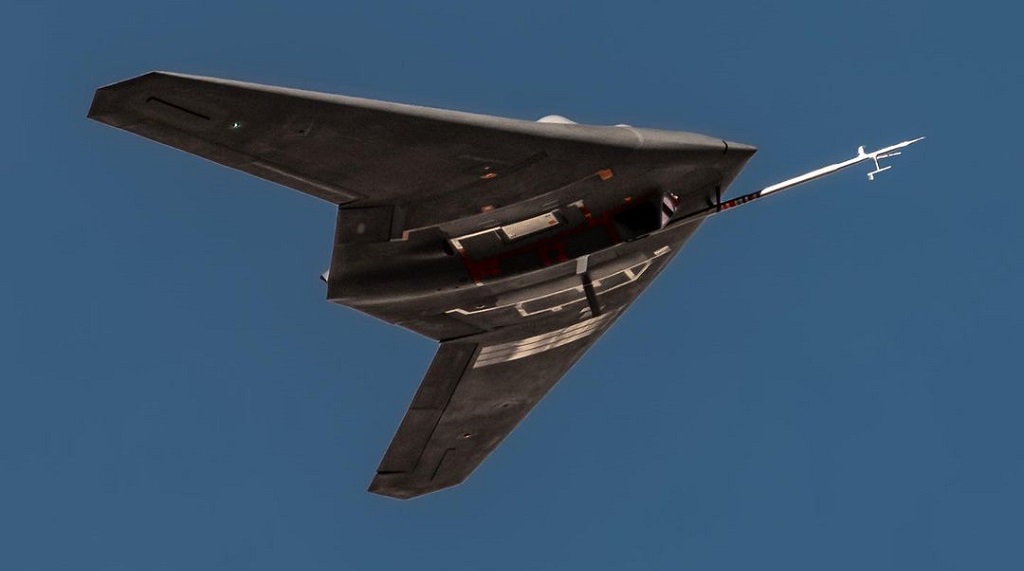
The Pentagon Leaks in 2023 also revealed that the drone was flown nine-times for reconnaissance missions since September 2022 over the Black Sea, with its small size and low-observability aiding surveillance on the waters on the Crimean peninsula.
You can read more about the RQ-170 and the various locations it has been spotted at so far in our coverage about the secretive drone here and here.