Four weeks after the launch of Epic Fury, additional F-16Cs, EA-18Gs and E-2Ds are flying to the Middle East, the USS Boxer ARG is enroute and rumors say the 82nd Airborne Division might be on alert.
We are now in the fourth week since the launch of Operation Epic Fury and the Israeli counterpart Operation Roaring Lion on Feb. 28, 2026. While the U.S. keeps stressing that Iranian military capabilities have been completely destroyed, additional assets are still being deployed to the Middle East.
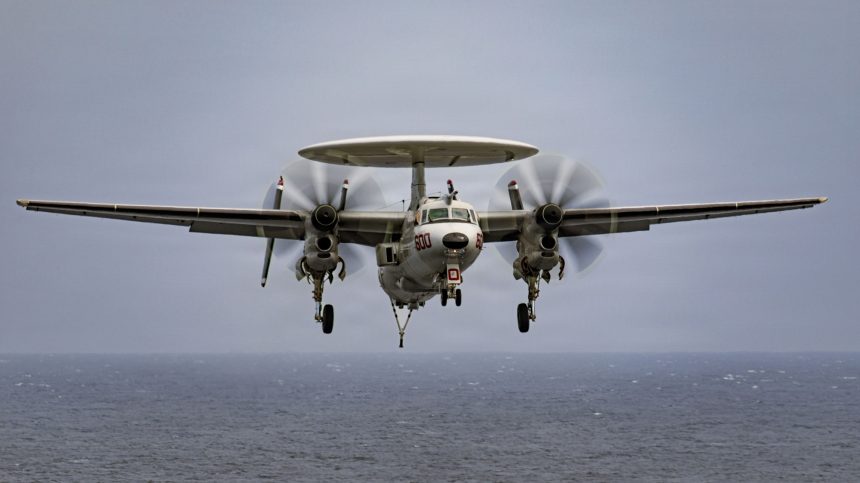
Among the assets that were observed deploying in the last few days are U.S. Air Force F-16CM Block 50 Fighting Falcons, as well as U.S. Navy EA-18 Growlers and E-2D Hawkeyes. Additionally, the Amphibious Ready Group (ARG) of the USS Boxer (LHD-4) is now sailing towards the Middle East, joining the USS Tripoli’s (LHA-7) ARG whose deployment was announced last week.
- 1 Four weeks after the launch of Epic Fury, additional F-16Cs, EA-18Gs and E-2Ds are flying to the Middle East, the USS Boxer ARG is enroute and rumors say the 82nd Airborne Division might be on alert.
- 1.1 Misawa’s F-16s Deploy
- 1.2 Additional Growlers
- 1.3 Reinforcing AEW Capabilities
- 1.4 More Marines
- 1.5 Rumors about 82nd Airborne Division
As the possibility of U.S. ground operations in Iran looms, unconfirmed reports claim that the U.S. Army’s 82nd Airborne Division might have also been put on alert. The U.S. government says that it is not excluding boots on the ground in Iran, but a decision has not been taken.
Misawa’s F-16s Deploy
After the U.S. Air Force deployed the F-16s from its bases in Europe – Aviano and Spangdahlem – and from bases on the U.S. East Coast – Shaw and McEntire – additional fighters are now being deployed from a PACAF (Pacific Air Forces) base. In fact, the latest F-16 deployment sees the involvement of Misawa Air Base, Japan.
The Vipers (as the F-16s are nicknamed by crews) departed from Shaw Air Force Base, South Carolina, where Misawa’s jets reportedly arrived few weeks ago. The flight across the Atlantic Ocean was rescheduled due to tanker issues, and a number of F-16s are still on the way to Europe.
KC-135 #VINYL63-65 & #VINYL73-75 are out with “WW” F-16s #SPINE11 (x6) & #SPINE21 (x6) flt, which are en route to Spangdahlem AB from Shaw AFB after arriving there a few weeks ago. KC-135 #VINYL66 & #VINYL76 from RAF Mildenhall will pick up the drag around 35W. pic.twitter.com/7UJRnNNdbH
— EISNspotter (@EISNspotter) March 21, 2026
In total, up to 24 F-16s from Misawa and Shaw are headed to Spangdahlem Air Base, Germany. Six fighters reportedly arrived there on Mar. 19, followed by 12 more on Mar. 21, and the last six possibly arrived on Mar. 22.
2x KC-135T out of KPIT and 4x KC-135R/T out of KBGR picking up 12x(?) “SW” F-16 (TREND71-76 and TREND81-86?) from Shaw AFB this morning and are heading to Spangdahlem AB (ETAD).
BOBBY43 was unable to takeoff out of KBGR, BOBBY93 took there spot to bring TREND71 flt across the… pic.twitter.com/zKtAHeZmOG
— Aux OSINT (@AUX_OSINT) March 19, 2026
A number of these Vipers departed Spangdahlem on Mar. 23 and are now headed to the Middle East. The final destination of these fighters is unclear, although F-16s have been deployed to multiple bases across the Middle East.
Busy morning, a number of “SW” and possibly “WW” F-16 that had arrived at Spangdahlem AB (ETAD) last week are currently being ferried to the Middle East via GOLD Crew.#AE07BA – 62-3557 – GOLD01#AE047B – 58-0117 – GOLD02#AE035D – 58-0063 – GOLD11#AE066F – 62-3580 – GOLD12… pic.twitter.com/mIGxE45eow
— Aux OSINT (@AUX_OSINT) March 23, 2026
Notably, this could be the last deployment abroad for Misawa’s F-16s. In fact, the base is transitioning to the F-35A Lightning II, and multiple F-16s have already been transferred to other bases, including the nearby Osan Air Base, South Korea.
My images of F-16C Block 50 Fighting Falcons of the U.S. Air Force from the 14th and 77th Fighter Squadrons en route to Ovda Airbase, Israel. They are set to replace fighter elements previously deployed aboard the USS Gerald R. Ford of the U.S. Navy, which were conducting combat… pic.twitter.com/niX9JSCtUN
— Babak Taghvaee – The Crisis Watch (@BabakTaghvaee1) March 23, 2026
Additional Growlers
Reports on Mar. 16 mentioned that additional EA-18G Growler electronic warfare aircraft departed Naval Air Station Oceana, Virginia. A total of six aircraft arrived at Lajes Air Base, in the Azores.
KC-135 #BORA13-14 are out with three more EA-18G Growlers off NAS Oceana for Lajes as #MAZDA81 flt. https://t.co/o4vATFFXbL pic.twitter.com/5pVDQEdSix
— EISNspotter (@EISNspotter) March 17, 2026
The aircraft departed again on Mar. 21, headed to the Middle East. Notably, while some of the EA-18Gs were only carrying external fuel tanks, some we also equipped with AN/ALQ-249 Next Generation Jammer Mid-Band (NGJ-MB) pods.
Several EA-18Gs, E-2Ds, and KC-46s departed Lajes this morning, heading east.
📸 Kurt Mendonça #Lajes #USNavy #USAF pic.twitter.com/QerjcHUQVF
— Silva_Azores🇵🇹 (@Azorean_Lion) March 21, 2026
Growlers have been intensively employed throughout Operation Epic Fury, which sees them flying their primary Suppression/Destruction of Enemy Air Defenses (SEAD/DEAD) missions. Photos have shown that at least some of these missions are being flown with a heavy load of four AGM-88 anti-radiation missiles for attacking enemy radars and an EW pod in place of the usual payload of two missiles and three pods.
More USAF jets taking off today from Lajes AFB – Pictures by Mr. Rui Caria pic.twitter.com/EeAEJ4FJLW
— Air Safety #OTD by Francisco Cunha (@OnDisasters) March 21, 2026
Reinforcing AEW Capabilities
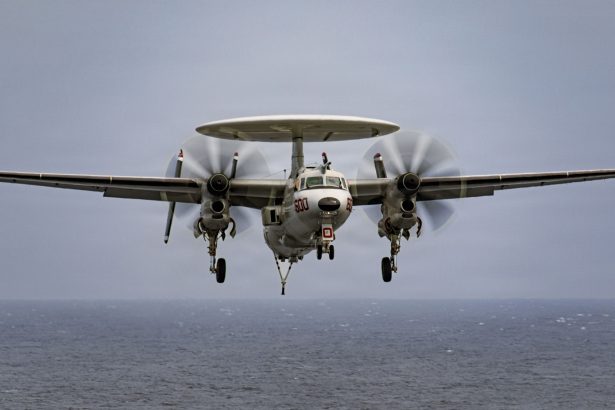
Fighter jets are not the only ones that continue to be deployed in support of Operation Epic Fury. In fact, on Mar. 16, in addition to the first flight of Growlers, five E-2D Hawkeye Airborne Early Warning and Control (AEW&C) aircraft arrived at Lajes.
5x E-2D Hawkeyes (MAZDA11-15) from VAW-126 ‘Seahawks’ leaving KBGR after arriving Mar 13. Headed for LPLA with 2x KC-46A (VINYL61-62)#AE2FD7 – 168077 – MAZDA12#AE744D – 169869 – MAZDA14#AE5F92 – 18-46039 – VINYL61 #AE63B8 – 20-46076 – VINYL62
Photo: Emily Casavant https://t.co/DmC65osaDU pic.twitter.com/HWqwxUtOSg
— Aux OSINT (@AUX_OSINT) March 16, 2026
The Hawkeyes departed Lajes on Mar. 21 headed to Aviano Air Base, Italy. The aircraft left Aviano on Mar. 23 headed towards their destination in the Middle East, but it is unclear if they will join one of the two Carrier Air Wings currently in the region or a land based unit.
Five US Navy E-2D Hawkeyes arrived into Lajes from Bangor tonight as #MAZDA11-15, supported by KC-46 #VINYL61-62 on Coronet East 060. pic.twitter.com/XGznpKKcNz
— EISNspotter (@EISNspotter) March 16, 2026
The E-2D is the latest variant of the Hawkeye, equipped with a state-of-the-art AN/APY-9 active electronically scanned array (AESA) radar. The characteristics of AESA radars make the E-2D an ideal platform for spotting targets with low signature such as one-way attack (OWA) drones and cruise missiles, which have small dimensions and are also able to fly at very low altitude and low speeds, complicating the detection.
Also in motion to the Middle East are the E-2D AEWC that had arrived at Aviano AB last week. They are being moved by KC-46A that have been recently operating out of Lajes Airport (LPLA).#AE5F92 – 18-46039 – VINYL61 pic.twitter.com/QWglTr44Bl
— Aux OSINT (@AUX_OSINT) March 23, 2026
The Hawkeyes will join the U.S. Air Force’s E-3 Sentry AWACS (Airborne Warning and Control System), which use the older passive electronically scanned array (PESA) radar. Additionally, the Royal Australian Air Force has also deployed one of its E-7A Wedgetail AEW&C aircraft to the region two weeks ago.
E-2 Hawkeye at Lajes AFB, pictured today by Mr. Kurt Mendonça (if you see it posted elsewhere without credit, know you know who took them) pic.twitter.com/crPAKqhgRb
— Air Safety #OTD by Francisco Cunha (@OnDisasters) March 21, 2026
More Marines
Additional Marines are now heading to the Middle East, following the announced deployment last week of the USS Tripoli (LHA-7) Amphibious Ready Group (ARG) and the 31st Expeditionary Unit (MEU). In fact, it is now being reported that the USS Boxer (LHD-4) ARG and the 11th MEU are now also been dispatched to the region.
The Boxer ARG includes the Wasp-class amphibious assault ship USS Boxer (LHD-4), dock landing ship USS Comstock (LSD-45) and amphibious transport dock USS Portland (LPD-27). The ARG and the 11th MEU recently completed their certification exercises as part of the pre-deployment workup, and were thus already aboard the ships when the order to deploy arrived.
Can confirm the deployment of the Boxer Amphibious Ready Group and embarked 11th Marine Expeditionary Unit from California has been sped up to occur within days, per two officials.
The task force, with about 4,500 sailors and Marines, is expected to head across the Pacific,… https://t.co/xikiq4aFHt
— Dan Lamothe (@DanLamothe) March 20, 2026
Multiple U.S. outlets reported that the Pentagon “accelerated” the deployment, and the ships left the West Coast within days. The Boxer ARG would join the Tripoli ARG which is already sailing towards the Middle East.
The Tripoli ARG includes the America-class amphibious assault ship USS Tripoli (LHA-7), and amphibious transport docks USS San Diego (LPD-22) and USS New Orleans (LPD-18). USNI News has reported that USS San Diego is currently in port in Japan, and thus only the USS Tripoli and USS New Orleans are heading to the Middle East.
The Boxer Amphibious Ready Group (ARG), comprised of the USS Boxer (LHD-4), USS Comstock (LSD-45), and the USS Portland (LPD-27) with the embarked 11th Marine Expeditionary Group (MEU), is on its way to the Middle East after departing the U.S. west coast for deployment. pic.twitter.com/EjNYNi4BvP
— OSINTdefender (@sentdefender) March 19, 2026
Rumors about 82nd Airborne Division
The abrupt cancellation of a major exercise for some elements of the 82nd Airborne Division spurred rumors that the unit might have been alerted to prepare for a possible deployment. The exercise’s cancellation was confirmed by officials to The Washington Post earlier this month, but rumors are now surfacing again.
In fact, the latest rumors claim that elements of the 82nd Airborne Division might have already arrived in the Middle East, according to Fox News, after plane spotters noted some of the cargo flights arrived in the region originated from Fort Bragg, North Carolina, the unit’s home. It is important to note, however, that the order to deploy has not been officially confirmed, and thus it is not possible to verify whether elements of the unit have left the U.S.
Plane spotters say elements of the 82nd Airborne Division have arrived in the Middle East pic.twitter.com/eBJgF3do4B
— Lucas Tomlinson (@LucasFoxNews) March 23, 2026
The 82nd Airborne Division is the U.S. Army’s premier rapid-deployment force, and forms the core of the Immediate Response Force (IRF). The IRF is built around a Brigade Combat Team (BCT) from the Division plus supporting U.S. Air Force assets, and can deploy within 18 hours of notification without prior warning.
The 82nd Airborne Division has three BCTs, each including 4,000 to 5,000 soldiers. The Division is completed by the 82nd Division Artillery, the 82nd Combat Aviation Brigade and the 82nd Airborne Division Sustainment Brigade.