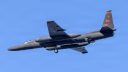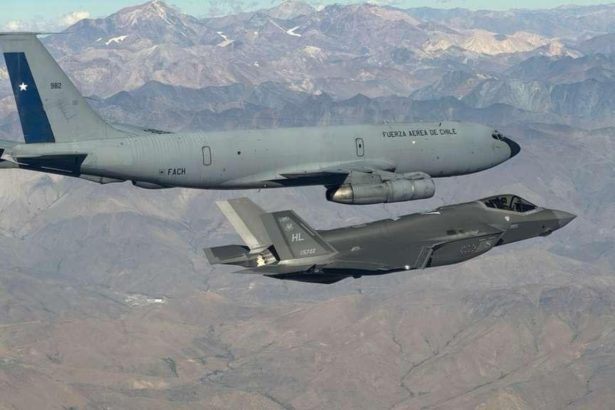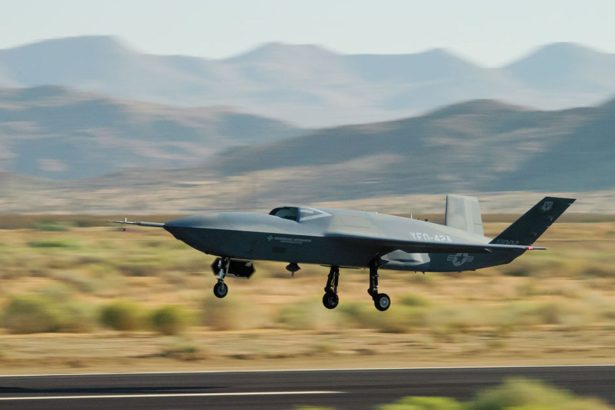
According to Greek outlet OnLarissa, a flying wing aircraft, clearly not a B-2 Spirit, was photographed reportedly flying over Larissa, Greece. Is this our best view ever of the U.S. Air Force’s secretive ISR drone?
OnLarissa reports, based on comment from local sources, that the aircraft was a B-2 Spirit that diverted into Larissa Airport with an apparent technical issue. Of course, to any trained observer, the aircraft shape is clearly not that of a B-2. Additionally, the undercarriage visible does not resemble that of the B-21 Raider, and the overall shape of the aircraft rules out the RQ-170 Sentinel.
The closest match we can find, corroborated by anonymous sources with some familiarity with the clandestine jet, is with the famous (yet still classified) intelligence, surveillance, and reconaissance UAV operated by the U.S. Air Force that we have come to know as the RQ-180. Almost certainly this designation is not used officially, but we use it in lieu of a confirmed one. Thank you to @MechDesignxyz on X/Twitter for forwarding this sighting to us.
Article saying that a B-2 (!) landed on a military base in Larissa, Greece because of some issue
The photos however showing something that’s neither a B-2, nor a drone like RQ170
Not sure how credible is this or if it’s actually a US aircraft @onlarissahttps://t.co/I8VcpGIPTp pic.twitter.com/42xLCwTcIg
— MechDesign.xyz (@MechDesignxyz) March 18, 2026
Larissa is no stranger to a U.S. military presence, and has hosted MQ-9 Reaper detachments on an ongoing basis. It does remain unclear, though, if these images genuinely depict an RQ-180 – what were the circumstances that led it to be essentially revealed in broad daylight over a populated, inland area of Greece?
Previous speculation as to the operation of these secretive aircraft assumed that they primarily operated from remote, perhaps coastal, airbases where even nighttime sightings would be uncommon or easily explained away. Examples might include Diego Garcia in the Indian Ocean, RAF Akrotiri on Cyprus, or one of the massive U.S. installations in the Gulf.
This aircraft seen over Larissa, Greece is not a B-2 like the local Greek news reported or an RQ-170, but is in fact best imagery ever published of the RQ-180, an undisclosed low observable drone used by the USAF. Location suggests use in the Iran conflict https://t.co/Pa9whNlQSV pic.twitter.com/UsDxy9Tc4n
— IntelWalrus (@IntelWalrus) March 18, 2026
The RQ-180 has reportedly featured a near-white colour scheme, similar to the B-21, and as we have previously reported it apparently has garnered the nicknames ‘White Bat’, ‘Great White Bat’, or ‘Shikaka’ in service. The dark appearance of the aircraft here may reflect a new colour scheme, or simply be a trick of lighting. It was developed by Northrop Grumman as part of the Penetrating ISR or P-ISR project, and according to aviation historian Peter Merlin at least nine pre-production examples had flown by 2016.
Israel is also known to operate its own stealth drone, which has been labelled RA-01. It is difficult to compare since we do not have confirmed images of this aircraft, but some supposed sightings show some differences in planform. Additionally, the question must be asked – why would Israel fly its secretive stealth drone to Greece?
Update 2315 UTC
Armchair Admiral on X/Twitter, one of many users who monitor and log military aircraft movements, has dug out some historical data regarding U.S. Air Force C-17 Globemaster III flights to Larissa. As stated above, Larissa is an established U.S. base so regular support aircraft movements are understandable. However, in at least two instances during February and March of this year, these C-17s arrived at Larissa from Edwards Air Force Base, California.
These photos are really interesting as they explain the two C-17s which flew from Edwards Air Force Base to Larissa Air Base in Greece in early March and late February.
Boeing C-17 Globemaster III 2x#AE07F8 97-0046 – REACH 532 (9 Mar)#AE1196 03-3113 – REACH 432 (25 Feb)… https://t.co/Jb0vx0zzzG pic.twitter.com/EnKMatkh1w
— Armchair Admiral 🇬🇧 (@ArmchairAdml) March 18, 2026
Edwards is, of course, front and centre in the world of U.S. aircraft development and testing. The base at Groom Lake, known as Area 51, operates as a detachment of Edwards AFB, and Edwards is also relatively close to Plant 42 at Palmdale. Northrop Grumman maintains a significant presence at Palmdale, and it is the manufacturing location for the B-21 Raider as well as the B-2 Spirit. Their secure facilities here almost certainly also produced the aircraft we know as the RQ-180. A C-17 moving from Edwards to Larissa, then, could have been carrying support equipment tailored to the jet.
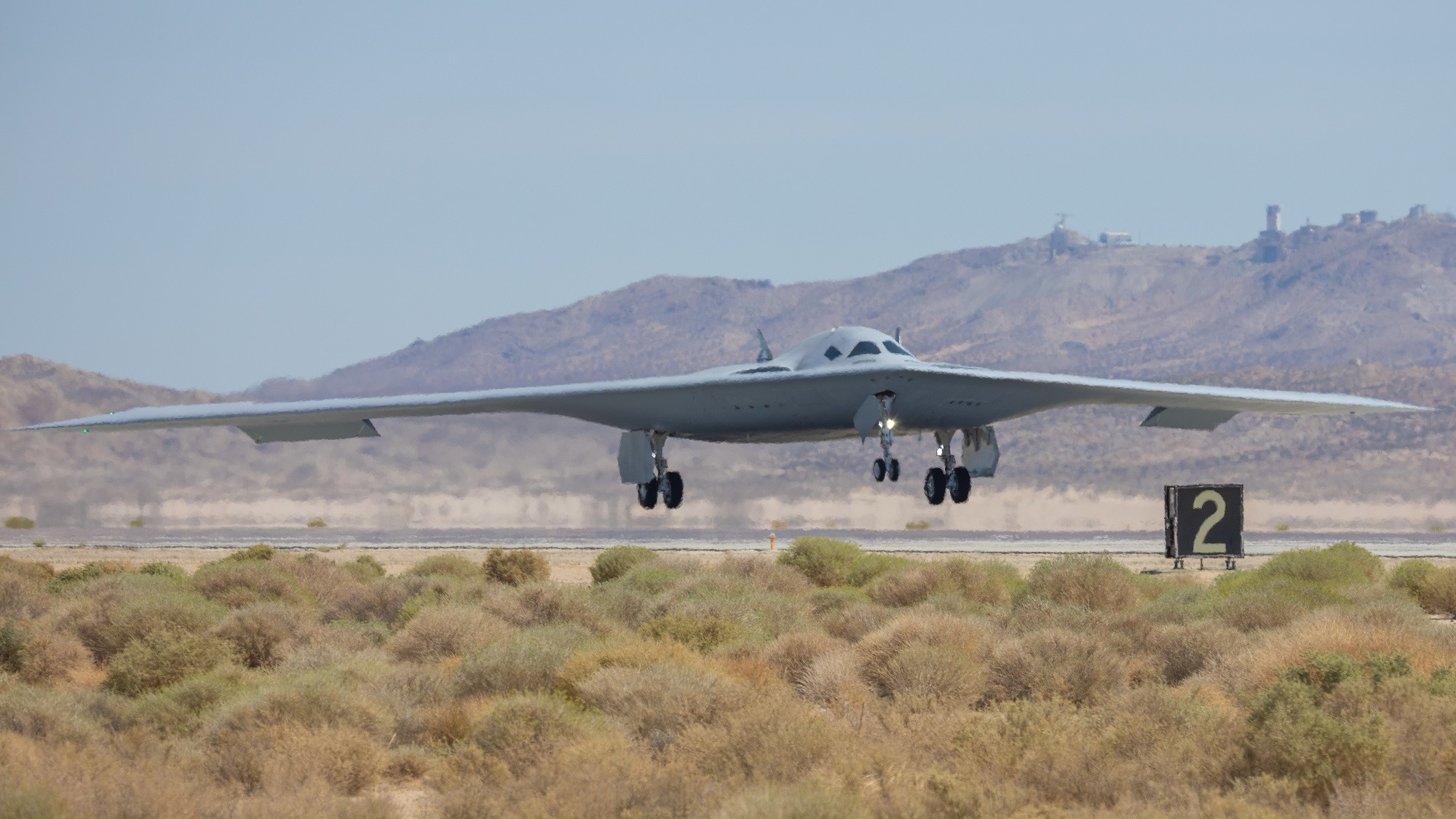
Could this suggest that, in fact, the RQ-180 has been forward deployed to Larissa, or otherwise specifically earmarked in advance for potential diversions? It is possible that some RQ-180 operations have occurred at Larissa before, but strictly during the night hours only to avoid sightings. Even if the aircraft’s capabilities were in fact required in the daytime, the RQ-180’s reportedly exceptional range performance can allow it to loiter for significant periods over uninhabited areas to ensure the necessary arrival time on station can be met. In this instance, the aircraft returning during the day time is explained by the reports from onlarissa.org that the aircraft had suffered a mechanical fault.
It is, of course, likely that the RQ-180’s presence anywhere in this region is related to Operation Epic Fury. Even prior to this sighting it was considered a near certainty that the RQ-180 was actively involved in the ongoing military action, and may also have had an intelligence gathering role prior to any shots being fired. It may also have participated in U.S. operations against Venezuela, though at this stage the only stealth drone that can be confirmed in that theater is the RQ-170 Sentinel. The RQ-180’s aforementioned range means that, for Venezuela, aircraft may have simply flown their missions directly from the United States.
Update 19th March 1105 UTC: Video released
OnLarissa has, this morning, released on their YouTube channel a video recorded of the flying wing aircraft – still misidentified as a B-2 – presumably as it approached the nearby airbase.
The footage is taken from directly underneath the aircraft, and as the aircraft is moving it gives us the clearest view so far of its exact planform. Based on what we understand and have seen previously, this aircraft is a certain match for the RQ-180.
This article concerns a breaking news story and may be updated as and when new information or analysis is available.