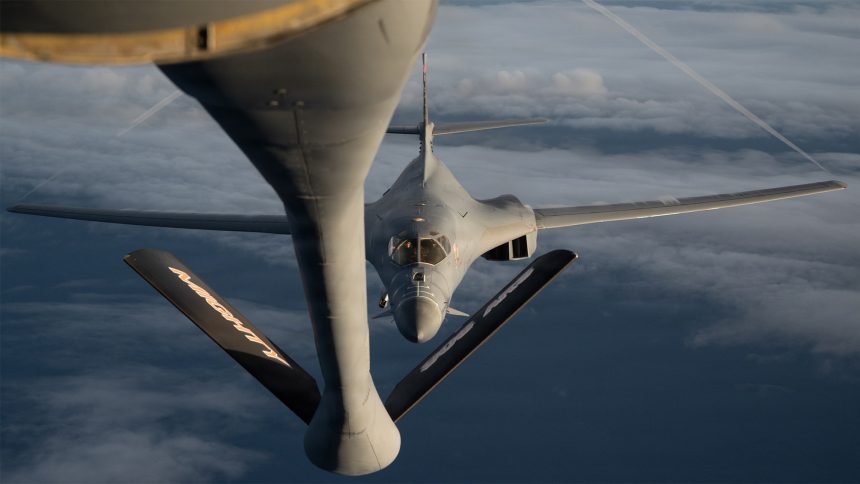
It has been confirmed, after movements were quietly tracked by enthusiasts, that USAF B-1B Lancer strategic bombers flying direct from South Dakota were deployed in action against Iranian military sites.
As Chairman of the Joint Chiefs of Staff General Dan Caine provided an update on Operation Epic Fury in a live press conference, U.S. officials confirmed the use of B-1B Lancer bombers against Iranian ballistic missile sites and command & control centres.
Launched a day after a raid by B-2 Spirit stealth bombers, the B-1s traveled from their South Dakota home at Ellsworth Air Force Base across the Atlantic and through the Mediterranean towards the target area, supported by a series of aerial refueling aircraft stationed along the route.
🚨U.S. air force B-1 strategic bombers conducted strikes overnight on above ground ballistic missile and command and control sites in Iran, U.S. official says
— Barak Ravid (@BarakRavid) March 2, 2026
While these movements were tracked over the U.S. East Coast by aviation enthusiasts, an announcement came from the United Kingdom that it would now allow the U.S. to use its bases, including RAF Fairford and Diego Garcia, for certain types of missions. This raised the question of whether the B-1s would first travel to Fairford to then forward base from there, or carry out a strike in Iran before continuing to Diego Garcia in the Indian Ocean.
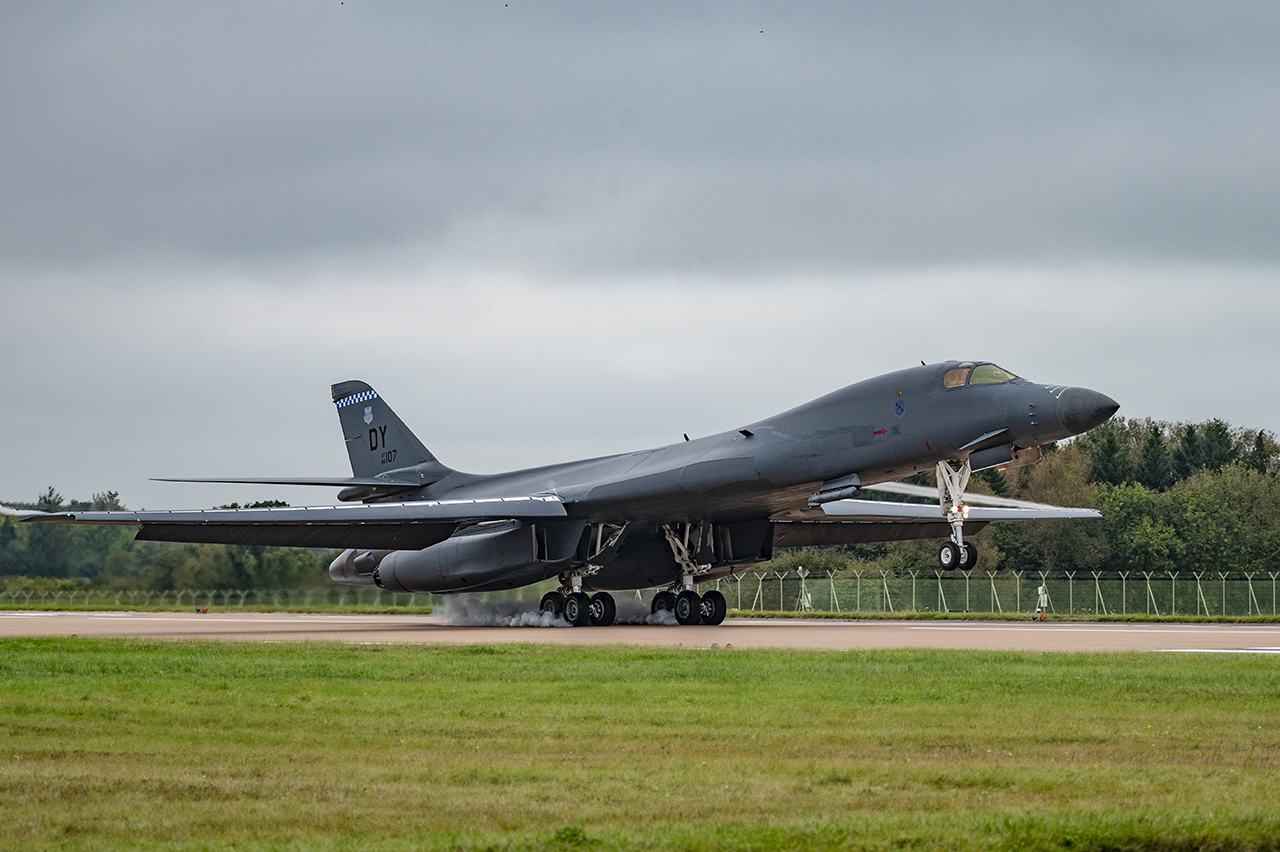
In the end, the bombers flew a similar round robin sortie to the B-2s, exfiltrating the area back along the same route home towards Ellsworth, though the potential of now using Fairford and Diego Garcia certainly allows for greater flexibility in terms of planning future missions.
Although the B-1B has a very small radar cross section for an aircraft of its size, it is not considered a stealth aircraft in the same way as the B-2 Spirit. It’s unclear what types of munitions were employed by the B-1s for this strike, though a number of long range standoff strike weapons are available to the aircraft which would allow it to remain far away from potential air defence threats. We do know that, for the B-2 strike, 2000 lb guided bombs were used, meaning the aircraft would have needed to be within a relatively close range to the intended target.
“2000 lb bombs” in this case presumably refers to GBU-31(V)3/B series JDAMs, which have a hard-target-penetrator warhead. Each B-2A can carry up to 16 such munitions. https://t.co/qiJXNVcepJ
— Guy Plopsky (@GuyPlopsky) March 1, 2026
That being said, the continual bombardment of military targets in Iran by U.S. and Israeli aircraft using kinetic and electronic effects is sure to have significantly degraded Iran’s air defence capabilities – we have even seen vulnerable medium altitude, long endurance (MALE) UAVs like the Hermes 900 operating deep inside Iranian territory (though in at least one case, the drone was eventually downed by a missile).
#Breaking: This footage shows what appears to be a Hermes-900 armed drone of the Israeli Air Force, searching for ballistic missile launchers to hunt and destroy at #Shiraz, southern #Iran.#IranRevolution #IranRevolution2026 #OperationEpicFury #OperationLionsRoar pic.twitter.com/qLP3rH7e4F
— Babak Taghvaee – The Crisis Watch (@BabakTaghvaee1) March 2, 2026
For the next contribution by Air Force Global Strike Command (AFGSC), we may see the deployment of B-52 Stratofortress bombers – again able to use a number of standoff strike weapons – or we may see a tag-team effort between the B-1 and B-2 forces taking turns to deliver these long-range missions to prolong their sustainability.
Operations by fighter aircraft deployed to the U.S. Central Command (CENTCOM) continue to hit Iranian targets, as well as act in defence of missile and drone attacks from Iran. Three F-15E Strike Eagles have so far been lost to friendly fire, though with no reported casualties. As well as hitting military targets, U.S. and Israeli airstrikes have taken place against known government facilities and locations – with one of these resulting in the death of Ali Khamenei, Supreme Leader of Iran.
B-1B Lancer
The B-1B, derived from the B-1A which had been developed and then cancelled in the preceding years, was delivered in the mid 1980s as a more survivable alternative to the B-52 for delivering nuclear payloads. It would use speed and low level flight as its defence mechanism, with its variable geometry ‘swing wings’ and four afterburning GE F101 engines allowing near supersonic flight at low level (and above supersonic at altitude) while still providing ample maneuverability at slower speeds.
Rockwell B-1 Lancer in flight with its camouflage paint scheme in 1980. Nicknamed the “Bone”, its 75,000-pound payload is the heaviest of any U.S. bomber.
B-1A prototypes: 4 built (1970s)
B-1B production aircraft: 100 built (1980–1988) pic.twitter.com/qB928OX6Bp
— Chris Bolton (@CcibChris) November 20, 2025
Its nuclear mission would eventually be stripped away in 1994 to comply with arms reduction treaties, and the B-1B morphed into a purely conventional bomber. It has the largest payload of any active U.S. strategic bomber and flew missions over Yugoslavia, Iraq, Afghanistan, Libya, and Syria. Its payload and loiter time at altitude made it an excellent ‘bomb truck’ for close air support in relatively uncontested airspace, leading to the Lancer being forward deployed on a near permanent basis to the Middle East during the early to mid 2010s. B-1Bs conducted nearly 10% of all combat sorties during first months of Operation Inherent Resolve, dropping thousands of munitions.
Since being reassigned from Air Combat Command (ACC) to AFGSC, the successor to Strategic Air Command (SAC), the B-1B has undertaken a greater number of strategic deterrence deployments in Europe and the Pacific. This has included participating in joint exercises with South Korea in response to North Korean threats, as well as Bomber Task Force (BTF) deployments aimed at reinforcing Europe amid increasing levels of Russian aggression leading up to and since the full-scale invasion of Ukraine.
Epic Fury’s first Pentagon briefing
During a briefing to reporters at the Pentagon, the Chairman of the Joint Chiefs of Staff, Air Force Gen. Dan Caine, provided some details about the launch of Operation Epic Fury.
LIVE: @SecWar and Chairman of the Joint Chiefs of Staff, Air Force Gen. Dan Caine, hold a press briefing at the Pentagon. https://t.co/PaA7POQsL5
— Department of War 🇺🇸 (@DeptofWar) March 2, 2026
“At 3:38 pm, on Friday February 27, the United States Central Command, through the Secretary of War, received the final go order from President Trump,” said Caine. This prompted all the units involved to begin final preparations for the beginning of the operations.
The General confirmed that the initial attack was preceded by the use of non-kinetic effects by both the U.S. Cyber Command and Space Command. This aspect is similar to what we saw at the beginning of Operation Absolute Resolve, which led to the capture of Venezuelan President Nicolás Maduro.
“This operation was highly classified so that at H hour the enemy would see one thing: speed, surprise and violence of action,” continued Caine. “The first movers were USCYBERCOM and USSPACECOM, layering non-kinetic effects disrupting, degrading and blinding Iran’s ability to see, communicate and respond.”
Gen. Caine then detailed the beginning of the kinetic operations, mentioning the employment of over 100 aircraft in the first wave of the attack.
“At H hour, the beginning of major combat operations, 01:15 Eastern Daylight Time, 09:45 local am Tehran time, as dawn crept up across Central Command’s AOR, the skies surged to life,” said Caine. “More than 100 aircraft launched from land and sea, fighters, tankers, airborne early warning, electronic attack, bombers from the States and unmanned platforms, forming a single synchronized wave.”
Although he did not mention it explicitly, the General confirmed the reports that the operation was launched in daylight following the Israeli strike on the meeting to which Iran’s Supreme Leader Ali Khamenei was taking part. Also, he confirmed the involvement of the U.S. intelligence community.
NYT: Satellite imagery released today reportedly shows significant damage to the compound linked to Iran’s Supreme Leader, Ali Khamenei, in Tehran following an Israeli strike. pic.twitter.com/1PAwqaSaci
— Open Source Intel (@Osint613) February 28, 2026
“This was a daylight strike, based on a trigger event conducted by the Israeli Defense Forces, enabled by the U.S. intelligence community,” said Caine.
Talking about the scale of the attack, Caine mentioned that more than 1,000 targets were hit in the first day of combat.
“The first shooters at sea were Tomahawks unleashed by the United States Navy, closed in on Iranian naval forces and began to conduct strikes across the southern flank in Iran,” said the General. “On the ground, forces fired precision standoff weapons, measured, deliberate, precise and lethal. This was a massive, overwhelming attack across all domains of warfare, striking more than 1,000 targets in the first 24 hours.”
Talking about the targets, Gen. Caine confirmed once again that the focus is on destroying Iran’s ability to see attacking forces and coordinate to respond to the attacks. He also confirmed that air superiority was achieved, as announced by the Israeli Air Force on Mar. 1.
“In the initial phase, CENTCOM’s focus was systematic targeting of Iranian command and control infrastructure, naval forces, ballistic missile sites and intelligence infrastructure, designed to daze and confuse them,” said Caine. “Coordinated space and cyber operations effectively disrupted communications and sensor networks across the area of responsibility, leaving the adversary without the ability to see, coordinate or respond effectively. The combined impact of these strikes, swift, precise and overwhelming, has resulted in the establishment of local air superiority.”
Notably, Gen. Caine mentioned the strikes conducted by the B-2 bombers. However, there is no mention of the newly reported B-1B strikes.
“Over the course of the last two days, the Joint Force has launched hundreds of missions from land and sea, and delivered tens of thousands of pieces of ordnance, and the efforts continue to scale. This included American B-2 bombers which again, similar to Midnight Hammer, flew a 37-hour round-trip sortie from the continental United States, dropping precision, penetrating munitions on Iranian underground facilities across the southern flank and slightly deeper.”
Another video of US Air Force B-2A Spirits as PETRO41-44 touching down at Dyess AFB, TX after a mission that began yesterday to bomb Iran.
📹https://t.co/oQK5nzXZdH https://t.co/uGRq2sWBCA pic.twitter.com/vzGPPlgBAY
— TheIntelFrog (@TheIntelFrog) March 1, 2026
The briefing then moved to the defensive effort against the Iranian retaliation, which sees the air defenses continuing to counter the incoming Iranian weapons.
“While we prosecuted our relentless offensive campaign, our defense has been equally important. Across the theater, operation have remained steady and disciplined. Once again, our integrated air and missile defense network is performing exactly as it is intended. U.S. Patriots and THAAD batteries, along with ballistic missile defense-capable Navy destroyers, continue to coordinate and execute intercept with precision and consistency.”
A note was specifically dedicated to the threat by One-Way Attack (OWA) drones.
“Collectively, these systems have intercepted hundreds of ballistic missiles, targeting U.S. forces, our partners and regional stability. The threat from one-way attack UAVs has remained persistent. Our systems have proven effective in countering these platforms, engaging targets rapidly. Each intercept represents hundreds of hours of training, readiness and technology, all coming together to work as designed.”
At the end of the briefing, Gen. Caine also acknowledged the loss of three F-15E Strike Eagles. The aircraft were reportedly shot down by air defenses in what has been described as a friendly fire incident, with CNN reporting that one of the aircraft might have come down in the vicinity of Ali Al Salem base in Kuwait.
“I am aware of the loss of three U.S. Air Force F-15Es overnight in the region,” said Caine. “I’m grateful for the safety of the crews and we know that this was not from hostile enemy fire. As this matter is under active investigation, I will not comment further on this.”
Update 18:00 UTC: CENTCOM confirms B-1B strikes
CENTCOM has now confirmed with a post on social media that B-1B Lancer bombers were employed in the night between Mar. 1 and 2 to strike “deep inside Iran to degrade Iranian ballistic missile capabilities.” The command did not provide details about the number of bombers and the weapons employed.
A video attached to the post shows crews boarding one of the aircraft, followed by the night take-off of three B-1Bs, with one clearly showing its EL tail flash. This would coincide with earlier reports that three B-1Bs from Ellsworth Air Force Base, South Dakota, took part in the strike mission.
Last night, U.S. B-1 bombers, struck deep inside Iran to degrade Iranian ballistic missile capabilities. As the President stated, “we’re going to destroy their missiles and raze their missile industry to the ground.” pic.twitter.com/tIkIo5ugWv
— U.S. Central Command (@CENTCOM) March 2, 2026
This article concerns a developing story and may be updated as new details become available.