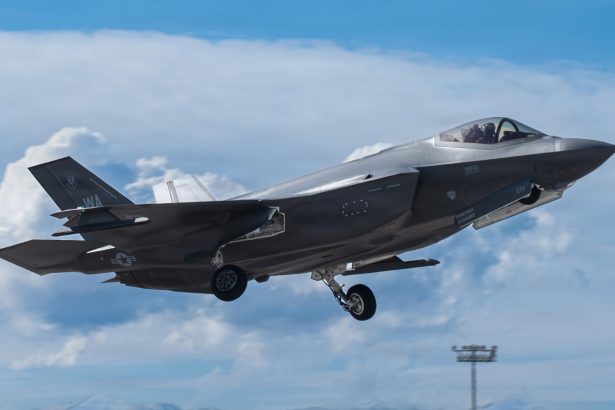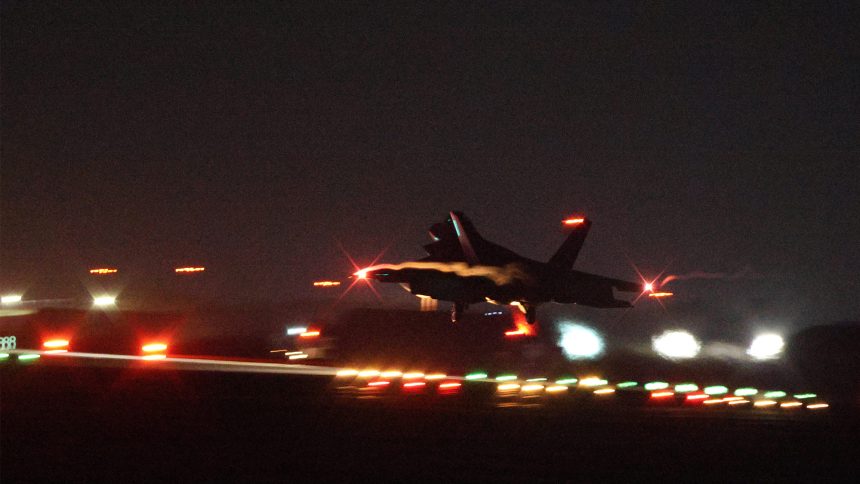
The deployment of F-22s towards the Middle East has been considered by many to be one of the final pieces of the puzzle regarding U.S. preparations for potential offensive action against Iran.
The Langley Air Force Base (AFB) jets landed at the UK base shortly before 1830 UTC, with their arrival well documented by local planespotters, many of whom had been waiting at the fenceline all day to catch a glimpse of the F-22s. Many thanks to Gustavs Gailitis (@gustavs_g_photography), who was among them, for allowing us to use his images of the jets’ post-sunset appearance.
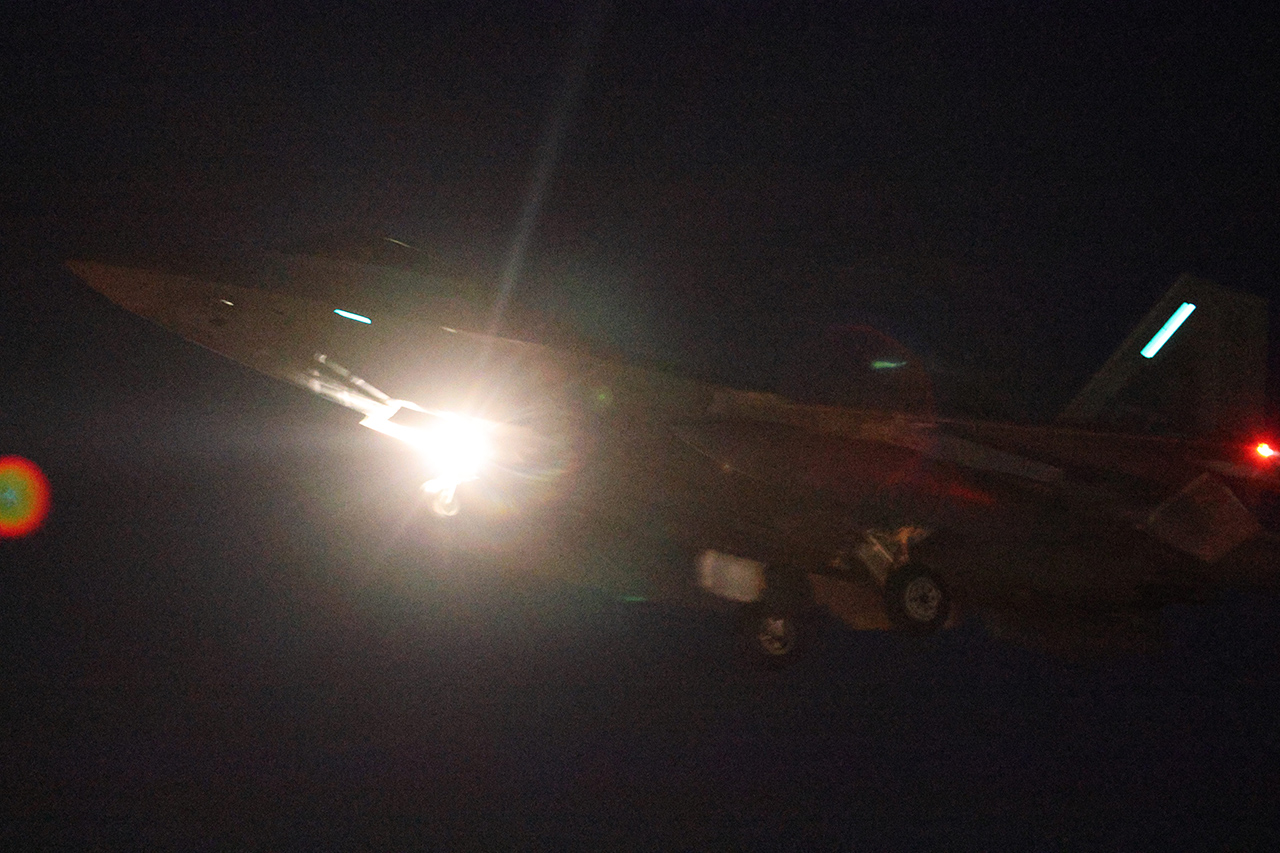
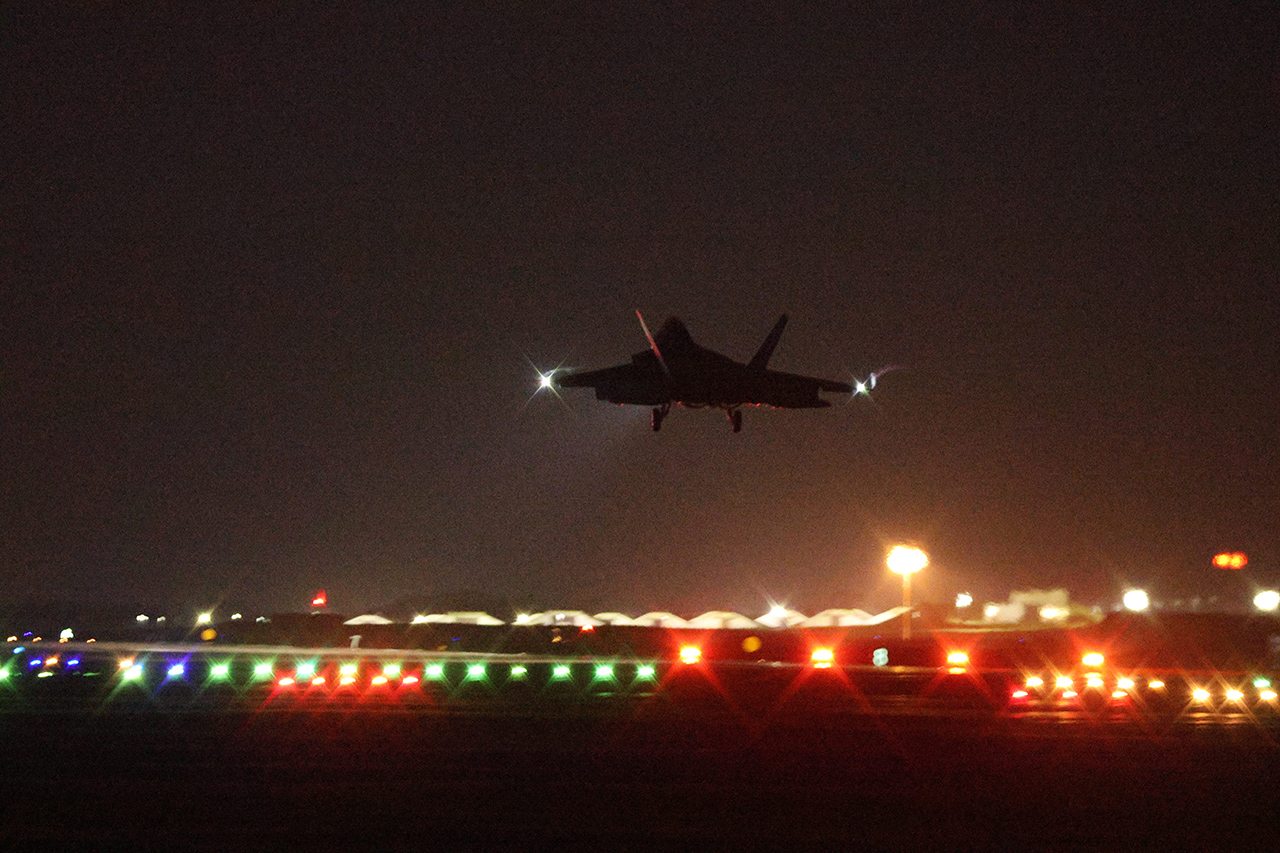
Though the imminent deployment of F-22s has been widely considered to be on the cards for some days, a more direct heads up was given by the departure of the jets and accompanying refueling tankers from the U.S. East Coast using Coronet callsigns on the morning of Feb. 17, 2026. Coronets are the U.S. Air Force’s term for long-distance transits of aircraft, usually fighter aircraft, in formation with refueling tankers.
KC-46 #ROMA02-03 & KC-135 #ROMA04 are heading across the pond on Coronet East 033 with #TREND51 flt (x6 F-22), which are en route to RAF Lakenheath from Langley AFB. KC-46 #ROMA01 supported the initial drag. pic.twitter.com/Dwk0kw4V1B
— EISNspotter (@EISNspotter) February 17, 2026
Another batch of six F-22s is expected to follow, potentially as soon as tomorrow (Feb. 18). Both sets of aircraft will almost certainly head ‘downrange’ towards the Middle East within a few days at most, joining a huge array of other fighters and support aircraft. Along with the Carrier Air Wing of the USS Abraham Lincoln, and that of the USS Gerald R. Ford which will arrive soon, the U.S. has deployed additional F-16 Fighting Falcons, F-35A Lightning IIs, and EA-18G Growlers to the U.S. Central Command region in recent weeks.
Twelve F-16s departed from McEntire ANGB #KMMT to Lajes #LPLA as TABOR 71 and TABOR 81 flight, February 17th 2026. The airspares HURON 77 and HURON 87 returned to KMMT. Supporting #ALTRV Coronet East 030 were CLEAN 21/22/23 and CLEAN 31/32/33 #CoronetEast #CE030 #TABOR71 #TABOR81 pic.twitter.com/cBZAouOKPB
— Coronet_deployments 🇳🇱 🇺🇸 (@CoronetEast) February 17, 2026
These are in addition to F-15E Strike Eagles and A-10C Thunderbolt IIs that have been deployed for some time, though the long-deployed Mountain Home AFB based Strike Eagles have now finally departed for home. More F-15Es – notably the only fighter in the U.S. inventory known to be able to deliver the GBU-28 and GBU-72 bunker buster bombs – may soon head into theater, however.
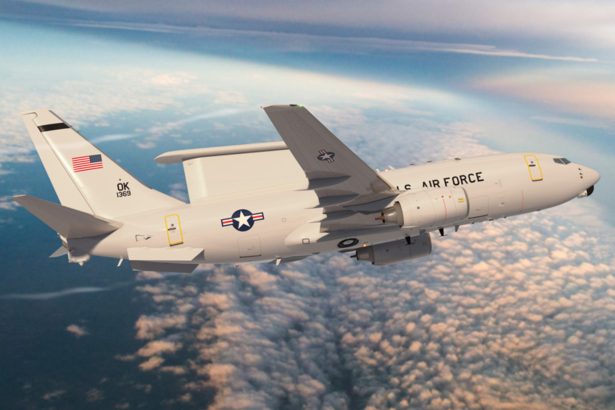
On Feb. 16, two E-3 Sentry AWACS departed Elmendorf AFB, Alaska, for a direct flight to RAF Mildenhall, UK – callsigns DENALI 01 and 02 – arriving on the morning of the 17th. A number of additional E-3s are, at the time of writing, airborne from the U.S. and heading for Ramstein, Germany. The deployment of this many E-3s in quick succession is essentially unprecedented in recent years, and they represent a significant proportion of the U.S. Air Force’s dwindling inventory of the airborne early warning & control (AEW&C) aircraft.
Two E-3 AWACS aircraft departed from Elmendorf AFB #PAED to RAF Mildenhall #EGUN as DENALI 01 (82-0007) and DENALI 02 (75-0556), February 16 2026. They are enroute to the Gulf. Photo by T_asahi21https://t.co/TaGQ8Mv3Ri pic.twitter.com/v4ZsFR2B0j
— Coronet_deployments 🇳🇱 🇺🇸 (@CoronetEast) February 16, 2026
The next day, E-11A Battlefield Airborne Communications Node (BACN) 22-9046 began a transit heading in the same direction, joining other aircraft of the type that have already been sent to CENTCOM.
🇺🇸 #USAF Bombardier E-11A Battlefield Airborne Communications Node (BACN) BLKWF02/22-9046 (#AE77A3) is currently moving towards Europe/Middle East across the pond.
E-11A BACN is a key enabler for real-time information flow across the battlespace and provision of critical… pic.twitter.com/FHP75tMMsy
— Status-6 (War & Military News) (@Archer83Able) February 17, 2026
Along with the F-22s, the deployment of AWACS and BACN aircraft has been noted by civilian analysts as some of the strongest signals that the U.S. is preparing for the possibility of a major conflict scenario.
A U-2 Dragon Lady departed from the type’s regular forward operating base at RAF Fairford, UK, on Feb. 17 also, though it should be noted that rotations of these aircraft through RAF Fairford are a fairly regular occurrence. Two U-2s still remain at Fairford where they regularly fly missions towards Eastern and Northern Europe. The more interesting point is that the departing U-2 actually headed to the west, towards the Atlantic, after leaving the base.
While this is, in theory, the wrong way for a Middle East deployment, this routing via Cornwall has historically been used by U.S. military aircraft heading to the Middle East when the U.S. Air Force has either not attempted or not been able to secure overflight permissions from one or more European nations. This was the case for Operation El Dorado Canyon, where F-111s based in the UK struck targets in Libya, as well as for many B-52 Stratofortress sorties flown by the U.S. during the Gulf Wars. When the U-2s transit to and from the U.S. they usually head north to take a great circle routing.
Due to the rapid flow of news on this topic, please note that any information presented above was known to be or thought to be correct at the time of writing but the situation may have evolved since that point. We will endeavor to keep you up to date in further stories.
U.S. – Iran Dispute
Talks between the U.S. and Iran are still ongoing, with U.S. demands focusing on Iran’s nuclear program. Shortly before the F-22s arrived at RAF Lakenheath, Iranian officials announced that an agreement on the “guiding principles” of a possible future deal had been reached.
‘I’ll be involved in those talks indirectly. And they’ll be very important,’ Trump told reporters ahead of high-stakes talks between Iran and the US over Tehran’s nuclear program, adding he believed Tehran wanted to make a deal https://t.co/JLcqIuGpnP pic.twitter.com/iojrn0XO81
— Reuters (@Reuters) February 17, 2026
U.S. President Donald Trump’s latest focus on Iran was initially spurred by widespread protests against the Iranian regime, which was met with a brutal crackdown by state forces that is said to have cost tens of thousands of lives.
Trump warned that the U.S. would intervene to protect the protesters, but large-scale protests have mostly now subsided due to the threat of a violent response by the Iranian state. There were a number of moments where it seemed that U.S. forces were preparing for immediate action, but it is speculated that this was discouraged by military officials until more assets could be deployed to the region.
The buildup of forces in the Caribbean, which we now know was in anticipation of Operation Absolute Resolve, took many of the resources which would previously have been available for CENTCOM, and some have now been deployed directly from there to the Middle East. Most notably, had the USS Gerald R. Ford not been recalled from its planned deployment it would likely have been in or near to CENTCOM waters as the protests in Iran began to develop.