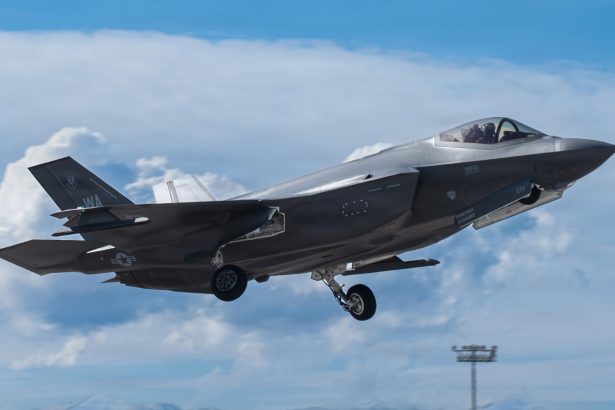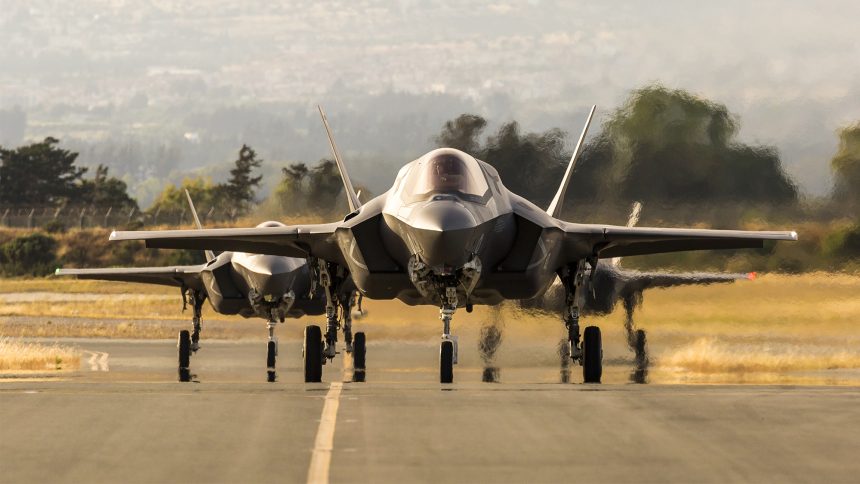
Six F-35Bs have been sent to RAF Akrotiri on Cyprus in a move, sources told The Times, intended to better protect base should current tensions in the region break into open conflict.
The six jets left RAF Marham in two batches on Friday Feb. 6, 2026, accompanied by two Voyager refueling aircraft from RAF Brize Norton. Flight tracking data shows the lead tanker, which flew the whole distance to Akrotiri, forming up with the F-35s over south west England before proceeding south over France, across Sicily, and through the Mediterranean to Cyprus.
Two RAF Voyagers🇬🇧 in convoy heading towards the Med, likely with 6 F-35s (4+2) from RAF Marham https://t.co/6UkyloYczy pic.twitter.com/OTuBdCUDot
— Saint1 (@Saint1Mil) February 6, 2026
Sources from the UK’s Ministry of Defence reportedly confirmed to The Times that the jets were being moved to increase Akrotiri’s defensive capacity if the situation in the region becomes “hot”. Most protests in Iran – which were the cause célèbre for President Trump’s mooting of military intervention – have been quelled after reported mass killings by state forces involving tens of thousands of casualties, though remarks from the U.S. frequently suggest that offensive action against the Iranian regime is still on the table. A series of official talks between the two nations are still in progress.
💥Britain has deployed fighter jets to RAF Akrotiri in Cyprus to defend the base and the sovereign base territories from any attacks, sources tell the @thetimes. Six F-35Bs left RAF Marham on Friday amid concerns the situation in the region become “hot”. (Spotted by @Saint1Mil)
— Larisa Brown (@larisamlbrown) February 6, 2026
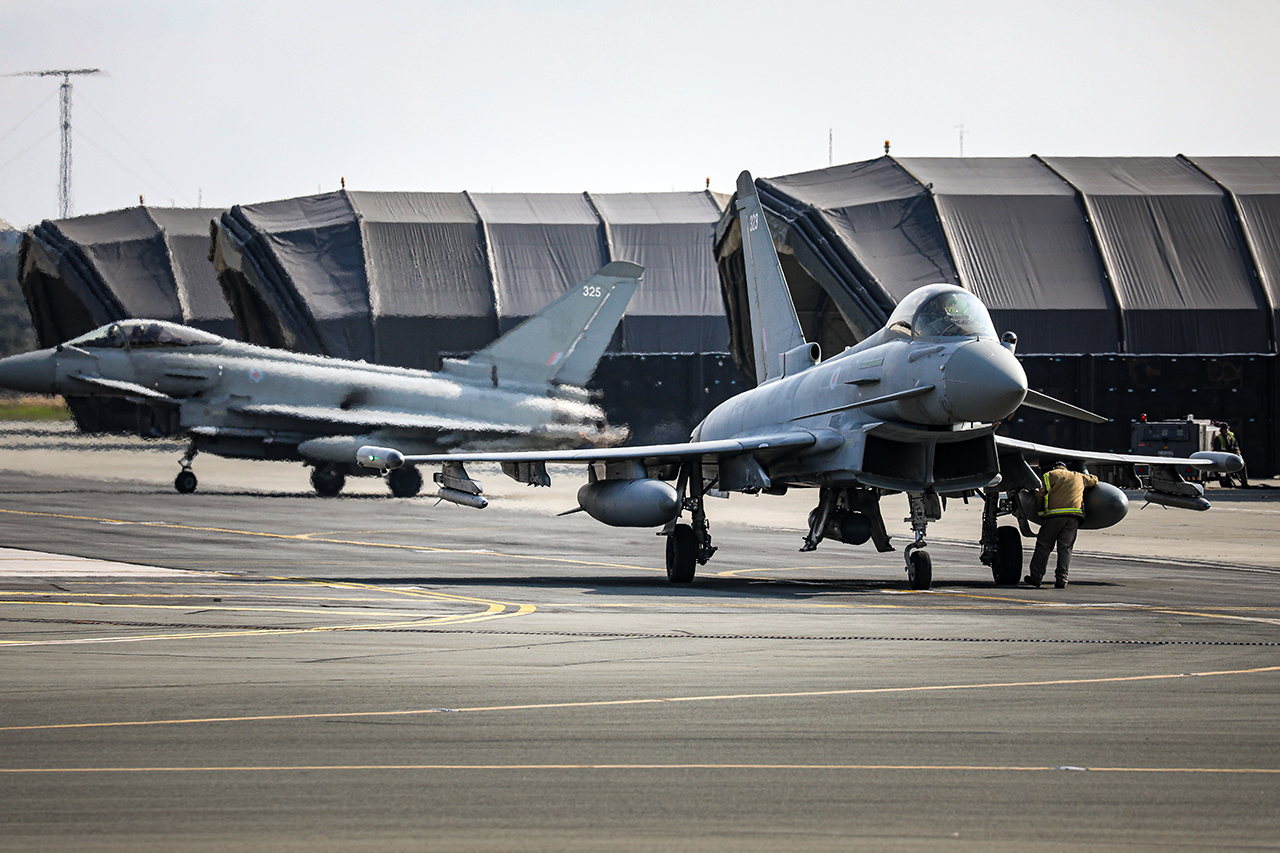
RAF Akrotiri already hosts 10 Typhoon FGR4s and has had a continuous fighter presence since 2014 as part of Operation Shader. During the Iranian strike on Israel in 2024, Typhoons flying from Akrotiri engaged and destroyed at least three Iranian drones.
Essentially acting as a permanent aircraft carrier in the Eastern Mediterranean, the base exists as part of a British Overseas Territory and the UK maintains full sovereignty – mitigating the need for a foreign nation to sign off on any potential actions. Alongside RAF fighters, the base also provides a home for deployed Protector RG1 drones, transport and refueling aircraft, and intelligence, surveillance, and reconnaissance (ISR) aircraft. A U.S. Air Force U-2 detachment additionally flies from the base. Whenever UK reinforcements are required in the Middle East, Akrotiri is frequently one of the first ports of call.
As a fixed location, though, unlike an aircraft carrier it is more vulnerable to attacks by hostile actors. Akrotiri is well within the range of Iran’s more capable missiles but the UK’s shortfall of ground-based air defence capabilities mean that protection is limited to the deployed fighter aircraft alongside any suitably equipped Royal Navy ship that may be present in the region (currently none).
The F-35B in UK service still lacks the RAF’s potent long range Meteor air to air missile, but is capable of carrying the highly regarded infrared-guided Advanced Short Range Air to Air Missile (ASRAAM) externally as well as AIM-120 AMRAAMs internally.
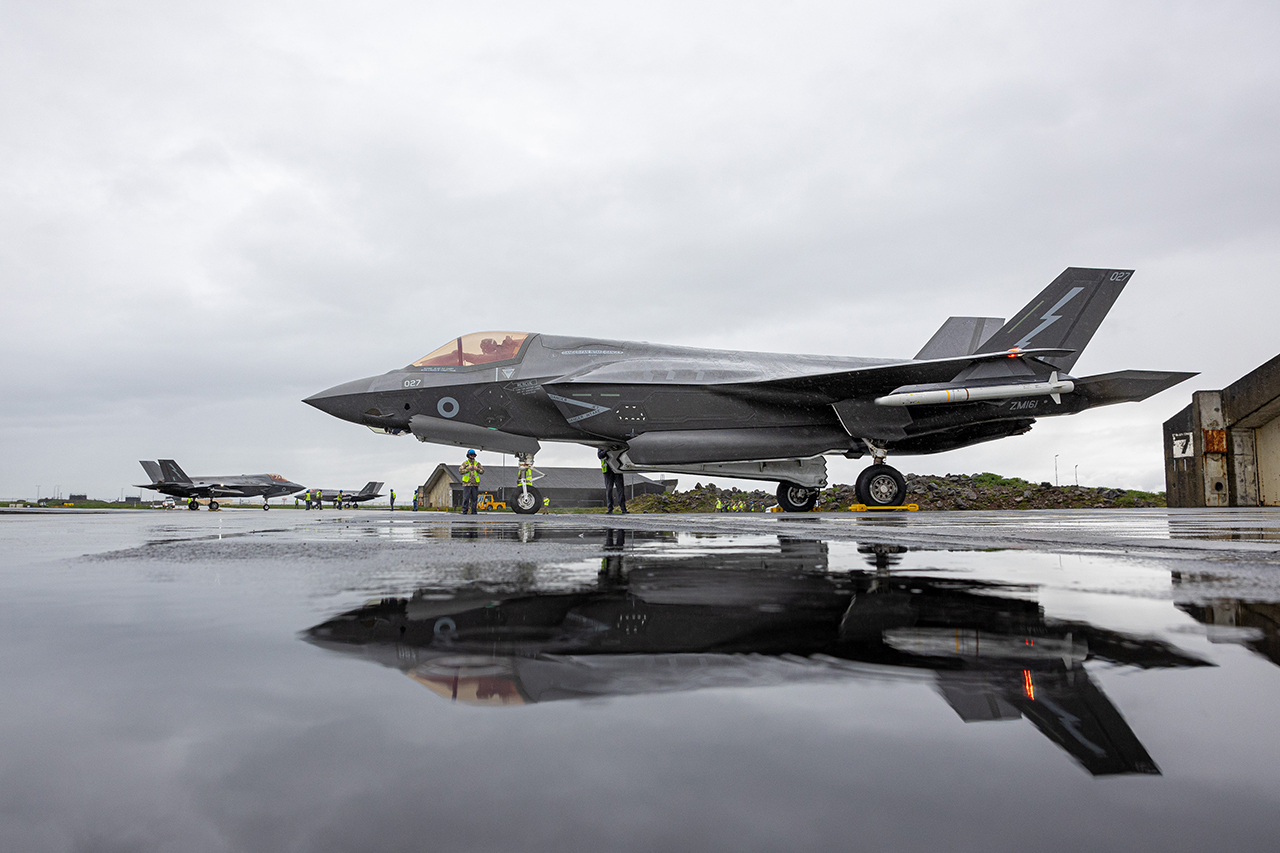
Though the F-35B can’t compete with the Typhoon for the number of these weapons able to be carried on each sortie, nonetheless a force of six aircraft does still increase the total number of available aircraft and available weapons that can be in the air. Indeed, when deployed on board the Queen Elizabeth class aircraft carrier air defence is one of the F-35B’s most consistent roles, and the UK F-35 force has conducted air policing deployments. Compared to the Typhoon as it is presently equipped, the F-35B adds a significantly more advanced active electronically scanned array (AESA) radar capability in the form of the AN/APG-81. An AESA upgrade for the RAF’s Typhoons is in the works but is yet to be rolled out.
Further into the Middle East, 12 Squadron – a joint UK-Qatar unit – has deployed four Typhoons at to Qatar at the Qatar Government’s request for ‘defensive purposes’. These jets notably arrived in Qatar with a full load of eight air to air missiles. With an existing commitment of jets already at Akrotiri plus twelve jets in the U.S. for Red Flag, alongside the 24/7 quick reaction alert tasking, the RAF’s Typhoon fleet currently has little spare capacity. The deployment additionally gives the F-35B crews from Marham some experience on a frontline, land-based tasking after 2025 saw the fleet focused on the Carrier Strike Group 25 deployment.
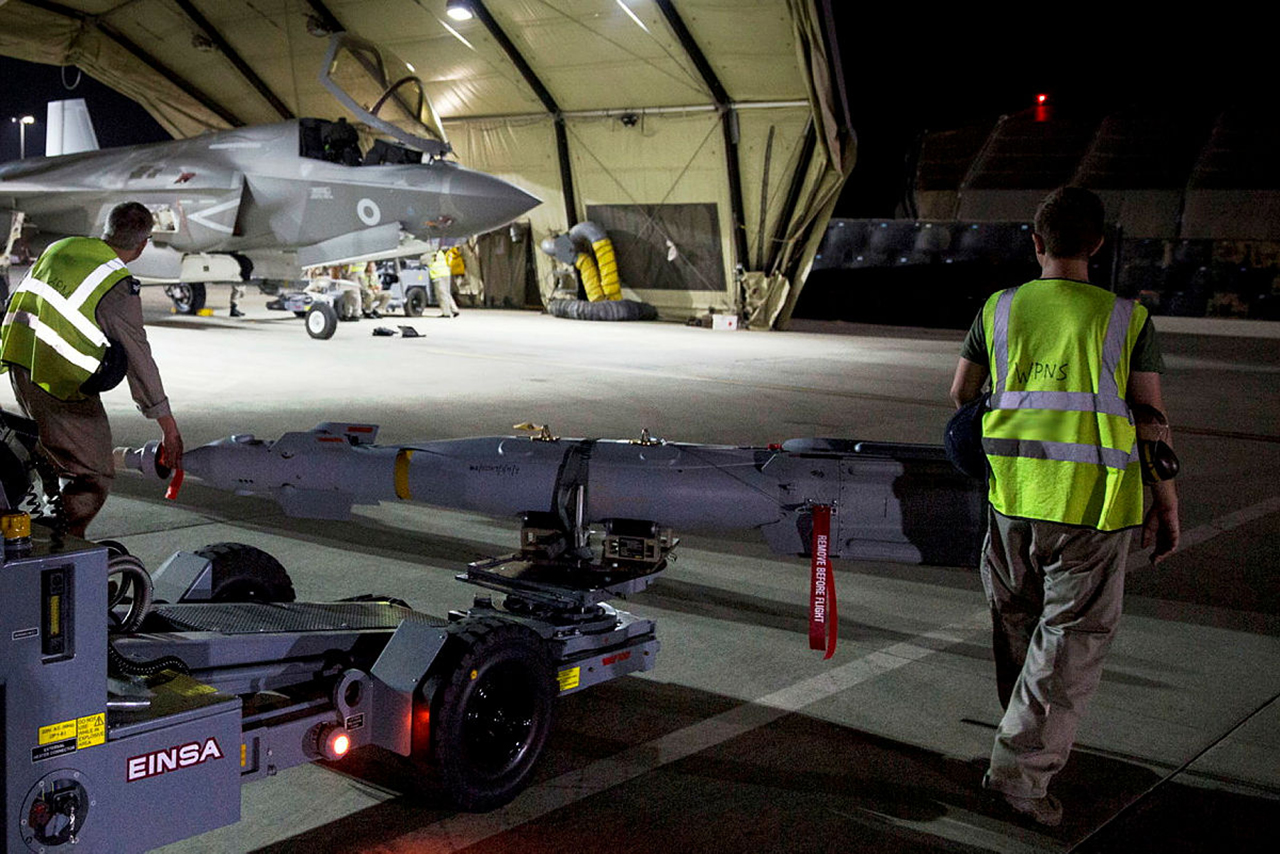
The last time the UK’s F-35Bs deployed to Akrotiri was in 2019 for Exercise Lightning Dawn, simultaneously seeing the force debut in combat over Iraq and Syria. The UK’s Lightning force is formed of both Royal Air Force and Royal Navy personnel, each squadron containing members of both regardless of the squadron’s own lineage. Active frontline squadrons currently include 617 Squadron RAF and 809 Naval Air Squadron, with 207 Squadron RAF acting as the Operational Conversion Unit (OCU) and 17 Squadron RAF – based in the U.S. – as the Operational Evaluation Unit (OEU).
U.S. Buildup
Whether these British deployments signify any belief on the UK Government’s part that a U.S. operation against Iran is forthcoming in the short term is unclear. Rather than having this additional intelligence, the moves may have been coordinated as a preemptive measure. It’s no secret that the U.S. has been building up its forces around Iran, both with publicly announced deployments as well as more discreet ones.
Lots of understandable conjecture over the recent deployment of @RoyalAirForce combat aircraft to the eastern Mediterranean and Middle East. Not all deployments are aimed at immediate operational effect: reinforcement, reassurance & messaging are usually the first reasons.🧵1/8 https://t.co/R6vk6hOJeO
— Greg Bagwell (@gregbagwell) February 7, 2026
LATEST: Updates on the U.S. military buildup in the Middle East
U.S. Air Force
• Roughly 110 C-17 transport flights, 5 flights by C-5M Super Galaxy heavy-lift, and numerous C-130J/H flights have moved troops and equipment into the region.
• Up to 20 aerial refuelling… pic.twitter.com/23eNpFuk7j
— Egypt’s Intel Observer (@EGYOSINT) February 3, 2026
Some of these movements were hindered for a time by an incident at Morón Air Base, Spain, which saw a U.S. Air Force KC-46 abort takeoff while running at speed down the runway, apparently due to engine troubles. Reference was also made to all eight tires having burst, though this was likely a deliberate blast deflation by the thermal fuse plugs in each wheel that are designed to ensure a relatively safe, controlled failure should the tires exceed their design pressure and/or temperature.
The aircraft, with blown tires, was subsequently stuck on the runway and caused major disruption to the airfield – a frequent stopover for U.S. forces moving into the Mediterranean.
KC-46 20-46073 “GOLD71” still sitting on the runway as of today at Morón. pic.twitter.com/4hThGAtdBS
— Santi Blánquez (@SantiBlanquez) February 3, 2026
Morón AB – LEMO still NOTAM’d closed until the 6th. GOLD 71 shelled engine and blew 8 tires. The KC-46 does not have thrust reversers. https://t.co/GZcAyhd32v pic.twitter.com/F8ImJGqgc6
— Thenewarea51 (@thenewarea51) February 2, 2026
GOLD 71 was, as indicated by its callsign, operating a Coronet flight. Coronet is a term used by the U.S. to identify movements of aircraft over long distances supported by the constant presence of air to air refueling aircraft. In this case, GOLD 71 was supporting a force of Vermont Air National Guard (ANG) F-35As crossing the Atlantic towards the Mediterranean.
One of the six F-35As🇺🇸 from the Vermont ANG departing Lajes yesterday, now at Rota🇪🇸. Credit to Island Aviation Terceira Azores, his video at Link: https://t.co/dkGQ345oI4 pic.twitter.com/GJk196B3uE
— Saint1 (@Saint1Mil) February 1, 2026
Notably, these Vermont ANG aircraft had previously been deployed to Puerto Rico and played a part in Operation Absolute Resolve – the U.S. mission that captured Venezuelan President Nicolas Maduro.