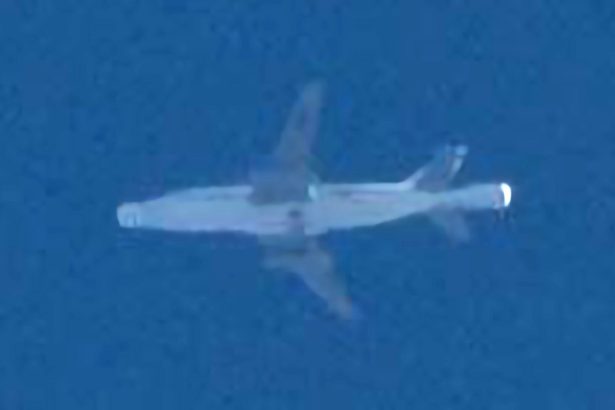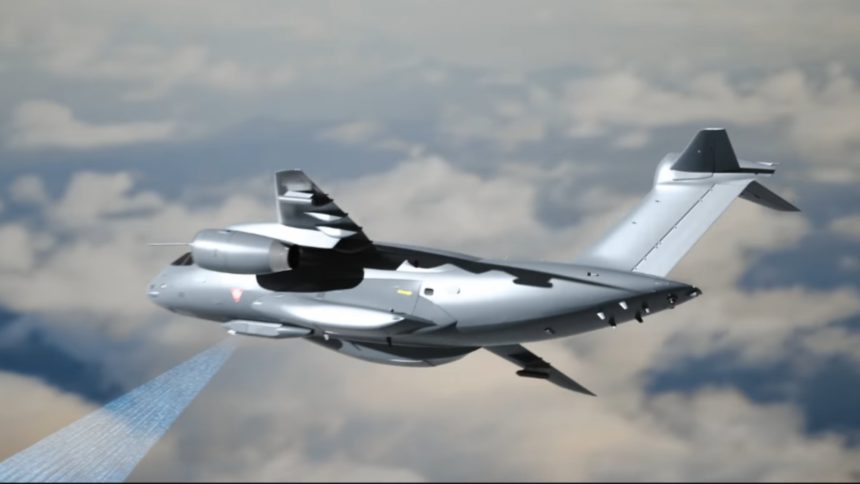
Israel’s Elbit Systems has shown a concept of a specialized variant of the C-390 Millenium for ISR and SIGINT at the Singapore Airshow.
Israeli defense company Elbit Systems has revealed at the ongoing Singapore Airshow it is working on an Intelligence, Surveillance and Reconnaissance (ISR) and Signals Intelligence (SIGINT) version of the Embraer C/KC-390 Millenium cargo aircraft. Aviation Week further published an image of a small scale model at the exhibition and quoted Elbit officials in deep background saying the company is “pursuing the market to use the Embraer C-390 as an airborne intelligence platform.”
Also, during the airshow on Feb. 3, Embraer announced that South Korea’s first C-390 “reached the final stage of its assembly process,” and also identified Uzbekistan as one of the previously undisclosed buyers of the aircraft. Including Brazil, the C-390 is also used by Sweden, Portugal, Czech Republic, Lithuania and Hungary, while future customers are the Netherlands, Slovakia and Austria. The addition of South Korea and Uzbekistan brings the total number of C-390 users to 11.
At the 71st anniversary of the @fap_pt (🇵🇹), the air demonstration of the @embraer KC-390 revealed the official deployment of 2x @ElbitSystemsLtd wing tip electronic warfare pods. pic.twitter.com/ZpSY5iHxum
— SA Defensa (@SA_Defensa) July 4, 2023
Elbit’s airborne intelligence and maritime patrol missionized C-390
While Elbit executives did not reveal the potential buyer of the new variant, the report said the model showed the SIGINT concept has an electro-optical/infrared (EO/IR) ball turret and electronic warfare systems. Both the video and the photo of the model published by Aviation Week also show the presence of a pod installed under the chin, which resembles the MS-110 Multispectral Airborne Reconnaissance System.
The EO sensor could be either one of the turret-like structures on the fairing housing the port (left-side) landing gear. Multiple fin antennas are also visible, likely related to the EW/SIGINT suite, as well as Communications and Electronic Intelligence (COMINT/ELINT).
Elbit has worked on the C-390 before, installing its electronic countermeasures (ECM) and self-defensive missile, radar and infrared warning sensors on Portuguese C-390s after a 2019 order, and is on contract since Dec. 10, 2024 for future Dutch and Austrian C-390s.
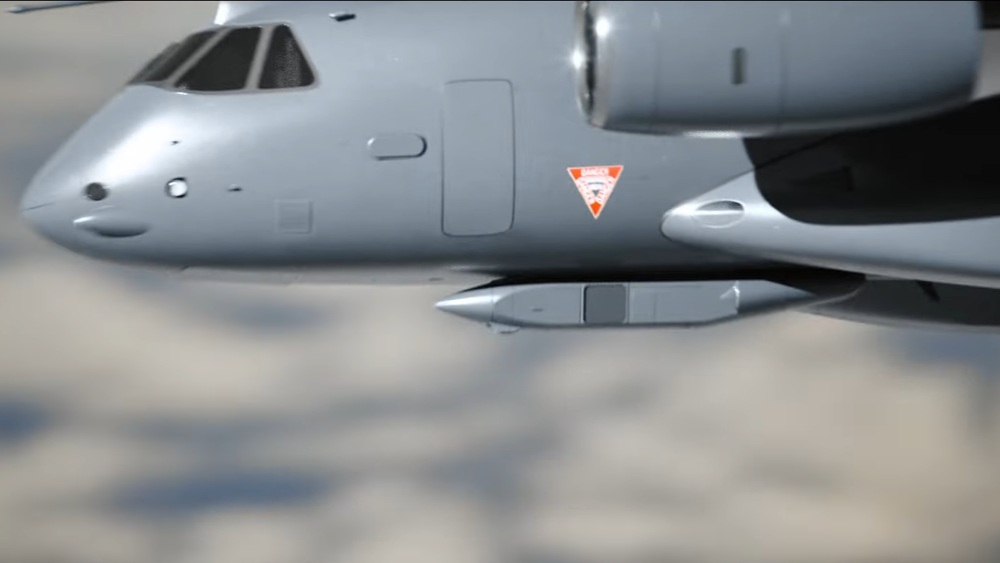
Elbit recently portrayed the C-390 in a maritime scenario in a concept video published on Jan. 13, 2026, where the aircraft was acting as a component of an integrated naval sensing, detection, tracking, communication, electronic warfare network. The missionized C-390 is shown working in concert with friendly surface combatants, Unmanned Surface Vessels, and long-endurance ISR drones in destroying hostile USVs, shore-fired anti-ship missiles and enemy drone swarms.
The January Elbit video also shows the aircraft carrying the SPEAR Advanced Electronic Counter-Measures (AECM) pods under the wings. We had reached out to both Embraer and Elbit in January regarding the concept video and, recently, about the Singapore Airshow unveiling for more details, and will update this story when we receive a response.
It is possible that the January rendition could be loosely related to the SIGINT, ISR and EW concept revealed at the Singapore Airshow. The slight divergences in the sensor configuration and outfitting would be presumably frozen until the company identifies a potential customer.
📍#Brazil (🇧🇷)@embraer & @fab_oficial have signed agreements today in collaboration on developing the C-390 in the ISR role, with a special emphasis on maritime patrol.
The project has also gained the name C-390 IVR. https://t.co/lccpuKVK0Q pic.twitter.com/OB4tbUJEhg
— SA Defensa (@SA_Defensa) December 3, 2024
Interestingly, the Brazilian Air Force (Força Aérea Brasileira – FAB) and Embraer have been working together since 2024 to develop a dedicated Maritime Patrol Aircraft (MPA) version, designated the C-390 IVR.
Elbit’s EW and self-protection suites
As mentioned earlier, Elbit announced on Oct. 31, 2019, that it had been contracted by Portugal in a $50 million award to integrate its complete ECM and self-protection suite on the Portuguese Air Force’s (PtAF) KC-390s. Elbit at the time had said it included the complete EW suite, comprising “radar and laser warning systems, IR Missile Warning System, Countermeasures Dispensing System, a Directional IR Countermeasures (DIRCM) system and Active ECM (AECM) POD system.”
Bekannt und auf jeder Airshow geschätzt sind die Flare-Selbstschutz-Systeme.
Sie sollen die Erfassung erschweren oder unterbrechen. Gegen echte High-Tech-Raketen komme sie aber an ihre Grenzen.
Es geh aber noch besser…viel besser…🤓
2/5 pic.twitter.com/8x2aPeXKDJ
— Martin Rosenkranz🇦🇹🇪🇺🇺🇳🇺🇦🇮🇱 (@MartinRosenkra3) December 10, 2024
The work was to be completed over a five-year period, and by Jul. 5, 2023, images emerged of the official deployment of the two pods in an aerial demonstration. Then, on Dec. 10, 2024, Elbit announced two contracts with two unnamed European nations, collectively valued at $175 million, which included Self-Protection Suites for the C-390 aircraft of one European nation, and an “Advanced EW suite” for the C-390 of another European NATO member. Observers concluded these nations to be the Netherlands and Austria.
DIRCM-Systeme entdecken die IR-Signatur des Raketenmotors.
3/5 pic.twitter.com/Fx7qhCnvwm
— Martin Rosenkranz🇦🇹🇪🇺🇺🇳🇺🇦🇮🇱 (@MartinRosenkra3) December 10, 2024
Elbit went on to identify the EW system as its SPEAR AECM pod, “which can be easily installed and transferred between aircraft on the flight line.” It listed the self-protection systems as the “Digital Radar Warning Receiver, IR Missile Warning System (MWS), Laser Warning System (LWS), Countermeasure Dispenser System (CMDS), and the MUSIC family DIRCM System.”
Elbit’s J-MUSIC DIRCM system, part of the MUSIC family of sensors that disrupt the seeker heads of incoming missiles with directed energy, also equips part of Germany’s A400Ms. The Luftwaffe (German Air Force) received its first aircraft equipped with the system in September 2025.
Weitere Bestandteile des Kits sind Radar-Warnempfänger, Laser-Warnempfänger sowie der “SPEAR” Pod für elektronische Gegenmaßnahmen (“Jammer”).
Das Selbstschutzsystem ist also in der Lage eine Vielzahl von Bedrohungen aufzuspüren, zu analysieren und abzuwehren.
5/5 pic.twitter.com/sIqpxqzIxO
— Martin Rosenkranz🇦🇹🇪🇺🇺🇳🇺🇦🇮🇱 (@MartinRosenkra3) December 10, 2024
Uzbek and South Korean C-390s
Meanwhile, on Feb. 3, after identifying Uzbekistan as a new C-390 customer that it had previously not disclosed, Embraer said it is the first country in Central Asia to become the Millennium’s operator, validating its success in the “military transport market segment.” Neither Embraer nor reports from Uzbekistan specify the number of airframes the country has sought.
The first Dutch 🇳🇱 pilots & loadmasters successfully completed their #C390 training today at the Portuguese AF 🇵🇹 Sqn506, marking the 1st step in introducing RNLAF’s successor to the @LockheedMartin C130. 1st/5 🇳🇱 C390s will be received in late 2027
📷 @Kon_Luchtmacht pic.twitter.com/cmLOC1BpPI
— Paulo Mata (@ironbirdphotos) February 3, 2026
“We officially welcome the Republic of Uzbekistan to the group of C-390 operators as the Uzbekistan Air Force modernizes its transport capabilities”, said Bosco da Costa Junior, President and CEO of Embraer Defense & Security. The same day Embraer also announced the first of Republic of Korea Air Force’s (RoKAF) C-390s reaching the final stage of assembly, prior to “production flights before the integration of specific systems.”
NOTÍCIA | Embraer apresenta o primeiro C-390 Millennium da Força Aérea da República da Coreia. Leia notícia completa: https://t.co/R5sag0PsEE pic.twitter.com/9V1sT2yqMr
— Embraer (@embraer) February 3, 2026
Embraer was chosen in 2023 after competitive bidding for the RoKAF’s Large Transport Aircraft (LTA-II) program for three aircraft, as we reported at the time here at The Aviationist. making it the first customer in the Asia-Pacific region. Embraer also has partnerships with local South Korean firms Aerospace Technology of Global (ASTG), EM Korea (EMK), and Kencoa Aerospace to manufacture spares and components.