During a recent mission, Spanish Air Force F-18M Hornets intercepted a Russian Naval Aviation Su-30SM2 carrying an unusual loadout for operations over the Baltic region.
On Jan. 28, 2026, the Spanish Ministry of Defense released details about an interesting mission carried out by Spanish Air Force EF-18M (or F-18M) aircraft deployed to Šiauliai, Lithuania, in support of NATO’s Baltic Air Policing (BAP) mission in the Baltic Sea region.
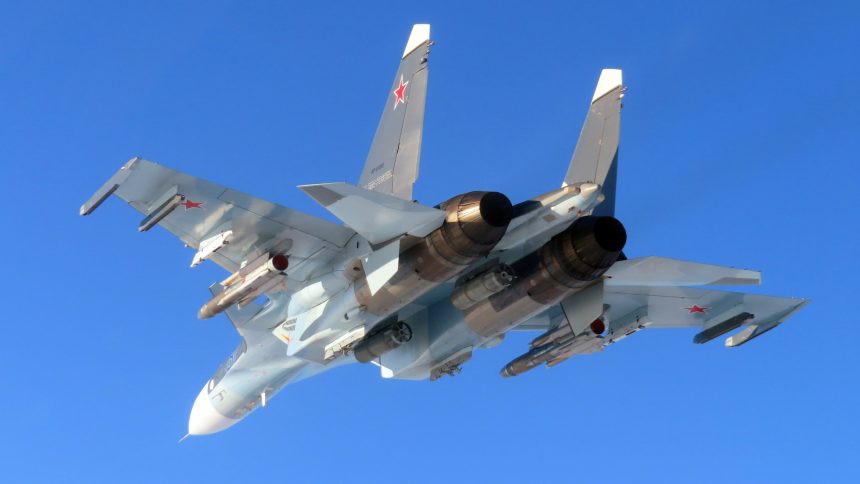
The Spanish Hornets, belonging to Ala 15 and operating as part of DAT (Tactical Air Deployment) Vikas, intercepted an unspecified number of Russian combat aircraft flying over international waters near NATO airspace. Based on the photos released by the Spanish MOD, one of the Russian jets was a MA VMF (Russian Naval Aviation) Su-30SM2.
Defense analyst and expert on Russian military aviation Guy Plopsky noted that the airframe, Bort No. “81 Blue” / RF-81885, is assigned to the 4th Guards Composite Aviation Regiment (SAP) at Chernyakhovsk AB, in Kaliningrad Oblast.
A very clear photo taken from a Spanish Hornet showing an MA VMF Su-30SM2 (Bort No. “81” Blue / RF-81885) assigned to the Kaliningrad-based 4th SAP. It is seen here armed with a pair of Kh-31A anti-ship or Kh-31P/PK anti-radiation missiles and two RBK-500 series cluster bombs. https://t.co/692IIc4AAG pic.twitter.com/XVozsrfvRk
— Guy Plopsky (@GuyPlopsky) January 29, 2026
While Su-30SM aircraft are common visitors to international airspace over the Baltic region, what makes this intercept particularly noteworthy is the aircraft’s peculiar loadout. The Su-30SM was carrying a pair of Kh-31A anti-ship or Kh-31P/PK anti-radiation missiles, along with two RBK-500 series cluster bombs.
“If the Kh-31s were the anti-ship variant, this would represent one of their maritime strike loadouts. If they were the anti-radiation variant, then this would be one of their SEAD/DEAD loadouts,” Plopsky told us.
A payload combining cluster bombs with either anti-ship or anti-radiation missiles has been observed multiple times in the Black Sea region, where Russian Su-30SMs assigned to the 43rd Independent Naval Attack Aviation Regiment (43rd OMShAP) have employed cluster bombs against Ukrainian USVs (Unmanned Surface Vessels).
1/ A still image from a newly released Russian MoD video showing an MA VMF Su-30SM assigned to the Black Sea Fleet’s 43rd OMShAP. The multirole fighter is seen armed with two R-77-1 medium-range air-to-air missiles and two RBK-500-series cluster bombs. pic.twitter.com/4rnQ26V5Jz
— Guy Plopsky (@GuyPlopsky) September 23, 2024
A Russian Naval Aviation (MA VMF) Su-30SM2 (B/N “86” Blue) multirole fighter, seen here armed with a single Kh-31PM anti-radiation missile (ARM) or Kh-31AD anti-ship missile (AShM) and what appear to be a pair of RBK-500 series cluster bombs. https://t.co/gQUgcbYoRF pic.twitter.com/dbi35ngcZx
— Guy Plopsky (@GuyPlopsky) February 27, 2025
Russian Sukhoi Su-30SM fighter jet flying at low altitude drops an unguided aerial bomb with cluster warhead on a Ukrainian unmanned surface vessel (USV) in the Black Sea waters.
Pretty unorthodox way of combating USVs. pic.twitter.com/JnxlAK1ifk
— Status-6 (War & Military News) (@Archer83Able) January 28, 2026
But this is the first confirmed time the same loadout is seen in the Baltic region. It is unclear whether the Russian multirole aircraft was conducting a show of force or a routine patrol, flying a training sortie, or transiting on a ferry flight to or from mainland Russia.
It is also worth noting that, around the same timeframe, Russia’s state-owned TASS news agency reported that Baltic Fleet naval aviation fighters and bombers had taken part in scheduled exercises involving precision strikes against ground targets. According to the report, crews of Su-30SM2 multirole fighters and Su-24M frontline bombers practiced fire support missions, aerial reconnaissance, and precision bombing at a training range in the eastern part of Kaliningrad Oblast, using OFAB-250-270 high-explosive fragmentation bombs, while also rehearsing combat maneuvering and evasive actions against simulated enemy fighters and air defense systems.
While the Russian Navy has not directly linked the intercepted Su-30SM2 to those drills, the TASS report raises the possibility that the aircraft observed over the Baltic Sea may have been operating in connection with, or as part of, a broader exercise activity rather than a standalone patrol or show of force mission.
In any case, the sighting is really interesting.
Tactical Air Detachment (TAD) “Vilkas”
TAD “Vilkas”, Lithuanian for “wolf”, is a Spanish Air and Space Force Tactical Air Detachment tasked with air surveillance and airspace protection on NATO’s eastern flank.
Since early December 2025, Spain has taken the lead of NATO’s Baltic Air Policing mission as part of Operation Persistent Effort. At the same time, TAD Vilkas has been operating under the enhanced Vigilance Activity (eVA) Eastern Sentry framework, which aims to strengthen defensive measures across the area of responsibility and prevent unidentified aircraft from approaching or violating Allied airspace. In doing so, the detachment contributes directly to NATO’s collective defense and, ultimately, to Spain’s own security.
The detachment includes around 200 personnel drawn from a wide range of units and specialties, from flight operations to logistics and force protection. It operates a fleet of twelve aircraft: eleven EF-18M Hornet fighters from Ala (Wing) 15 at Zaragoza and a single TK23 A400M transport aircraft from Wing 31, also based in Zaragoza. Altogether, this represents Spain’s largest air deployment to NATO’s eastern flank to date and highlights the scale and effectiveness of the Alliance’s air policing mission.
H/T Antonio Valencia (@AValencia_Alfa) for the heads up!