A newly released video shows RQ-170 Sentinels at Creech Air Force Base, offering also a rare size comparison with an MQ-9 Reaper and nearby pickup trucks.
Less than two weeks after the images and video of the mysterious ‘Dorito-shaped’ aircraft flying late at night near Area 51, Anders Otteson, the famous author of the popular Uncanny Expeditions YouTube channel, published a new interesting video, providing a close look at the RQ-170’s nest located at Creech Air Force Base, Nevada. The aircraft recently returned to the spotlight during Operation Absolute Resolve, when it provided overwatch as Venezuelan President Maduro was captured.
While U.S. officials did not explicitly name the RQ-170 among the assets which took part in the operation, videos showing the aircraft landing in Puerto Rico quickly emerged as the assets involved recovered. Almost a month later, on Jan. 29, 2026, Lockheed Martin’s CEO Jim Taiclet, during a quarterly earnings call , confirmed that the stealth drone was indeed involved in the Operation to capture Maduro.
The Video
As we explained in a previous report here at The Aviationist, Otteson routinely sets up camp in remote and scarcely known locations with the specific goal of documenting activity rarely seen by the public. In his most recent clip, Anders set up a position in public land near Indian Springs, on the south side of Creech AFB.
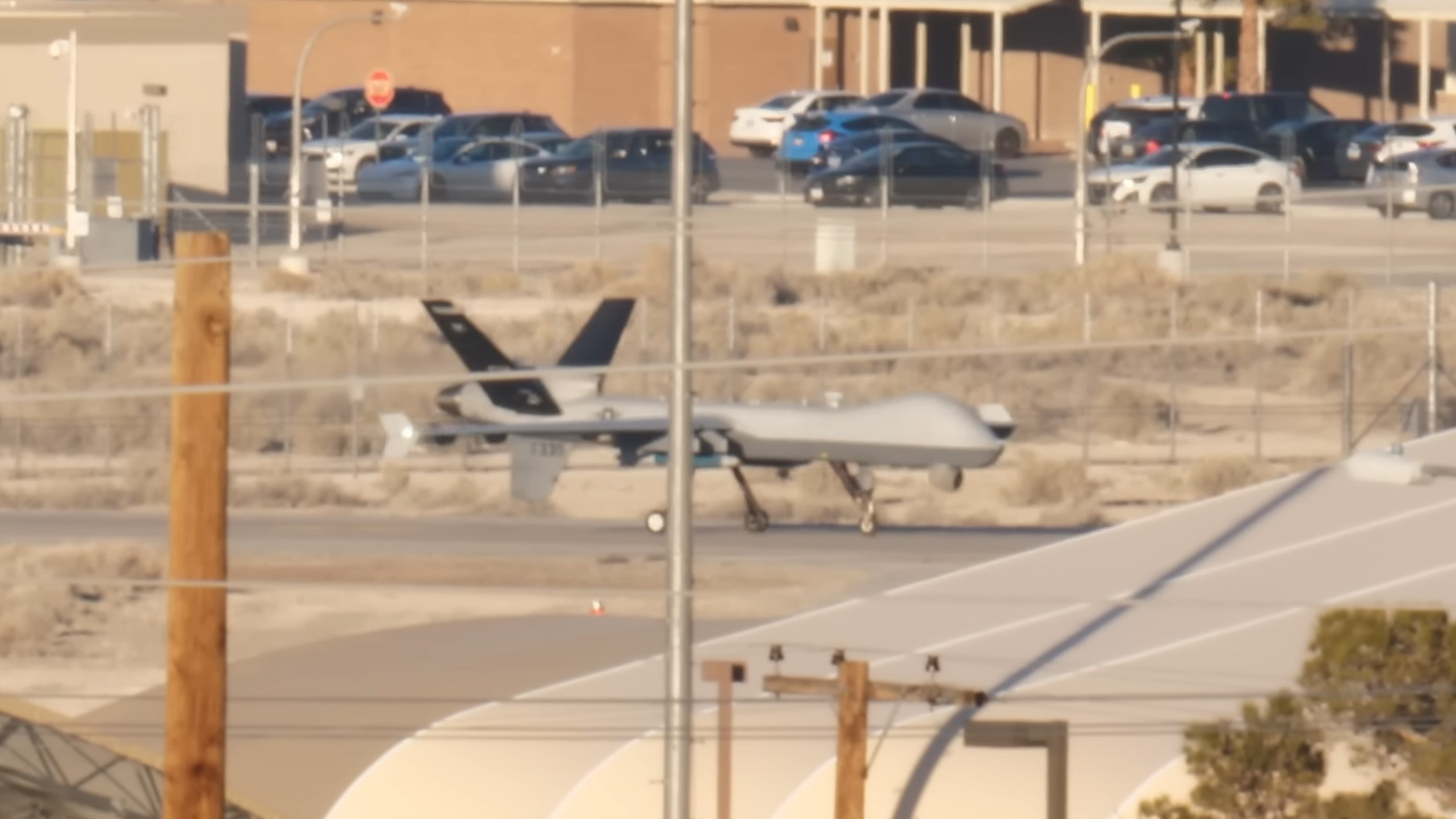
Multiple MQ-9A Reaper Remotely Piloted Aircraft (RPA) are immediately visible during ground operations. Creech is in fact home to the 432nd Wing, the first U.S. Air Force unit dedicated to unmanned aircraft, the base primarily hosts the MQ-9A Reaper.
It is therefore no surprise to see numerous Reapers preparing for flight or parked on the ramp while being attended by maintenance crews. Notably, the first MQ-9 observed had a black tail, repainted in 2023 to represent the Reaper Aircraft Maintenance Unit, and was also carrying an inert GBU-38 Joint Direct Attack Munition (JDAM) under its wing.
Creech makes ample use of the large training spaces provided by the Nevada Test and Training Range (NTTR). The position of the base, secluded and surrounded by high-security, restricted airspace, makes it ideal for a secretive platform: the RQ-170A Sentinel.
Official details about the RQ-170 are limited, but the fleet is estimated to comprise between 20 and 30 airframes. These are operated by the 30th and 44th Reconnaissance Squadrons, both assigned to the 432nd Operations Group of the 432nd Wing.
The existence of the “Beast of Kandahar”, as it was dubbed following the first sightings during a deployment in Afghanistan in 2007, was acknowledged by the U.S. Air Force for the first time in 2009. Nevertheless, the RQ-170 remains a highly elusive platform to this day. Needless to say, as one might expect considering Otteson was observing operations at the secretive drone’s home base, the RQ-170 made an appearance in the new video.
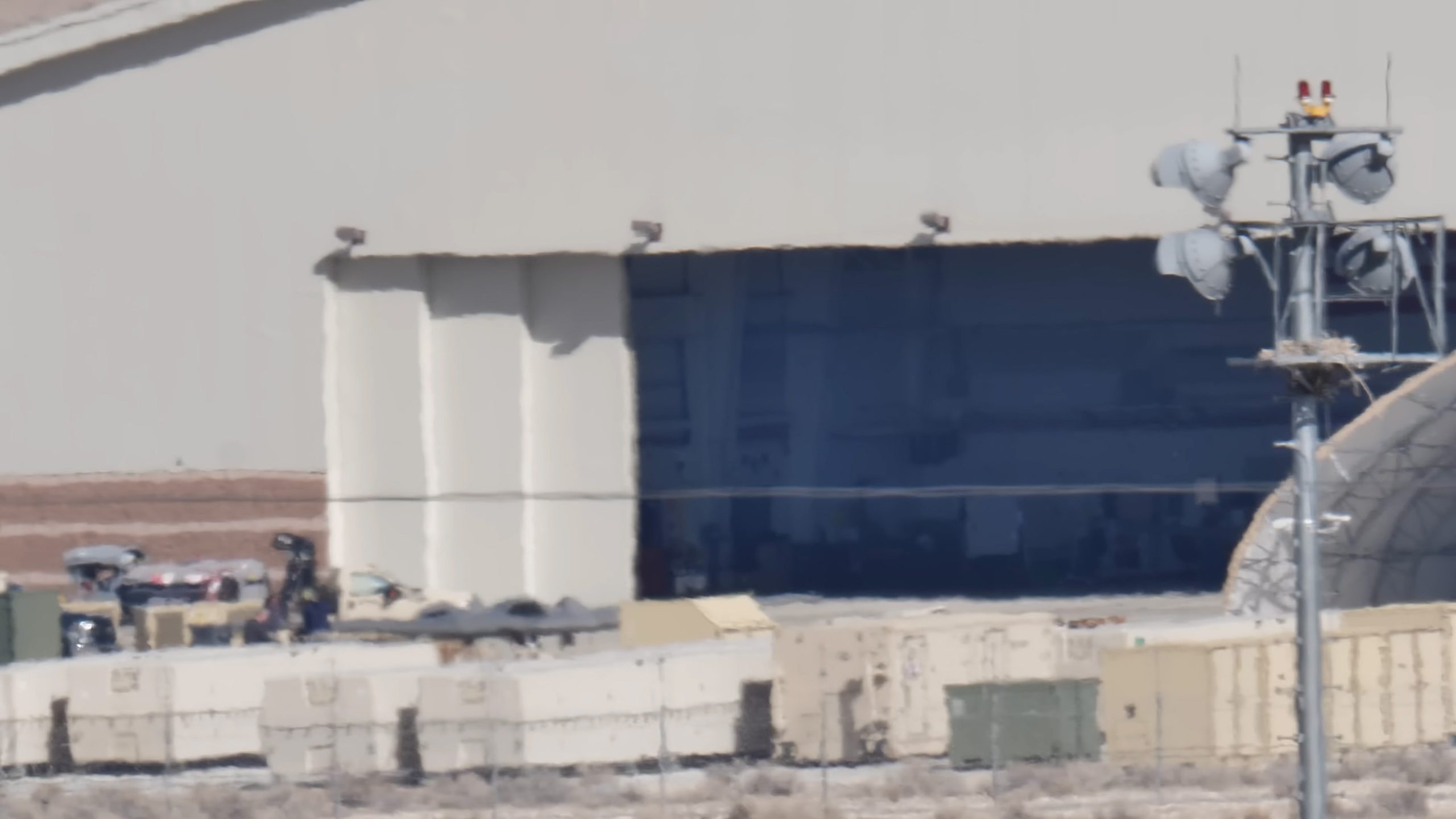
“I was watching the Reapers take off and land for most of the day from a hill on the other side of the highway from Creech,” Anders told us. “Later in the afternoon, I noticed that one of the large hangars behind the Reapers, on the north side of the base, was open and I could make out the slim profile of an RQ-170 out front. The crews working around it and the other aircraft really gave a good sense of scale as to how small the aircraft is.”
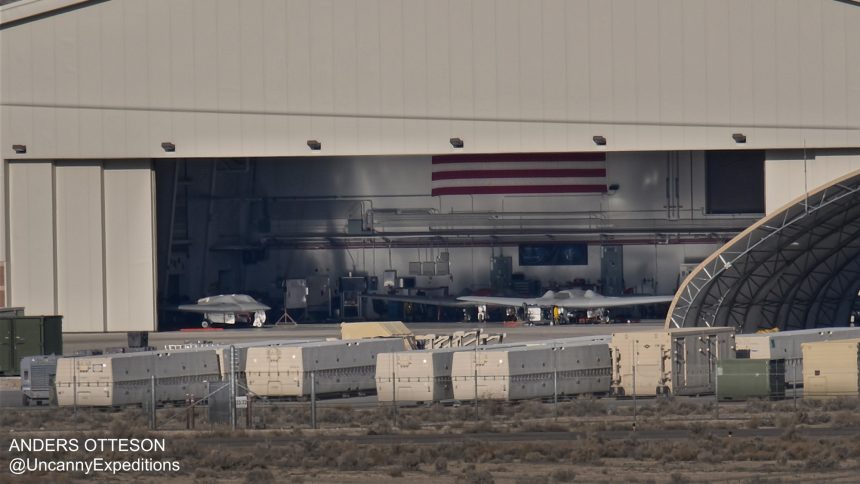
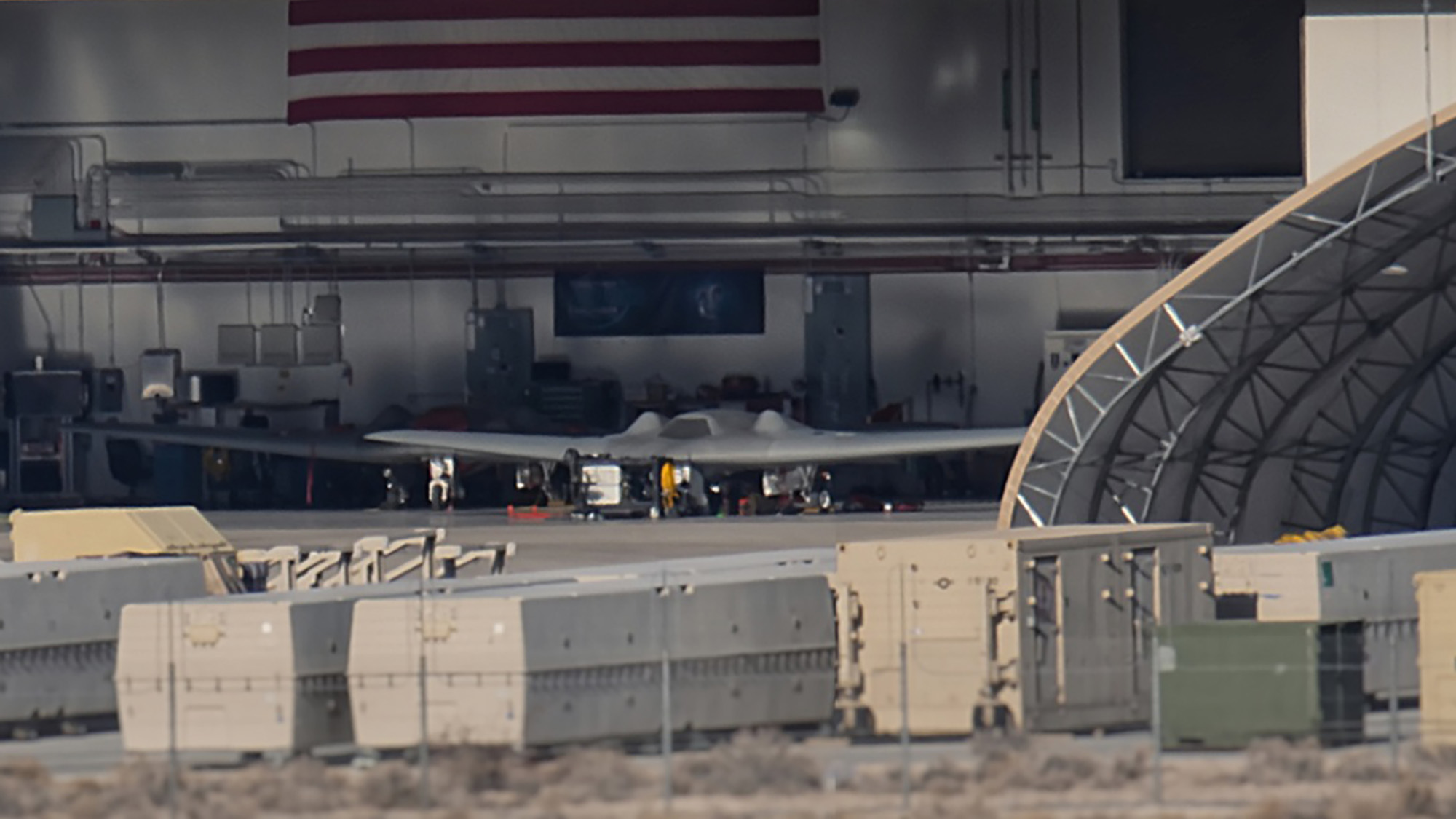
“Not long after, the second one landed and taxied over to the hangar. I hiked along the hills a bit to try and get an unobstructed view directly into that hangar and luckily I was able to see in for a few minutes while the lighting was good and the door was open. There were three RQ-170s inside,” he continues.
Notably, inside the hangar, a banner with the Skunk Works‘ logo can be seen on the wall, below the U.S. flag. In fact, the RQ-170 is one of the many advanced platforms built by Lockheed Martin’s secretive division.
A “Pocket-Size” Drone
The dimensions of the RQ-170 are among the unconfirmed details of this platform, with various figures available from different sources. The U.S. Air Force, which operates the unmanned aircraft, only published a brief fact sheet years ago, without including specifications.
The only official source so far appears to be a U.S. Army visual aircraft recognition training manual. This manual, dated May 2017, lists a length of 14 ft 9 in (4.5 m) and a wingspan of 65 ft 7 in (19.99 m).
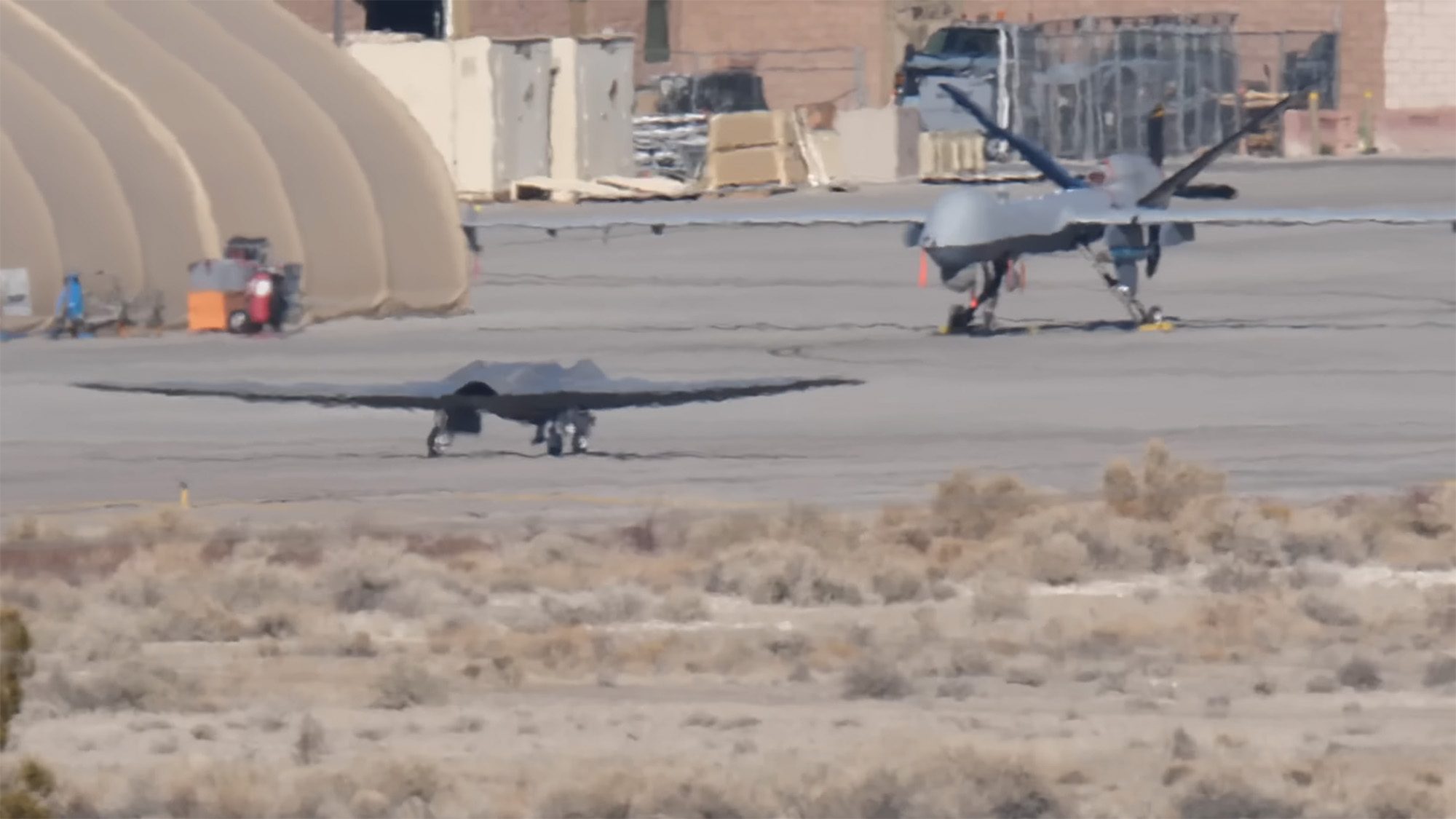
These dimensions would put the wingspan close to the MQ-9A’s, which is 66 feet (20.12 m). However, the proportions of the RQ-170 don’t match, pointing to a smaller wingspan, as confirmed also by satellite images of the RQ-170 beside an MQ-9 at Creech AFB, with estimates of 38 ft (11.58 m) which appear to be a closer match.
The different dimensions are easy to visualize in Ander’s video, starting from the close encounter on the taxiway where the RQ-170 and the MQ-9 faced each other. It can be clearly seen that the Sentinel’s wingspan is much shorter than the Reaper’s.
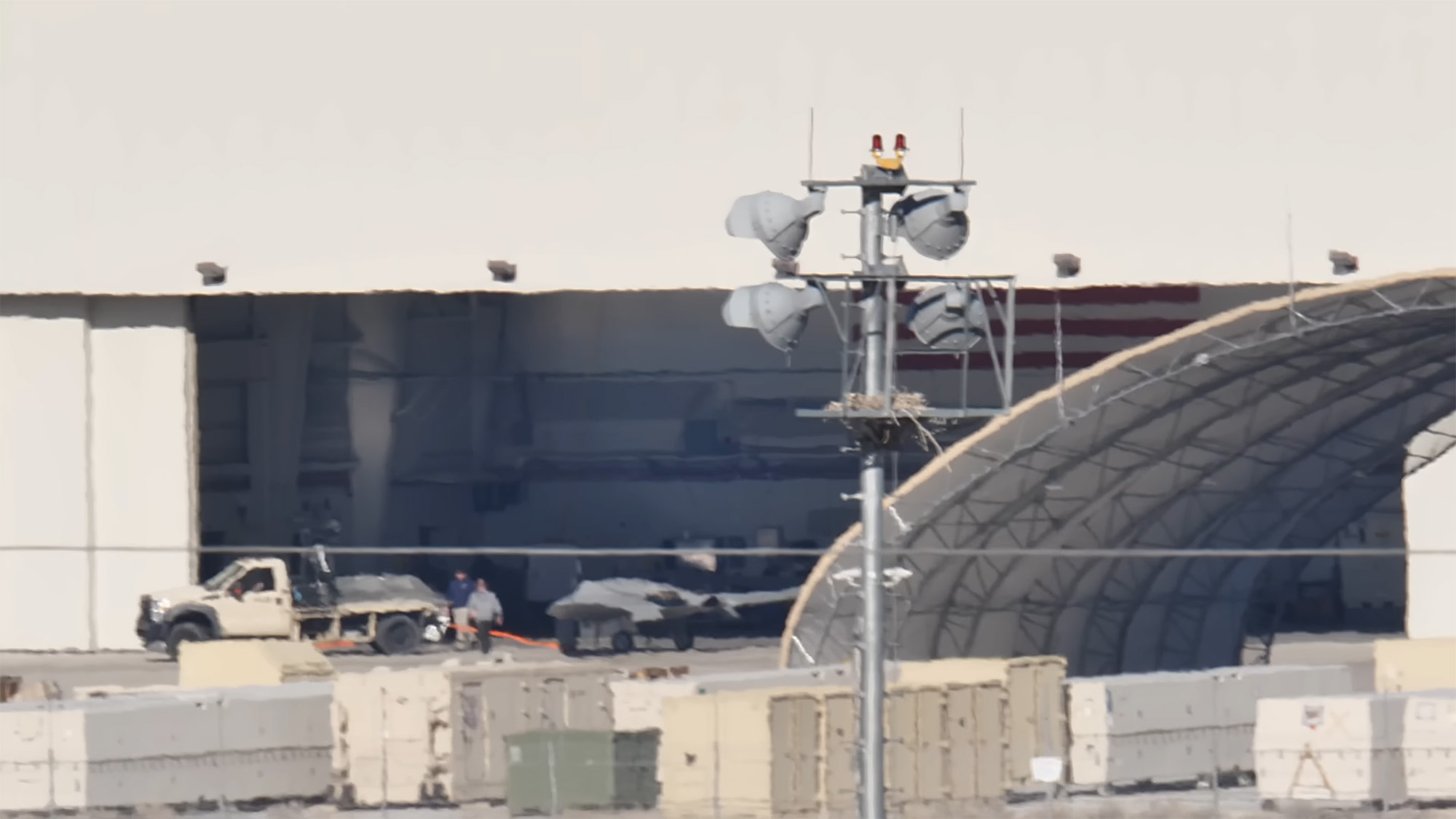
Another glimpse into the dimensions of the secretive aircraft can be caught as the drone is being attended by ground personnel during towing operations. A pickup truck can also be seen easily towing the aircraft, whose length appears comparable to the truck itself (possibly a Ford F250 Super Duty with a minimum length of 231.8 inch or 5.89 m).
As for the height, the personnel nearby help to get a good idea. Some estimates available online mention a possible height of about 6 ft (1.8 m), which appear to be largely correct, judging from the video.
Still in the Shadows Two Decades Later
Seen in this light, the newly released footage from Creech AFB adds an important piece to the still-fragmentary public picture of the RQ-170 Sentinel, a platform that has remained largely in the shadows since its first appearance nearly two decades ago. As we have detailed in several previous reports here at The Aviationist, the RQ-170 occupies a unique niche within the U.S. Air Force inventory as one of the first operational low-observable unmanned aircraft designed specifically for high-end intelligence, surveillance and reconnaissance missions.
Since the first sightings in 2007, the Sentinel has become emblematic of a generation of stealth UAVs that bridged the gap between conventional RPAs such as the MQ-9 Reaper and more advanced, still-classified systems like the RQ-180. Its flying-wing configuration, compact dimensions and low observability point to a design optimized for penetrating or closely monitoring contested airspace while minimizing the risk of detection, without the long endurance of the MQ-9 or the RQ-4.
Previous imagery which we covered here at The Aviationist have shown the aircraft operating from a small number of highly controlled locations far from public scrutiny, such as the NTTR and the Air Force Plant 42 in Palmdale, California. The new video is therefore valuable because it offers rare insight into the Sentinel’s physical scale, daily operations and coexistence with more familiar platforms like the MQ-9A Reaper.
While it does not reveal sensitive details which might be subject to operational security (OPSEC), the footage contributes to a more concrete understanding of a system that today still remains officially largely undocumented, yet continues to represent an important milestone in the evolution of stealthy unmanned aviation.
We strongly suggest our readers check out the Uncanny Expeditions YouTube channel to watch the full video as well as his other adventures. Make sure you also follow Anders on Instagram here.