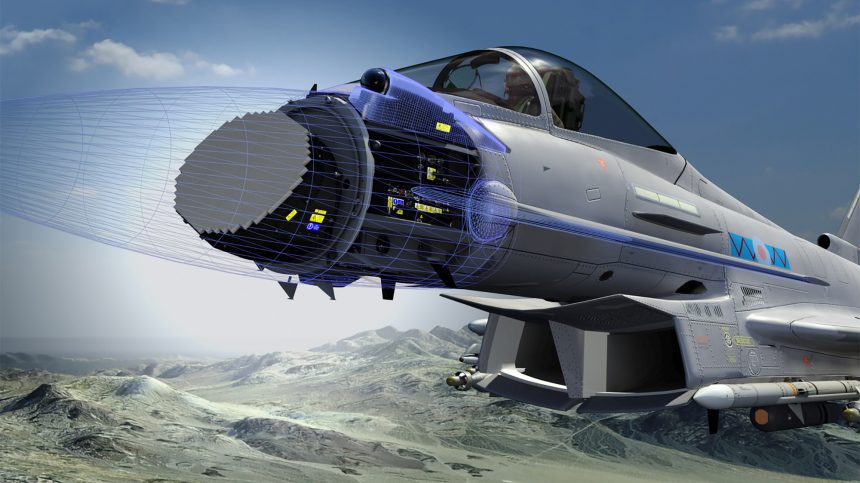
BAE Systems, Leonardo UK and Parker Meggitt have been awarded a £453 million contract for the supply of ECRS Mk2 AESA radars for RAF Typhoons, though at present only 40 jets will be upgraded.
The long awaited ECRS Mk2 contract award has come after many years of development, with the first Typhoon fitted with the new active electronically scanned array (AESA) radar taking to the sky in September 2024.
ECRS Mk2 (European Common Radar System Mk2) will replace the existing Captor-M radar, which is a mechanically scanned pulse doppler radar. Development of the ECRS Mk2 is led by BAE Systems and Leonardo UK, and the RAF is currently the only confirmed customer – though it seems likely Italy will also opt for this variant due to the involvement of Leonardo. Other operators use either the ECRS Mk0 (Kuwait and Qatar) or plan to use the ECRS Mk1 (Germany and Spain). These three separate, though related, designs are referred to collectively as Captor-E.
UK defence news as MoD awards BAE Systems £453.5m for full production of ECRS Mk2 AESA radar for 40 RAF Typhoons. Been a while coming but will deliver highly advanced radar & crucially, cutting edge EW/electronic attack capabilities to Typhoon fleet – bridging gap to GCAP #avgeek pic.twitter.com/WqF5zPTYWZ
— Tim Robinson (@RAeSTimR) January 22, 2026
Compared to the Mk1, the Mk2 includes much more refined electronic warfare (EW) and electronic attack (EA) functionality and provides the Typhoon with a sophisticated jamming capability without requiring any additional equipment. Using over 1,000 electronically steered transmit/receive modules, the radar can be directed to scan different sections of the sky or ground within milliseconds. The radar scan area can also be narrowed or widened as required, with an available steerable range in excess of 180 degrees.
The addition of an AESA radar will finally bring the Typhoon closer in line to its most direct competitor, the Dassault Rafale, which has had an AESA available in frontline service for over a decade. Many older U.S. aircraft, like the F-15 and F-16, have also received AESA radars in upgrade programs.
USAF is on track to complete its #F15 Radar Modernization Program in 2024. F-15 RMP replaces the F15E’s APG-70 radar with the APG-82v1 Active Electronically Scanned Array thus pure fleeting the F-15 (E & EX) enterprise with the more capable AESA radar. pic.twitter.com/NdiUsiIopv
— AirPower | MIL-STD (@AirPowerNEW1) October 27, 2023
40 of the RAF’s Typhoon FGR4s will be equipped with the new radar, all of them being the most recently delivered Tranche 3 aircraft. Whether a follow-on contract will see the radar roll out among the older but more numerous Tranche 2 aircraft is yet to be confirmed. Alternatively, there have long been strong campaigns endorsing a new order of Tranche 4 or Tranche 5 airframes for the RAF to bolster the UK’s combat air force and bridge the gap between the Typhoon and the forthcoming GCAP fighter. The small number of Tranche 1 aircraft still in service with 1435 Flight on the Falkland Islands would not be in line for an upgrade.
UK Secretary of State for Defence John Healey, who visited a Leonardo facility in Scotland alongside Douglas Alexander, Secretary of State for Scotland, to mark the contract award said: “Our Typhoon fleet is the backbone of UK and NATO air defence, operated across Europe by the Royal Air Force and our allies to protect our skies and security. As the threats we face increase, and as Russian drones continue to strike Ukraine and violate NATO airspace, this cutting-edge radar capability will keep Britain secure at home and strong abroad for many years to come.”
He added: “In Edinburgh and across the UK, we’re backing more than 20,000 skilled workers on the Typhoon programme who ensure our RAF remains ready to protect Britain. Our government has backed their high-skilled work with more than £650 million of investment this week alone, securing British jobs and making defence an engine for growth in Scotland and beyond. This massive workforce will be sustained for years following the biggest fighter jet exports deal in a generation, worth £8 billion which we secured with Türkiye in October.”
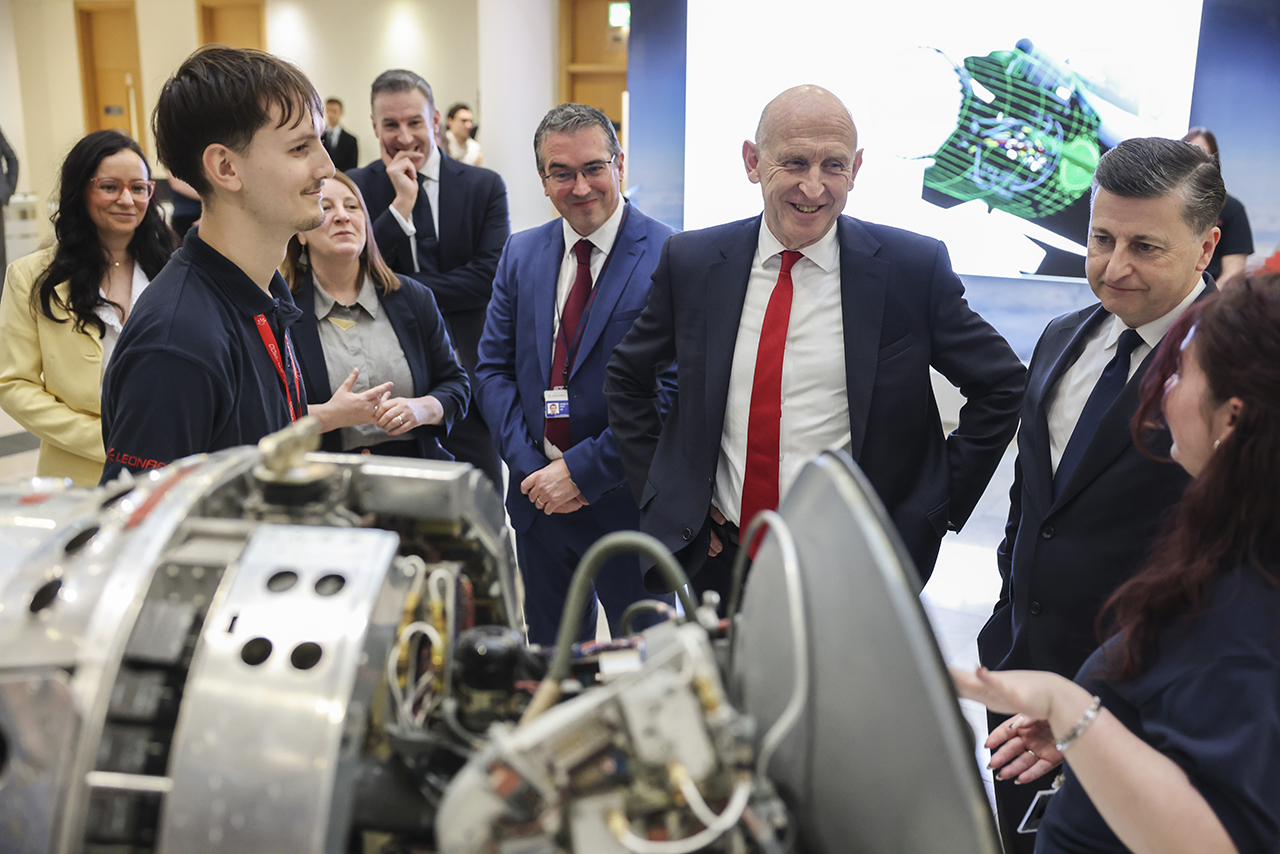
Alexander celebrated the fact Scottish industry is involved with the radar’s development and production, noting that it “shows just how vital Scottish expertise is to the UK’s national security and why Scotland is globally recognised as a centre of defence excellence”.
Mark Hamilton, Managing Director of Electronics UK, Leonardo, said: “ECRS Mk2 isn’t just an exceptional radar – it’s equipped with advanced electronic surveillance and electronic attack capabilities which will make RAF’s Typhoons more potent against their adversaries, adapting to new and unpredictable threats. This contract secures 300 highly skilled jobs at Leonardo’s Edinburgh site, and 100 at our Luton site. As well as supporting over 71 UK-based suppliers, we hope ECRS Mk2 will see wider adoption by other Typhoon export users given its advanced capabilities against current and future threats.”
Slow Pace
The contract award is expected but welcome news for Leonardo UK, who have stressed their ongoing frustrations with a lack of orders and contracts from the UK Government before the release of the delayed Defence Investment Plan (DIP). While the integration of the radar with the Typhoon is managed by BAE Systems, the radar components themselves are manufactured by Leonardo UK. Unfortunately, uncertainty over the New Medium Helicopter contract which would sustain Leonardo’s major helicopter manufacturing facility in Yeovil continues without any news.
Ultimately, the procurement of ECRS Mk2 has been a done deal for some time, and this new contract is simply another step along a road already partially traveled. Even as long as six years ago, contract awards of over £300 million to support the development of ECRS Mk2 were being celebrated. More recently, in 2023, the official RAF account marked an £870 million contract award.
An £870 million five-year contract awarded to @BAESystemsAir and @Leonardo_UK to upgrade radar capabilities on RAF Typhoons, fitting the fighter jets with one of the world’s most advanced radars – the European Common Radar System (ECRS) Mk2.
Full Story: https://t.co/nudpJmRtnh pic.twitter.com/gGw5N1IDDN
— Royal Air Force (@RoyalAirForce) July 4, 2023
The Typhoon’s mechanically scanned radar is overdue for replacement, and as such any step towards that goal is welcome, but it would be a mistake to see this contract as an example of upgrade work proceeding at a pace that is close to what would be required under what the UK Government has termed a ‘war footing’.
Long Term Support Contract
Adding to the sum of £453 million awarded for the ECRS Mk2 contract, a further £205 million was recently awarded to QinetiQ for a five-year contract extension providing long-term specialist engineering support for the Typhoon, including work to maintain and upgrade its weapon systems. Combined with the 1,300 jobs supported by the ECRS Mk2, this contract sees around 1,500 skilled jobs in total across the country sustained for years to come.
We’ve been awarded a five-year £205 million contract by the @DefenceHQ to deliver engineering services for the @RoyalAirForce ‘s Typhoon.
Find out more 👉 https://t.co/ILX0NljKeq
#RoyalAirForce #TyphoonAircraft #UKDefence pic.twitter.com/MXKtcc6m3I
— QinetiQ Group (@QinetiQ) January 19, 2026
Luke Pollard, Minister of State for Defence Readiness and Industry, said: “Our Typhoon fighter fleet is crucial in how we keep Britain secure at home and strong abroad, deploying across the world in support of our allies. Through our continued investment in the Typhoon programme and last year’s £8 billion Typhoon export deal with Türkiye, we are showing how defence is an engine for growth supporting prosperity across the country.”