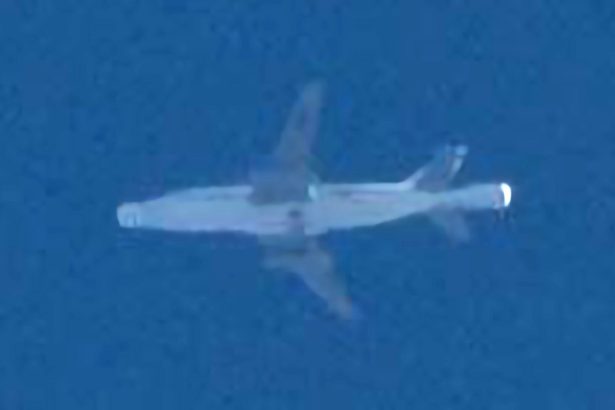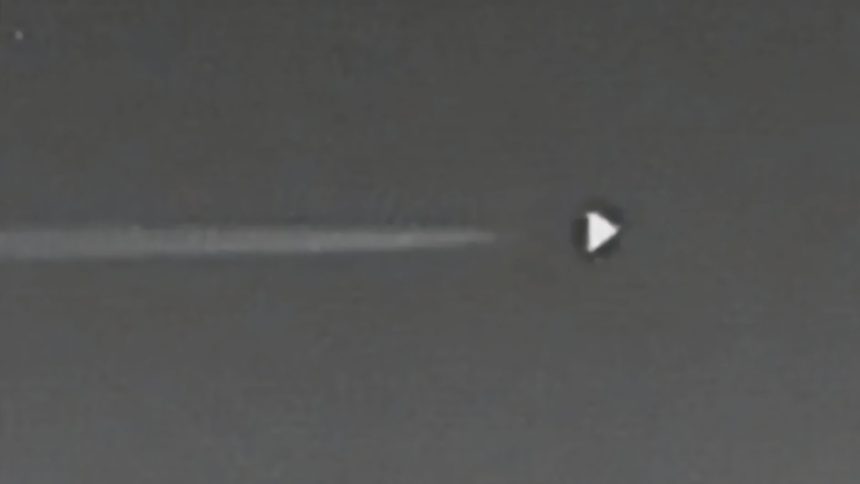
A nighttime thermal image captured during flight activity involving a B-2 Spirit shows a sharply triangular aircraft that resembles an unexplained platform photographed over Wichita in 2014.
Anders Otteson, the man behind the popular Uncanny Expeditions YouTube channel (that we have featured before here at The Aviationist), spotted something particularly intriguing during his latest trip to the Groom Lake area. While camping along Groom Lake Road and monitoring nighttime flight activity, early on Jan. 14, 2026, Otteson captured thermal imagery of a sharply triangular, “Dorito-shaped” aircraft operating in the restricted airspace surrounding Area 51. “Dorito” is a nickname commonly used by observers to describe an aircraft with a sharply triangular shape.
Otteson is not a casual observer. A videographer, explorer, and content creator, he routinely sets up camp in remote and unlikely locations with the specific goal of documenting activity rarely seen by the public. His epic expeditions into the deserts surrounding Groom Lake and other classified sites combine long nights in the field with thermal imaging equipment, optical sensors, and scanner monitoring, offering a unique perspective on flight activity associated with stealth aircraft and black programs.
However, the latest sighting is even more interesting than usual, as the aircraft he spotted flying at night over Nevada bears a striking resemblance to the now somewhat famous triangular aircraft photographed in daylight over Wichita, Kansas, in 2014, an image that, as our analysis at the time showed, appeared to be legitimate and unaltered.
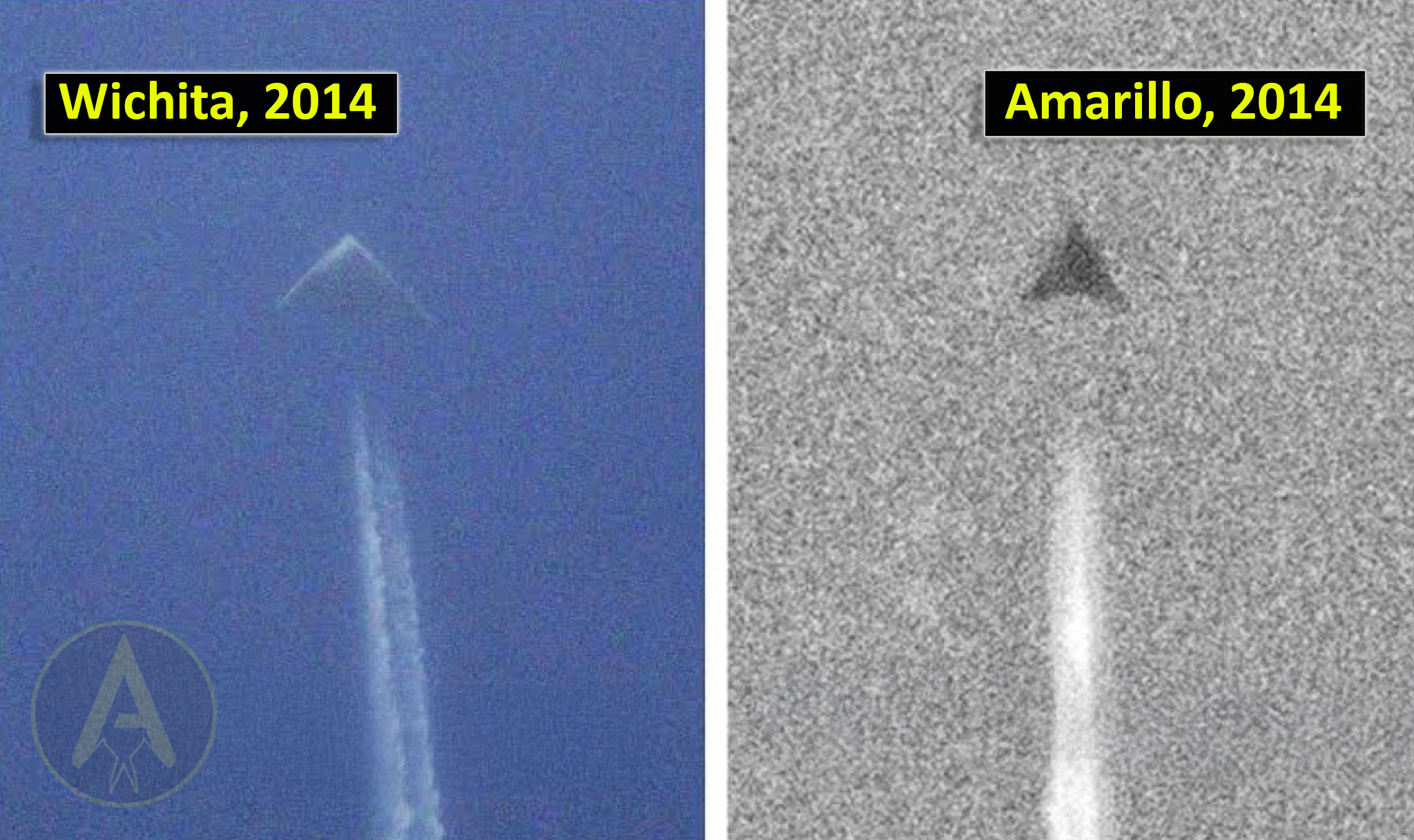
In fact, as our readers may remember, in 2014 we reported about an aircraft with a distinctly triangular planform was photographed in broad daylight over Wichita, Kansas. The image, captured by a local observer, showed a large, dark, flying wing-like aircraft with proportions that did not correspond to any known operational type. At the time, we noted that Wichita’s proximity to major aircraft manufacturing and testing facilities, combined with the then-recent tensions with Russia following the invasion of Crimea, made the sighting particularly intriguing.
Noteworthy, although it had been taken in February 2014, the image of the mysterious triangular aircraft over Wichita was released in April 2014, roughly one month after another intruguing sighting: on Mar. 10, 2014 Steve Douglass and Dean Muskett took some photographs of three mysterious planes flying at very high altitude over Amarillo, Texas. The images of the three aircraft showed what looked like an almost boomerang-shaped plane, equipped with two engines (or at least two exhaust nozzles), bearing some resemblance, although not identical, to the aircraft spotted over Kansas.
Every time a new aircraft is unveiled, I can’t help but think back to the mysterious sightings over Wichita and Amarillo in 2014 (Story here: https://t.co/25v5yi04aI). Now, with the first rendering of the F-47 unveiled and confirmation that it has been flying for five years, one… pic.twitter.com/C2Rl0wSsVX
— David Cenciotti (@cencio4) March 21, 2025
Despite years of speculation, no official explanation was ever offered, and the aircraft over Wichita was never publicly identified nor seen again. What makes the recent Area 51 sighting noteworthy is how closely the thermal image aligns with that earlier photograph, despite being captured more than a decade later, under completely different conditions, and with an entirely different sensor.
“I was camping near Groom Lake Rd, the road leading to the front gate to Area 51,” Anders told us in a message. “I heard what sounded like multiple aircraft in the valley. There were no visible lights so I began scanning around the sky for a while with a thermal imager. Eventually a B-2 passed overhead, and I then saw a second contrail above the ridge line near groom lake but it was out of range to get a clear picture of it. I moved down the road a bit, closer to the base and scanned the sky again, getting lucky and landing on this aircraft. The trailing edge immediately looked different than the B-2, in which the distinctive jagged trailing edge was visible.”
While the image, captured with an AGM TM50-640 thermographic camera, may be affected by distance-related distortion, the shape of the “Dorito” appears markedly different from that of the B-2 Spirit stealth bomber, suggesting it was a completely different type. Even allowing for some distortion, the planform still appears triangular. Moreover, Otteson was able to directly compare the object with a B-2 observed earlier the same night, noting clear differences in both planform and thermal signature. Still, as Anders pointed out to us, there may be certain conditions where a B-2 or other blended wing aircraft might look like it had a flat trailing edge so obviously we can’t 100% rule that out. “Though, given that I know there were other aircraft operating in the airspace I believe it to have been distinct,” he added.
Visualizza questo post su Instagram
The context of the sighting is also interesting.
As mentioned, the Dorito was spotted as a B-2 was operating in the vicinity, using callsign REARM71. The Spirit operated in the area for about four hours before returning to Whiteman Air Force Base, Missouri. The audio file can be found here.
The sighting itself was later discussed during a YouTube livestream hosted by Joerg Arnu of Dreamland Resort, where Otteson walked viewers through how the footage was obtained. An element that stood out during the discussion was the radio traffic captured that night. According to Arnu, the scanner audio featured an unusually high number of codewords, many of them seemingly mundane or even playful, with references to snacks, drinks, and everyday items (Corona, Pretzel, Garlic, Mustard, Michelob, to name but few). While such lingo might sound odd to casual listeners, it is not uncommon for military crews to rely on innocuous-sounding terminology to mask the nature of an operation, particularly during sensitive or real operations, as well as exercises.
What made this instance notable was not the mere presence of codewords, but their density and context. The traffic coincided with confirmed activity involving a B-2 Spirit and appeared to support a more complex scenario than a routine training sortie. Both Arnu and Otteson noted that some of the terminology used was unfamiliar even to seasoned listeners, suggesting either a specialized test profile or a deliberately obfuscated communications plan. Arnu said the operations saw the involvement Sabre callsigns, usually by aircraft launched from Area 51/Groom Lake airfield.
At the same time, it was also clear that whatever aircraft produced the triangular thermal signature was not participating openly in the radio exchanges. As discussed during the livestream, high-value or sensitive test assets would be expected to rely primarily on secure or data-linked communications, leaving supporting aircraft, in this case the B-2, to handle overt coordination over clear channels accessible to scanners. If so, the oddly coded chatter may have been part of a deliberate effort to manage the airspace and supporting elements while keeping the primary asset effectively invisible from a communications standpoint.
During the livestream, Arnu also floated a possible explanation for the activity that night, stressing that it was an educated guess rather than a conclusion. Given the presence of a clearly identifiable B-2 Spirit operating in the same airspace, alongside a second aircraft that remained visually and electronically elusive, he suggested the scenario could be consistent with some form of radar cross-section comparison or “fly-off” test. In such cases, a known low-observable platform could serve as a reference while another asset is evaluated under similar conditions. Both Arnu and Otteson were careful to note that there is no direct evidence confirming this, and that highly sensitive test aircraft would be expected to rely on secure communications, leaving little to no trace on open radio channels.
We will not speculate about its role, designation, whether it is manned or unmanned, or its performance. The only point worth making here, and the most interesting aspect for us, is that the new image seems to suggest that the mysterious aircraft first spotted in 2014 may still be flying 12 years later. If so, it would further confirm that some aircraft remain in operation for decades before their existence becomes publicly known.
I strongly suggest our readers check out the Uncanny Expeditions YouTube channel to watch the full video, set to be released on Tuesday, Jan. 20, 2026, which provides valuable context for the night’s activity and shows the “Dorito” in action. Make sure you also follow Anders on Instagram here.