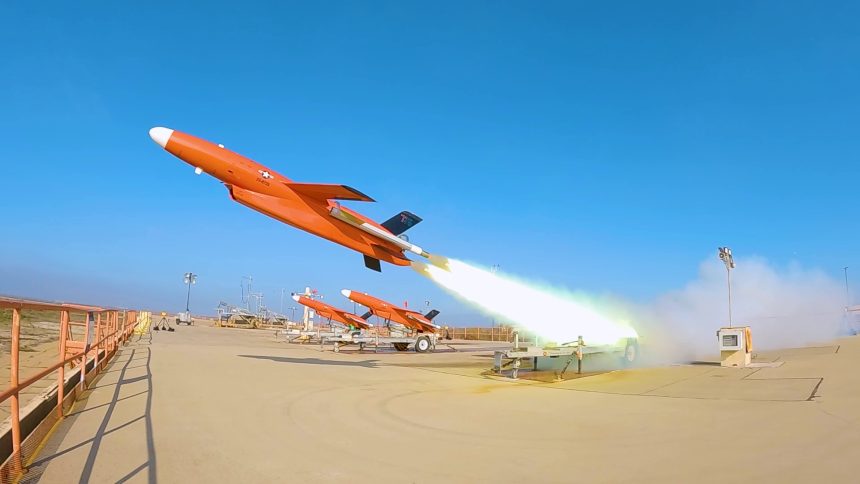
The U.S. Navy demonstrated the manned-unmanned teaming capabilities of BQM-177s using Shield AI’s Hivemind software in a simulated CCA air combat scenario.
The Naval Air Systems Command (NAVAIR) announced on Jan. 12, 2026, that the U.S. Navy completed a second successful demonstration of the BQM-177A subsonic aerial target equipped with Shield AI’s Hivemind software in late 2025. The test, conducted on Dec. 11 at Point Mugu Sea Range in California, is part of the service’s work towards the future fielding of Collaborative Combat Aircraft (CCA).
The disclosure of this demo follows the first demonstration of the AI’s integration on the BQM-177 in August 2025, again unveiled a month later. Notably, this also follows the recent announcement of the integration of F-35s with CCAs in the Joint Simulation Environment (JSE) training system.
Taking #AI to the Skies: The #Navy recently completed a demo validating AI-enabled autonomy for future CCA. Using Shield AI’s “Hivemind” software, BQM-177As successfully defended simulated airspace alongside a virtual F/A-18.
🔗: https://t.co/LLCpOVReKG pic.twitter.com/AX5ibcrsCZ
— NAVAIR (@NAVAIRNews) January 12, 2026
BQM-177 & Hivemind AI Second Demo
The new test of the BQM-177 focused on maturing manned-unmanned teaming capabilities for CCAs and to advance the multi-platform coordination of autonomous systems. The event was led by PEO (U&W)’s Aerial Targets (PMA-208) and Strike Planning and Execution Systems (PMA-281) program offices, together with industry partners Shield AI, Kratos (the BQM-177’s manufacturers), and CTSI (who provided mission planning and pilot-vehicle interface).
“This demonstration is an important step toward advancing autonomous capabilities for the fleet,” said Rear Adm. Tony Rossi, Program Executive Officer for Unmanned Aviation and Strike Weapons (PEO (U&W)). “Integrating AI-enabled autonomy across manned and unmanned platforms will be critical as the Navy develops next-generation air wing concepts and prepares for more complex operational environments.”
The press release explained that “two BQM-177A subsonic aerial targets were flown autonomously using Shield AI’s Hivemind software and connected to a Live Virtual Constructive (LVC) environment.” In the LVC environment were also included “a virtual F/A-18 and two simulated adversary aircraft, allowing real and simulated assets to operate together in the same scenario.”
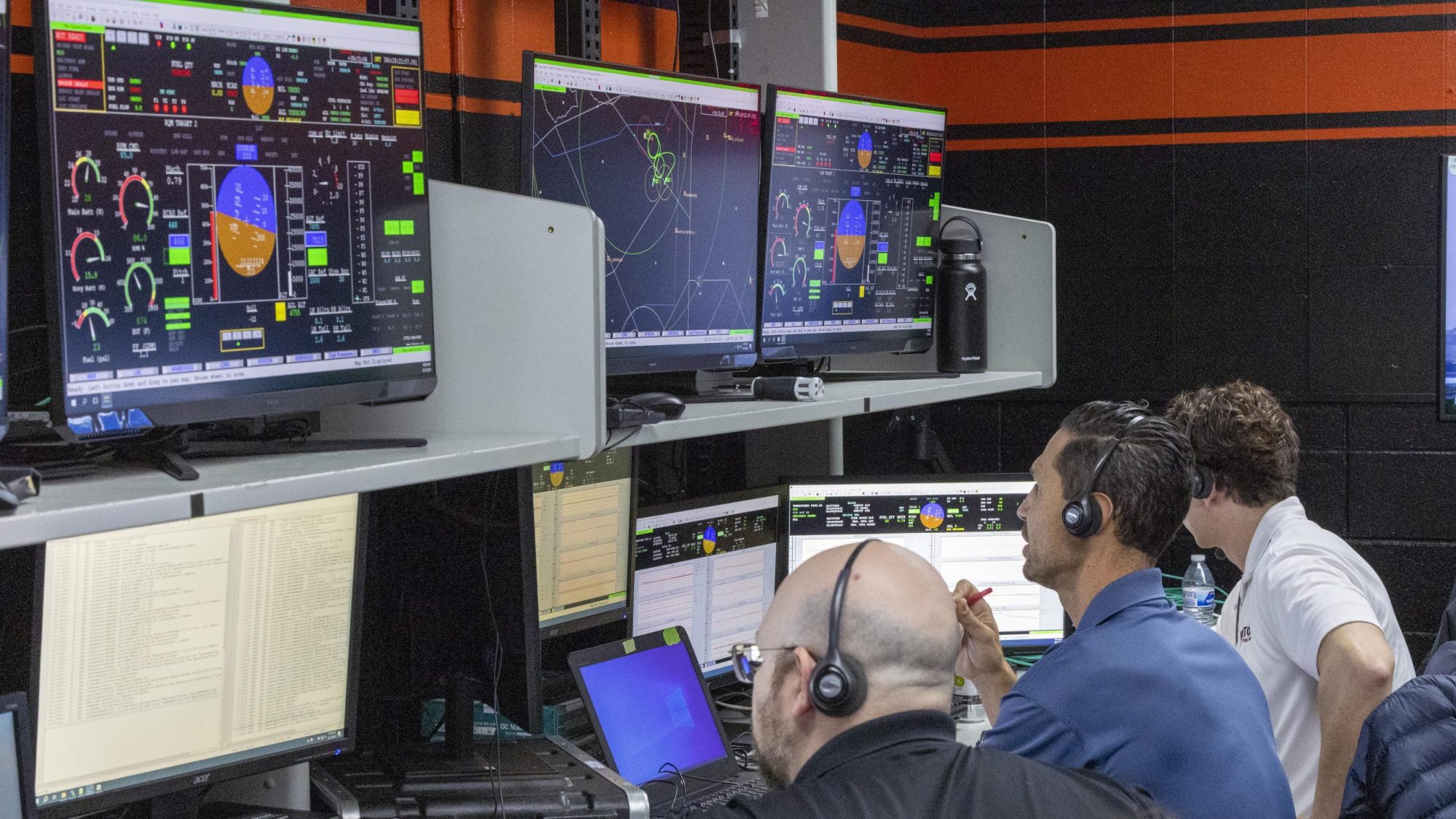
As part of the scenario, the virtual F/A-18 was designated as the mission lead and directed the BQM-177As to defend designated Combat Air Patrol locations. The autonomy software then responded to the detection of the simulated adversary aircraft attempting to fly into those designated areas, in accordance with the tasking assigned by the mission lead.
The scenario also made use of the Navy’s Autonomy Government Reference Architecture (A-GRA) interfaces. A-GRA is a Department of Defense (DoD) framework designed to enhance interoperability across autonomous military platforms, also described as “key to improving interoperability and accelerating the integration of mission autonomy across future unmanned naval platforms.”
“The fact that this is the first time we’re flying a fully autonomous aircraft in execution of a mission beyond the visual range of the remote-control operator is laying the foundation for allowing autonomous mission planning in the future,” said Veronica Wesson, PMA-281 special projects integrated program team lead. “Being able to accomplish all of this over only a 16-month period using the new agile methods of contracting was a great experience.”
Why the BQM-177
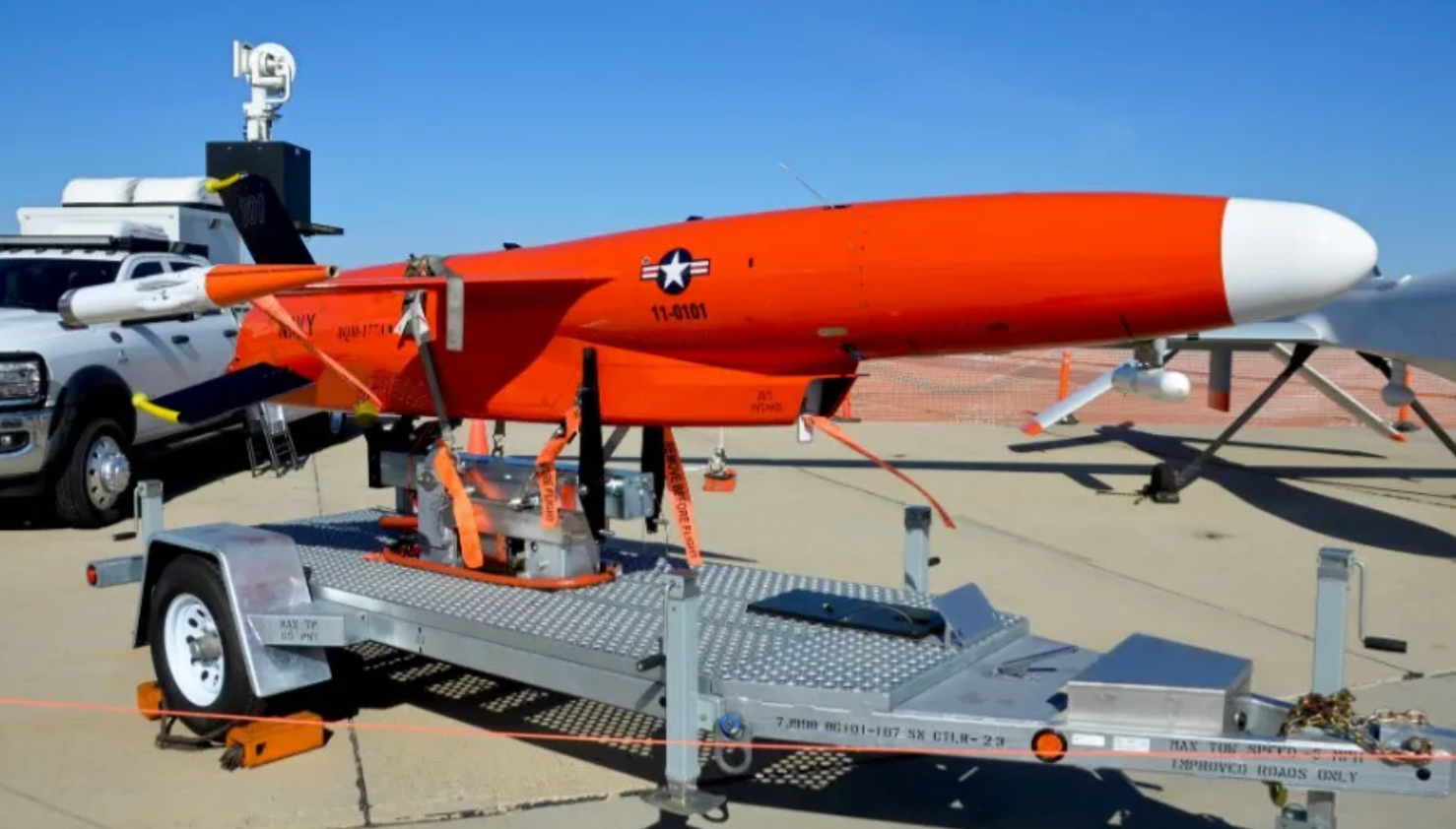
The decision to use the BQM-177 subsonic aerial target to test the integration of autonomy software has a well defined reason. In fact, as explained by the Navy, “the use of surrogate platforms like the BQM-177A allows for rapid testing and improvement, providing a cost-effective alternative to operational platforms during early development phases.”
With the service in the early phases of its Collaborative Combat Aircraft (CCA) program, a simpler and “off-the-shelf” unmanned platform such as the BQM-177 allow to accelerate the autonomy testing cycle and validate the platforms behavior in real-world conditions. The experience gathered from these tests will likely influence the conceptual design for a carrier-based CCA that General Atomics Aeronautical Systems and Anduril have been recently selected to develop.
At the same time, these efforts also serve as an improvement of the training value the drone can offer. In fact, the BQM-177A is meant to replicate modern subsonic anti-ship cruise missile threats and support a range of missions with its internal and external payload options.
As part of the first demonstration in August 2025, the integration of the first autonomy elements allowed the BQM-177A to perform more advanced maneuvers and closer engagements, accurately simulating interactions with manned ships. As consequence, the more threat-representative maneuvers conducted during while simulating realistic interactions with fleet assets allowed to provide more effective test and training scenarios for the personnel aboard the ships.