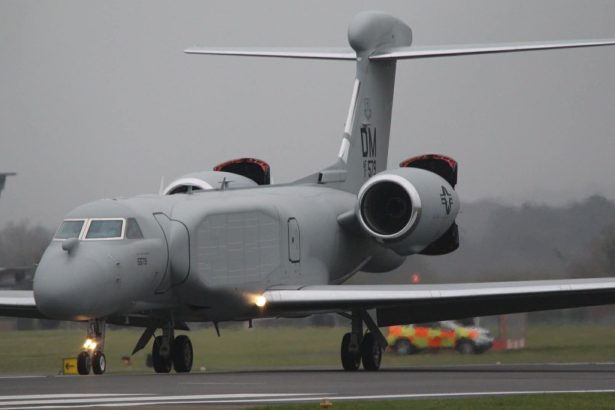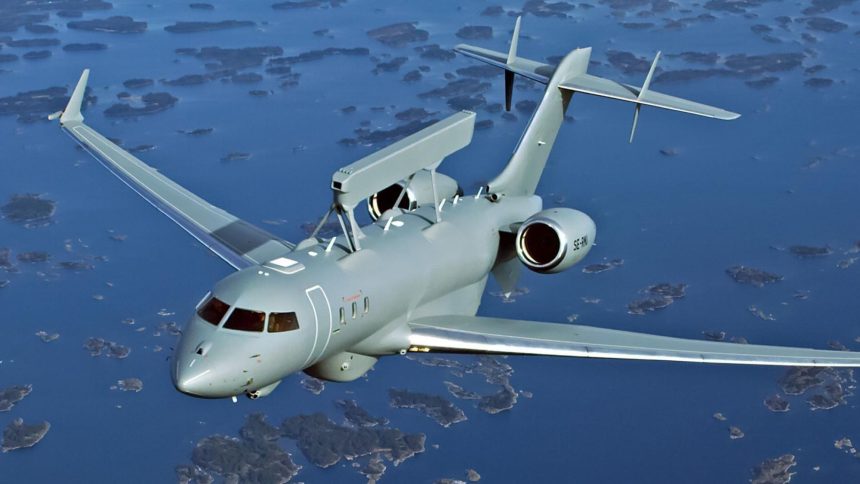
The French government is acquiring two Saab GlobalEye platforms, with an option for two more, to maintain a credible and deterrent airborne radar capability.
Saab announced on Dec. 30, 2025, that it has been formally contracted by the French Direction Générale de l’Armement (Directorate General of Armaments – DGA) for the procurement of two GlobalEye Airborne Early Warning and Control (AEW&C) aircraft. The contract, worth Swedish Krona (SEK) 12.3 billion ($1.3 billion), includes ground equipment, training and support, with the deliveries expected to take place in the 2029-2032 timeframe.
The development follows a Jun. 18, 2025, Letter of Intent (LoI) signed at the Paris Air Show for two airframes, with an option for two more, inked between then French Defense Minister Sébastien Lecornu and his counterpart Pål Jonson. The LoO also covered a host of other naval and surface-to-air systems.
The LoI had been preceded by a year of speculation and reports about France having chosen the GlobalEye to replace the older E-3F Sentry AWACS, amid a diminishing European capability in the airborne radar surveillance role. This is especially after NATO backed out of the E-7A Wedgetail AEW&C program.
The GlobalEye will replace the French Air and Space Force’s (Armée de l’Air et de l’Espace/FASF) four E-3F Sentry AWACS aircraft based at the 702 Air Base in Avord and first delivered in the early 1990s. Like the U.S. Air Force fleet, the aircraft are beset with maintainability issues.
RELEASE: Saab receives order for GlobalEye, including ground equipment, training and support, from France. https://t.co/bi92NMcp31
— Saab (@Saab) December 31, 2025
French E-3F Sentry fleet and European AEW&C force
Across the Atlantic, the U.S. Congress, in the FY 2026 National Defense Authorization Act (NDAA), has pushed back on the cancellation of the E-7A and retirement of the E-3 Sentry. To prevent capability gaps arising from the current E-3 Sentry AWACS fleet falling below 16 aircraft, the NDAA bill prohibits the U.S. Air Force from divesting any of those airframes, and expects either a readiness and mission-continuity plan for the E-3 Sentry, or the procurement of adequate E-7s.
France too has adopted a similar route, possibly to maintain readiness levels until the arrival of the GlobalEye. In fact, the Direction de la Maintenance Aéronautique (Directorate of Aeronautical Maintenance – DMAé) announced on Nov. 25, 2025, a contract awarded on Oct. 16 to France Industries KLM Engineering and Maintenance to sustain and support the E-3F fleet for 10 years.
“The AWACS market, established in a spirit of partnership, covers the entire fleet activity, with a requirement for global availability, while integrating high value-added services,” the DMAé said. KLM is expected to provide “in-depth logistics engineering” and “monitoring and anticipatory treatment of obsolescence.”
Aujourd’hui, 36-CB, l’un des 4 @Boeing E-3F Sentry AWACS de l’@Armee_de_lair en maintenance chez Air France Industries, à réalisé un ultime vol d’essai de 30 minutes sous le soleil Toulousain 🇫🇷
Il est repartis sur la base d’Istres en début d’après-midi.#AWAC #E3Sentry pic.twitter.com/sEcoTd5CZ8
— ©Icare Spotter 📷 / Seletti Nuno (@NunoSeletti) March 29, 2024
Thus, with the E-3F fleet planned to be kept active until 2035 and the two Saab GlobalEyes coming by 2032 – assuming that delivery does not overshoot the deadline – the FASF for a brief period would be operating six AEW&C airframes of two different aircraft types. This, combined with NATO’s own 14-aircraft E-3A fleet and the Royal Air Force three E-7A Wedgetails, affords the alliance a 23-airframe airborne radar fleet.
Of course, this takes into account that at least five of NATO’s older E-3s would be unavailable owing to greater maintenance needs, since the airframes will have accrued more flight hours.
France contracts Saab
Saab’s press release, while noting the award includes the option for two more aircraft, quoted president and CEO Micael Johansson: “[The] order underscores the robust partnership between Saab and France. By selecting GlobalEye, France is investing in a highly modern and capable Airborne Early Warning & Control solution. This choice reinforces France’s commitment to sovereignty and strengthens Europe’s overall protection, with both Sweden and France operating GlobalEye.”
Frankrikes beslut att upphandla 2 Global Eye kommer att bidra till att ytterligare att fördjupa försvarssamarbetet mellan våra länder och även det strategiska försvarsmaterielsamarbetet. Det kommer också att främja ett närmare samarbete mellan ländernas försvarsföretag. (2/3)
— Pål Jonson (@PlJonson) December 30, 2025
Sweden’s Defense Minister Pål Jonson called the GlobalEye “crucial in today’s threat environment” while adding how Sweden’s defense industry is “strengthening Europe’s defense capability and security.” He welcomed the news about the contract saying that “France’s decision to procure 2 Global Eye aircraft will contribute to further deepening the defense cooperation between our countries.”
Saab had also previously signed a framework agreement with the French aircraft maintenance and modification provider Sabena technics for GlobalEye’s aircraft modification work. “Transforming the airframe into a GlobalEye platform involves extensive technically complex work which requires highly-skilled and dedicated personnel,” says the company, and this agreement will cover “complex aircraft modification and associated services for GlobalEye.”
“This reenforces Saab’s commitment to collaborate with French industry while supporting the expansion of our modification capacity to meet the increasing demand for GlobalEye. Sabena technics has the expertise and experience to provide this support,” says Lars Tossman, head of Saab’s business area Aeronautics.
RELEASE: 🇫🇷 France announces intention to procure GlobalEye
Joint declaration of intent regarding the sale of Saab’s GlobalEye Early Warning and Control (AEW&C) aircraft to France signed with @DGA. #AEWC #defence #parisairshow https://t.co/t8V7WYSAc6 pic.twitter.com/2UEiwrpHlX
— Saab (@Saab) June 18, 2025
Saab GlobalEye AEW&C
Saab calls the GlobalEye a “multi-domain AEW&C” platform capable of tracking and detecting targets in the air, sea and land “with an array of active and passive sensors that provide long-range detection and identification.” Saab’s S 106 GlobalEye AEW&C aircraft is derived from the company’s Erieye airborne radar system carried on the Saab 340 AEW, Saab 2000 AEW, and Embraer E-99 aerial platforms. In the case of GlobalEye, Erieye is installed on the Canadian-made Bombardier Global 6000/6500 aircraft family, Saab says.
The Erieye is based around the PS-890 AESA (Active Electronically Scanned Array) radar, mounted on a distinctive ‘plank’ above the carrier aircraft’s fuselage. According to Jane’s, it enables a detection range of up to 450 km for fighter-sized aircraft, depending on altitude and the radar cross section.
Along with AEW&C capability, the upgraded Erieye ER system offers maritime surveillance with a Leonardo SeaSpray 7500E radar, assisted by a FLIR Systems Star Safire 380-HD EO/IR turret. It also has a GMTI (Ground Moving Target Indication) capability.