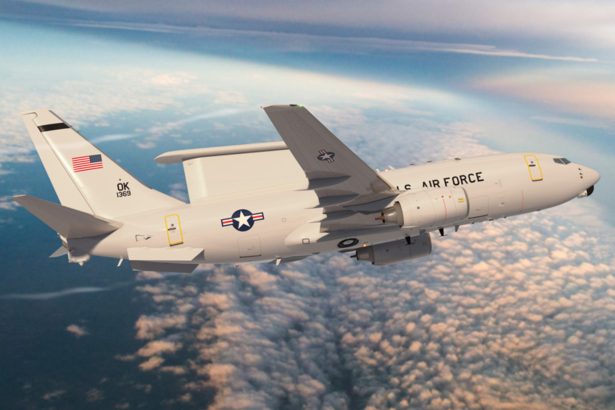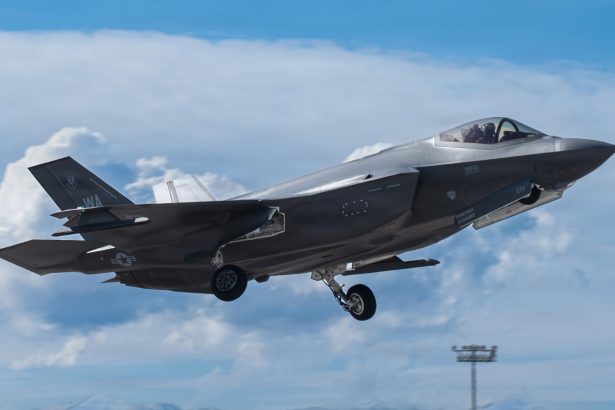
The U.S. Navy is acquiring and undisclosed number of BriteCloud Active Expendable Decoys specifically for the F-35 Lightning II.
The Naval Air Systems Command (NAVAIR) has awarded Leonardo UK a contract to supply the U.S. Navy with an undisclosed number of BriteCloud decoys, designated by the military as AN/ALQ-260(V) Anti-Missile Countermeasure. The development follows report earlier this year and in 2024 about NAVAIR negotiating the procurement.
The Contract
A contract notice for Active Expendable Decoy (AED) Procurement and Support was published on U.S. Government’s platforms on Dec. 23, 2025. The award was classified as a not competitive, sole source contract.
The notice mentions the contract “includes procurement of the AED, as well as initial spare impulse cartridges and support equipment to provide required radio frequency countermeasure capability to the Department of Defense (DoD).” The duration “consist of a base year and up to one option.”
The value of the contract and the amount of decoys to be procured have been redacted from the notice. However, earlier reporting suggested the Navy was looking to procure up to 6,000 AEDs.
NAVAIR explained the selection after a sources sought notice was published in 2024. Leonardo UK, Elbit America and Raytheon responded to the notice, “with inadequate responses received from BHPE LLC and Kastel Enterprises.” However, “only Leonardo can meet the Government’s immediate requirements in the timeframe required,” stated the command.
Here is a further justification provided in the contract notice:
“Award of this contract to any source other than Leonardo UK, LTD would result in an unacceptable delay of eight years. Approximately 14 years of research and development have been completed through a partnership with Leonardo UK, LTD and UK Ministry of Defense (MOD) to develop and test the AED. These efforts include laboratory hardware in the loop testing, software development testing and validation, safe separation, and effectiveness testing to qualify the AED on the F-35. A new source would require at least four years to achieve the desired product maturity, three years to qualify an alternate device and one year for manufacturing readiness in preparation for a low-rate production line. The unacceptable delay calculation of eight years is based on subject matter expert analysis of historical information with fielding of similar technologies. Any interruption in production would pose critical setbacks to current schedules and fielding requirements. Based on unacceptable delays, the Government has determined that Leonardo UK, LTD is the only responsible source capable of meeting the U.S. Government’s requirements. The efforts described herein cannot be performed by a source other than Leonardo UK, LTD without unacceptable delays in deliveries to the Fleet.”
This further stresses Leonardo’s previous descriptions by the service as the “only contractor who possesses the manufacturing technology, infrastructure, capacity, and platform qualifications to complete all requirements” and deliver the AEDs.
Requirements
As previously mentioned, the AEDs are supposed to provide additional Radio Frequency Countermeasure (RFCM) capability to the aircraft, complementing the ones already fielded.

For instance, the F-35 is equipped with the BAE Systems ASQ-239 onboard self-protection system, which also includes the ALE-70 fiber-optic towed decoy. Equipping the F-35 with BriteCloud significantly enhances the aircraft’s survivability, as the stealth jet is not equipped with chaffs, while it is able to carry only a limited number of ALE-70 decoys.
The April 2025 Sources Sought notice listed the criteria that the contractor, now identified as Leonardo, must meet:
- 2″ x 1″ x 8″ form factor
- Mission load programmable by the Government
- Demonstrated RFCM performance capability evaluated at TRL-9, defined as: “Actual system proven through successful mission operations”
- Evaluated at MRL-9, defined as: “Demonstrated Low-Rate Production capability in place to begin Full-Rate production”
- Must be qualified for use on F-35 and ready for immediate production
- Must be qualified and ready for use on F-18 and other USG platforms following a production decision
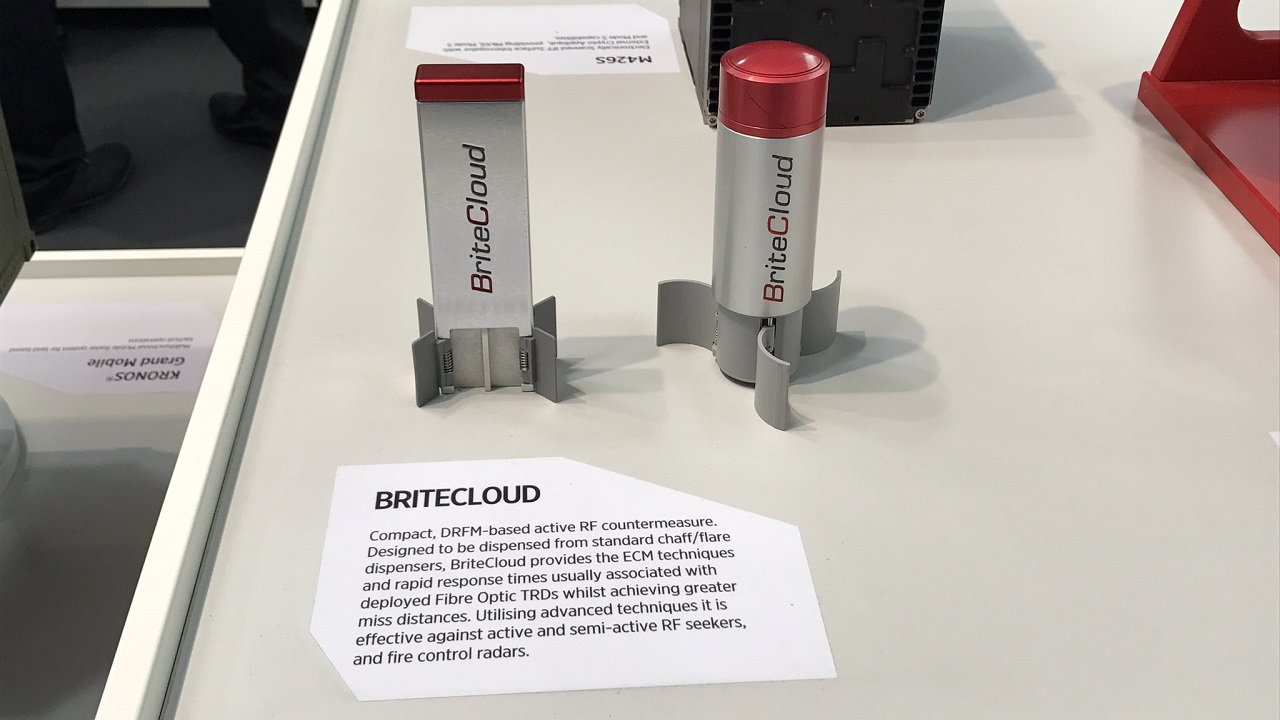
These requirements fit the description of BriteCloud 218, a smaller variant of the 55 mm cylindrical BriteCloud round which can fit the 2”x1”x8” U.S.-made chaff/flare dispensers, like the standard AN/ALE-47 countermeasure dispensers installed on many U.S. aircraft. The U.S. Air National Guard has issued a “fielding recommendation” for the decoy after the successful completion of the Foreign Comparative Testing on the service’s F-16 Fighting Falcon fighter jets in 2022.
The notice also mentioned that the contract award was expected in November 2026, with deliveries set to start “as early as four months, but no later than ten months after contract award.” The same delivery schedule applies to the option years, and all AEDs must be “delivered within 12 months of the first delivery in each period.”
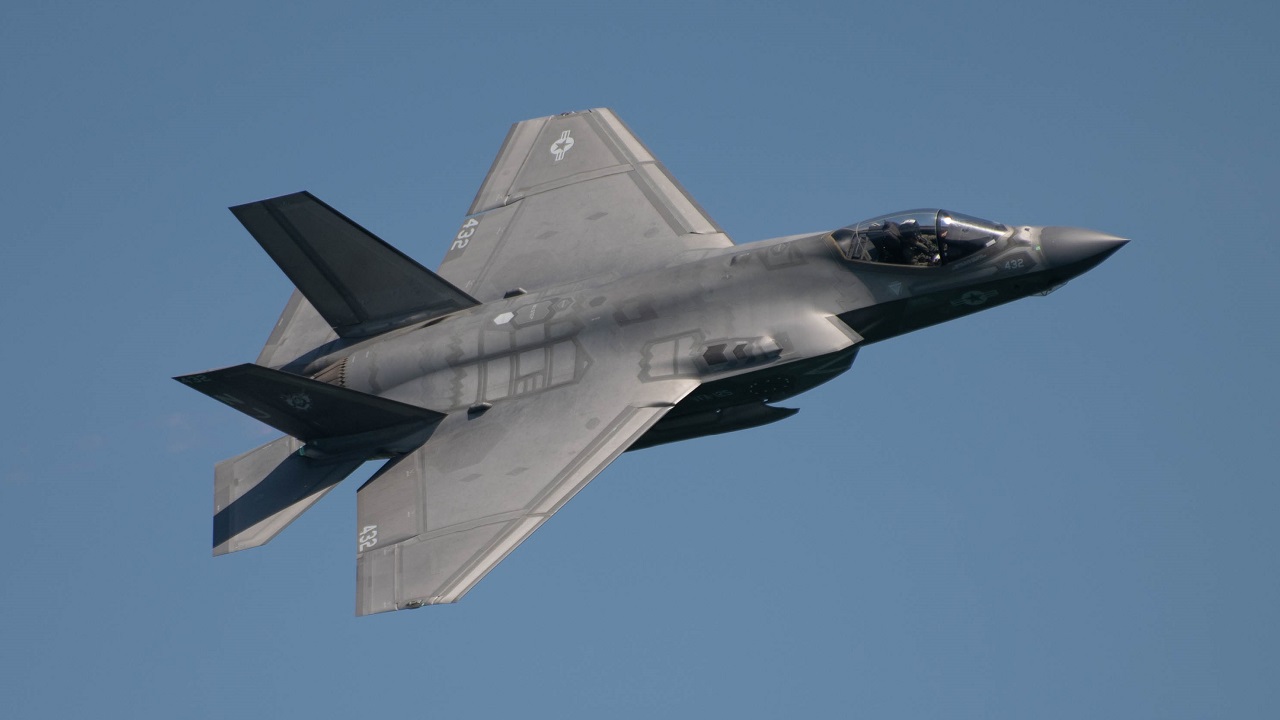
A total of 3,000 to 6,000 AEDs will be procured per year, together with “spare impulse cartridges, related support equipment and repairs, and field service representative support.” The notice also mentioned the F-35 has already “tested and integrated AED capability, which resulted in a fielding decision,” while the decision for the F/A-18, possibly referring to both the F/A-18-E/F Super Hornet and EA-18G Growler, will be taken in 2027.
BriteCloud 218
In our 2021 exhaustive feature on the BriteCloud, we reported that the system is a battery powered, self-contained cartridge offering off-board jamming – hence the term “active” – and dropped like conventional chaffs and flares. The system creates a large distance between the aircraft and itself, so the missile and its shrapnel miss completely the aircraft.
According to Leonardo, BriteCloud can defeat the majority of RF-guided surface-to-air and air-to-air threat systems, including the ones that rely on the “home-on-jam” guidance (when the missile targets the jamming signal, dangerous especially for aircraft equipped only with an internal or podded jammer). After BriteCloud is ejected, it starts to search for priority threats, collecting the incoming radar pulses and cross-referencing them against a pre-programmed threat library.
Upon finding a match, BriteCloud’s on-board computer applies its advanced algorithms to simulate a “false target” so accurate that the threat system cannot detect the deception and distinguish it from the real aircraft. This happens because, as mentioned by Leonardo, the decoy is able provide both Doppler and range obscuration with range and velocity “gates” that confuse the ECCM systems.
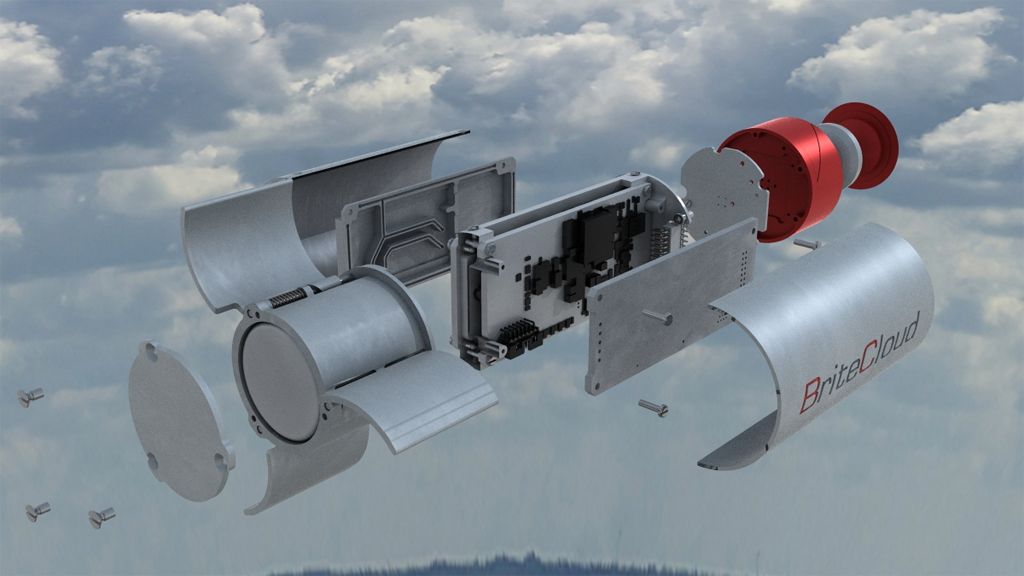
BriteCloud is what is known as a “second generation” expendable active decoy, which differs from the first generation decoys, generically called also towed decoys, developed towards the end of the Cold War and reliant on a cable that connects them to the aircraft so they can keep the required distance and also receive data and power for the jamming signal.
BriteCloud is developed by Leonardo’s facilities in Luton (UK). Following the successful tests of the 55 mm BriteCloud round, called BriteCloud 55, Leonardo developed an even smaller variant called BriteCloud 218 which can fit the 2”x1”x8” US-made chaff/flare dispensers.
Leonardo says BriteCloud requires minimal platform integration as it just needs to be loaded in the chaff/flare dispensers. Because of this, the system requires little to no integration efforts with the F-35 since it can fit inside its existing chaff dispensers, making it a sort of plug-and-play capability.