Following the delivery earlier this year, the first Portuguese Super Tucanos have been retrofitted with NATO-compatible systems.
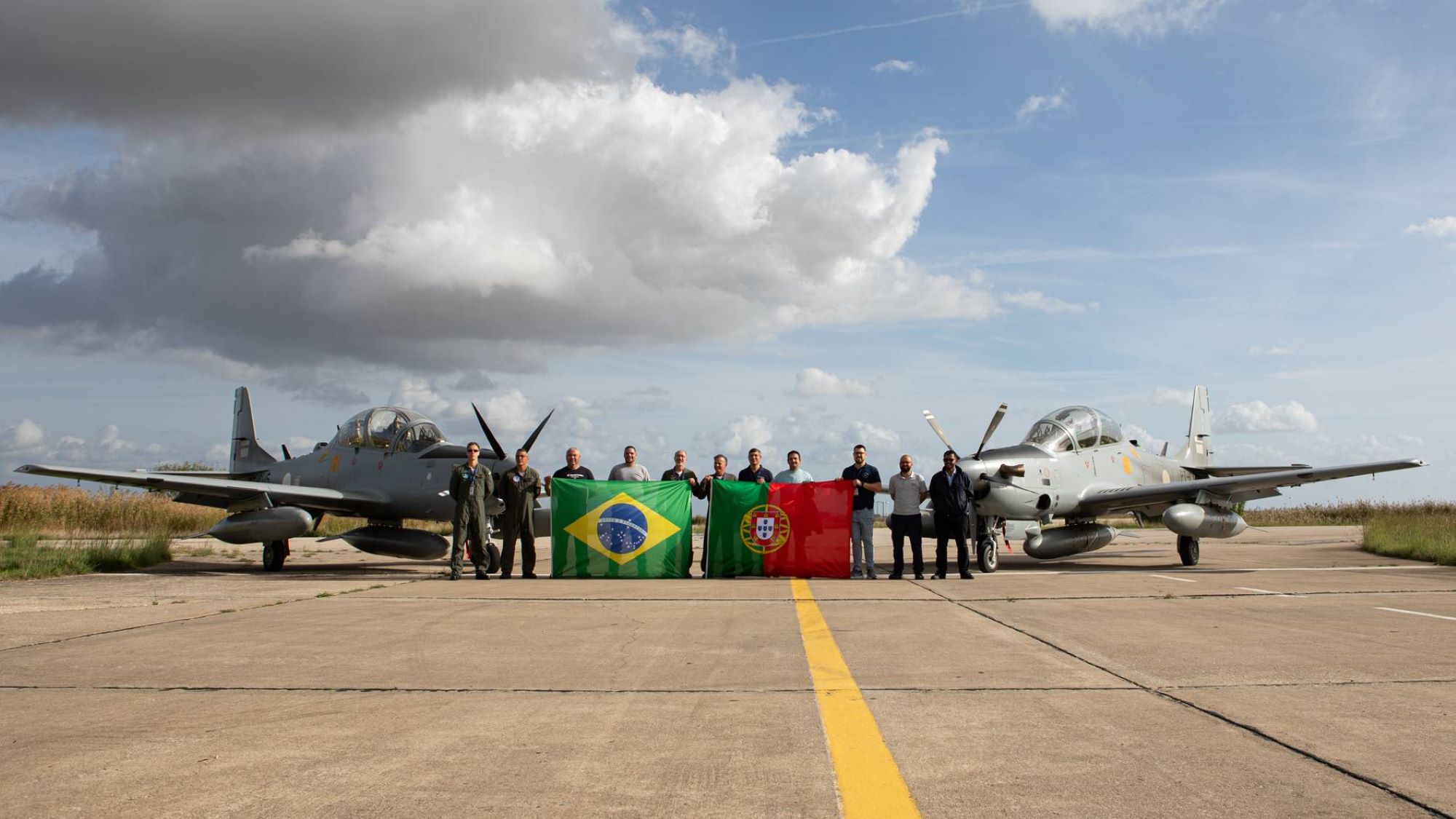
The Portuguese Air Force (Força Aérea Portuguesa – FAP) received on Dec. 17, 2025, the first five of its A-29N Super Tucanos converted to NATO standards from Embraer, the service and the company announced. The retrofit of the mission systems, communication, avionics, navigation and data links required for the alliance’s military operations took place at the facilities of OGMA, an Embraer subsidiary.
The five airframes are a part of a 12-aircraft order, worth €200 million ($210 million), signed in Dec. 2024. The first three aircraft landed at OGMA’s facilities in Alverca do Ribatejo on Aug. 31, 2025.
The FAP announced on Nov. 8, 2025, the delivery of two more aircraft. All Super Tucanos will fly to Air Base No. 11 in Beja for formal delivery to Squadron 101 “Roncos”, the FAP said in a statement.
While Portugal is the first European operator of the A-29 Super Tucano, the FAP added that its A-29s are also the first in the world in the A-29N configuration. The ‘N’ designation represents the NATO standard configuration.
The A-29Ns in Portuguese service will be used both for pilot training, light attack and reconnaissance roles. Both FAP and Embraer underscored the aircraft’s counter-drone capability, and the broader Brazilian-Portuguese partnership driving Lisbon’s industrial, technological development and employment generation goals.
A #ForçaAérea dá um passo decisivo no reforço das suas capacidades.
Os primeiros #A29N Super Tucano, com configuração #NATO, inauguram uma nova era na instrução de pilotos e no apoio aéreo próximo, colocando #Portugal na linha da frente da aviação militar europeia.#SuperTucano pic.twitter.com/uJ64wkth37
— Força Aérea Portuguesa (@fap_pt) December 17, 2025
This reflected in the signing of an LoI (Letter of Interest) for “the installation of an aeronautical factory in Beja, with the capacity to manufacture A-29N Super Tucano aircraft in Portugal, generating skilled jobs that will benefit the Portuguese economy and industry,” the FAP release said.
The Super Tucano is a widely used trainer aircraft, operated by 22 air forces which collectively flew 600,000 flight hours. The U.S. Air Force and Portugal are two prominent users, with the former’s Test Pilot School receiving three units early in October 2024.
‘Vital for Portuguese air force modernization and future operations’
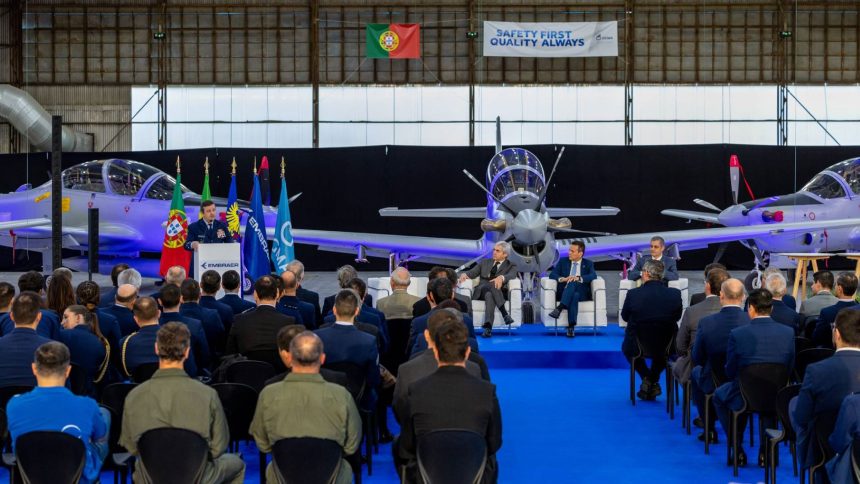
The handover that took place at OGMA’s facility was attended by the Minister of National Defence, Nuno Melo, and the FAP Chief of Staff, General João Cartaxo Alves. Alves said the delivery of the NATO-compatible A-29s mark a “decisive step” in the FAP’s modernization, “reinforcing its robustness and technological capacity.”
“Beyond replacing pilot training equipment that has been in operation for almost four decades, this acquisition also allows for the strengthening of new capabilities, namely in close air support in joint and/or combined operations, ensuring the armed protection of forces on the ground. In parallel, the Air Force reaffirms itself as a benchmark among its peer forces, operating the first A-29N Super Tucano with NATO configuration, guaranteeing Portugal a position of strategic advantage and a return for the national economy,” Alves said.
Defence minister Nuno Melo emphasised the “proven ground attack” capability the A-29 brings. “We are also talking about new scenarios. The Super Tucano now offers the possibility of carrying out anti-drone combat missions, proving the flexibility of the aircraft chosen by the Air Force. I emphasize ‘chosen by the Air Force’, with political decisions supported by technical opinions,” stated Nuno Melo.
Counter-drone A-29 Super Tucano
An unidentified drone incursion at a French Navy (Marine Nationale) nuclear submarine base earlier this month and Russian drones intruding into Polish airspace in mid-September had again upheld the importance of cost-effective, simple platforms to counter cheap and asymmetric unmanned threats. The need for such capabilities has also been reinforced in consistent warfare trends, from the Ukrainian front to the Middle East.
Embraer had implied about the A-29 being upgraded with the APKWS II system in its counter-UAS role pitch for the aircraft, leveraging the guided rocket system’s proven utility against Houthi threats. A demonstration of that fusion would further improve prospects for the Super Tucano in flashpoints facing drone, low-intensity conflict and insurgency threats.
The existing A-29s have two wing-mounted .50 cal machine guns and an EO/IR (Electro-Optical/Infra-Red) sensor turret, allowing a basic counter-drone capability.
NEWS | Embraer delivers first A-29N Super Tucano to the Portuguese Air Force @fap_pt and announces potential assembly line in Portugal. Read full news: https://t.co/1i2go7OvM2 @OGMA_PT pic.twitter.com/A0Yb48oofl
— Embraer (@embraer) December 17, 2025
“Relying on A-29 features in operation and new sensors, including specific datalinks for receiving initial target coordinates and queueing, the Electro-Optical/ Infra-Red (EO/IR) sensor for laser tracking and designation, as well as the laser guided rockets and the wing-mounted .50 machine guns for neutralizing targeted Unmanned Aerial Systems (UAS), the Operational Concept (CONOPS) defined by Embraer will allow current and future A-29 operators to add counter drone missions to their operational profiles whenever needed,” Embraer had said in its C-UAS pitch for the A-29.
A-29’s and Embraer’s future
Embraer Defense and Security’s CEO Bosco da Costa Junior said the delivery speaks to the broader Brazilian and Portuguese “strategic partnership,” which now includes the FAP’s A-29N Super Tucano upgrade, the KC-390 and the LoI for an assembly line for the A-29. “There is growing interest in employing the A-29 for counter-UAS missions in Europe, and a potential assembly line in Portugal paves the way for the development of new business and broader cooperation with the Portuguese defense industry,” further added the CEO.
The new assembly line proposed in Beja would, if approved, become the third such facility in the world, after Gaviao Peixoto, Brazil, and Jacksonville, Florida. Aviation Week quoted a statement by the Portuguese Ministry of National Defence, which mentioned that the facility would also assemble A-29s for future European users.
Today, Embraer delivered the first five A-29N Super Tucanos to the Portuguese Air Force and signed a Letter of Intent for potential establishment of an A-29N assembly line in Portugal, the first country to operate the NATO’s A-29 configured aircraft. Watch now to learn more. pic.twitter.com/PCV9tVmkN7
— Embraer (@embraer) December 17, 2025
The Super Tucano’s trainer and ISR-strike capability has already been operationally proven. Origin country and the A-29’s first user Brazil also announced in late 2024 a major upgrade of its 68 A-29A/Bs (military designation of the EMB 314) to the A-29M standard, which among others, included a BR-2 datalink to network with its Saab F-39E Gripens.
This would also help Slow Moving Intercept (SMI) roles against small aircraft carrying narcotics. Portugal is also an Embraer C/KC-390 Millenium user, among other current and future European operators including Sweden, Czech Republic, Lithuania, the Netherlands, Slovakia and Austria.