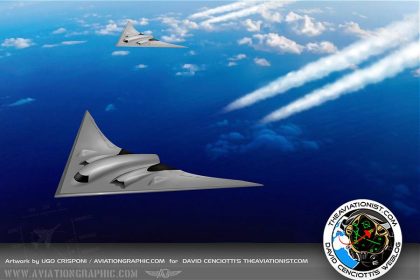
Europe’s first stealth killer drone “nEUROn” makes maiden flight December 1, 2012
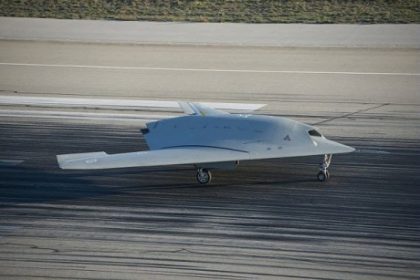
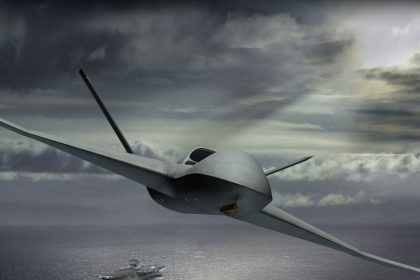
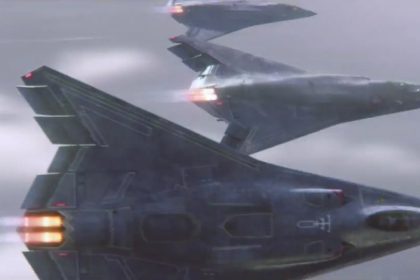
Posted by David Cenciotti in : Drones , 1 comment so farOn Dec. 1, the “nEUROn”, the technology demonstrator for a European UCAV (Unmanned Combat Aerial Vehicle), made its first flight from Dassault Aviation company’s flight test base in Istres, France.
Image credit: Dassault Aviation
The nEUROn, a project involving France, Italy, Sweden, Spain, Switzerland and Greece, had rolled out on Jan. 20, 2012, after five years of design, development, and static testing.
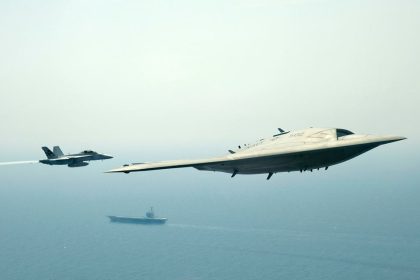
With a length of 10 meters, 12.5 meters of wingspan and an empty weight of 5 tons, the first stealth combat drone developed in Europe has a shape that reminds that of the American X-47B. But, unlike the U.S. killer robot that the U.S. Navy is preparing to launch from aircraft carrier, the nEURONn is only a full-scale technology demonstrator (powered by a Rolls-Royce Turbomeca “Adour” engine) for an UCAV and will not be produced in series.
Image credit: Dassault Aviation
Still, UCAVs developed from the nEUROn concept will be much more advanced than the current “Predator-class” Unmanned Aerial Systems, that in the MQ-1 and 9 (Predator A and Reaper) variants have been intensely involved in Iraq, Afghanistan, Pakistan and Libya.
After its maiden flight, the nEUROn will be involved in a testing campaign in France until 2014, when it will be deployed to Vidsel range, in Sweden and then to the Perdasdefogu range in Italy, where its stealthiness and capability to drop PGM (Precision Guided Munitions) through the internal weapon bay, will be evaluated.
Image credit: Dassault Aviation
Related articles
US Navy to get Unmanned Carrier Launched Surveillance & Strike stealthy drones November 15, 2012
Posted by Richard Clements in : Drones , add a commentNaval Air Systems Command (US Navy) has announced on its website that the Deputy Chief of Naval Operations for Information Dominance has “identified a need for an aircraft carrier based aircraft system providing persistent Intelligence, Surveillance, and Reconnaissance (ISR).”
It is thought that the US Navy is to release its requirements during December for the new aircraft, to be named Unmanned Carrier Launched Surveillance & Strike (UCLASS) . It is thought that the requirements will ask that the UCAV will need to be able to fly 2000 nautical miles from the carrier and carry a suite of weapons and sensors or a mixture of both. The aircraft would need to have stealth capability to penetrate hostile airspace and then send back the data its sensors have collected. Then, if necessary, they would have to destroy selected targets.
Many companies are developing their take on the UCLASS requirements. Lockheed Martin with their Sea Ghost UAS, Boeing (tweaked X-45C), Northrop Grumman (X-47B) and General Atomics (Sea Avenger) are the other leaders in the race to place a UAS on the decks of US carriers by 2018.
This may seem an aggressive schedule but the technology has also been tested to land a UAV onto the Deck of a carrier. Hence, it will be more than likely a case of modifying an existing design for the carrier operations.
Richard Clements for TheAviationist.com
The Sea Avenger in a General Atomics image
Related Articles
- Iran unveils new weird flying machine: a tilt-wing vertical takeoff and landing “ultra-advanced” drone (theaviationist.com)
- Iran’s new spy drone is an Israeli Hermes 450/Watchkeeper clone. Capable of carrying missiles. (theaviationist.com)
- Prototype of Turkey’s first armed drone crashes during test flight. Again. (theaviationist.com)
- Iran announces new combat drone capable of carrying missiles for air defense missions (theaviationist.com)
Hand Signals: the next step to controlling UAVs on aircraft carriers April 4, 2012
Posted by Richard Clements in : Aircraft Carriers, Drones , add a commentThe environment you find on the flight deck of an aircraft carrier is constantly monitored. The organized chaos of launches, recoveries and taxi takes place in a totally unforgiving environment for an unmanned aircraft (and for manned planes too…).
According to an interesting article published by Navy Times, researchers at the Massachusetts Institute of Technology (MIT) took a very close look at the problem of moving UAVs (Unmanned Aerial Vehicles) about the deck whilst not endangering crew or interfering to the normal operations and they came up with an ingenious camera and computer that recognises the hand signals the sailors use to guide aircraft about an aircraft carrier deck.
It may be a step that finally makes UAV use on a aircraft carrier possible. “It would be really nice if we had an unmanned vehicle that can understand human gestures” said Yale Song a Ph.D candidate at MIT who developed the system.
“Gesturing is an instinctive skill we all have, so it requires little or no thought, leaving the focus itself, as it should be, not the interaction modality” said Song.
Song’s project which began in January 2009, and was funded by the Office of Naval Research, took him to Naval Air Station Pensacola, Florida, where he learned the hand signals used by the sailors on the flight deck that he used to “train” 20 students 24 signals. The students wore a Yellow Turtleneck and a cranial to replicate the clothing used onboard carriers.
The students performed all of the signals whilst being filmed by Song’s camera/computer combination, which in turn translated their hand movements to stick figures. With this data, Song was able to develop an algorithm that is able to learn how to identify and recognize the signals from people it hadn’t met before therefore hadn’t learned their individual slight variables.
Song said “Based on that training data, we trained our model so that when new data comes in, it has our algorithm to classify the sequence of gestures.”
Song admitted that his system gets the gestures correct around 75 percent of the time, so obviously a lot of more research is needed before this system could be introduced onto an unmanned air system.
According to the Navy Times article, while Song and MIT look into recognizing hand signals, Northrop Grumman has developed a special remote control for moving the X-47B on flight decks by means of a device which attaches to the wrist, waist and one hand. The “yellow shirt” operating the device will have access to a display and will be able to control the aircraft’s throttle, tailhook, brakes and perform several other functions associated with maneuvring an aircraft on deck.
Image credit: U.S. Naval Air Systems Command
Anyway, drone operations automation has already reached aircraft carriers, at least for testing purposes.
An automated landing system, which allowed the X-47’s controllers to take control of an F-18, fly the approach and land the plane onto the flight deck of USS Dwight D Eisenhower whilst the Hornet’s crew makes no input into the plane’s flight, has already been tested. Seen from the outside, the landing looks totally normal. The LSOs still has the power to wave off the landing should they feel that the landing is unsafe or does not meet any other criteria required for a trap landing.
Richard Clements for TheAviationist.com
First European experimental stealth combat drone rolled out: the nEUROn UCAV almost ready for flight January 20, 2012
Posted by David Cenciotti in : Drones , 4commentsOn Jan. 20, the nEUROn, the technology demonstrator for a European UCAV (Unmanned Combat Aerial Vehicle), was officially presented by Charles Edelstenne, Chairman and CEO of Dassault Aviation to the representatives of the countries that have been contributing to the project France, Italy, Sweden, Spain, Switzerland and Greece.
The nEUROn, whose shape reminds that of the American X-47B, is the first stealth combat drone developed in Europe and was rolled out after five years of design, development, and static testing. The first engine tests will be carried out in the next weeks, while the maiden flight is expected to be conducted in mid 2012. Following the first flight a testing campaign in France, Sweden and Italy will begin to evaluate the handling of the drone, its stealthiness, its capability to drop PGM (Precision Guided Munitions) through the internal weapon bay, as well as the integration in a C4i environment (command, communication control, computer and intelligence).
Although the nEUROn is only a full-scale technology demonstrator for an UCAV (Unmanned Combat Aerial Vehicle) and will not be produced in series, it is the first step of the six partecipating countries towards the advanced technologies used in future stealthy combat ‘bots.
The UCAV developed from the nEUROn will feature capabilities, payloads and ranges, similar to to those of the manned combat planes and will be much more advanced than the current “Predator-class” Unmanned Aerial Systems, that in the MQ-1 and 9 (Predator A and Reaper) variants have been intensely involved in Iraq, Afghanistan, Pakistan and Libya.
All images via Alenia Aermacchi
Related articles
- Killer Drones Get Stealthy (wired.com)
- Iran seizes a U.S. Stealth Drone by taking over controls. Maybe… And what about that Predator virus? (theaviationist.com)
- New Satellite Images Reveal A Secret Drone Testing US Drone Base In Nevada (tarpon.wordpress.com)