.
jump to navigation

Pentagon deploys anti-ballistic missile defense system to Guam while North Korea announces nuclear attack on U.S. April 3, 2013

Posted by Richard Clements in : North Korea , 1 comment so far

Wednesday Apr. 3 saw the Pentagon announce that the U.S. is to deploy the Terminal High-Altitude Area Defense (THAAD) system to Guam as a precautionary measure in response to threats from North Korea that, few hours later, said it has “ratified” a merciless attack against the United States, possibly involving a “diversified nuclear strike”.

Guam is believed to be one of the most important airbases in the Pacific region in case of attack on North Korea.

The Pentagon released a statement that said: ““This deployment will strengthen defense capabilities for American citizens in the U.S. Territory of Guam and U.S. forces stationed there. The United States continues to urge the North Korean leadership to cease provocative threats and choose the path of peace by complying with its international obligations. [...] The United States remains vigilant in the face of North Korean provocations and stands ready to defend U.S. territory, our allies, and our national interests.”

THAAD is a land based truck mounted system comprising of five parts: the Launchers, the Interceptors, a radar, THAAD fire control and communications (TFCC) units, and THAAD-specific support equipment.

THAAD Launch

According to the Lockheed Martin website: THAAD is interoperable with other BMDS elements and can accept cues from Aegis, satellites and other external sensors, as well as work in concert with the Patriot/PAC-3.

The part about Aegis is interesting in that the USS McCain a Aegis Destroyer (Arleigh Burke Class) has been moved from her homeport at the Yokosuka Naval Base in Japan, close to the maritime border with North Korea.

The Aegis radar system has the ability to shoot down missiles itself and in theory coupled with THAAD and satellites could provide a tracking ‘net’ so the missiles would be tracked as soon as they left North Korean airspace.

As of writing, nothing has been mentioned with regards to Hawaii, the other target mentioned by North Korea. Considered that there are two Aegis Arleigh Burke Class destroyers based at Pearl Harbour, USS Paul Hamilton and USS Hopper, both of which have been upgraded and now have the ability to engage Ballistic missiles, in theory, THAAD wouldn’t be required for Hawaii.

David Cenciotti has contributed to this post

Enhanced by Zemanta

“F-35 super stealth plane will get pilots shot down in aerial combat” new leaked report says March 7, 2013

Posted by David Cenciotti in : F-35 , 12comments

According to an article published by the Washington Times, the F-35A, the Conventional Take Off and Landing version of the Joint Strike Fighter, would be defeated in aerial combat because of his current shortcomings.

Mentioning a leaked Pentagon report made available by POGO, the article explains that “out-of-cockpit visibility in the F-35A is less than other Air Force fighter aircraft” thus limiting a pilot’s ability to see aerial threats surrounding him.

The problem is in the large head rest that impede rear visibility and the ability of the pilot to check the aircraft’s 6 o’clock for incoming aerial or surface threats.

Another shortcoming is the aircraft adveniristic helmet mounted display system (HMDS Gen. II), that has not yet solved focal problems, blurry and double vision in the display and misalignment of the virtual horizon display with the actual horizon.

The HMDS Gen. II integrates FLIR (Forward Looking Infra Red) and DAS (Distributed Aperture System) imaging, and night vision (without somehow uncomfortable NVGs – Night Vision Goggles) into a single helmet in which essential flight and weapon aiming information are project onto a virtual HUD (Head Up Display) on the visor.

F-35A EG

Image credit: Lockheed Martin

Few weeks ago in a Flight Global piece by Dave Majumdar, Bill Flynn, Lockheed test pilot responsible for flight envelope expansion activities for the F-35 had claimed that all three variants of the Joint Strike Fighter will have better kinematic performance than any fourth-generation fighter plane with combat payload, including the Eurofighter Typhoon and the Boeing F/A-18E/F Super Hornet.

Such claims were strongly disputed by a Eurofighter Typhoon industry test pilot, who tried to debunk all Flynn’s “theories” about the alleged superior F-35 performance.

Considered the above mentioned F-35′s flaws (and all the shortcomings highlighted by the report…), the kinematic performance of the (recently, once again, grounded) stealth fighter, is the least problem.

Aviation journalist David Axe has published an insightful piece about Lockheed Martin’s marketing efforts to keep up “the much-delayed, over-budget” F-35 Joint Strike Fighter reputation.

Enhanced by Zemanta

Pentagon F-35 Chief batters Lockheed Martin and Pratt & Whitney over program March 2, 2013

Posted by Richard Clements in : F-35, Military Aviation , add a comment

Shortly before the F-35 fleetwide grounding was lifted (as investigation found that cracked turbine blade affected only overused test plane and no redesign is needed), Reuters reported that during an Airshow in Australia held in Southern Victoria the Pentagon’s program chief for the F-35 project, U.S. Lieutenant-General Christopher Bogdan, made some stinging comments towards the two contractors (Lockheed Martin & Pratt & Whitney) and accused them of “trying to squeeze every nickel out of the U.S Government” and failing to see the long term benefits of the project.

He wasn’t finished there. He went on to add “What I see Lockheed Martin and Pratt & Whitney doing today is behaving as if they are getting ready to sell me the very last F-35 and the very last engine and are trying to squeeze every nickel out of that last F-35 and that last engine.”

“I want them both to start behaving like they want to be around for 40 years,” he added. “I want them to take on some of the risk of this program, I want them to invest in cost reductions, I want them to do the things that will build a better relationship. I’m not getting all that love yet.”

Reuters said they approached a Lockheed Martin executive who declined to comment on the remarks made by Bogdan, saying he was unaware of them.

Bogdan is flying back to the U.S. to hear if any of the funding or the program is to be cut in the latest round of budget cuts within the Pentagon. Currently $6 billion is set aside for the development of the program.

Bogdan said of the possibility of losing some of his funding: “I need every penny of that $6 billion to get over the finish line, [..] if they take money out of development something’s going to have to give. I’m either going to have to push the program out or I’m going to have to shed capability.”

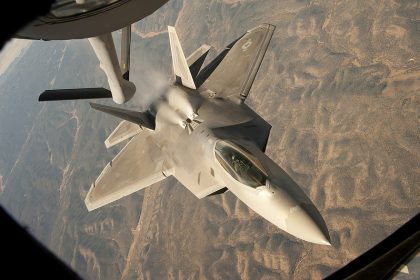
In the meanwhile, sequestration or not, the F-22 does not suffer so many budget constraints just having being awarded a $6.9 billion upgrade “indefinite-delivery/indefinite-quantity” contract.

David Cenciotti has contributed to this post

F-35C refuel

Image credit: Lockheed Martin

Enhanced by Zemanta

Entire fleet of F-35 stealth fighters grounded by new engine problem February 22, 2013

Posted by David Cenciotti in : F-35 , 2comments

On Feb. 22, the Pentagon decided to suspend the flights of all Lockheed Martin F-35 Lightning II fighter planes after a crack was found on a turbine blade of a test aircraft at Edwards Air Force Base, California.

The decision comes only nine days after the DoD had cleared the STOVL (Short Take Off Vertical Landing) variant of the 5th generation combat plane, designed the F-35B, to resume flying activity after a month long grounding due to a fueldraulic engine problem.

Even though both groundings were caused by engine problems, the extent of the last suspension is wider as it affects all the JSF (Joint Strike Fighter) types: the F-35A conventional takeoff version, the F-35B jump jet variant (destined to replace the AV-8B Harrier) and the F-35C Carrier Variant.

The crack on the low pressure turbine of the F135 engine problem will roughly require a week-long investigation according to a P&W spokesman quoted by DefenseNews.

According to the official statements, Lockheed Martin, Pratt & Whitney, which builds the engine for the fighter, are working closely to “ensure the integrity of the engine and return the F-35 fleet to flight as soon as possible.”

Maybe there’s someone in Washington DC who repent for killing the F-35′s second engine program….

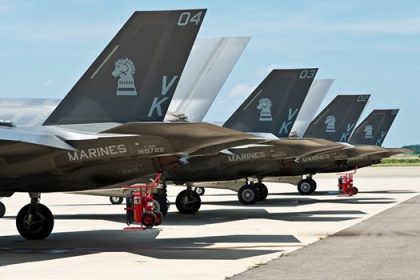
F35B take off

Enhanced by Zemanta

[Infographic] U.S. new raids, drone attacks target review process May 24, 2012

Posted by David Cenciotti in : Drones, Military Aviation , 1 comment so far

The Associated Press has recently published the first detailed description of the once classified military’s review process for choosing terror leaders to be added to the capture or kill list.

Two current and three former officials U.S. officials spoke on condition of anonymity to the AP and described the current targeting procedure, developed by the Assistant to the President of the U.S. for Homeland Security John Brennan, that concentrates power over the use of both drones and special forces outside war zones, withinin a small White House’s team.

According to the U.S. officials, the Pentagon’s role in targeting process has been minimized: it can still carry out its own procedures to make recommendations to the Secretary of Defense, but the Brennan’s team would be in charge of approving the final recommendation to Obama.

[Read also: The mysterious U.S. F-15E Strike Eagle detachment in Djibouti. Are they conducting covert air strikes in Yemen?]

Previously, targets were reviewed within a military-run procedure that saw Brennan as just one of the voices in the debate. Under the new plan, Brennan’s staff leads the debate on which targets must be put on the list and runs the names past agencies such as the State Department at a weekly White House meeting.

Since Brennan is still the one to approve the final recommendation to President Barack Obama, there’s a widespread concern that bringing more power to his team could turn it into a sort of military headquarters, entrusting the fate of terrorist targets all around the world to a small number of senior officials.

[Read also: Covert US drone operations tracked in real time, via Twitter. Exposing tactics too.]

Several human rights groups have requested the White House to make public the process by which individuals end up on the targeting lists and the revelation by the officials who have spoken to the AP could help showing the American public that terrorist targets are chosen only after painstaking and exhaustive debate.

This could be particularly useful in an election year, when drone strikes across the globe can be a quite sensitive debating point.

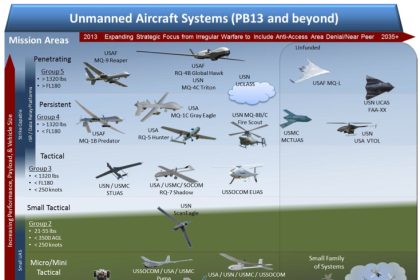
The above image is a modified version of an AP infographic released on May 21


Switch to our mobile site