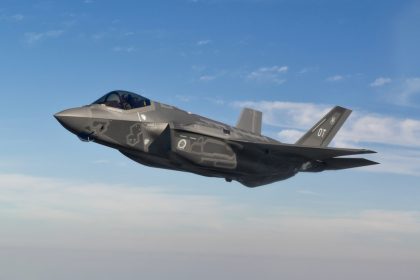
Non-US F-35 takes to the skies: first UK’s Joint Strike Fighter inaugural flight (with some nice low-visibility markings) April 16, 2012
Posted by Richard Clements in F-35.Tags: Lockheed Martin, Joint Strike Fighter, Royal Air Force, Lockheed, Royal Navy, STOVL, F-35 Lightning II, Lockheed Martin F-35 Lightning II
3 comments
Lockheed Martin’s Fort Worth facility has been deafened by the first non-U.S customers F-35 taking to the skies for the first time.
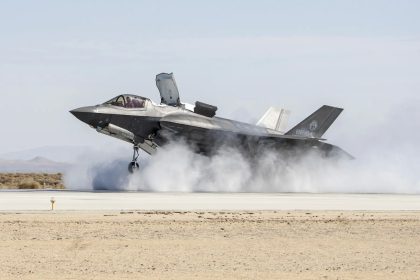
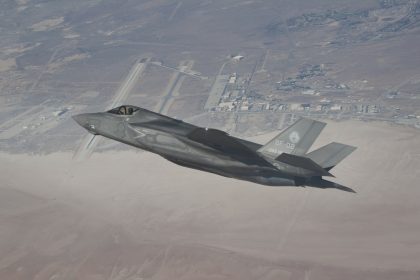
BK1, the UK’s first of three development aircraft which rolled off the production line during November 2011 and will fly with the RAF serial ZM135, made its inaugural test flight on Apr. 13 with Lockheed’s pilot Bill Gigliotti at the controls.
The second non-U.S F-35 destined for The Netherlands, has just rolled off the line and will be second in line to take to the air.
Image credit: Lockheed Martin
The “B” model flight announces a milestone in the F-35 story, but also the beginning of the UK’s involvement which is proving to be a story in itself.
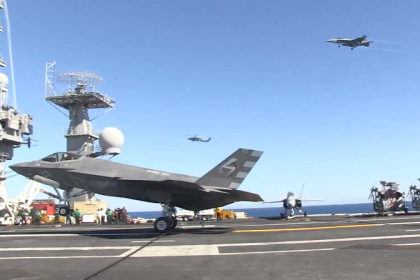
Originally, the first three test planes for the UK had to be “B” ones in the STOVL (short take off vertical landing) version, but in 2010 as consequence of the Defence Spending Review, decided to go with the C model with the arrestor hook. Following the decision, the UK worked out a deal with the US to swap BK3 (the third plane) to a C model (CK-1).
However after looking more closely at how much the change to the C model (that in the meanwhile experienced some problems with its arrestor hook to such an extent a new one had to be re-designed) will cost over the lifetime of the carriers the UK is currently building, the Ministry of Defense is thinking about reverting to the B model once again.
The two Queen Elizabeth Class Carriers (HMS Queen Elizabeth & HMS Prince of Wales) were originally designed with the STOVL version of the F-35 in mind, therefore were not designed with a cat and trap launch and recovery system similar to the one used by the American flattops. Hence, the cost of refitting one of the two carriers, only slightly smaller than a Nimitz class supercarrier, with a brand new catapult system, could be greater than anticipated.
Noteworthy, the new British JSF (Joint Strike Fighter) wears interesting low visibility national markings (roundel and tail flash). By the way, it’s not going to be easy to distinguish the UK’s roundel from that of Italy.
Written with The Aviationist’s Editor David Cenciotti
Image credit: Lockheed Martin via Combat Aircraft FB page
Related articles
- F-35B Finally on track? (theaviationist.com)
- F-35 progress report. The year so far in review. (theaviationist.com)
- “The F-35 remains essential to the future of air superiority” Panetta says. And Lockheed Martin reassures: “we will solve all JSF problems.” (theaviationist.com)
- Photo: F-35B with weapons bay doors open (theaviationist.com)
- First image of F-35B with an AIM-120C5 missile in the weapon bay (theaviationist.com)
Video: F-35A night refueling April 7, 2012
Posted by David Cenciotti in F-35.Tags: Boeing KC-135 Stratotanker, Joint Strike Fighter, JSF, Lockheed Martin, Lockheed Martin F-35 Lightning II, McDonnell Douglas KC-10 Extender, United States Airforce
add a comment
Just released by Lockheed Martin, a short but interesting video showing the F-35 performing night refueling from both a U.S. Air Force KC-135 and KC-10.
Related articles
- Photo: F-35 completes first night air-to-air refueling (theaviationist.com)
- KC-130J: a tactical gas station in the sky. Serving fighters, bombers, choppers. And maybe even F-35s sometime in the future. (theaviationist.com)
- The F-35 Looks Like a Stealth Spaceship at Night [Image Cache] (gizmodo.com)
- First image of F-35B with an AIM-120C5 missile in the weapon bay (theaviationist.com)
[Updated] New image of F-35B with an AIM-120C5 missile in the weapon bay March 28, 2012
Posted by David Cenciotti in F-35.Tags: AIM-120 AMRAAM, Air-to-ground weaponry, Joint Direct Attack Munition, Joint Strike Fighter, Lockheed Martin, Lockheed Martin F-35 Lightning II
5 comments
Update Mar. 29, 2012 20.30 GMT
Mar. 22, 2012 not only marked the first night air-to-air refueling: although not widely advertised, on the same day, the F-35B BF-4, during its 100th flight, piloted by RAF Sqdn. Ldr. Jim Schofield, flew with the open weapon bay door for an environmental testing with an (inert) AIM-120C5.
After showing some images of air-to-ground weapons inside the weapon bay, this is the second time a photograph shows an AIM-120 AMRAAM (Advanced Medium Range Air-to-Air Missile) carried by the 5th generation JSF (Joint Strike Fighter) in the Short Take Off Vertical Landing (STOVL) variant.
The F-35 will be able to carry one AIM-120D (AIM-120C8), an improved version of the BVR (Beyond Visual Range) missile, and a 1,000-lb JDAM (Joint Direct Attack Munition) or LGB in each weapon bay or two AIM-120Ds for each weapon bay (using a trapeze plus ejector to lower the inner missile into the airstream before launch).
Image credit: Andy Wolfe via Lockheed Martin
Related articles
- Photo: Lockheed Martin F-35′s first mission with external weapons (theaviationist.com)
- Photo: F-35B with weapons bay doors open (theaviationist.com)
- Breaking: never seen before F-35′s centerline gun pod unveiled (theaviationist.com)
- RAF’s weapon of choice in Libya to be upgraded as export opportunities emerge (theaviationist.com)
- F-35 progress report. The year so far in review. (theaviationist.com)
Photo: F-35B with weapons bay doors open March 14, 2012
Posted by David Cenciotti in F-35.Tags: CTOL, F-35 Joint Strike Fighter, gun pod, Joint Strike Fighter, Lockheed Martin, Lockheed Martin F-35 Lightning II, STOVL
add a comment
As flight testing continues, Lockheed Martin released new images of the F-35 Joint Strike Fighter.
After the F-35A CTOL (Conventional Take Off and Landing) with external stores, and the F-35 B flying for the first time with external weapons, including a never seen before white 25 mm gun pod on the centerline, the new photographs show the STOVL (Short Take Off Vertical Landing) variant with the weapon bay doors open.
Even if this is not the first time the aircraft’s weapon bays are visible, the following pictures are the first ones to clearly show both of them in detail (including the two dummy 2,000lb JDAMs).
Pictures were taken on Mar. 1, 2012.
Image credit: Lockheed Martin
Related articles
- Breaking: never seen before F-35′s centerline gun pod unveiled (theaviationist.com)
- Photo: Lockheed Martin F-35′s first mission with external weapons (theaviationist.com)
- F-35 progress report. The year so far in review. (theaviationist.com)
- F-35B Finally on track? (theaviationist.com)
Never seen before F-35′s centerline gun pod unveiled February 23, 2012
Posted by David Cenciotti in F-35.Tags: AIM-9 Sidewinder, CTOL, gun pod, Joint Strike Fighter, Lockheed Martin, Lockheed Martin F-35 Lightning II, Naval Air Systems Command, STOVL
4 comments
This image was posted on the Naval Air Systems Command (NAVAIR) few hours after I published the F-35 progress report with all the 2012′s updates.
On Feb. 22, six days after the first F-35A CTOL (Conventional Take Off and Landing) had flown with external stores, even the STOVL (Short Take Off and Vertical Landing) variant of the Joint Strike Fighter, flew for the first time with external weapons.
Noteworthy, along with the AIM-9X carried by the CTOL, the F-35B carried a never seen before (at least in photo) white 25 mm gun pod on the centerline.
Its particular shape was probably designed to fit in the triangular space between the fuselage weapons doors.
Image credit: Lockheed Martin
Exclusive Infographic: all Cyber Attacks on Military Aviation and Aerospace Industry February 21, 2012
Posted by Paolo Passeri in Information Security.Tags: Boeing 787 Dreamliner, China, Creech Air Force Base, Cyber Attacks Timeline, Cyberwar, Cyberwarfare, drone, F-35 Joint Strike Fighter, F-35 Lightning II, Hacking, Information Security, Iran, Jaxa, Joint Strike Fighter, JSF, L-3, L-3 Communications, Lockheed Martin, Lockheed Martin RQ-170 Sentinel, Malware, McAfee, Mitsubishi Heavy Industries, Northrop Grumman, Pentagon, RQ-170, RSA, SecurID, Sophos, Trend Micro, Virus
add a comment
2011 has been an annus horribilis for information security, and aviation has not been an exception to this rule: not only in 2011 the corporate networks of several aviation and aerospace industries have been targeted by digital storms (not a surprise in the so-called hackmageddon) but, above all, last year will be probably remembered for the unwelcome record of two alleged hacking events targeting drones (“alleged” because in the RQ-170 Sentinel downed in Iran episode, several doubts surround the theory according to which GPS hacking could have been the real cause of the crash landing).
But, if Information Security professionals are quite familiar with the idea that military contractors are primary and preferred targets of the current Cyberwar as the following infographic shows, realizing that malware can be used to target a drone is still considered an isolated episode, and even worse, the idea of a malware targeting the multirole Joint Strike Fighter is still something hard to accept.
However, things are about change dramatically. And quickly.
The reason is simple: the latest military and civil airplanes are literally full of electronics, which play a primary role in managing avionics, onboard systems, flight surfaces, communcation equipment and armament.
For instance an F-22 Raptor owns about 1.7 millions od line of codes , an F-35 Joint Strike Fighter about 5.7 millions and a Boeing 787 Dreamliner about 6.5 millions. Everything with some built in code may be exploited, therefore, with plenty of code and much current and future vulnerabilities, one may not rule out a priori that these systems will be targeted with specific tailored or generic malware for Cyberwar, Cybercrime, or even hacktivism purposes.
Unfortunately it looks like the latter hypothesis is closer to reality since too often these systems are managed by standard Windows operating systems, and as a matter of fact a generic malware has proven to be capable to infect the most important U.S. robots flying in Afghanistan, Pakistan, Libya, and Indian Ocean: Predator and Reaper Drones.
As a consequence, it should not be surprising, nor it is a coincidence, that McAfee, Sophos and Trend Micro, three leading players for Endpoint Security, consider the embedded systems as one of the main security concerns for 2012.
Making networks more secure (and personnel more educated) to prevent the leak of mission critical documents and costly project plans (as happened in at least a couple of circumstances) will not be aviation and aerospace industry’s information security challenge; the real challenge will be to embrace the security-by-design paradigm and make secure and malware-proof products ab initio.
While you wait to see if an endpoint security solution becomes available for an F-35, scroll down the image below and enjoy the list of aviation and aerospace related cyber attacks occurred since the very first hack targeting the F-35 Lightning II in 2009.
Of course aviation and aerospace industries are not the only targets for hackers and cybercriminals. So, if you want to have an idea of how fragile our data are inside the cyberspace, have a look at the timelines of the main Cyber Attacks in 2011 and 2012 (regularly updated) at hackmageddon.com. And follow @pausparrows on Twitter for the latest updates.
Photo: Lockheed Martin F-35′s first mission with external weapons February 20, 2012
Posted by David Cenciotti in F-35.Tags: AIM-120 AMRAAM, AIM-9 Sidewinder, air-to-air missile, Air-to-ground weaponry, CTOL, Edwards Air Force Base, F-35, Joint Direct Attack Munition, Joint Strike Fighter, JSF, Lockheed Martin F-35 Lightning II
add a comment
On Feb. 16, 2012, an F-35A aircraft from Edwards AFB, California, flew for the first time with external weapons.
Although no weapons were delivered during the sortie, the payload of the Joint Strike Fighter’s Conventional Takeoff and Landing (CTOL) variant in this test mission included two AIM-9X air-to-air missiles on the outboard wing stations, two internal 2,000-pound GBU-31 GPS-guided bombs and two AIM-120 AMRAAMs (Advanced Medium Range Air-to-Air Missiles) inside the two internal weapon bays.
The F-35 had also four external pylons that can carry 2,000-lb air-to-ground weapons.
The 5th Generation multirole fighter is designed to carry up to 18,000 pounds on 10 weapon stations featuring four weapon stations inside two weapon bays, for maximum stealth capability, and an additional three weapon stations on each wing.
Image credit: Lockheed Martin by Paul Weatherman
Along with the B STOVL (Short Take Off Vertical Landing) variant, the CTOL one was selected by Italy to replace the Air Force’s Tornado and AMX bombers.
Related articles
- F-35 First Night Flight video (theaviationist.com)
- The F-35 unable to meet South Korea’s fighter competition requirements? (theaviationist.com)
- Touch screen, voice activated commands, portal. A new smartphone or tablet? No, the Lockheed Martin F-35′s glass cockpit. (theaviationist.com)
Old Harriers and new choppers unleashed. Welcome aboard the Cavour aircraft carrier during “blue water ops”. January 27, 2012
Posted by David Cenciotti in Aircraft Carriers.Tags: AW-101, Caio Duilio, Cavour, F-35, Italian aircraft carrier Cavour (550), Italian Navy, Joint Strike Fighter, Lockheed Martin F-35 Lightning II, Marina Militare, McDonnell Douglas AV-8B Harrier II, NH-90, STOVL
2 comments
On Jan. 25, along with the ambassadors of NATO members, EU, Middle East and Mediterranean partners, The Aviationist has had the opportunity to visit the Cavour aircraft carrier during “blue water ops” off Civitavecchia port.
The event was jointly organized by the Ministry of Defense and the Ministry of Foreign Affairs to showcase one of the most important assets of the Italian Defense, one of the few European aircraft carriers that is not only important for military operations, but it is also a versatile platform that made its operative debut during the Haiti relief mission.
The Cavour symbolizes “a variety of possible uses that make it cost-effective” said Adm. Luigi Binelli Mantelli, future Chief of Staff of the Italian Navy.
Along with the F-35 program, the Italian Navy flagship was recently targeted by potential budget cuts as a consequence of the country’s financial crisis. However, “the AV-8B will fly until 2020, when they will be replaced by the F-35B. The MoD Di Paola has confirmed the project will continue. We don’t know how many aircraft we will get. The Air Force will get the majority, but even the Italian Navy will receive its planes” Binelli Mantelli said.
According to the Admiral, the F-35, is mainly an Air Force project, since the service needs the plane for its future. However, the Navy has joined the program and the future STOVL (Short Take Off Vertical Landing) variant of the Joint Strike Fighter, that was removed from probation one year earlier than expected, will serve as a force multiplier and complement the capabilities of the ship, capabilities that were showed to the ambassadors, diplomats and media during a tactical event involving the AV-8B+ Harrier (both single and double seat), AW-101 and NH-90 helicopters, the San Marco Regiment special forces and the Caio Duilio, a radar-evading Anti-Air Warfare destroyer.
Giovanni Maduli took the following images for The Aviationist.
“The F-35 remains essential to the future of air superiority” Panetta says. And Lockheed Martin reassures: “we will solve all JSF problems.” January 27, 2012
Posted by David Cenciotti in F-35.Tags: Eurofighter Typhoon, F-35, Italian Air Force, Italian Navy, Japan Air Self Defense Force, Joint Strike Fighter, Leon Panetta, Lockheed Martin, Lockheed Martin F-35 Lightning II, STOVL, USS Wasp
1 comment so far
On Jan. 26, several hours before U.S. SECDEF Leon Panetta would say the Joint Strike Fighter remains a DoD top priority program “essential to the future of air superiority”, Charles “Tom” Burbage, Executive VP of Lockheed Martin and General Manager of F-35 Program Integration, had already explained in a Press Briefing held in Rome that, in spite of rumors and criticism surrounding the costly fifth generation combat plane, he did not anticipate any significant downsizing of the program.
“Every country is reducing defense budget but no country has reduced the F-35” he said, explaining also that one of the most appealing features of the program for international partners is the involvement of local companies, which supply components, systems and know-how, well before a single aircraft is purchased.
Moreover, the F-35 has recently collected some important achievement, making Burbage and the rest of the company optimistic about the future of the entire program.
First came in December 2011 the selection of the JSF as the Japan Air Self Defense Force (JASDF) next gengeration aircraft, following the F-X competitive bid process that saw the Lockheed plane win on both the Eurofighter Typhoon and the Boeing F-18 Super Hornet.
Then the F-35B STOVL (Short Take Off Vertical Landing) was removed from probation one year ahead of schedule. Finally, the F-35C (Carrier Variant) was fixed with a new tailhook system that will be tested beginning next April, making arrested landing on aircraft carriers possible after the series of failed tests.
Last year was particularly important for the revolutionary plane. It flew about 20% more than expected, performed sea trials taking off and landing (vertically) from USS Wasp and “had no issues on the ship”, Burbage said, in spite of the alleged noise and heating problems.
Dealing with the series of issues highlighted by the JSF Concurrency Quick Look Review and other official and unofficial reports leaked at the end of last year, Burbage explains: “we are currently 20% into the test program. Today’s issues are not going to affect customers that will receive the aircraft years later, when the problem is fixed.”
In the last few days, Burbage and its entourage have met the Italian Minister of Defense Di Paola and the top Italian Air Force and Navy officers. Talks were satisfactory and Lockheed is quite confident that in spite of the financial crisis and raising criticism at political level, Italy will keep the commitment as Level 2 partner (worth 2 Billion USD already invested) in the program, which calls for total U.S. purchases of 2,443 F-35s in both A, B and C versions for the Air Force, Navy and Marine Corps, and envisages 697 planes for other partners (UK, Italy, Netherlands, Australia, Canada, Denmark, Norway and Turkey).
Japan aside, the F-35 has export chances also in South Korea, that is the only non-partner country Lockheed Martin is in talks for a possible JSF sale. Should the F-35 be selected in South Korea, the number of planes procured by Security Cooperative Participants (Singapore and Israel) and foreign customers (including Japan) will exceed the number of F-35s ordered by partners.
Since there’s no commitment yet nor any value was set, no reduction or cut in the amount of aircraft can be foreseen. Italy is not buying 131 planes. The initial requirement was for 69 F-35A and 62 F-35B (40 for the Air Force and 22 for the Navy), but Italy will buy the plane in batches: 4 planes, then 5 planes and so on. Therefore, Italy will have some F-35s, some of them will be STOVL ones to equip the Cavour aircraft carrier.
Eventually, in the U.S. the F-35 survived the Pentagon budget cuts: the US will continue buying F-35s, but will slow its purchase of the stealth fighter planes.
Indeed, it’s a very good period for the Joint Strike Fighter.