Investigators found that turned compressor vanes triggered a chain of engine damage that ultimately left the F-16 without sufficient thrust to remain airborne.
On Dec. 3, 2025, an F-16CM of the U.S. Air Force Air Demonstration Squadron (USAFADS), the “Thunderbirds”, crashed into a lakebed near Trona, California. While the pilot successfully ejected and survived with minor injuries, the aircraft was a total loss.
The Aircraft Accident Investigation Board (AAIB) report, completed on Sept. 1, 2026 and released publicly on Sept. 21, has determined “misaligned or turned vanes” in the jet’s engine were the cause that led to the catastrophic engine damage and, ultimately, the crash. The aircraft was powered by a Pratt & Whitney F100-PW-229 turbofan engine.
These vanes are located in the 4th and 5th stages of the engine’s compressor section, explained the report. The board could not conclusively determine what caused the vanes to turn, but found that the inability to inspect the affected compressor stages “without removing the engine from the aircraft and opening the rear compressor case” substantially contributed to the mishap.
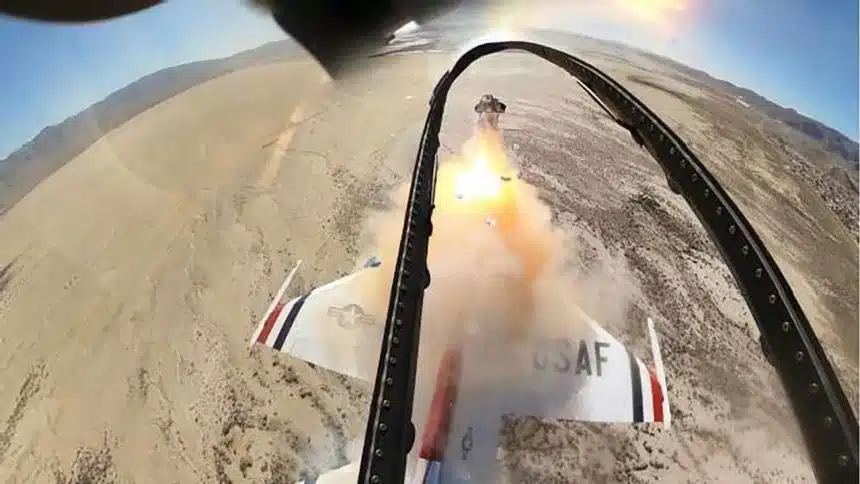
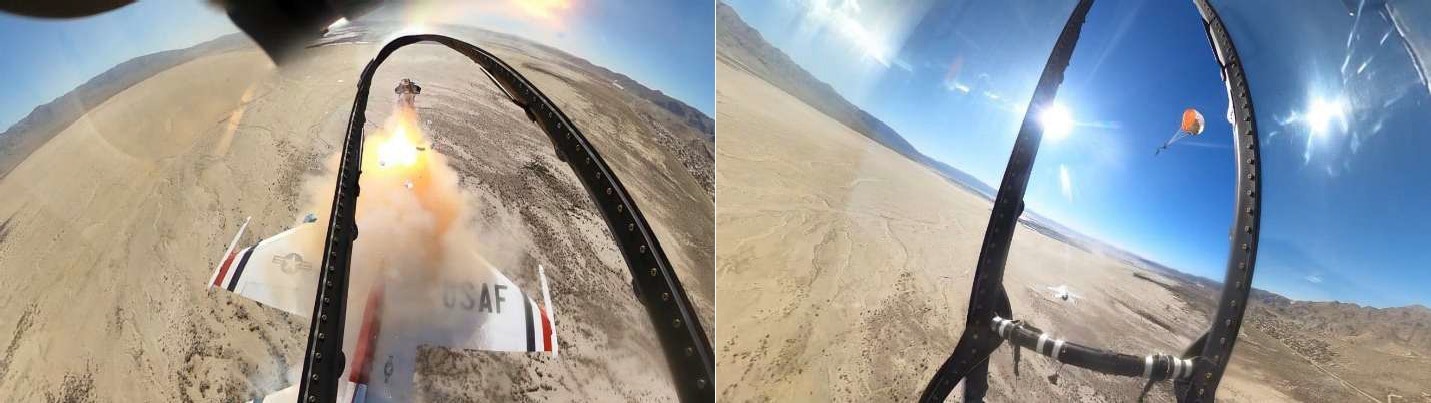
During the training flight, at approximately 10:21 am local time, the pilot experienced a sudden loss of thrust at low altitude. 4 minutes and 21 seconds later, after unsuccessful corrective measures to regain thrust, and “due to low altitude and decreasing airspeed,” the pilot ejected.
Reports of an F-16C Fighting Falcon from the U.S. Air Force Thunderbirds crashed near Trona Airport, south of Death Valley, California. The pilot reportedly ejected safely, suffered minor injuries, and was taken to a Ridgecrest hospital. pic.twitter.com/Nl9xRjcC6G
— Breaking911 (@Breaking911) December 3, 2025
The F-16 impacted the ground approximately 18 nautical miles East-Northeast of Naval Air Weapons Station (NAWS) China Lake, in the vicinity of Trona, California. While the pilot was recovered safely, the aircraft was a total loss and valued at $33.46 million.
The airframe had accumulated a total of 7,732 flight hours, while its engine had recorded 4,128 Total Accumulated Cycles (TAC). The report said the maintenance personnel, the pilot, maintainers and senior officers had followed all pre-flight, inspection, planning and emergency procedures.
The flight and mishap
The Mishap Aircraft (MA), F-16CM serial 92-3881, was assigned to the USAFADS within the 57th Wing at Nellis AFB, Nevada, and was part of a routine training flight with six other F-16CMs. The planned mission was to conduct “loops and rolls” in a “Delta formation.”
The sequence of events leading to the mishap began when the F-16 had, as planned, broke away from the formation by executing a 360-degree right turn. While rejoining the formation, the MP experienced a non-recoverable stall, which he described as if “the jet just…stopped midair.”
An attempt to execute a 10-15 degree climb to trade airspeed for altitude, in order to be able to divert to NAWS China Lake, also failed since “the engine produced insufficient thrust to maintain airspeed in level flight.” The MP then informed the MF that he was switching to Secondary Engine Control (SEC), transitioning from the Digital Engine Electronic Control (DEEC), which is the primary control.
However, switching to SEC caused the “fuel flow [to] increase substantially, causing the engine to ‘flameout’, and subsequently begin to spool down.” The Mishap Pilot (MP) reported that “it sounded like things were grinding” in the engine.
The MP then manually returned the engine back to DEEC. The engine “successfully restarted, and was able to operate at idle.” However, it “failed to respond to throttle input above idle” and the “thrust the engine produced was insufficient to sustain flight.” The MP then ejected at 10:25:55 am local Ttime, approximately 4 minutes and 21 seconds after the non-recoverable stall.
Engine’s history
The AAIB report noted that, in the weeks preceding the mishap, “the MA experienced a repeated engine oil indicating system discrepancy wherein the hydraulic and/or engine oil pressure (HYD/OIL PRESS) warning light was illuminated on the front cockpit right-hand warning/caution panel.”
The engine was last inspected during a 50-hour inspection on Oct. 1, 2025, with no defects noted. Previously, on Oct. 4, 2021, when the Mishap Engine (ME) was installed on a different aircraft, USAFADS technicians identified non-repairable damage to a first stage fan blade.
The ME was removed for potential Foreign Object Damage (FOD) and sent to the Jet Engine Intermediate Maintenance (JEIM) unit at Nellis AFB for inspection and repair. Repairable damage to fan blades in various stages was discovered on Mar. 7, 2025, Jun. 6, Jul. 18 and Nov. 21, with the engine returned to service after each instance.
Issues with the engine
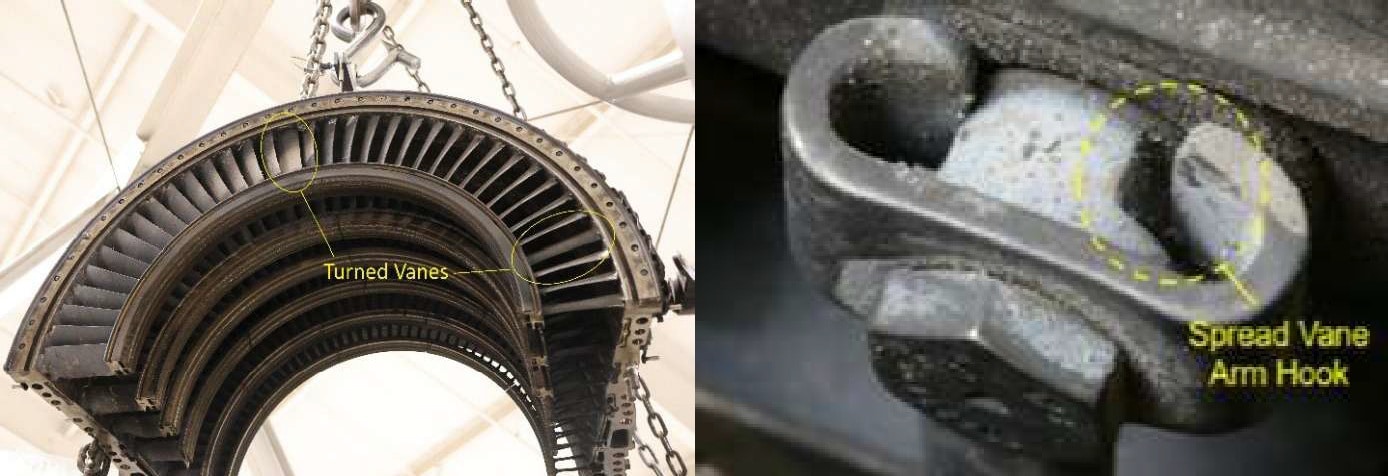
The AIB reviewed two engineering technical analysis reports of the engine, which noted “signs of claw spread on multiple rear compressor variable vane (RCVV) actuation linkages and subsequent vane turning along the 4th and 5th stages of the High Pressure Compressor (HPC).”
The report explained ‘claw spread’ as follows: “Vane turning occurs when the linkage arm hook loses flush contact with the machined timing slot of the RCVV (claw spread), resulting in an irregular wake pattern, or disturbed airflow, localized around the turned vane.”
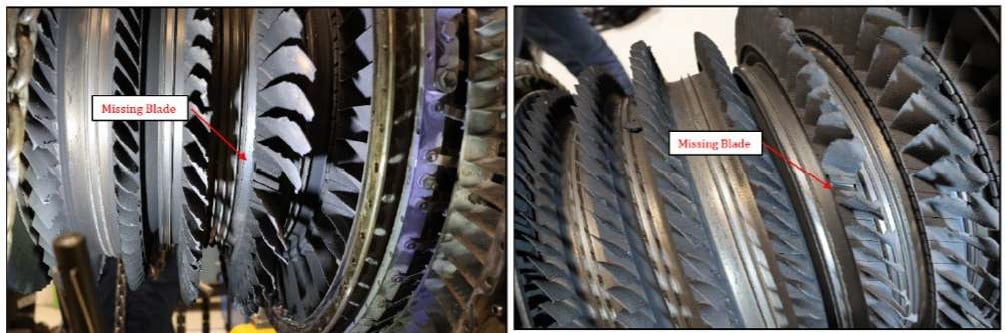
Investigators “concluded multiple vanes were turned at several locations along the 4th and 5th stages of the HPC and that single blade separations occurred at its 5th and 6th stages, resulting in subsequent damage through the 7th stage.”
While the board noted it was “impossible to conclusively determine” what caused the turned vanes, it noted an inability to inspect the fifth and sixth stages following an FOD event “substantially contributed to the mishap.”
“The post-FOD event guidance contains an inherent inability to inspect these specific sections of the engine core,” stated the report. “Additionally, the core of the engine is only inspected during scheduled maintenance when a core component reaches its overhaul threshold, leaving time for potential damage to progress undetected.”