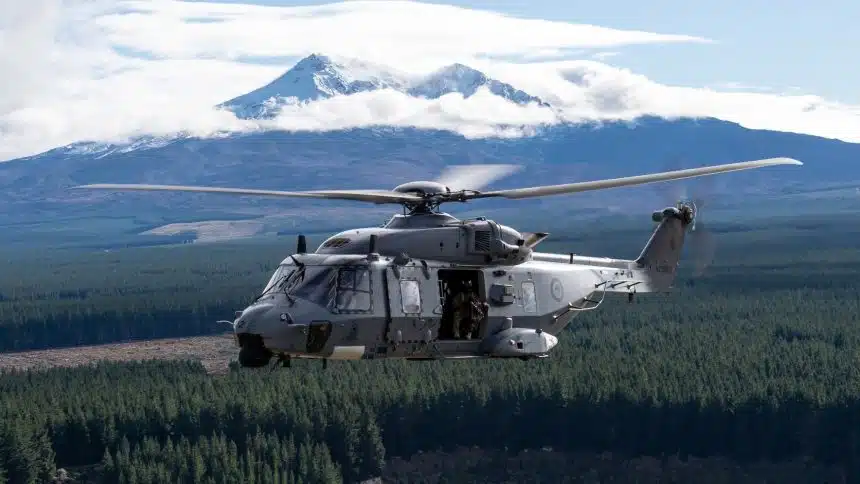
The Royal New Zealand Air Force has achieved impressive availability rates with its NH90 fleet, and one of its helicopters has now become the first NH90 in the world to surpass 3,000 flight hours.
An NH90 TTH helicopter of the Royal New Zealand Air Force (RNZAF) became the first of the type to complete 3,000 flight hours, the service said in a Sep. 7, 2026 release. The service said the feat was achieved “this week” and later mentioned “on Wednesday,” although the official photos and Airbus’ press release mention Aug. 26, 2026 as the correct date (which by the way was on Wednesday).
The helicopter was conducting a “normal test flight between RNZAF Base Ohakea and the coastline,” when the “clock ticked over the 3,000-hour mark,” the statement said. RNZAF Base Ohakea is the home of No. 3 Squadron, which operates the service’s eight NH90s.
The Royal New Zealand Air Force (RNZAF) No. 3 Squadron reached a very significant milestone. At the end of August 2026, aircraft TNZA002 officially became the world’s first NH90 to surpass 3,000 flight hours.
Dive into the story! 👉 https://t.co/nQ0m0HlYJc pic.twitter.com/sTTV5RJgC8
— Airbus Helicopters (@AirbusHeli) September 8, 2026
The RNZAF NH90s have logged over 20,000 flying hours, a significant achievement for the service’s small fleet and a type that has otherwise seen mostly poor service records with nearly all of its users – including neighbour Australia. The RNZAF has not only boasted impressive maintainability and availability records of its NH90s, as the type aircraft has also been on a long-distance flight record breaking spree since 2025 under Kiwi hands.
In September 2025 according to Defense News, two RNZAF NH90s flew a two-day 1,765-mile distance over water between Australia and New Zealand. This feat surpassed another over-water record achieved just a month prior, when two RNZAF NH90s flew between two countries for the first time, journeying 453 nautical miles from Cairns in Australia to Papua New Guinea, the service reported.
RNZAF NH90 records
The press release quoted NH90 Flight Commander Squadron Leader Lachie Johnston, who credited the “small team” of maintainers, supply chains and fleet planners who put in long days to keep the helicopters flying. The release also mentioned the team lead from Airbus for the NH90 program, Patrick Power, who “has worked continuously on the platform since its introduction.”
“The squadron relies on detailed maintenance planning to ensure maximum economies and efficiencies to provide the highest number of flying hours for the airframes. The early members of the project team put systems in place that are still bearing fruit to this day,” Johnston added.
Johnston referred to the over water flight between Australia and New Zealand, when two RNZAF No. 3 Squadron NH90s flew the 1,765-mile journey via Norfolk Island. In the record-breaking journey, the two NH90s carried 1,100 lb (500 kg) of external fuel tanks, and flew from Royal Australian Air Force (RAAF) Base Amberley, near Brisbane.
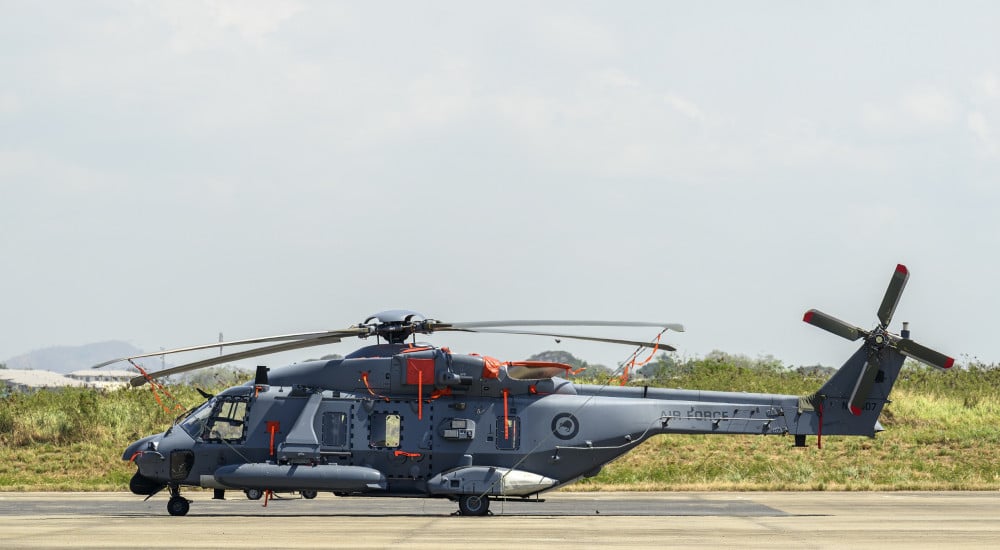
The RNZAF release quoted one of the pilots, Flight Lieutenant Hayley Vincent, who said the two 500 kg external fuel made for a “different silhouette”. An extra internal gas tank was also fitted, but that fuel was not required.
The unique flight was given an international Kiwi call-sign instead of the Warrior call-sign used for national flights. Both aircraft landed safely home at RNZAF Base Ohakea Sep. 30. The longest leg of the trip, 660 miles, took around four and a half hours.
The Squadron first trained for the feat with a “a long-range flight from RNZAF Base Ohakea to Invercargill.” Vincent said they generated a “fuel graph” to predict the amount of fuel burned at various waypoints with the aircraft weights, helping accurately track consumption during the flight.
Those calculations helped in the Australia to Papua New Guinea flight, where storms often gather in the afternoons around Port Moresby. Kiwi NH90s have been previously transported to Australia from the latter’s C-17 Globemaster IIIs.
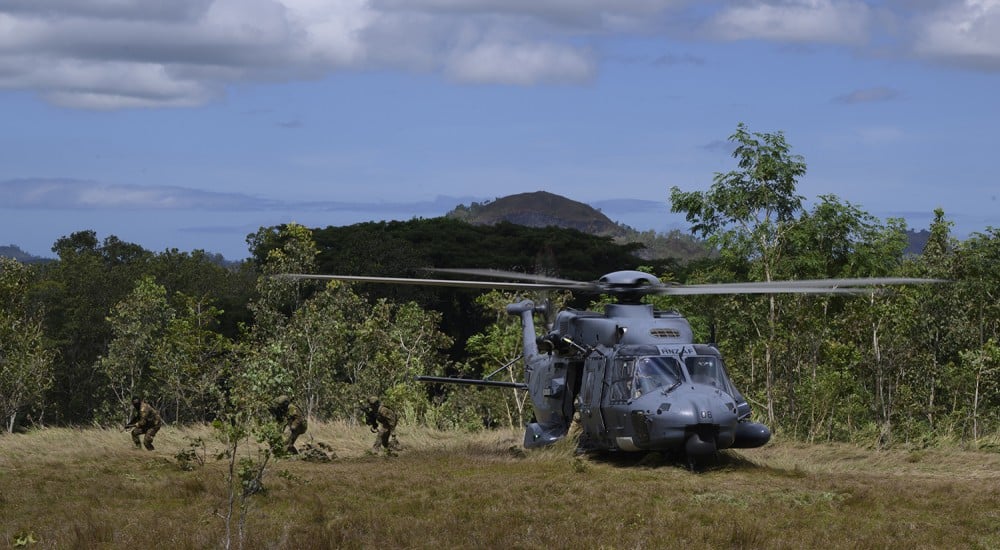
The RNZAF NH90s had also just concluded a successful deployment to Exercise Talisman Sabre in Australia, before they were sent to Papua New Guinea for the country’s 50th Independence Day celebrations.
RNZAF NH90s
Fully operational since 2015, the NH90 helicopters completely replaced the Bell UH-1H Iroquois. The RNZAF operated 16-17 UH-1s, which were initially delivered between 1966 and 1976 as the UH-1D and were subsequently upgraded to the H variant in the 1970s.
The RNZAF also lists a series of multi-utility roles for the NH90, ranging from core military tactical combat support for other services like the Army, to civilian functionalities.
“The NH90’s central role is to provide tactical air mobility operations for our Defence Force,” said the press release. “This includes support to special operations, casualty evacuation, and movement of troops and equipment. Additionally, the NH90 provides a range of support services to government agencies including search and rescue, police operations, disaster relief, and counter-terrorism response.”
NEWS || Today we’ve sent the first of our three @NZAirForce NH90 helicopters on an @AusAirForce C-17 Globemaster aircraft to undertake transport tasks to support @DeptDefence’s efforts in tackling the #AustralianBushfires.
#Force4Good pic.twitter.com/ilENR2CvFi
— NZ Defence Force (@NZDefenceForce) January 6, 2020
The latest release mentions HADR (humanitarian assistance and disaster relief) deployments RNZAF NH90s have served in since 2011-2012, like the Kaikōura earthquake and Tropical Cyclone Gabrielle.
A maintenance success
In May 2026, while reporting on seven of the No. 3 Squadron’s eight NH90s flying over Manawatū in a “rare formation flight,” the RNZAF claimed its fleet clocked 18,250 flying hours and an availability rate of 70%. “No. 3 Squadron maintainers have an enviable international reputation of having the highest NH90 serviceability rate in the world,” the service said.
It credited the successful flight to a combination of “hard work” by the maintainers, and “stars aligning” with the coincidental availability of all the aircrew and the benching of only one aircraft for maintenance. The service also said its NH90 fleet is the first in the world to have received “updated software with improved navigation and radio features,” which the maintainers “completed well before deadline.”
NEWS 📢The crew of our @NZAirForce NH90 helicopter rescued three people from floods in the Ashburton area overnight. A man was rescued from a tree surrounded by floodwater & an elderly couple were rescued from a car roof.
📸 File photo#Force4NZ #CanterburyFloods pic.twitter.com/9pQODRS0Vj
— NZ Defence Force (@NZDefenceForce) May 30, 2021
The RNZAF in May 2025 listed the Saturn “secure […] inter-aircraft communications system” and a New Zealand Civil Aviation-compliant aircraft identification system called the ADS-B OUT, as components of the software and equipment upgrade. The entire upgrade for the full fleet of eight NH90s took four weeks, in what would have been three years, had they been transported to the NH Industries facilities in Europe.
The RNZAF went for an in-house maintenance at RNZAF Base Ohakea itself, while successfully “securing equipment from an Australian Defence Force’s retired NH90.” This meant “modifications to New Zealand’s NH90 fleet could be done without grounding the fleet, allowing for the whole upgrade project of eight aircraft to be completed in just four weeks.”
Australia, which operated 46 NH90 airframes designated the MRH-90 Taipan (Multi-Role Helicopter) since 2008, retired them a decade ahead of schedule. The helicopters faced recurring engine failures and maintenance issues. In August 2022, Canberra approved the purchase of 40 UH-60M Black Hawks to replace the Taipan.
Our @NZAirForce NH90 helicopter crew transported Prime Minister @jacindaardern to Ashburton this morning to assess the region’s flooding, and to speak with local leaders.
Support from our Defence Force in the Canterbury communities is still ongoing.#Force4NZ pic.twitter.com/HfP6Tf7fly
— NZ Defence Force (@NZDefenceForce) June 1, 2021
Other users like Norway, Finland, Sweden and Belgium too don’t have a pleasant experience with their NH90s. France however remains a largely satisfied user, commencing the gradual induction of 18 NH90 Standard 2 helicopters, dedicated to special operations.