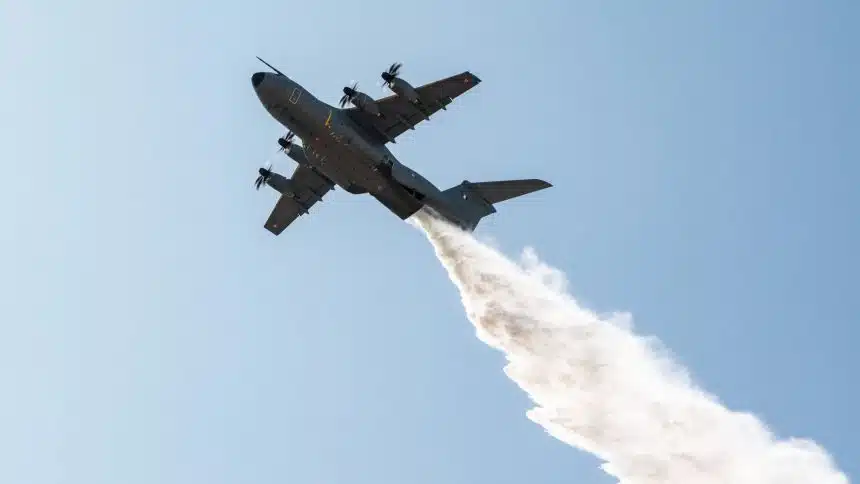
France has deployed the newly-developed firefighting kit aboard the A400M to support the assets suppressing the fires in the country’s southwest.
The Airbus A400M conducted its first firefighting operation when an aircraft operated by the French Air and Space Force (FASF) dropped fire retardant over raging wildfires in France’s southwest on Jun. 25, 2026. The move is part of the response to the massive fires that are raging in France.
With the flames now closing in on the city of Bordeaux, Paris is saying the blazes could continue burning for months. Over 220,000 persons have been evacuated, according to the European Commissioner for crisis management Hadja Lahbib.
Congratulations to the @Armee_de_lair and Sécurité Civile @SecCivileFrance for the first successful #A400M deployment to fight the wildfires in South West of France.
On July 25, a FFrench Air & Space Force A400M has been equipped with a Roll-on/Roll-off (RO-RO) firefighting… pic.twitter.com/ArWdhwUzeR
— Airbus Defence (@AirbusDefence) July 26, 2026
Airbus has been testing a modification kit to rapidly convert the A400M into a water bomber aircraft. This would allow the A400M to supplement traditional firefighting aircraft in case of high demand, such as with the current wildfires.
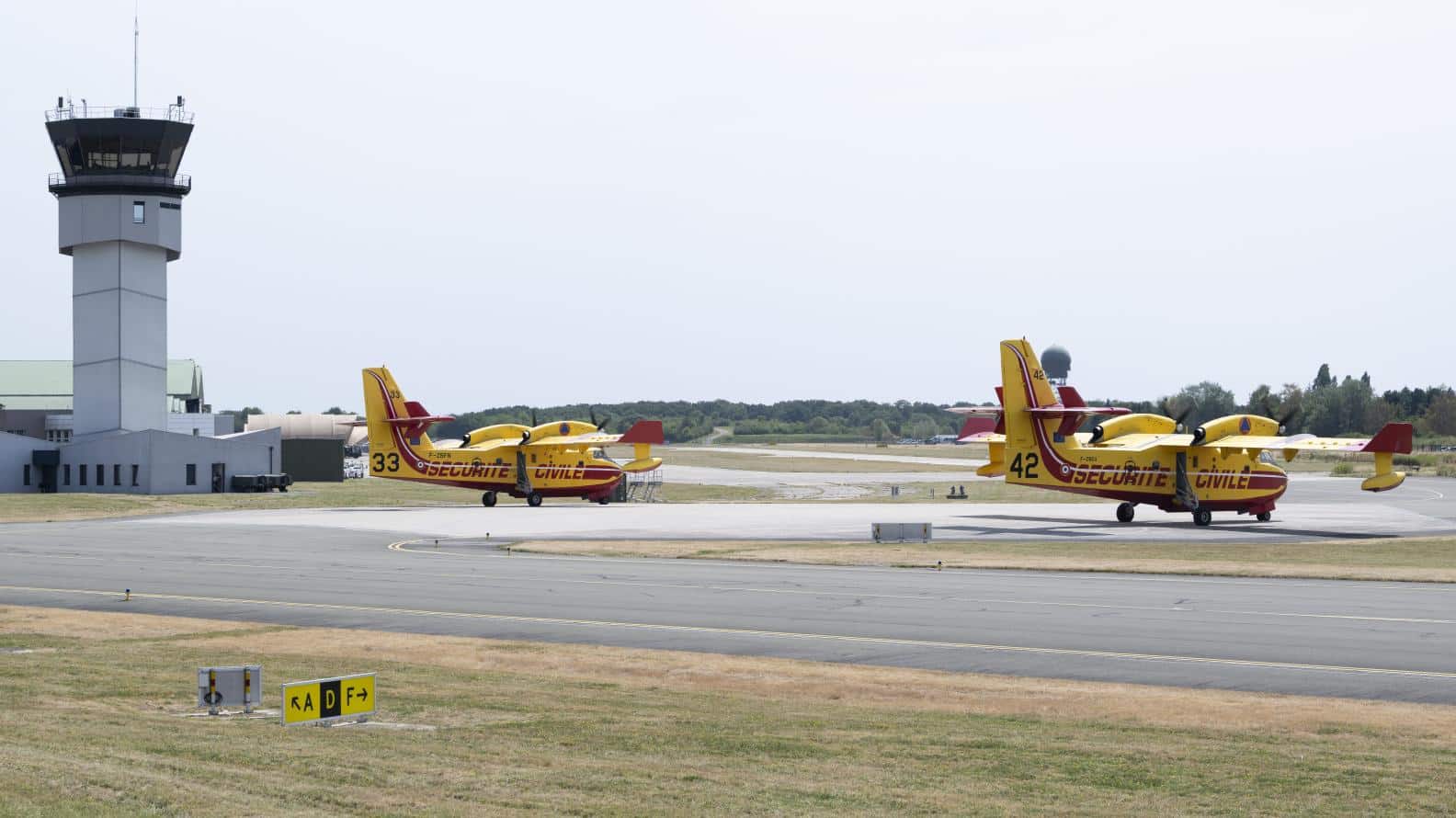
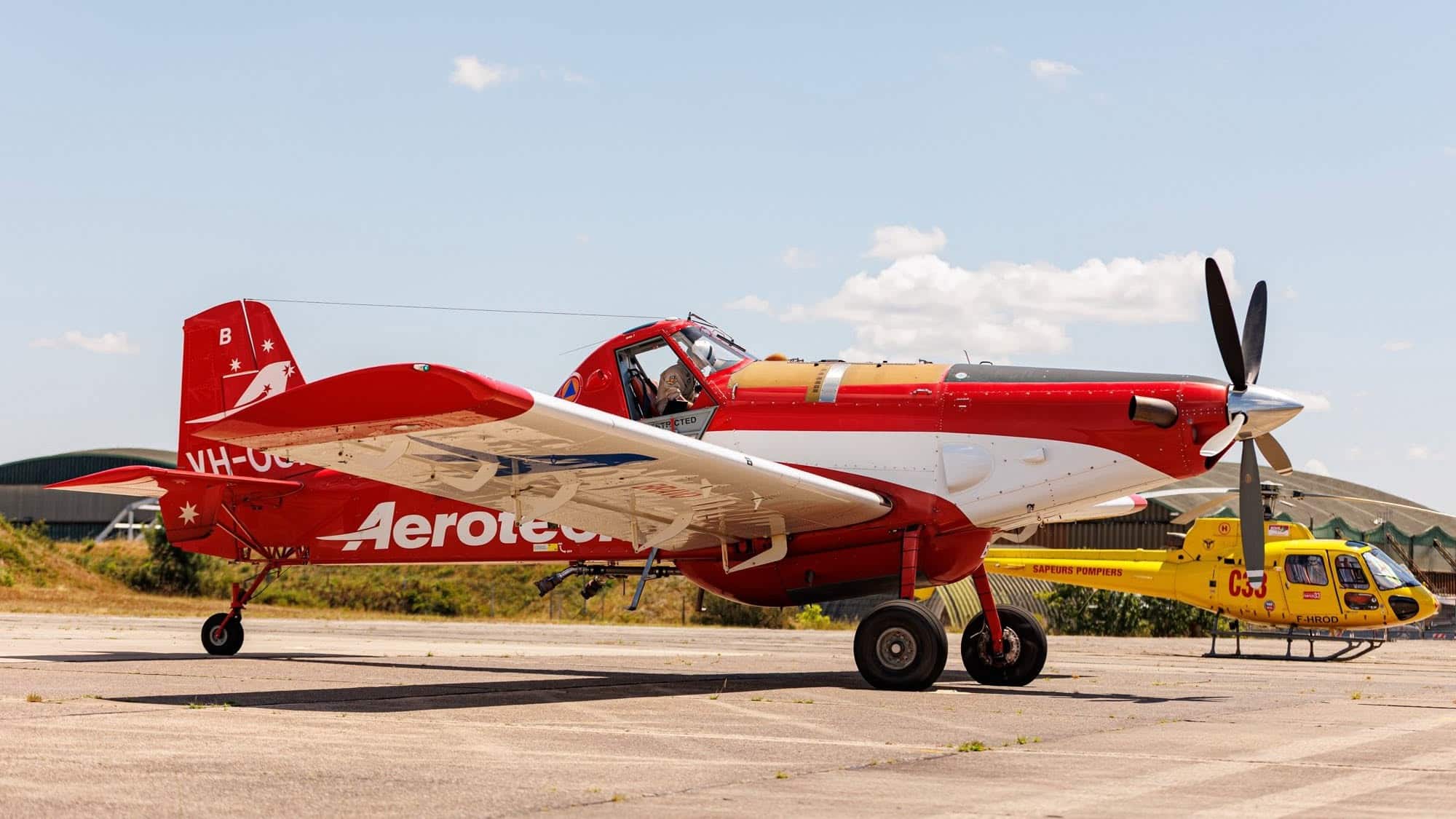
A variety of assets is being employed in the operation, including France’s fleet of 12 Canadair CL-415 amphibian firefighting aircraft operated by the Sécurité Civile (Civil Protection) force; Aérospatiale AS 350B3 helicopters of the Bouches-du-Rhône Fire and Rescue Service (Pompiers13) equipped with the Bambi Bucket system and Dash-8 Q400-MR multirole tankers. According to Aerial Fire, six Australian Air Tractor AT-802Fs from Aerotech Group and Xo Aviation have also been pressed into service for this effort.
L’ A400M dans la lutte🔥.
L’AAE avec @AirbusDefence , @CeamAwc , @SecCivileFrance et EMATT testent un kit de largage de retardant permettant de larguer jusqu’à 20t d’eau.
🎯 Appuyer les moyens spécialisés pour renforcer la lutte contre les incendies.
🔗 https://t.co/4H5AJFAfSB pic.twitter.com/XNbYfPZc3h
— Armée de l’Air et de l’Espace (@Armee_de_lair) July 24, 2026
A400M firefighting conversion and capability
The images released by Airbus and the FASF show the aircraft carrying the ‘A400M Firefighter Demo Kit Mk2’ and releasing the fire retardant. The press release by the Ministry of the Armed Forces suggested a single A400M being used in what it termed ‘Operation Sentinelle’, as a part of the continuing firefighting qualification testing being carried out with the Military Air Expertise Centre (CEAM), Airbus and the Directorate General for Civil Security and Crisis Management since 2024.
The service’s 25-plus A400Ms are based at Air Base 123 (BA 123) in Orléans.
A French A400M military plane dumped retardant over Lacanau’s wildfire-hit forest land, joining firefighting efforts for the first time pic.twitter.com/iLx4gMmyVI
— Reuters (@Reuters) July 25, 2026
Indonesia too has been considering ordering firefighting kits for two of its own A400Ms from Airbus. Airbus said in November 2025 that the roll-on/ roll-off (Ro-Ro) modular firefighting kit allows the A400M to be rapidly converted into a water bomber aircraft, capable of dropping up to 20,000 litres (20 tons) of fire retardant or water in a single pass.
The Ro-Ro kit can be rapidly installed in the cargo hold without any permanent airframe modification. The tanks, which discharge the fire retardant through the rear ramp, can be refilled in under 10 minutes by standard ground pumps.
The company previously conducted trials and certification of this firefighting module in April 2025 at Nîmes-Garons. The performance of the kits firefighting ability was separately assessed by Entente-Valabre’s Test and Research Centre (CEREN).
Images du premier largage de liquide retardant depuis la soute d’un A400M.
Une première mondiale, rendue possible en seulement quinze jours grâce à la mobilisation exemplaire de la Sécurité civile, des armées et d’Airbus. Merci à toutes celles et ceux qui l’ont rendue possible.… pic.twitter.com/XpA7afWFXb
— Sébastien Lecornu (@SebLecornu) July 25, 2026
The statement from Airbus said the so-called “cup grid tests” demonstrated “the accurate distribution and concentration of retardant upon reaching the ground,” with the modified A400M flying at altitudes below 30 meters (98 feet) and speeds around 230 km/hour (125 knots).
The French Ministry of the Armed Forces added that the 20 ton fire-retardant drop capability is “equivalent to two drops by Dash aircraft.” The Ministry further explained how the A400M would be used in the firefighting role: “The aircraft would operate upstream of the flames. Its use would thus contribute to providing ad hoc support to specialized resources in this field, particularly those of the Civil Security service: Canadair and Dash aircraft. This new capability would not change the aircraft’s structure, which would retain its military capabilities.”
Impresionante, gracias por vuestra lucha. pic.twitter.com/3y1g6UfmS1
— Capitán General de los Tercios (@capTercio) July 26, 2026
While the firefighting kit has now been used operationally, the trial phase will still continue and put the kit through the “necessary […] testing and qualification.” The statement further added “The CEAM (Air Warfare Experimentation Center) is fully committed to this effort, particularly in the operational performance evaluation phases and the formulation of conclusions.”
France’s former defense minister and current Prime Minister Sébastien Lecornu described the first real-life fire retardant drop by the A400M as “A world first, made possible in just fifteen days thanks to the exemplary mobilization of Civil Security, the armed forces, and Airbus.” He further added: “Thank you to all those who made it possible. This new capability now strengthens the aerial resources already deployed in the field.”
Le combat continue, force à ceux qui sont en pleine bataille encore aujourd’hui ! Il faudra s’en rappeler une fois le calme revenu. pic.twitter.com/XSc1l3UroF
— Thomas Pesquet (@Thom_astro) July 27, 2026
Europe mobilizes
Interestingly, at least one of the two Czech S-70 Firehawks that Prague ordered in November 2025 also operated in suppressing the fires in the village of La Temple, in the Gironde department in southwestern France’s Nouvelle-Aquitaine region. The Fire and Rescue Service of the Czech Republic said on X that “The Czech air firefighting module in France today helped protect the village of Le Temple, which was practically surrounded by flames. The fire in the Gironde department affected around 30,000 ha.”
🚁Český modul leteckého hašení ve Francii dnes pomáhal chránit obec Le Temple, kterou plameny prakticky obklíčily. 🔥 Požár v departementu Gironde zasáhl okolo 30 000 ha. Pracovali jsme ve formaci s francouzským vrtulníkem a kolegy ze Slovenska.
✅ Český tým je v pořádku. pic.twitter.com/A00Huqn6yN
— Hasičský záchranný sbor ČR (@hasici_cr) July 25, 2026
The EU Civil Protection and Humanitarian Aid has informed that seven aircraft and four helicopters from the Czech Republic, Croatia, Germany, Portugal, Serbia, Sweden and Turkey have been sent to France to help battling the fires.
More ⬇️https://t.co/8k2TLSrd7Y
— EU Civil Protection & Humanitarian Aid 🇪🇺 (@eu_echo) July 27, 2026
Europe is also mobilizing to help Spain with the wildfires that are similarly expanding across its territory. The Spanish Ministry of the Interior has informed that four Canadair CL-415s (two each from Italy and Greece), along with 14 and 33 specialist personnel, respectively, are in various stages of beginning firefighting operations.
Greece additionally reported sending a C-27J Spartan to Spain to support the operations.
Grazie Italia! 🇮🇹🇪🇺🇪🇸 https://t.co/nJkGxTCBzA
— EU Civil Protection & Humanitarian Aid 🇪🇺 (@eu_echo) July 27, 2026
France, Greece and Turkey have sent six aircraft to Spain, while Portugal has deployed 134 personnel and 41 vehicles. Many of these aircraft are Portuguese and Turkish AT-802 firefighting aircraft.
Teşekkürler Türkiye! 🇹🇷🇪🇺🇪🇸 https://t.co/Yz7XYQNBxF
— EU Civil Protection & Humanitarian Aid 🇪🇺 (@eu_echo) July 27, 2026
Firefighting efforts so far
The French Air and Space Force has also said that the BA 123 and BA 107 in Villacoublay were providing support to the Civil Security department’s CL-415s. The aircraft landed there for technical stops while dousing fires in the Fontainebleau forest in Seine-et-Marne region.
“At very short notice, the military was able to refuel the aircraft, allowing them to quickly resume their missions,” said a statement.
📍 Sud de la France | Les armées aux côtés de la population 🔥
➡️ Face à cette crise majeure, les armées sont mobilisées en appui des forces de sécurités intérieures et des services de secours engagés contre les incendies.
🎯 Au plus près des zones sinistrées, elles déploient… pic.twitter.com/vCWIb4m9nx
— Armée française – Opérations militaires (@EtatMajorFR) July 26, 2026
Other FASF bases supporting the firefighting efforts include BA 701 Salon-de-Provence in the Southeast, which is “positioned close to the most exposed areas” and “hosted a water-bombing helicopter from the Bouches-du-Rhône Fire and Rescue Service (SDIS) throughout the summer season.” Further west, BA 106 in Bordeaux-Mérignac reactivated its water-bombing base on Jun. 24, as it was “located in the immediate vicinity of the most vulnerable forest areas.”
En cette période d’épreuve, je salue l’engagement exemplaire de celles et ceux qui sont mobilisés face aux incendies. Le dévouement qui anime l’ensemble des acteurs de la lutte contre le feu, des services de secours aux sapeurs pompiers, appuyés par les hommes et les femmes des… pic.twitter.com/b0l6Xbh3YI
— Chef d’état-major des armées (@CEMA_FR) July 26, 2026
This facility specifically supported the resupply of water for the firefighting aircraft. “Since its commissioning this season, more than 240 movements have already been recorded, involving Dash 8s, Air Tractors, as well as Écureuil and Puma helicopters,” the FASF said.
Dans la vallée de la Restonica, le feu de forêt de Corte a déjà parcouru près de 1 000 hectares et continue de progresser. Les sapeurs-sauveteurs du 7e RIISC déploient 2 km de tuyaux pour contenir la progression des flammes.
👩🚒🚁Chaque nuit depuis une semaine, entre 10 et 20… pic.twitter.com/9l5q3swji9
— Sécurité Civile (@SecCivileFrance) July 27, 2026
Spain struggles
Even with Europe’s help, Spain is left with an aerial emergency rescue capability gap following the sanctions against Russia. In fact, its ten Russian Kamov Ka-32 11BC helicopters cannot receive spares or be serviced by Russian technicians owing to the embargo, La Razon reported.
Espagne : des hélicoptères anti-incendie russes cloués au sol par les sanctions européennes
Depuis 2024, l’Espagne combat les feux de forêt sans ses hélicoptères Kamov Ka-32. Ces appareils russes, capables de larguer plus de 5 000 litres d’eau avec une grande précision et… https://t.co/YYSCZ9tg8g pic.twitter.com/gBIvd80WMI
— Laurent Ozon (@LaurentOzon) July 25, 2026
Portugal is similarly a former user of the Ka-32 firefighting helicopter, highly recognizable for its coaxial rotors. The country sent six of the aircraft to Ukraine in late 2024, after they were grounded by the sanctions.
Others have also pointed to the Russian Beriev Be-200 jet-powered amphibian aircraft that could have been requisitioned to meet the pressing need. The aircraft have however their limitations in terms of logistics, maintenance and maneuverability while flying between valleys and mountainous regions.
Ces hydroavions amphibies russes sont extrêmement performants pour lutter contre les incendies de forêt. Ils peuvent charger 12000 litres d’eau en 14 secondes en rasant la surface de l’eau et sont parmi les plus rapides et les plus efficaces au monde dans leur catégorie (seul… https://t.co/VQJaGTuYHg
— Didier Maïsto (@DidierMaisto) July 26, 2026