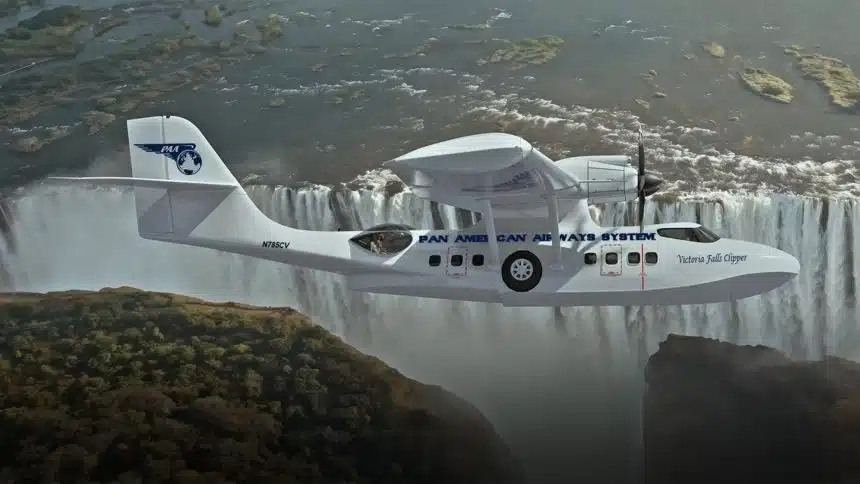
A plan for a modernised, turboprop-powered version of the iconic Catalina is one step closer to becoming realised with a Hong Kong operator signing a letter of intent covering the purchase of as many as 46 aircraft from the Florida-based Catalina Aircraft Trust.
The Next Generation Amphibious Aircraft (NGAA) Catalina II concept was officially launched in 2023 by the Catalina Aircraft Trust, who have been the custodian for the original PBY Catalina’s type certification for over a decade. Stepping beyond their expertise in supporting the operation of original Catalina aircraft worldwide, the firm believes that there is a market for a new, improved variant based directly on the tried and tested 1930s design.
Big news today up here at Oshkosh ‘23! Catalina Aircraft is announcing a production restart program with the rebirth of an iconic and respected legend as the Catalina II, a new production, modernized, turboprop with civil and government/military variants. #OSH23 #CatalinaII pic.twitter.com/Xs0QEc83af
— Catalina Aircraft (@NGAA_Catalina) July 25, 2023
Flightglobal was the first to report the news that Hong Kong-based startup Pan American Airways System (PAAS) – licensing the legendary Pan Am name from Pan American Global Holdings – has declared to the Catalina Aircraft Trust its intent to purchase up to 46 of its re-envisioned Catalinas.
PAAS would initially introduce the Catalina II on its planned ultra-luxury flights across Africa, before expanding to include routes in the Caribbean, South America, and South Asia. These services would take on the historic ‘Clipper’ name famously used by Pan Am’s transoceanic flying boat services in the first half of the 20th century, offering only 10 seats per aircraft alongside a lounge and galley.
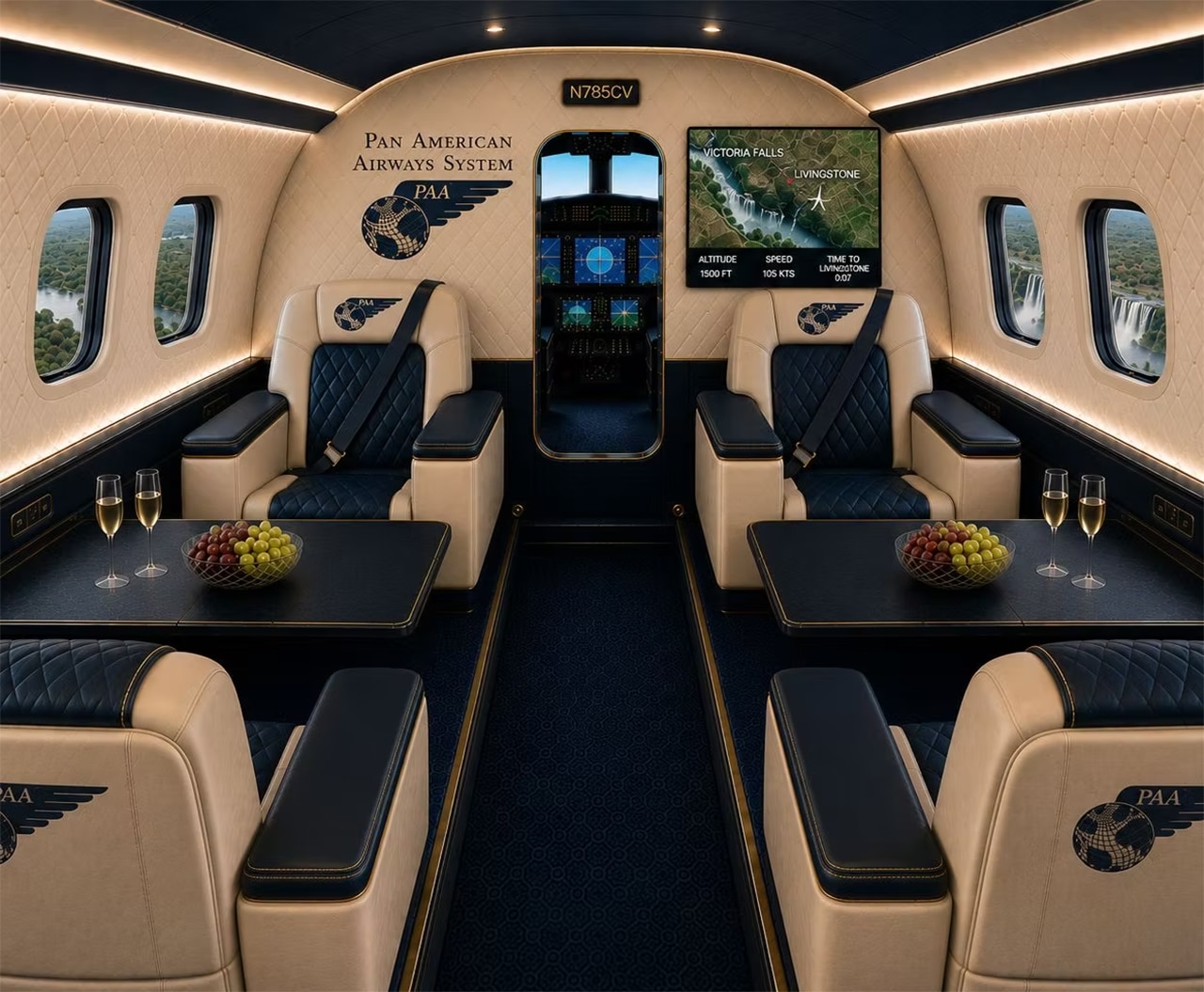
The company’s official website says its first services are planned to take flight in 2027, though as much of the development – let alone production – work for the Catalina II is yet to take place it is not certain how such a schedule would be implemented. The Catalina Aircraft Trust’s official press release says the airline’s letter of intent (LOI) is ‘funded’.
In 2023, the Catalina Aircraft Trust were aiming for deliveries of the Catalina II in 2029. It is unclear whether this has now been pushed back given the delay in receiving provisional orders. Flightglobal reports that options for engines, avionics, and other flight systems are now being evaluated by the firm, suggesting that even initial test flights are still some years away.
Nonetheless, founder and company president Lawrence Reece says that, as a modification of an existing aircraft type, he believes the Catalina II will have a simpler certification process than a completely new from-scratch design.
Military & Special Mission Use
Alongside niche commercial use, the Catalina II is being targeted at military and special mission customers as the benefits of amphibious fixed-wing aircraft are once again being examined by a number of nation states. Initially discarded decades ago as the helicopter came to reign supreme in the maritime domain, the generally greater speed, endurance, and airlift performance of flying boats and similar amphibious designs has been noted as being of potential value in future conflicts, particularly in the Pacific.
U.S. military personnel have frequently worked alongside and evaluated the Japanese ShinMaywa US-2 seaplane – Japan is one of a handful of nations to have never abandoned fixed wing amphibians. Additionally, the U.S. military has looked at a number of new and adapted designs aimed at introducing such a platform.
Based on its marketing and released renderings, the Catalina Aircraft Trust sees the Catalina II being suited to search and rescue (SAR), maritime patrol, anti-submarine warfare (ASW), firefighting, and gunship applications. In this regard, it would take on many of the same roles previously assigned to the original PBY Catalina.
Perhaps this is a niche that Catalina Aircraft can target with the relaunch of the iconic Catalina flying boat? A Leonardo Osprey AESA suite as seen in Fire Scout and SAR helicopter. Long loiter time. https://t.co/4WnyOGLMUk
— The Other Chris (@TotherChris) October 2, 2023
The company says a special mission-configured Catalina II could offer 19 hours of endurance, carry 30 troops or up to 16,000lbs of internal cargo/equipment, and operate with a wide flight envelope including speeds as high as 200 knots and as low as 62 knots. Two wing-mounted pylons could each support external stores up to 2,500lbs, and – if specified by a customer – the integral landing gear could be removed for additional performance at the cost of losing the flexibility of being able to land ashore.
I remain highly skeptical, but…they do have one of the major massive money holes, obtaining a new Type Certificate, already solved. I wish them luck. When I see three or more on their ramp, I will tip my hat! https://t.co/N6vYWerKnk
— aniemyer (@aniemyer) July 14, 2026
With only one customer currently lined up – one that, at present, operates no other aircraft – the Catalina IIs path towards operational service still has many hurdles to clear. The Catalina Aircraft Trust knows the Catalina airframe, and would certainly appear to have the expertise to make this project work. The main remaining question is whether more customers will follow suit and commit their names in the order books.
Notably, the Catalina Aircraft Trust is in fact one of two manufacturers in Florida vying to reignite the Catalina. The Catalina Aircraft Company of Vero Beach is aiming for a more ambitious effort, with a clean-sheet design inspired but not directly based on the original Catalina labelled the Catalina SPAR.
The Catalina Orkan is the first manned transport-class amphibious aircraft engineered from day one for open architecture, software defined mission systems and manned/unmanned teaming. pic.twitter.com/uCQBYutICn
— Catalina Aircraft Company (@catalina_air) June 22, 2026
As a clean-sheet design, the SPAR could offer more flexibility in terms of customer specification, even including options for payload ramps and a pressurized cabin. This would come at the cost of needing an all-new type certification by regulators.