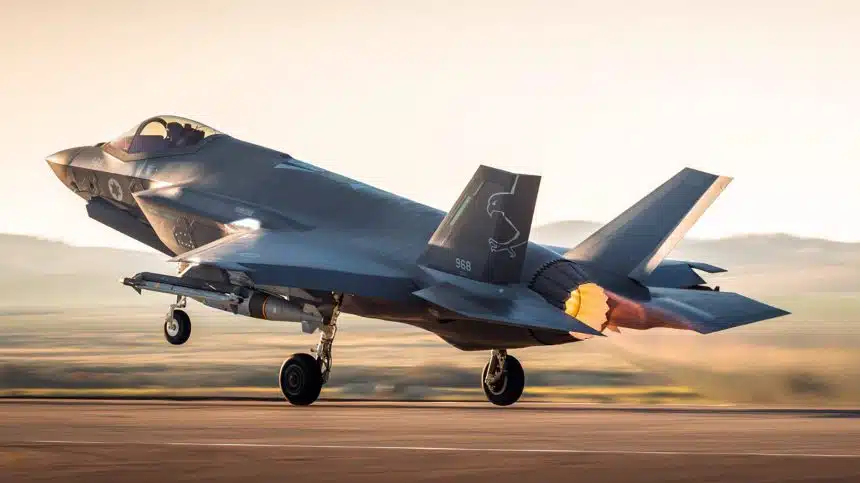
The Israel Ministry of Defense has signed a contract worth more than $34 million with Cyclone, a wholly owned subsidiary of Elbit Systems, to develop and integrate an extended-range capability for the F-35I.
On May 14, 2026, Elbit Systems announced on social media that the Israeli Ministry of Defense had signed a contract to develop and integrate an extended-range capability for the F-35I “Adir” fighter aircraft. Valued at approximately $34 million, the program is part of Israel’s ongoing efforts to enhance the aircraft’s operational flexibility and readiness for long-range missions in the years ahead.
According to the Elbit Systems press release, this is being done to “extend the aircraft’s operational range, reduce reliance on aerial refueling, and enhance operational flexibility across long-range missions.”
It is reportedly a part of the Israeli Ministry of Defence’s “force buildup strategy, led by Defense Minister Israel Katz and Director General Maj. Gen. (Res.) Amir Baram, to strengthen Israel’s readiness for an intense security decade ahead and maintain the country’s aerial and strategic superiority in the region.”
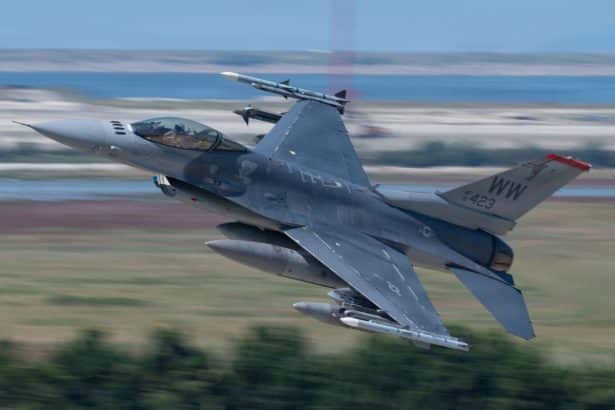
Some media outlets and observers have speculated that the tanks could be conformal fuel tanks, partly because the new system will be based on an existing Cyclone design originally developed for the F-16, and because the Israeli Air Force’s F-16I Sufa is famously fitted with CFTs. However, at this stage, nothing in the official wording suggests that the F-35I tanks will necessarily be conformal. The language used so far refers only to an extended-range capability and external fuel tanks, leaving open the possibility of underwing drop tanks, conformal tanks, or another external-tank configuration.
The decision to procure external tanks is likely based on experience in conducting Israel’s war in Iran, in which F-35I ‘Adir’ strike fighters saw extensive use over Iranian military sites.
F-35I aircraft usually carry 18,000 pounds of fuel giving them an unrefueled combat radius of roughly 700 miles during combat operations which is about half of the distance between Haifa and Tehran. This means that Israeli F-35Is cannot routinely operate in the Iranian interior without significant tanker aircraft support during combat operations.
Israel MOD Signs Contract with Elbit Systems for Extended Range Capability for the F-35 “Adir” Fighter Jet
Read More: https://t.co/51tKqUEIYd pic.twitter.com/eCdLWv7uoq
— Ministry of Defense (@Israel_MOD) May 14, 2026
As a result, strikes conducted against Iran by the Israeli Defence Forces during the ‘12 Day War’ in 2025 and Operation ‘Roar of the Lion’ this year have required extensive and complicated refueling missions over the Middle East, which have constrained the actions of Israeli aircraft. This led the Times of Israel to report that the first six days of the war saw “550 aerial refuelings” conducted by the IDF, with further refuelings conducted by the U.S. Air Force.
Therefore, there is a clear requirement for the need to extend the range of the F-35I to allow them greater freedom of manoeuvre during any future conflicts against Iran, or indeed if the current war continues. Both Israel’s F-15I ‘Ra’am’ and F-16I ‘Sufa’ fleets already operate with CFTs and drop tanks giving them a significant boost to their operational range during combat. If the F-35I fleet is upgraded in a similar way it would grant them a greater ability to operate in Iran’s interior regions, carrying larger weapons further to target Iran’s nuclear enterprise and military.
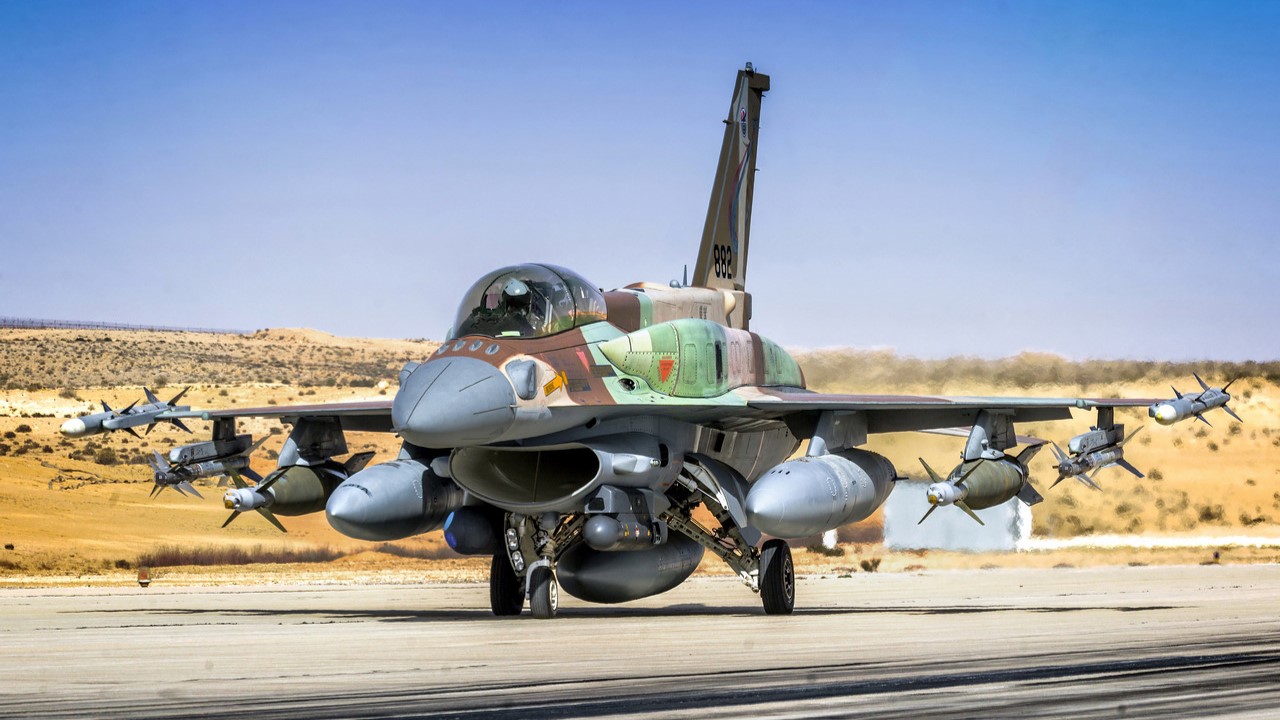
The F-35I ‘Adir’ (Mighty One)
The IAF currently operates around 48 F-35I fighter jets out of an initial order of 50, with additional orders of 25 each, made in 2023 and May of this year. The F-35I has seen extensive use by the IAF since its induction into service, participating in the bombings of Hamas in the Gaza strip, Hezbollah in Lebanon, multiple Syrian and Iranian weapon systems and groups in Syria, and more recently the conflict in Iran. This action saw F-35Is shoot down an Iranian air force Yakovlev Yak-130 trainer near the Iranian capital on Mar. 4, 2026.
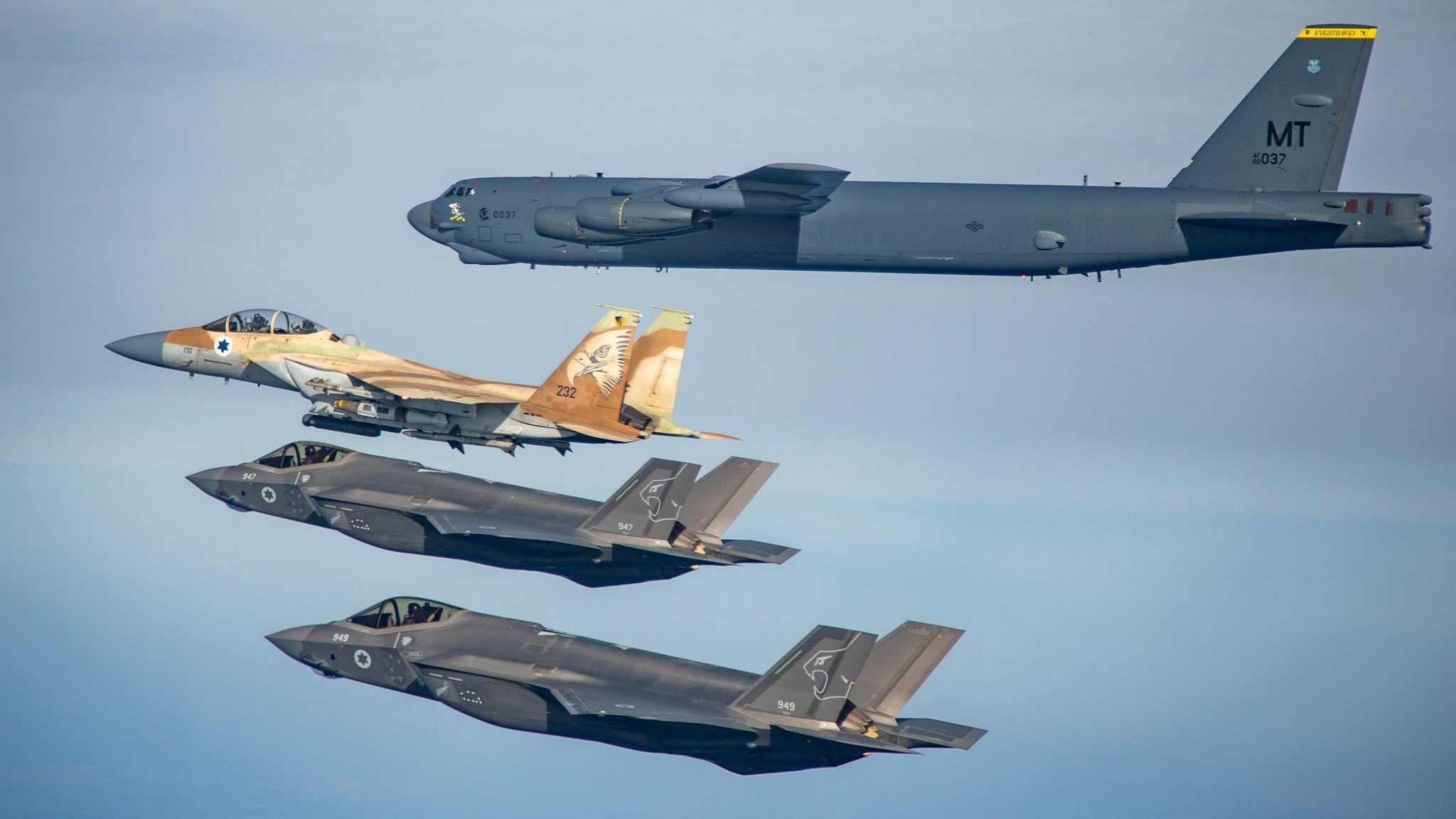
The F-35I is a stealth fighter, and so it carries its main armament inside internal weapon bays. Unlike most fourth generation aircraft the F-35 has, up until now, not been fitted with external fuel tanks, with its fuel instead stored in larger internal tanks. This gives the fighter on average more fuel than a clean winged fourth generation fighter, but not as much as a fighter with said external tanks.
Israel MOD Signs Contract with Elbit Systems for Extended Range Capability for the F-35 “Adir” Fighter Jet
Read More: https://t.co/51tKqUEIYd pic.twitter.com/eCdLWv7uoq
— Ministry of Defense (@Israel_MOD) May 14, 2026
This design choice had been made to ensure that the F-35 maintained a low radar cross section (RCS) in comparison to its fourth generation contemporaries as external fuel tanks and weapons carried on pylons disrupt the LO (Low Observable) geometry of the aircraft. These protrusions increase the surface area that can reflect radar waves back at a radar, instead of dissipating them or redirecting them, making the aircraft detectable. As a result, underwing hardpoints are typically avoided during combat operations so as to maintain the low observability of the fighter, allowing it to penetrate an opponent’s ground based air defences, destroying them and opening up the skies for non-stealthy aircraft to operate within their airspace safely.
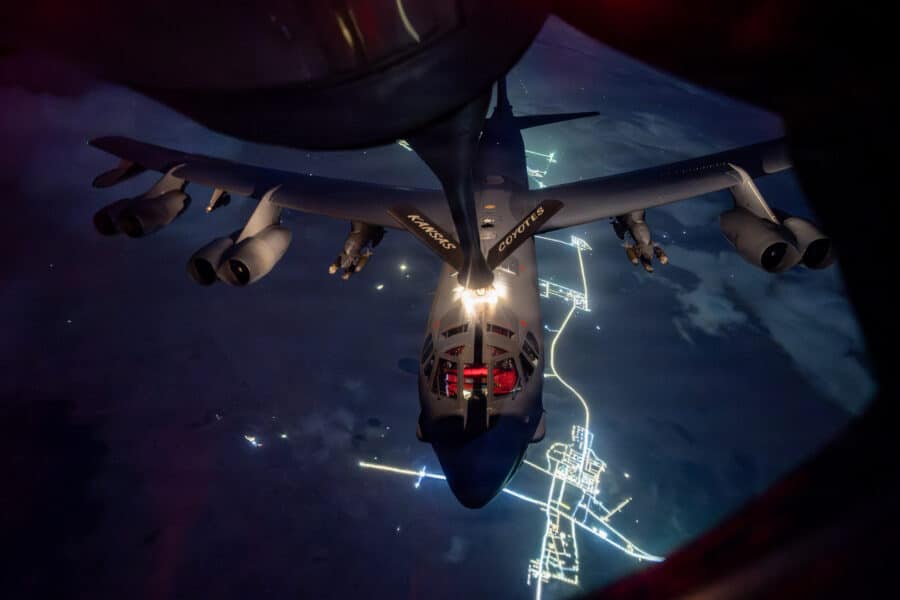
Imagery such as the above showing B-52 strategic bombers carrying short range JDAM GPS guided bombs, shows how degraded the Iranian ground based air defence structure has become, at least in some areas, as a result of the IAF and the USAF’s bombing efforts. As a result, for Israel there is likely now less of a need for the F-35I’s Low Observability, and more of a requirement for it to carry more bombs per sortie, at longer distances and without the limited refueling assets that Israel operates.
The extra range afforded by external tanks is likely becoming a more reasonable trade off for the increased RCS and detectability of the F-35I.
Footage and reports confirm: Israeli Air Force jets (F-35I Adir and F-15I Ra’am) were seen flying over Isfahan, central Iran, this morning during a wave of heavy airstrikes on military targets (missile facilities and air defense sites). That’s some next-level “we can reach you”… pic.twitter.com/DHJPZtRpTE
— Fahad Naim (@Fahadnaimb) March 15, 2026
However, the IDF may still wish for the external tanks to have some RCS reducing features to ensure that the RCS of the F-35I remains as low as possible. To this end the Lockheed Martin F-22 Raptor has recently been seen with stealthy drop tanks and so this is a possible route that Cyclone could be following, redesigning the tanks originally intended for the F-16I so that they have a lower RCS and therefore can be fitted to the Adir. However, as explained, specific details of the type of external tank and its design are so far unknown beyond what few details have been revealed publicly.
Notably, the F-35I ‘Adir’ is fitted with Israeli-only equipment and subsystems; Israeli sovereign electronic warfare systems and custom mission software that other F-35 operators do not have access to. It is unknown if these fuel tanks would be available for export to other F-35 customers, though this would come with a fair number of considerations for any potential buyer.
Either way, the IDF is clearly demonstrating that it sees its future opponents as operating far from Israel’s shores.