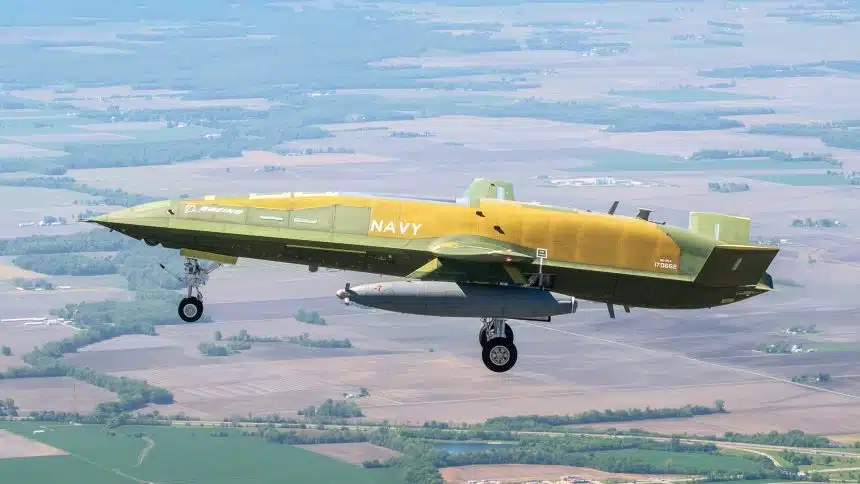
The U.S. Navy’s first production representative MQ-25 Stingray flew for the first time on April 25, 2026, demonstrating the ability to autonomously taxi, take off, fly and land.
Boeing and the U.S. Navy have officially announced first test flight of a production representative operational MQ-25A Stingray unmanned tanker. The Aviationist was the first and only outlet to report about the milestone soon after the aircraft landed back at MidAmerica St. Louis Airport in Mascoutah, Illinois, on Apr. 25, 2026.
The first flight
The MQ-25A took off at 10:49 a.m. CDT and flew for approximately two hours, according to the service. The test saw both Boeing and Navy Air Vehicle Pilots (AVPs) controlling the aircraft from the Unmanned Carrier Aviation Mission Control System (UMCS) MD-5 ground control station, which integrates Lockheed Martin’s MDCX system.
The images and video released by Boeing show the MQ-25 accompanied by a company-owned TA-4J Skyhawk and a U.S. Navy UC-12M Huron as chase aircraft. The drone was carrying the same Cobham ARS pod already used by the F/A-18, which will allow it to deliver up to 14,000–16,000 lb of fuel at 500 nautical miles, the Navy told Congress in an August 2025 report.
A new era in naval aviation takes flight!
The first @USNavy MQ-25A Stingray™ has completed its first flight, demonstrating its ability to taxi, take off, fly, and land autonomously.
MQ-25A will extend the carrier air wing’s reach by providing unmanned aerial refueling. pic.twitter.com/mZKCb8IpBE
— Boeing Defense (@BoeingDefense) April 27, 2026
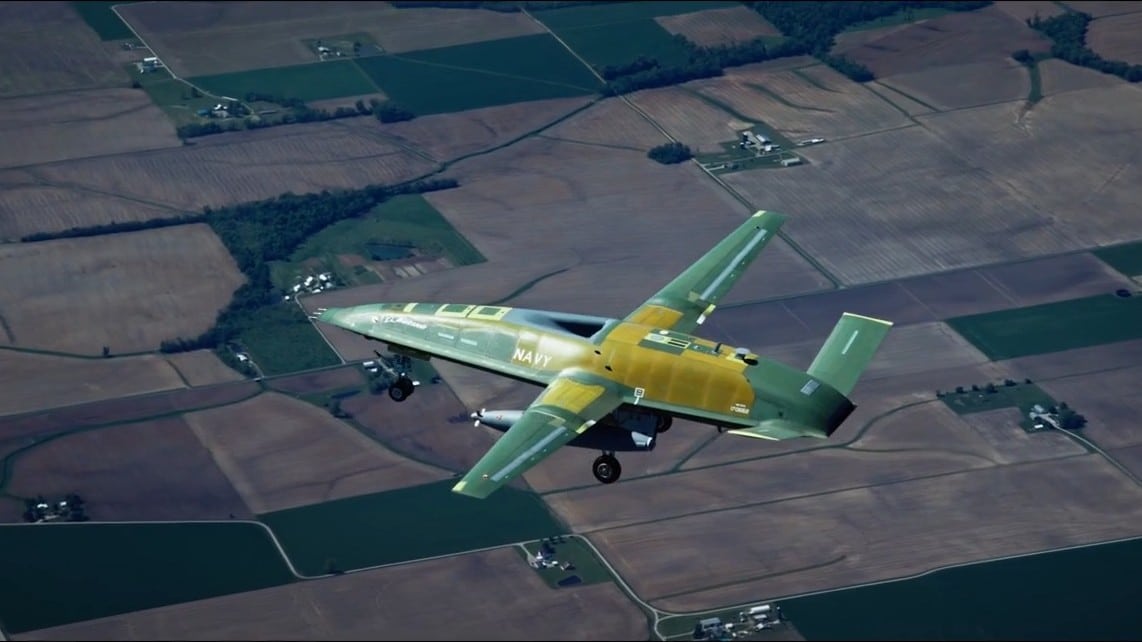
The maiden flight demonstrated the MQ-25’s ability to autonomously taxi, take off, fly, land and respond to commands from the GCS. The flight followed a pre-determined mission plan which included a series of maneuvers and tests, successfully validating the aircraft’s basic flight controls, engine performance, and handling characteristics, according to the service and the company.
“Achieving this first flight underscores the strong partnership between the Navy and our industry partners,” said Rear Adm. Tony Rossi, who oversees the Program Executive Office for Unmanned Aviation and Strike Weapons (PEO (U&W)). “The MQ-25A is not just an aircraft: it’s the first step in integrating unmanned aerial refueling onto the carrier deck, directly enabling our manned fighters to fly further and faster. This capability is vital to the future of naval aviation.”
As we noted in our previous reporting, the first flight of the production representative MQ-25 comes almost seven years after the first flight of the T1 test asset on Sept. 19, 2019.
“Today’s successful flight builds on years of learning from our MQ-25A T1 prototype and represents a major maturation of the program,” said Dan Gillian, vice president and general manager, Boeing Air Dominance. “The MQ-25A is the most complex autonomous system ever developed for the carrier environment, and this historic achievement advances us closer to safely integrating the Stingray into the carrier air wing.”
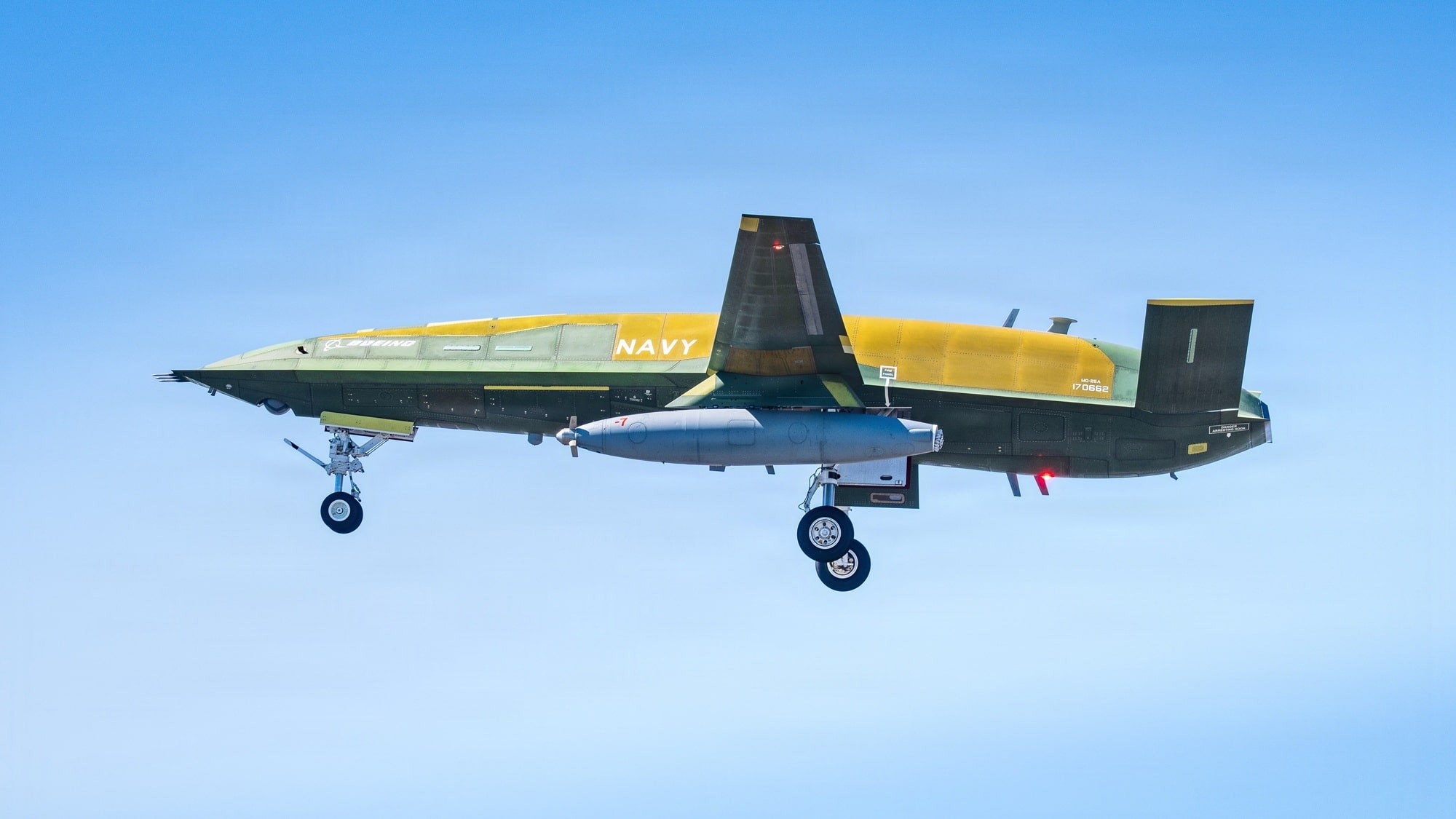
The aircraft is the first of four Engineering Development Model (EMD) aircraft that will be delivered to the Navy under an $805 million contract awarded in 2018. The company previously said that a total of nine aircraft are being built to conduct the required testing in support of that timeline, with five of these aircraft dedicated to static testing.
Earlier this year, in January, Boeing and the U.S. Navy’s Naval Air Systems Command (NAVAIR) announced that the production representative prototype was undergoing taxi trials. Later on, the aircraft completed high-speed taxi testing, paving the way for the first flight.
“I am incredibly proud of the team for working tirelessly over the last several months to achieve this milestone,” said Capt. Daniel Fucito, Unmanned Carrier Aviation program manager (PMA-268). “The successful first flight officially initiates the rigorous flight test program, which will focus on expanding the aircraft’s performance envelope and verifying all mission systems.”
Boeing and the Navy will conduct additional test flights out of MidAmerica St. Louis Airport to further validate the aircraft’s flight controls and capabilities, expand the flight envelope and continue ground control station integration. Once this phase is completed, the MQ-25 will fly to Naval Air Station Patuxent River, Maryland, to prepare for carrier qualifications.
A Long-Awaited First Flight
The MQ-25 program suffered some delays in its development which slowed down the transition to the EMD flight testing phase. The unmanned tanker was first expected to reach the Initial Operational Capability (IOC) in 2024, after the first deliveries in 2022.
December 2025 saw the confirmation by senior officials that the first flight, described as a pivotal milestone for the future of unmanned carrier aviation, slipped to early 2026. At the time, the IOC was already moved to Fiscal Year 2027.
The defense budget request for FY2027, however, now states that IOC has been further moved to the second quarter of FY2029. Initial Operational Test and Evaluation (IOT&E) is planned between the second and fourth quarter of FY2029.
The Navy’s MQ-25 drone refueler won’t reach IOC until FY-2029, according to new budget documents, another major delay for the program. It was originally supposed to reach IOC in 2024 but that date has been pushed back multiple times pic.twitter.com/1Pi9JYmkQq
— Audrey Decker (@audrey_decker9) April 27, 2026
Meanwhile, the Navy is continuing its planned acquisition of 76 MQ-25s, which also include the nine to be used for testing, for a to $181.6 million flyaway unit cost. Since last 2025, the service included three aircraft per year, which will increase to five per year in 2028 and to seven per year in 2029.