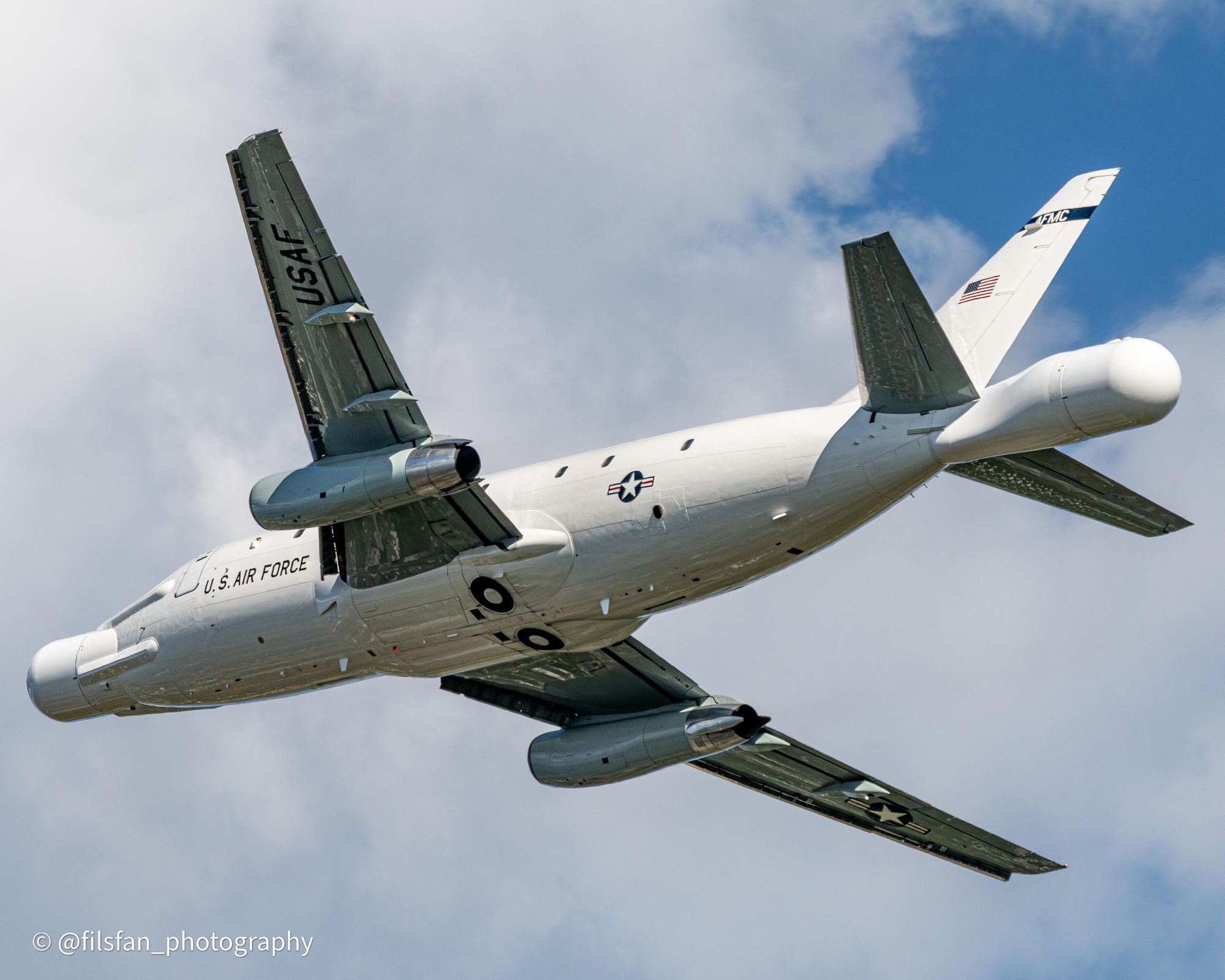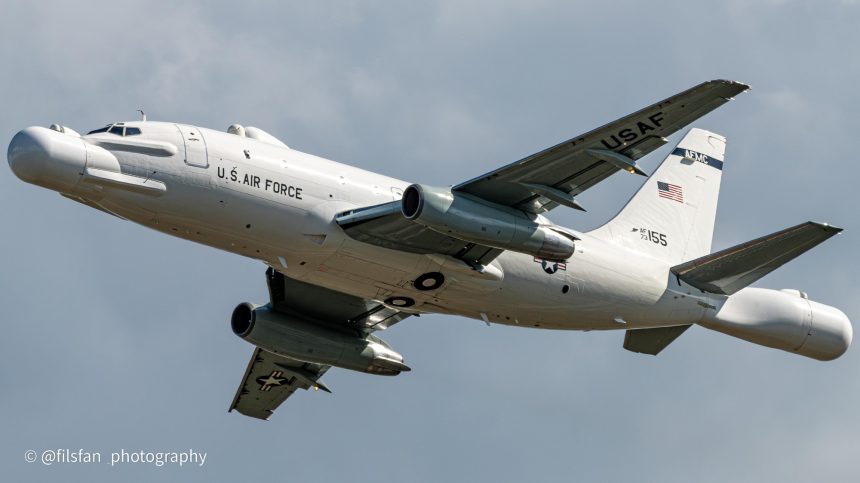
The deployment of the one-of-a-kind 737 to MacDill Air Force Base, Florida, to support the Artemis II launch, provided aircraft spotters and photographers with an unprecedented opportunity for a closer look at the NT-43A “RAT 55” and its dorsal EO/IR turret.
As we reported in detail yesterday, the highly-modified Boeing 737-200, the U.S. Air Force NT-43A, better known with its callsign RAT55 (or RATT 55), was among the assets operating around Cape Canaveral to support the Artemis II launch on Apr. 1, 2026.
Both on the day of the launch and the day prior to that (when a rehearsal was carried out), the aircraft, usually employed as Radar Airborne Testbed (RAT) and believed to be used almost exclusively to evaluate the radar signatures of stealthy aircraft, flew from MacDill Air Force Base, Florida, and operated to the north of the launch pad, in an airspace reserved by NOTAM 03/643 (KZMA-A1035/26):
!CARF 03/643 ZMA AIRSPACE DCC EROP K0949 WINDOWABC SUPT STNR ALT RESERVATION WI AN AREA DEFINED AS 285000N0804700W TO 290400N0792900W TO 292800N0793400W TO 291500N0810100W TO POINT OF ORIGIN FL200-FL350 2604012125-2604020105
Interestingly, the aircraft did not use its usual callsign, but a NASA one (NASA 522), and was also visible on flight tracking websites along with the other aircraft observing the launch, such as one of the agency’s famous WB-57 Canberra high-altitude research aircraft, N926NA.
#AE654A as #NASA522/#RATT55 #ACD5A1 as #N926NA
NT-43A tail number 73-1155 getting in to position along with one of the WB-57s tail number N926NA to support the launch of Artemis II. Just beautiful! pic.twitter.com/Eruu82tjTS
— Norb (@norb420) April 1, 2026
As we had speculated by connecting all the dots, the aircraft was indeed performing data-collection duties for the Artemis II launch, as the U.S. Air Force confirmed to TWZ, although the exact scope and details of this new role are still unclear. Generally speaking, the mission itself is not new, as the U.S. Air Force previously operated another asset dedicated to supplementing land- and sea-based tracking stations and covering telemetry gaps: the EC-135 Apollo/Range Instrumentation Aircraft (A/RIA), which later became the Advanced Range Instrumentation Aircraft (ARIA).
In an article about ARIA, that you can find here, we explained:
During the Apollo missions, ARIAs would fly where they were needed, and would receive and record the telemetry data of the spacecraft on magnetic tape recorders. In addition to this, they were also used as a receiving and transmitting base for verbal capsule communications between Houston and the spacecraft. The recorded telemetry data could either be held for post mission analysis, or could even be re-transmitted over different bands in real time.
Because of the aircraft’s mission high quality images of RATT55 are somewhat uncommon and usually only appear when the jet makes trips outside of the Nevada Test and Training Range (NTTR).
Noteworthy, for the NASA Artemis II support mission, the NT-43A was fitted again with a removable dorsal enclosure and Electro-Optical/Infra-Red turret, which were spotted in other photographs of the aircraft taken from distance. The top “humps” are indeed clearly visible in the images taken by photographer Tim Stevenson at MacDill AFB who sent us the photos that you can find in this article.
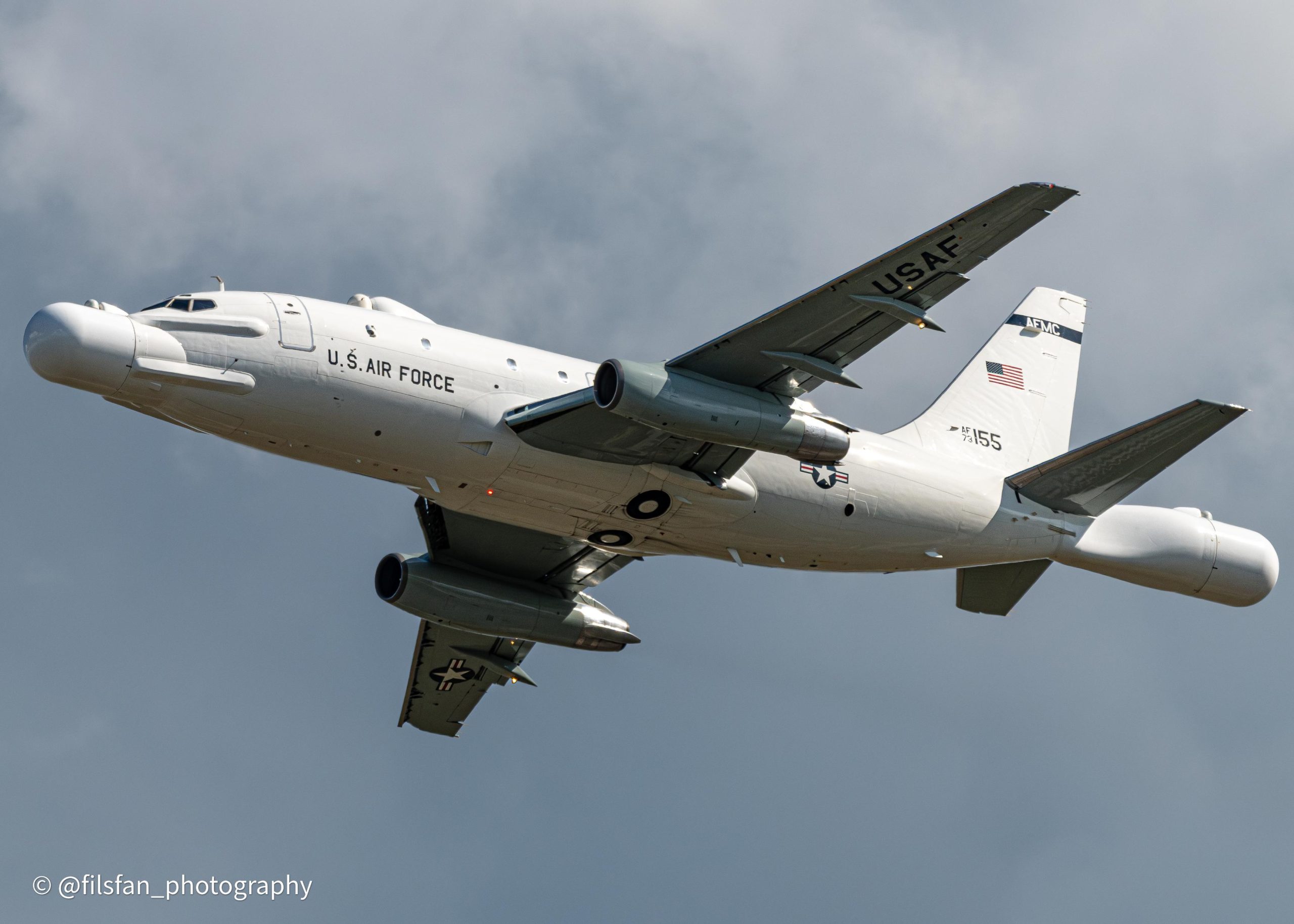
The presence of the dorsal EO/IR turret (complementing those already installed above the two main radomes) may suggest the data collection carried out by the highly secretive aircraft, usually operating out of Tonopah Test Range Airport (TTR) or Area 51 in Nevada, included an optical tracking component as well, potentially allowing the aircraft not only to gather telemetry data but also to visually monitor and record parts of the mission profile, especially during the ascent phase (possibly to complement the imagery collected by the WB-57’s electro-optical and infrared sensors), much like airborne range instrumentation assets used in the past to supplement ground- and sea-based tracking coverage.
For the records, the dorsal enclosure was not installed on RATT55 when it was spotted working with a B-2 in August 2025.
RAT55 working with a B2 #rat55 #b2 #ratt55 pic.twitter.com/mezwJKtJd8
— Julian Elnasser (@LAXSPOTTER97) May 28, 2025
As explained in other stories about the secretive RAT55, the T-43, based on the Boeing 737-200, was previously a relatively common airframe in the U.S. military, serving as training aircraft and then in a limited capacity for executive transport, but the unique NT-43A is the only such example still in service. Other 737s in U.S. service are of the more modern 737 NG or ‘Next Generation’ family, even including those that operate as part of Area 51’s ‘Janet’ fleet. While replacement of this ageing airframe would seem overdue, the continued modifications to the jet and the new role in NASA support more than ever suggest its time is not yet at an end.