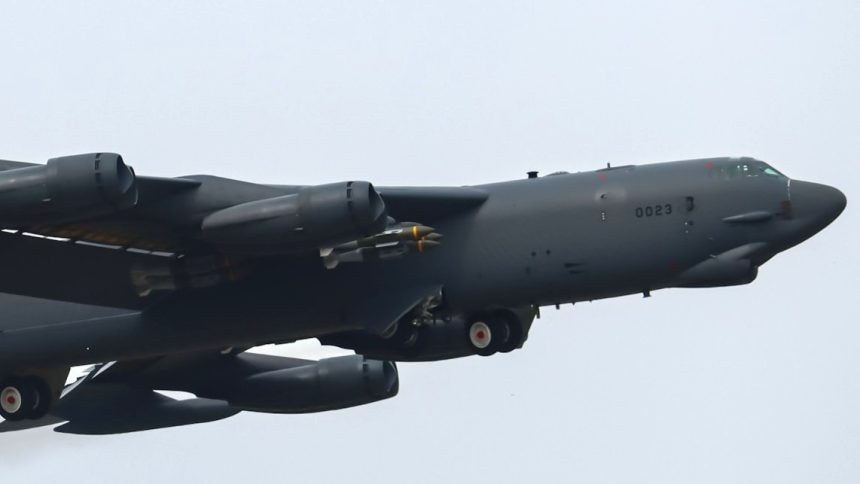
After initially employing only AGM-158 JASSM stand-off weapons, B-52s are now launching from RAF Fairford with the external pylons fully loaded with GBU-31 JDAM bombs.
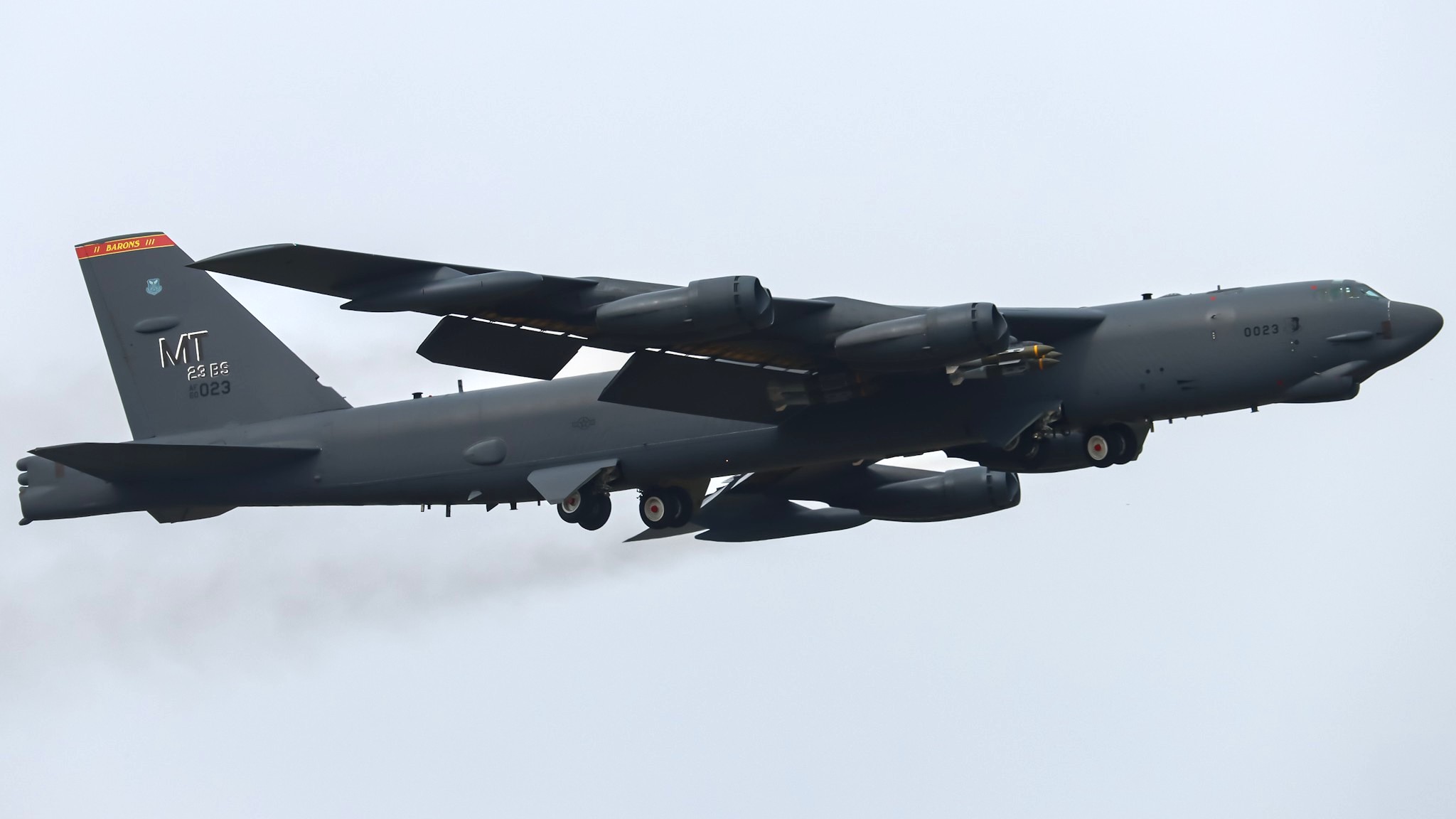
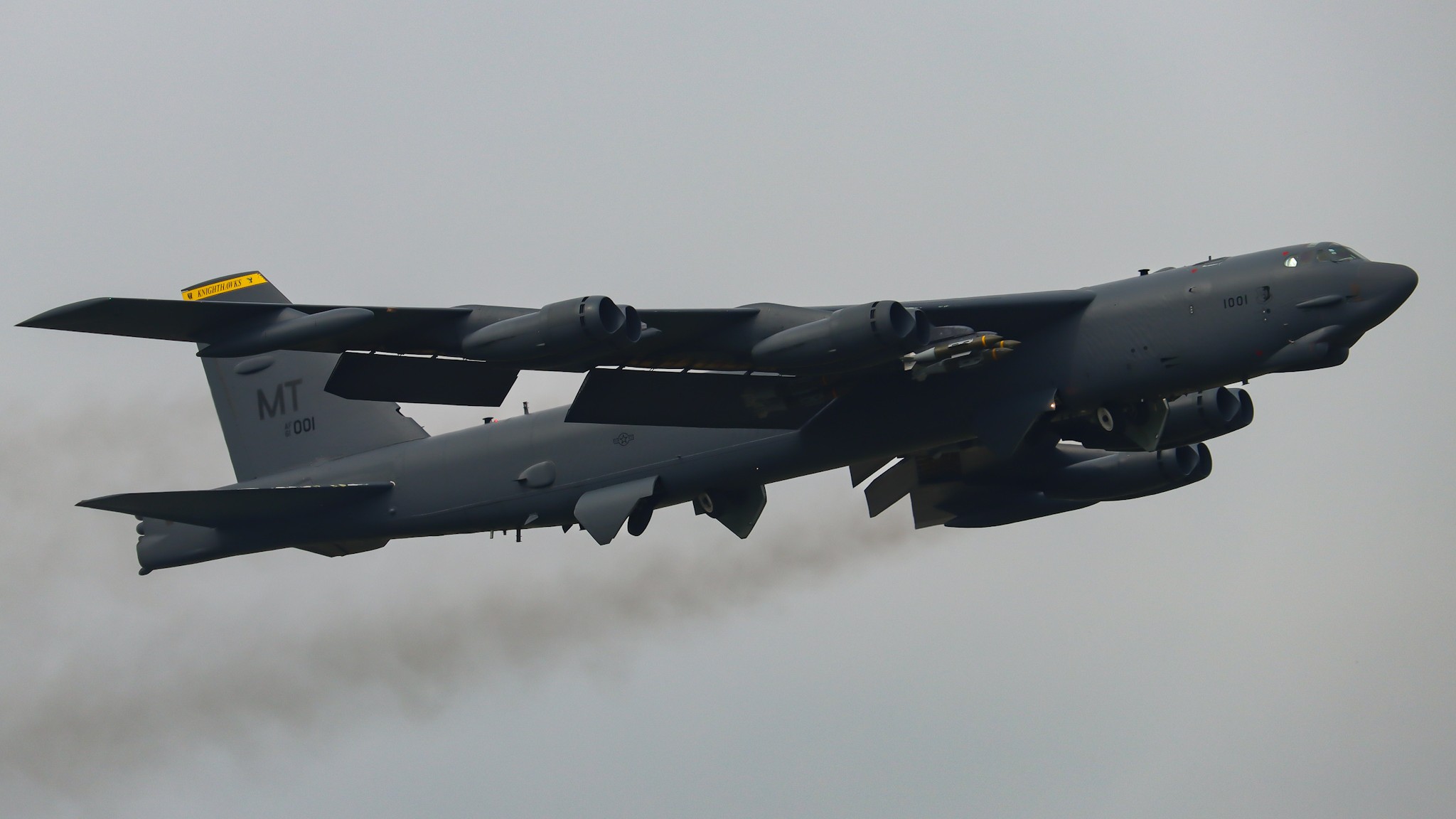
After weeks flying only with AGM-158 Joint Air-to-Surface Standoff Missiles (JASSM) under their wings, the U.S. Air Force B-52H Stratofortress strategic bombers deployed to RAF Fairford, UK, have now switched to GBU-31 Joint Direct Attack Munitions (JDAM). Two of the bombers were spotted by aviation photographer Lee Hathaway departing Fairford with the external pylons fully loaded with JDAMs on Mar. 22, 2026.
A total of six GBU-31s can be seen under the starboard wing and, with the weapon loadout always being symmetrical, six more are loaded under the port wing. It is unclear if more JDAMs were carried in the weapon bays, which can host up to eight of the 2,000 lb weapons, bringing the overall bomb load to 20.
B-52’s departing RAF Fairford early yesterday afternoon. They have recently landed at Fairford. pic.twitter.com/0SWd2u593m
— Lee Hathaway (@LHA2709) March 23, 2026
Once again, the JDAM variant being employed is the GBU-31(V)3, which is based on the 2,000 lb BLU-109/B bunker buster. Compared to the standard GBU-31(V)1 based on the MK 84 bomb, the (V)3 can be employed against hardened targets such as underground facilities and fortifications.
The U.S. Chairman of the Joint Chiefs of Staff, Gen. Dan Caine, mentioned during the latest Press Briefing at the Pentagon on Mar. 19, 2026, that bomber operations against Iran were moving to stand-in rather than stand-off strikes. However, while B-1B Lancer bombers already made the switch from JASSMs to JDAMs, the B-52s have continued to rely on JASSMs.
Bomber Mission XXXI – Who chooses these callsigns? #FreeIran
— Operation EPIC FURY —
The 31st bomber mission we’ve tracked, was also the 5th launch from RAF Fairford (EGVA) for the B-52H “Stratofortress” fleet since the jets arrived at the base a couple of weeks ago. In… pic.twitter.com/fyQlwRY2Wj
— DefenceGeek 🇬🇧 (@DefenceGeek) March 23, 2026
As we mentioned in our previous coverage of the bomber operations, it is unclear whether the motivations for using the different weapon types is based on the potential threat from air defenses or by other factors relating to the weapons’ specific capabilities. Secretary of Defense Pete Hegseth previously claimed that “Iran has no air defenses” and thus only 1% of the munitions being used were stand-off weapons.
RAF Fairford Bomber Operations
After the UK approved the use of its bases by U.S. forces for operations in Iran, RAF Fairford became a hub for the U.S. bomber’s operations as part of Epic Fury. As we previously reported, 18 bombers, including 12 B-1B Lancers and six B-52 Stratofortresses, have been deployed there within the first two weeks of the combat effort.
The bombers have been launching multiple daily missions since then, attracting lots of aviation photographers and spotters near RAF Fairford. Base security forces and local police later used road closures, parking restrictions, and privacy screens to keep operations secure and avoid photos of the ground operations, but many are still managing to get clear glimpses of the bombers, especially during takeoff and landing.
Bomber operations are still continuing also in the form of round-trip missions from CONUS, with some of these missions occasionally identified when they contact air traffic control (ATC) agencies. Among the assets which are mainly flying these round-trip missions are the B-2A Spirit stealth bombers.
Some of the bomber missions launching from the UK were also tracked online thanks to multilateration (MLAT). In fact, as they do not use Mode S or ADS-B, they are never tracked directly using applications like Flightradar24, and instead the aircraft’s position is determined by measuring the differences in time it takes for a transponder signal to arrive at multiple ground stations nearby.
FAIRFORD, ENGLAND – MARCH 21: A USAF Rockwell B-1 Lancer bomber takes off on a sortie from RAF Fairford near the Cotswold village of Kempsford and the village church of St. Mary the Virgin on March 21, 2026 #IranWar #aviation #military #bombing #fairford #avgeeks pic.twitter.com/scLnMVB82F
— Christopher Furlong (@Chris_Furlong) March 23, 2026
This has shown that both the B-1s and B-52s have been using two main routings to and from their missions over Iran, as we previously explained. The most direct route has seen the bombers heading south from Fairford, transiting in French airspace to reach the Mediterranean Sea. The other route sees the aircraft heading south west from Fairford and flying over the Atlantic Ocean around France, Spain and Portugal, before transiting over the Strait of Gibraltar to reach the Mediterranean.
Thank you to Lee Hathaway for allowing us to use his photos in this article, you can find more of his work on X/Twitter and Instagram.