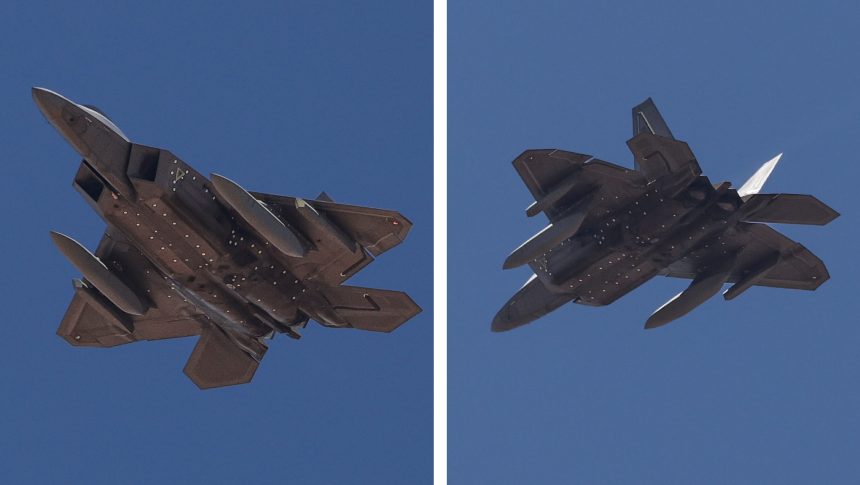
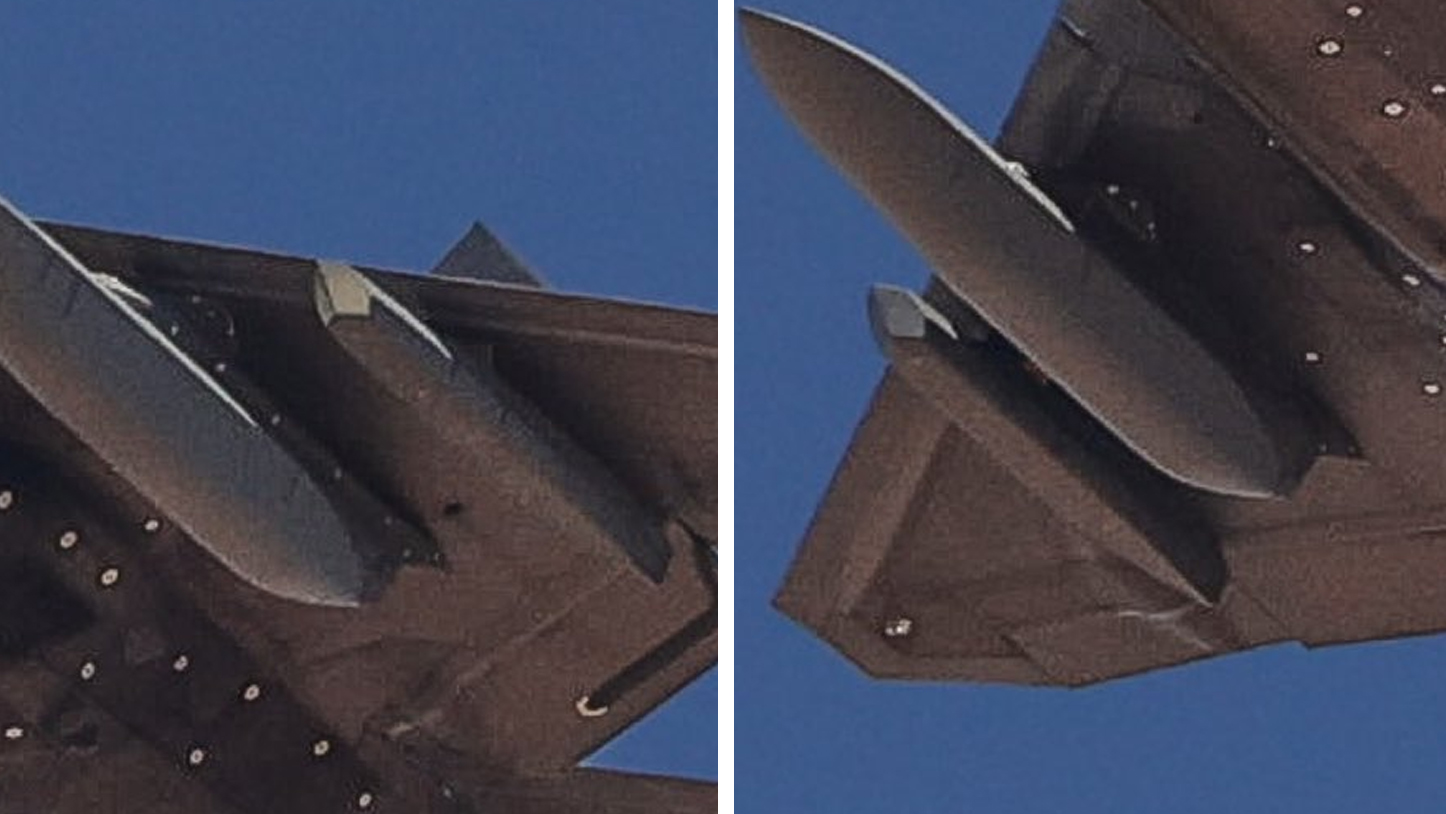
New photographs show the best view yet of an F-22A Raptor sporting the stealthy drop tanks and equipment pods in development for the stealth fighter.
Californian aviation photographer Jarod Hamilton once again caught a scoop, this time giving us the closest view yet of a Lockheed Martin F-22A Raptor sporting both the stealthy equipment pods – one of which at least seems to house an infrared search and track (IRST) or other optical based targeting capability – as well as new stealthy external fuel tanks. Both of these have been seen on the F-22 before, but only at a significantly greater distance.
Check out the full Raptor accessory line, just in time for Summer 🙌 #F22 #F22raptor pic.twitter.com/ml7cN6W7ki
— jmh.creates (@JarodMHamilton) March 21, 2026
Both of these new pieces of equipment address some of the F-22’s shortfalls compared to older aircraft types, or – in the case of the equipment pods – to the F-35 Lightning II. Originally, the F-22 was designed with an integrated infrared search and track (IRST) system which looked similar to the F-35’s Electro-Optical Targeting System, or EOTS, but this was cancelled for budgeting reasons.
At present, although the jet has been used for some strike missions, the F-22 has no way to optically scan for and designate its own targets – instead relying on external means, or on GPS-guided munitions.
The F-22 Raptor’s Infrared Search and Track (IRST) system was a casualty of post-Cold War budget cuts. While Lockheed’s original design reserved internal volume for this capability, that space was ultimately repurposed as the production airframe evolved. About five years ago, I… https://t.co/jN8cbX5CR1 pic.twitter.com/CgL1tLtIOG
— Air-Power | MIL-STD (@AirPowerNEW1) February 25, 2026
The equipment pods are both of the same shape, although only one appears to have a transparent area at the front or an IRST system or other targeting system to see through. It may be the case that as well as providing an infrared search function, the pods also provide other features – perhaps electronic warfare (EW) capabilities or even networking for collaborative combat aircraft (CCA).
‘Legacy’ types like the F-15, F-16, and F/A-18 are rarely ever seen in combat without at least one external fuel tank, but the F-22 almost always flies combat missions in a clean configuration. It has longer legs on internal fuel than these other fighters, but an even greater combat radius is always going to provide extra flexibility for mission planners.
4th and final cell of three F-22s departing Lakenheath. Not sure of the callsigns but I’m sure someone can confirm what they were. So that’s all 12 F-22s now on their way to the Middle East pic.twitter.com/WOAOiw95YT
— Glenn (@TallGlenn85) February 24, 2026
The F-22’s current drop tanks are intended primarily for ferry flights, though they have also been used on air defence missions. These tanks have no stealth features, other than the fact that when jettisoned both the fuel tank and its pylon can be ejected from the aircraft. This doesn’t bring the aircraft up to its full stealth configuration, as the mounting points for the pylons are left exposed, but certainly it would produce a lower radar cross-section than if they were still mounted.
Both the tanks and the pods have clearly been in development for some time, the combo having been seen together in flight as far back as March 2024. The increased demands on the U.S. military with the shift in foreign policy of the current Trump administration may be increasing the pace of development. These capabilities would certainly be of use to the F-22 Raptors currently taking part in Operation Epic Fury.
From the reference marks visible across the airframe we can see that it is still flying in a test role. It was also seen refueling from one of the U.S. Air Force’s NKC-135R Stratotankers, based at Edwards and frequently used to support aircraft test and development flights.
Thank you to Jarod Hamilton as always for allowing us to use his incredible images, you can find him on X/Twitter and Instagram.