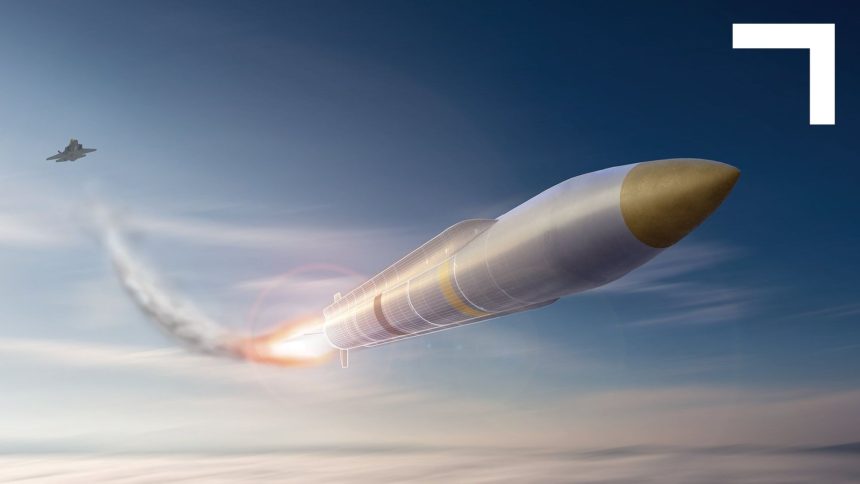
The U.S. Air Force is seeking companies that can offer a weapon with similar or improved capabilities compared to the Stand-in Attack Weapon (SiAW).
The U.S. Air Force is now scouring the market for potential sources who can supply a missile system equivalent to the Stand-in Attack Weapon (SiAW) in a new Mar. 4, 2026 sources sought notice. The SiAW is currently being procured by the service, and is in the Rapid Prototyping phase of the ongoing Middle Tier Acquisition (MTA) program.
The notice has also named the F-47 Next-Generation Air Dominance (NGAD) and the B-21 Raider among the aircraft that will employ the weapon, should the service go ahead with the procurement. The SiAW-equivalent missile should be an All-Up Round (AUR) missile including the “hardware and software, as well as any unique logistics elements, trainers, SiAW flyout model, and all system verification elements.”
It is unclear whether this implies the ongoing development by Northrop Grumman has been delayed, or the notice has been influenced by a pressing need for such capability. A safe assumption would be an attempt by the service to speed up the introduction of the new capability in large numbers with a reduced timeline, reflecting similar efforts to increase the production of other weapons already in service.
We completed a separation test of the Stand-In Attack Weapon from an F-16 with the @usairforce ! This milestone highlights SiAW’s flight safety, aerodynamic performance and progress toward integrating with fifth-generation platforms like the F-35. Read more:… pic.twitter.com/jtwWgBwsY3
— Northrop Grumman (@NGCNews) December 11, 2025
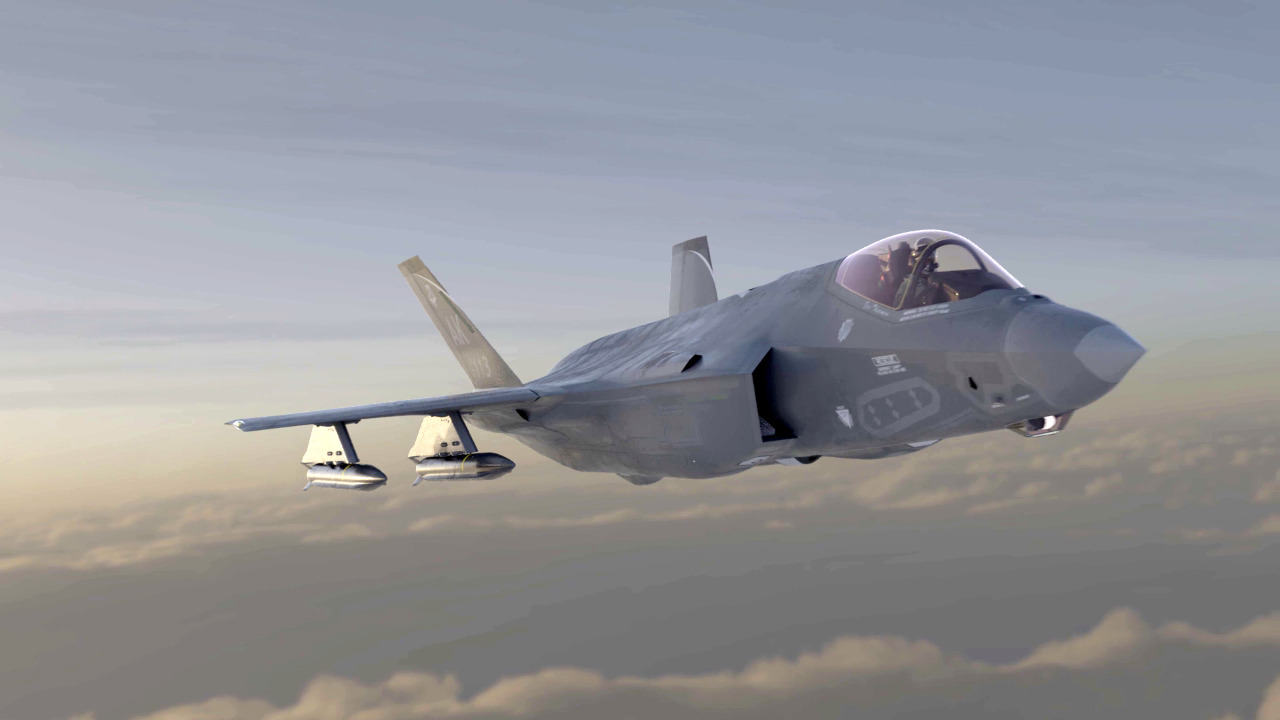
The current SiAW program is already in its Phase 2, with Northrop Grumman announcing in December 2025 a new separation test from an F-16 Fighting Falcon, within just over a year of its first inert drop. Beside the F-16, other future launching platforms include the F-35A Lightning II, which will carry it internally, the F-15E Strike Eagle, F-15EX Eagle II, and B-21 Raider.
Northrop Grumman was awarded the $705 million contract to develop the missile in 2023, with a 36-month timeline for completing the development, integration, and testing. The goal was to achieve a 2026 Initial Operational Capability (IOC).
New sources sought notice
The source sought has a short deadline, set for Mar. 19, and seeks a weapon offering “similar or improved capabilities compared to the SiAW” to “suppress and neutralize enemy air defenses in contested environments.” The effort focuses on “extended range, advanced targeting, counter-countermeasures, and integration with existing and future platforms.”
The notice lists extended standoff range as the primary capability, with other capabilities such as:
- Advanced anti-radiation seeker with broad frequency coverage;
- Ability to target modern and advanced radar systems, including frequency-agile and low-probability-of-intercept (LPI) emitters;
- Ability to target modern ballistic threats, and other non-cooperative targets;
- Precision navigation and guidance system (e.g., GPS/INS with anti-jamming capabilities);
- Potential for pre-emptive targeting capabilities;
- Ability to re-attack;
- Robust Electronic Counter-Countermeasures (ECCM) to defeat enemy countermeasures, including chaff, flares, and jamming.
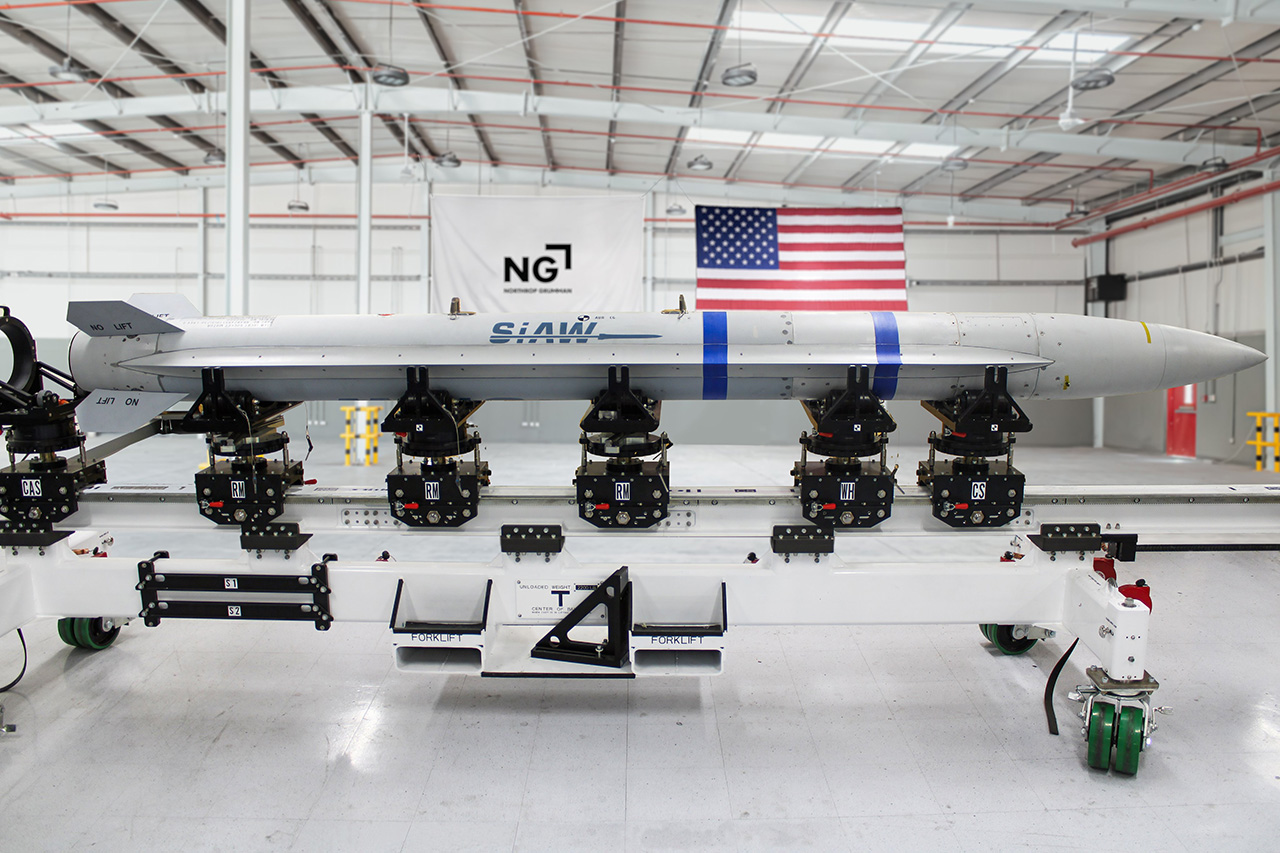
This could potentially up an avenue for Lockheed Martin’s Mako hypersonic missile, which the company had developed for the SiAW project, although it later chose not to proceed with that contract’s successive phases. Lockheed markets Mako as a mass-producible, cost-effective, and high performance weapon which can be carried internally by the F-35A and C, and externally by the F-35B, beside a wide range of fourth generation fighters.
The SiAW program
The SiAW program began in 2022 with contracts awarded to Northrop Grumman, Lockheed Martin and L3Harris, followed by two contracts in 2023 to Lockheed Martin and Northrop Grumman for the final stage of the program’s Phase 1. The Phase 2 development is a continuation of the Air Force requirement for this first-of-its-kind Middle Tier Acquisition large weapon program, developed through digital engineering and integrating Weapon Open System Architecture.
Phase 2 is split in two: Phase 2.1 concludes with a guided vehicle flight test, while Phase 2.2 wraps up with three additional flight tests and the delivery of SiAW leave-behind prototype missiles and test assets. Following Phase 2.2, the program is expected to move to the acquisition phase and be fielded on the F-35A Lightning II and possibly on the B-21 Raider stealth bomber.
The Air Force is hoping to achieve an Initial Operational Capability (IOC) by 2026 and buy 400 missile units by 2028, followed by around 3,000 additional weapons in the subsequent years. The AGM-88G Advanced Anti-Radiation Guided Missile (AARGM-ER) will serve as an interim capability, while also having influenced and informed the SiAW itself.
The AARGM-ER is an advancement over the AGM-88E AARGM, the latest variant of the AGM-88 High-speed Anti-Radiation Missile (HARM). The weapon uses the AGM-88E’s control and guidance sections, with a new warhead and rocket motor, improving the efficiency when engaging enemy air defenses, even when they turn off their radars.
Expected capabilities
The SiAW, while also designed to track electromagnetic emissions, goes much beyond a radar-killing Suppression/Destruction of Enemy Air Defense (SEAD/DEAD) weapon. In fact, it is meant to be employed against a wider variety of ground targets associated with anti-access/area-denial (A2/AD) environments, including ballistic missiles, missile defenses, anti-ship launchers, strategic command and control centers, large logistical nodes, anti-satellite systems and other high-value targets.
The SiAW is expected to be faster than both the current AGM-88 HARM and future AARGM-ER and with a greater, yet unspecified, range. The weapon is also expected to have multiple sensors and high-resolution GPS guidance, in addition to open architecture interfaces.