Israel has launched a daylight preemptive attack against multiple Iranian targets, with the U.S. now joining the operation. Here’s our constantly updated report.
Israel and the U.S. launched on Feb. 28, 2026, a new wave of strikes against Iran, in what Israel has called a “preemptive attack.” Details are still fragmentary, but it appears multiple targets across Iran, including the capital Tehran, were hit in broad daylight, and a first Iranian retaliation has already been launched.
Epic Fury / Roaring Lion
The U.S. Department of Defense announced in a post on social media that the U.S. operation has been named “Operation Epic Fury,” while Israel appears to have named its own operation “Roaring Lion.” According to reports, the attack appears to have started at around 8:10 am local time, with both U.S. President Donald Trump and Israel Prime Minister Benjamin Netanyahu releasing statements shortly thereafter.
OPERATION EPIC FURY 🇺🇸
— Department of War 🇺🇸 (@DeptofWar) February 28, 2026
🇮🇱 🤝 🇺🇸 OPERATION ROARING LION: The IDF and the U.S Armed Forces have launched a broad & joint operation to thoroughly degrade the Iranian terrorist regime and to remove existential threats to Israel over time.
The Iranian regime has not abandoned its plan to destroy Israel.…
— Israel Defense Forces (@IDF) February 28, 2026
Netanyahu says that “Israel and the United States embarked on an operation to remove the existential threat posed by the terrorist regime in Iran.” The statement also hinted at regime change being a goal: “Our joint action will create the conditions for the courageous Iranian people to take their destiny into their own hands. The time has come for all segments of the Iranian people – the Persians, the Kurds, the Azeris, the Baluchis, and the Ahwazis – to throw off the yoke of tyranny and bring about a free and peaceful Iran.”
Trump similarly said that the “U.S. military began major combat operations in Iran,” with the objective to “defend the American people by eliminating imminent threats from the Iranian regime, a vicious group of very hard, terrible people.” Trump reiterated that “they can never have a nuclear weapon,” and “we can’t take it anymore.”
— Donald J. Trump (@realDonaldTrump) February 28, 2026
First Reports
Multiple government buildings appear to have been targeted in the initial strikes.
Western source tells Fox: Attacks on the Iranian Parliament, National Supreme Council, Ministry of Inteligence, Iranian Atomic Agency.
Cyber attacks on news agencies, such as IRNA.
— Jennifer Griffin (@JenGriffinFNC) February 28, 2026
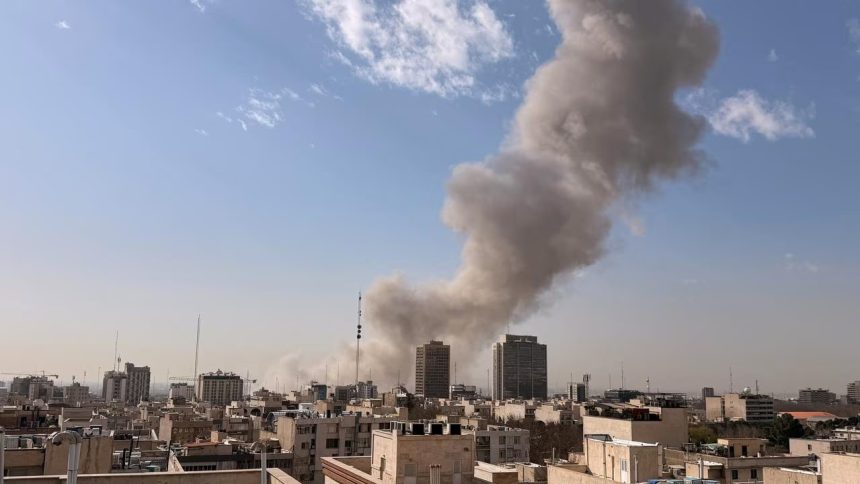
This video, posted by a semi-official Iranian news agency, shows thick smoke rising near Pasteur St (خیابان پاستور), where key government institutions are located. Point-of-view is southwest. Geolocation in tweet below. pic.twitter.com/uPzsipAnPd
— Christiaan Triebert (@trbrtc) February 28, 2026
According to Iranian media, missiles also struck the area near the Iranian presidential palace and the compound of the Supreme Leader Khamenei. Reports say he might have been already evacuated before the launch of the attacks.
SEVEN MISSILES HIT AREA NEAR PRESIDENTIAL PALACE AND SUPREME LEADER KHAMENEI’S COMPOUND – TASNIM REPORTS
— Phil Stewart (@phildstewart) February 28, 2026
Israel is confirmed to have launched “preemptive strikes” this morning against Iran. pic.twitter.com/KAMo8oldTe
— OSINTdefender (@sentdefender) February 28, 2026
The U.S. airstrikes appear to have been complemented by attacks with Tomahawk cruise missiles launched from U.S. Navy warships. Multiple missiles were caught on video while reportedly flying at low altitude over Iraq and then over Iran’s capital Tehran.
Footage of 21 Tomahawk cruise missiles headed towards Tehran this morning. pic.twitter.com/CYyJNjbICb
— OSINTtechnical (@Osinttechnical) February 28, 2026
U.S. Navy Tomahawk cruise missile flying over Tehran, Iran, this morning. pic.twitter.com/6FiuzvurL7
— OSINTtechnical (@Osinttechnical) February 28, 2026
A video appears to show an Iranian MiG-29 in flight over Tehran, however there are no reports of aerial confrontation with Israeli and U.S. aircraft.
Iranian MiG 29 jet scrambled above Tehran pic.twitter.com/glzsQyhB15
— Arya – آریا (@AryJeay) February 28, 2026
Both Iraqi and Syrian airspaces appear to have been used by aircraft on their way in to strike Iranian targets. Boosters associated with the Israeli Blue Sparrow air launched ballistic missile were found in Iraq, while fighters were seen in flight over Syria.
Israeli Blue-Sparrow series missile boosters found in Iraq. The same boosters were also found after previous Israeli strikes on Iran. pic.twitter.com/iURpTEptAe
— Trevor Ball (@Easybakeovensz) February 28, 2026
It is reported that about 20 U.S. and Israeli fighter jets are flying over Daraa, Syria, to bomb Iran. pic.twitter.com/AzspAq2WCn
— 𝔗𝔥𝔢 𝕯𝔢𝔞𝔡 𝕯𝔦𝔰𝔱𝔯𝔦𝔠𝔱△ 🇬🇪🇺🇦🇺🇲🇬🇷 (@TheDeadDistrict) February 28, 2026
Initial Retaliation
Within two hours from the beginning of the joint Israel-U.S. attack, Iran has launched a first retaliation.
The IDF posted on social media that a barrage of missiles was launched against Israel, with air defenses at work to intercept the threats.
A short while ago, the IDF identified missiles launched from Iran toward Israel.
Defensive systems are operating to intercept the threat. In the past few minutes, the Home Front Command has sent a precautionary directive directly to mobile phones in the relevant areas.
— Israel Defense Forces (@IDF) February 28, 2026
Intercepts appear to have taken place also outside of the Israeli airspace, with debris also found in Syria.
One of the interceptor missiles fell a short while ago in the city of Inkhil in the countryside of #Daraa. The skies over Daraa Governorate are still witnessing continuous aircraft activity as a result of the war between #Iran and the United States. pic.twitter.com/OHWvL3YZvr
— Mohammad Alasakra (@mohammed_asakra) February 28, 2026
Attacks appear to have targeted also U.S. bases in the region, with reports of interceptions and air defense activity over Abu Dhabi.
Iranian ballistic missile interceptions reported over the city of Abu Dhabi. pic.twitter.com/6GpFnjF7qR
— OSINTtechnical (@Osinttechnical) February 28, 2026
Smoke was also spotted rising from the U.S. 5th Fleet support center in Bahrain, after reports of explosions being heard. A missile was also videoed while impacting within the perimeter of the base.
Footage of an Iranian ballistic missile slamming into the headquarters of the US Navy’s 5th Fleet at Naval Support Activity (NSA) Bahrain earlier today. pic.twitter.com/6omkCrLy2u
— OSINTtechnical (@Osinttechnical) February 28, 2026
The U.S. 5th Fleet support center was targeted in the Iranian strike in Bahrain. Additionally, we are now seeing reports of explosions in multiple other U.S. partner nations, including Kuwait, Jordan, and the UAE. https://t.co/HvjfxsQMSa
— OSINTdefender (@sentdefender) February 28, 2026
Massive clouds of black smoke billow from the U.S. Navy’s 5th Fleet Headquarters at Naval Support Activity Bahrain in Juffair, a major district in Manama, Bahrain. pic.twitter.com/3HdT1dKdGm
— OSINTdefender (@sentdefender) February 28, 2026
New details
The IDF has disclosed some details about the operation, explaining that the operation was planned for several months. The decision to carry out the strike in plain daylight rather than at night allowed Israel to achieve a surprise.
The IDF provides new details on its simultaneous airstrikes this morning targeting senior Iranian political and military officials at several locations in Tehran.
The military says it developed the plan over months, and it included a major intelligence effort led by the…
— Emanuel (Mannie) Fabian (@manniefabian) February 28, 2026
A still image from the video showing IAF F-15D Baz “986” from the “Knights of the Twin Tail” Squadron. Visible under its starboard wing is a GPS-aided GBU-31(V)3/B series JDAM (features a 2,000-pound class BLU-109 series hard-target-penetrator warhead). https://t.co/MAbXx5w6Qw pic.twitter.com/1HZsz8SXc8
— Guy Plopsky (@GuyPlopsky) February 28, 2026
Italy’s Deputy Prime Minister, Foreign Minister Antonio Tajani, said that the Italian base in Kuwait, where 300 Italian soldiers as well as the Eurofighter Typhoons are stationed, has been hit; none were harmed. The base hosts the IT NCC Air/TFA-K (Italian National Contingent Command Air/Task Force Air-Kuwait) and, in particular, the Task Group TYPHOON, which operates with four F-2000A jets as well as the Task Group ARABA FENICE, with an MQ-9A Reaper.
As the hours pass, further images of the attack and the Iranian retaliation are being released online.
Footage of an Iranian attack drone slamming into the headquarters of the US Navy’s 5th Fleet at Naval Support Activity (NSA) Bahrain moments ago. pic.twitter.com/wHbje3eiiy
— OSINTtechnical (@Osinttechnical) February 28, 2026
Qatar, the moment a missile debris falls near a crowd of people on the streets pic.twitter.com/GcBc0WpCm3
— Special Kherson Cat 🐈🇺🇦 (@bayraktar_1love) February 28, 2026
Interestingly, the Israeli Air Force 1, IAF Boeing 767 also known as “The Wing of Zion”, has been circling off Israel since the Iranian retaliation attacks were launched.
Interesting: still tracking on FR24 is an Israeli Air Force Boeing 767-338(ER), a VIP aircraft (aka the Wing of Zion). It’s the principal government transport aircraft tasked with transporting the president and prime minister during overseas trips. It’s said to use c/s Israeli… pic.twitter.com/uP68LP9OhQ
— The Aviationist (@TheAviationist) February 28, 2026
Meanwhile, there are reports of Iranian missiles hitting Dubai, Kuwait and Bahrain.
#Dubai 28/2/2026 18.47 GST pic.twitter.com/vGYHkkUSZL
— Julian Hove (@niqqabro) February 28, 2026
WATCH: Aftermath of drone attack on Kuwait International Airport pic.twitter.com/Wjqtyomhvc
— Faytuks Network (@FaytuksNetwork) February 28, 2026
Footage of an Iranian drone slamming into a high-rise building in Bahrain this evening pic.twitter.com/EP54rtyaz8
— Faytuks News (@Faytuks) February 28, 2026
British PM Starmer said the UK has joined the war on Iran.
BREAKING: Sir Keir Starmer has said British planes “are in the sky today” in the Middle East “as part of co-ordinated regional defensive operations to protect our people, our interests and our values”.
Latest 🔗https://t.co/FSh5d8PtO2
📺 Sky 501 and YouTube pic.twitter.com/tqYqkPIjXE
— Sky News (@SkyNews) February 28, 2026
Meanwhile, more details about the initial phase of the air war have emerged.
NEW details on US military strikes targeting Iran:
The US military used some new capabilities in these strikes: for the first time they used “one way attack drones” in combat.
The US military has been focusing on “high value targets”: IRGC significant facilities and…
— Jennifer Griffin (@JenGriffinFNC) February 28, 2026
Considering the amount of air power deployed to the region and the size of Iran (hence, the number of potential targets) it looks like almost certain a second wave of US-Israeli air strikes will be carried out in the darkness of the night between Saturday Feb. 28 and Sunday Mar. 1, 2026.
Daylight strikes with one way attack drones, TLAMs etc are probably not the end of it. In many air campaigns, initial waves are used to shape the battlespace, degrade enemy’s air defense system and provoke responses that expose high-value targets.
Let’s see. https://t.co/WY8qO7iZwF
— The Aviationist (@TheAviationist) February 28, 2026
There are reports of ballistic missiles launch from Iran.
The IDF says that Iran may have launched ballistic missiles carrying cluster bomb warheads at Israel today.
The warhead of such missiles, which Iran also fired at Israel in June 2025’s war, opens up while descending and spreads around 20 smaller munitions with around 2.5…
— Emanuel (Mannie) Fabian (@manniefabian) February 28, 2026
And here are the images of the ballistic missiles being intercepted:
Stills of an exo-atmospheric interception of an Iranian ballistic missile recorded from Sulaymaniyah pic.twitter.com/L2pITX5Fne
— Woofers (@NotWoofers) February 28, 2026
Exo-atmospheric intercepts of Iranian ballistic missiles were successfully recorded over Erbil. pic.twitter.com/uEvDTuD3ZS
— GMI (@Global_Mil_Info) February 28, 2026
Some U.S. aerial refuelers are tracking online on FlightRadar24.com:
Three U.S. tankers tracking on FR24 right now over Israel almost certainly supporting fighters flying counter-UAV missions. Interestingly, an additional KC-135 is heading southeast over Jordan. pic.twitter.com/mGg3o1Z4F7
— The Aviationist (@TheAviationist) February 28, 2026
Update 19:00 UTC
As darkness falls over iran in this first day of hostilities, it appears that strikes are not over for both sides. Photos and videos emerging online show that a new wave of strikes might be in progress over Iran, while Iranian drones keep striking targets in Israel and the surrounding countries which host U.S. bases.
A US/Israeli airstrike hit an Iranian missile system in the city of Zanjan this evening. pic.twitter.com/7tzuL1SqjO
— OSINTtechnical (@Osinttechnical) February 28, 2026
Another strike this evening on the US 5th fleet in Bahrain pic.twitter.com/d4mJVnoBN7
— Sayed Ahmed AlWadaei (@SAlwadaei) February 28, 2026
An Iranian attack has also reportedly struck the area near Muwaffaq Salti Air Base, Jordan, which hosts a large contingent of U.S. combat aircraft. It is unclear if the base sustained damage.
Reports that an Iranian ballistic missile impacted in or near Muwaffaq Salti Air Base, Jordan, moments ago.
The airbase was hosting dozens of USAF fighters surged to the area over the past few weeks. pic.twitter.com/BftmSktOb8
— OSINTtechnical (@Osinttechnical) February 28, 2026
Multiple videos show that U.S. air defenses were indeed active, even if some of the Iranian drones and missiles were able to reach their targets. Among the systems being used are the Patriot systems which, together with THAAD, were deployed to the region to further reinforce the air defenses already present there.
A PAC-2 Interceptor fired by a MIM-104 “Patriot” Surface-to-Air Missile Launcher appears to down a ballistic missile during an Iranian retaliatory attack this morning on Ali Al Salem Air Base in Kuwait. pic.twitter.com/OWs5PMiUi2
— OSINTdefender (@sentdefender) February 28, 2026
Footage of a US Army PATRIOT SAM battery engaging an incoming Iranian missile barrage over Erbil, Iraq, earlier today. pic.twitter.com/PbVhkjJoTy
— OSINTtechnical (@Osinttechnical) February 28, 2026
According to some sources, Iranian defenses were also active and were able to shoot down some of the munitions launched by Israel and the U.S. since this morning. The airspace, however, seems to be rather permissive at the moment, with videos showing what appear to be MQ-9A Reaper drones over Iran, possibly being used to assess damage and locate further targets.
Here it is, a #USAF 🇺🇸 Reaper over Shiraz, Fars Province. #Iran
Reports: 20+ explosions
(All videos are exclusive, yet you can use them as long as you don’t watermark them) https://t.co/VCa9s2BhOm pic.twitter.com/M2RwMNyeA0
— Shin (@hey_itsmyturn) February 28, 2026
Several MQ-9 drones are circling over Tehran currently. US will be conducting BDA and searching for armed TELs
— Aurora Intel (@AuroraIntel) February 28, 2026
Meanwhile, multiple U.S. Air Force tanker aircraft appear to have departed from the U.S. and headed east. It is likely that these are either going to cross the Atlantic Ocean to join the operations in the Middle East or are being staged to support the movement of other assets across the ocean. It should be noted that there are around 36 fighter aircraft that arrived at RAF Lakenheath, UK, in the last few days, and are likely being prepared to continue they journey to the Middle East, requiring tanker support.
10 KC-135s headed East#AE04EA 61-0276 RCH566#AE0500 59-1495 RCH563#AE050A 63-8018 RCH564#AE04F8 63-7988 RCH559#AE04DC 57-1461 RCH???#AE0159 57-1512 RCH582#AE038B 62-3543 RCH568#AE041E 57-1487 RCH573#AE04E4 59-1469 RCH576#AE0487 62-3556 RCH575 pic.twitter.com/uysGSxfTeu
— 𝗦𝗥_𝗣𝗹𝗮𝗻𝗲𝘀𝗽𝗼𝘁𝘁𝗲𝗿 (@SR_Planespotter) February 28, 2026
Since U.S. officials already stated to media that the strikes against Iran will last for days, new waves of attacks might continue tonight.
US official: the airstrikes will last not hours but days; also no casualties from strike targeting US base in Bahrain.
— Jennifer Griffin (@JenGriffinFNC) February 28, 2026
CENTCOM has released some interesting footage of the U.S. forces taking part in the raid.
As the President stated, our objective is to defend the American people by eliminating imminent threats from the Iranian regime.
The President ordered bold action. CENTCOM forces are delivering an overwhelming and unrelenting blow. pic.twitter.com/B0k5gV4YnU
— U.S. Central Command (@CENTCOM) February 28, 2026
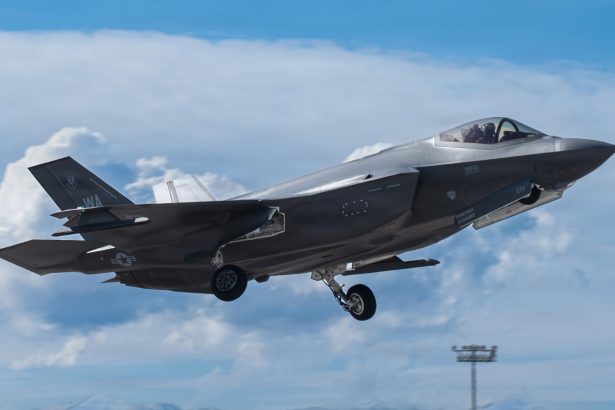
Interestingly, the F-35C shown in the video was operating in “full stealth mode” (ie without any RCS enhancers).
The F-35Cs appear to have been in “full stealth” mode during the first wave of airstrikes on Iran, based on the video released by the Pentagon. In fact, it looks like the Lightning II was not fitted with RCS enhancers (aka Luneburg lenses). pic.twitter.com/8jhtj2nuNJ
— The Aviationist (@TheAviationist) February 28, 2026
One might believe F-35s always operate without devices that are installed to increase their Radar Cross Section and make them visible to radars. However, the use of luneburg lenses depends on several things (type of mission, area, threats etc). Not always is LO (Low Observability) required. For instance, when on Sept. 27, 2018, U.S. Marine Corps F-35B jets with U.S. Marine Fighter Attack Squadron 211, the “Wake Island Avengers”, of the 13th Marine Expeditionary Unit, carried out their first air strike in Afghanistan’s Kandahar Province launching from U.S. Navy Wasp-class amphibious assault ship USS Essex (LHD-2) on station in the Persian Gulf, the aircraft also carried RCS enhancers and the externally mounted GAU-22 25mm gun pod in addition to the weapons in the internal bays.
In other words, the type’s first combat mission ever was not in full stealth mode.
Khamenei killed in the airstrikes
After a series of unconfirmed reports, U.S. President confirms Khamenei has been killed in the joint strikes with Israel.
#BREAKING: President Trump confirms Iran’s Supreme Leader Ayatollah Ali Khamenei has been killed pic.twitter.com/9NIQG3fRSv
— ELINT News (@ELINTNews) February 28, 2026
We continue our reporting here: U.S. Backs Israel’s Assessment That Khamenei Was Killed in Airstrike