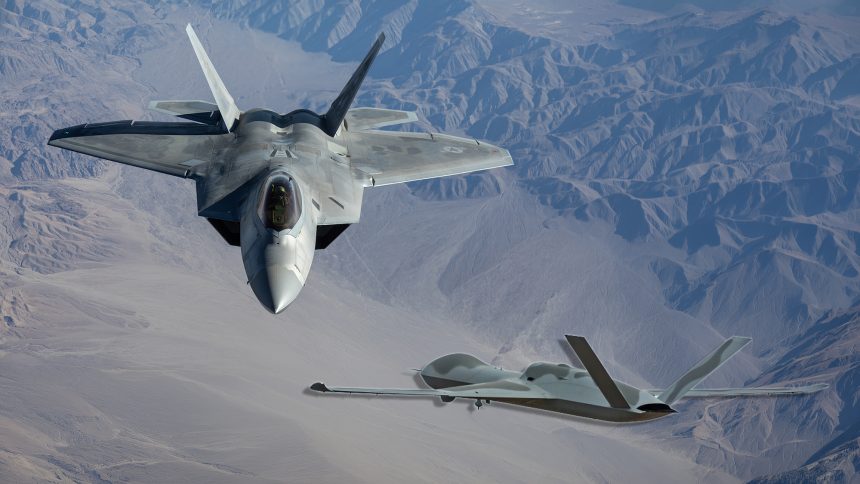
During the latest mission from Edwards AFB, the pilot aboard the F-22 directed the MQ-20 to perform tactical maneuvers, adjust waypoints, fly Combat Air Patrol profiles, and execute simulated threat engagement tasks.
The U.S. Air Force and General Atomics Aeronautical Systems, Inc. carried out a new autonomy demonstration involving an F-22 Raptor equipped with the latest government reference autonomy software and MQ-20 Avenger unmanned aircraft, GA-ASI announced in a public statement. While details have not been disclosed, the test, which was carried out recently, took place out of Edwards Air Force Base, California, and focused on validating MUMT (manned-unmanned teaming) between the two platforms, which were connected by means of tactical data link.
According to GA-ASI, during the demo mission, the pilot aboard the F-22 acting as “command aircraft,” issued teaming commands to the MQ-20, which received and executed those commands, demonstrating its ability to operate in coordination with a crewed fighter in a realistic operational scenario.
“We appreciate the flawless execution of this mission using the government’s advanced autonomous systems,” said GA-ASI President David R. Alexander. “This demo featured the integration of mission elements and the ability of autonomy to utilize onboard sensors to make independent decisions and execute commands from the F-22.”
The demonstration validated not only the integration of autonomy software but also the ability of the two aircraft to exchange information via tactical data link. Using the Autonodyne Bashi Pilot Vehicle Interface (PVI), the F-22 was able to send autonomy tasking directly to the MQ-20, directing it to perform tactical maneuvers, adjust waypoints, fly Combat Air Patrol profiles, and execute simulated threat engagement tasks.
The recent tests are yet another step towards the development of Collaborative Combat Aircraft (CCA), unmanned systems designed to operate alongside piloted fighters as force multipliers in what was called, until a few years ago, a “loyal wingman scenario”. In this role, autonomous aircraft like the MQ-20 can extend sensor coverage, increase survivability, and carry out missions that would otherwise place the life of human pilots at risk.
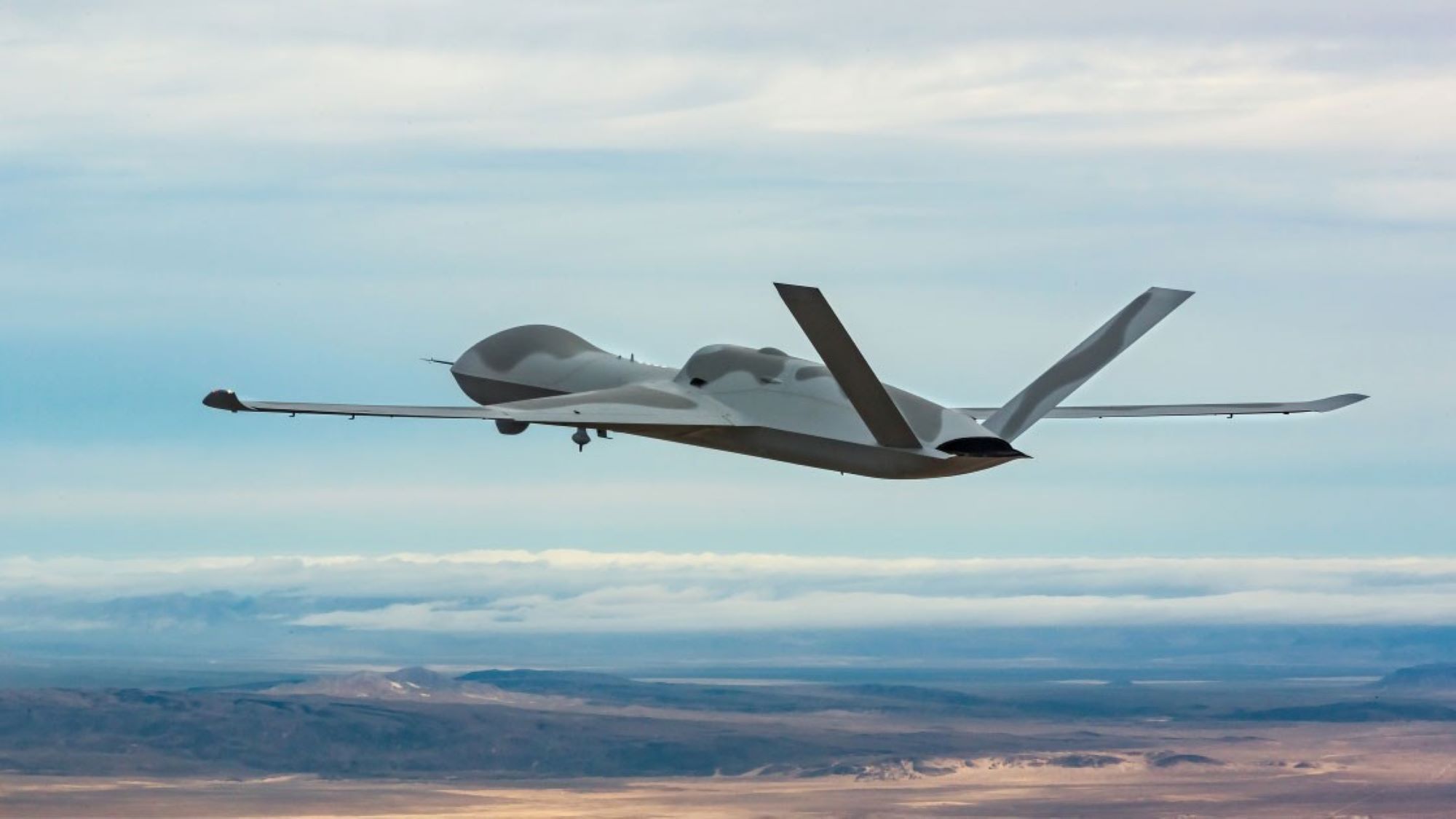
A similar test, was carried out last year. On Oct. 21, 2025, an F-22 and an MQ-20 cooperated to demonstrate the integration of L3Harris’ BANSHEE Advanced Tactical Datalinks with its Pantera software-defined radios (SDRs) via Lockheed Martin’s open radio architectures, all integrated and shared from the Raptor. As explained in our previous article, the F-22 pilot took command of the MQ-20 in flight using a PVI on a tablet and the F‑22’s GRACE (Government Reference Architecture Compute Environment) module. The latter is a new software being integrated on the Raptor, which would allow “non-traditional F-22 software” to be installed on the aircraft and provide “additional processing and pilot interfaces.” The existence of this software was first mentioned in 2024 as part of the ongoing upgrades for the F-22 fleet.
Noteworthy, the F-22 is the so-called “threshold platform” for CCA: in fact, while integration with F-16s, F-35As, F-15Es and F-15EXs is being considered, the U.S. Air Force will initially pair CCAs only with the F-22 Raptor. Dealing with the MQ-20, the Avenger has been used as a surrogate CCA platform for more than five years, supporting the development and validation of autonomy concepts before and after the arrival of newer purpose-built platforms such as the XQ-67A and YFQ-42A.