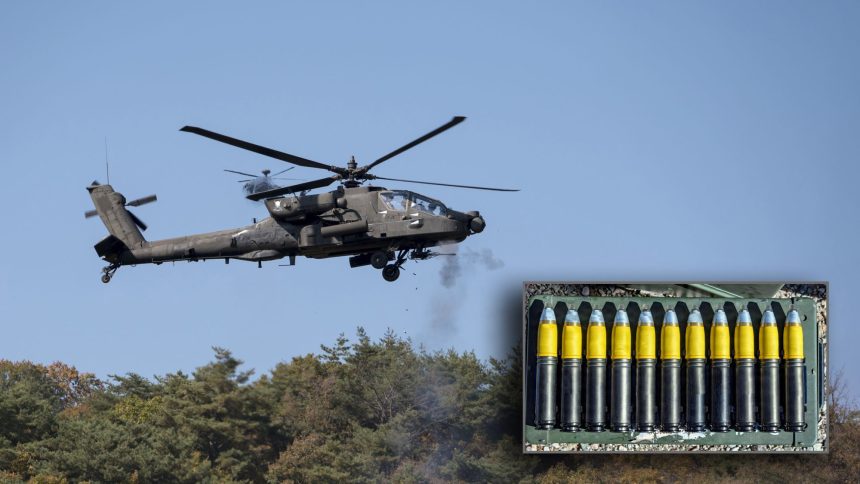
Live-fire trials of the AH-64 with XM1225 APEX ammunition come as both U.S. and Russian attack helicopters experiment with proximity-fused cannon rounds to defeat small UAVs.
The U.S. Army conducted the first successful live fire test of the 30×113 mm XM1225 Aviation Proximity Explosive (APEX) ammunition, employed by an AH-64 Apache attack helicopter in an air-to-air engagement at Yuma Proving Grounds, Arizona. The XM1225 is a new programmable proximity fuzed round that explodes around the target, and eases the employment of the 30 mm gun against drones as a kill can be achieved even without a direct hit.
The test is focused on enhancing the helicopter’s counter-unmanned aerial system (C-UAS) capabilities. According to the service’s press release, the trial took place in December 2025, although it was only revealed on Feb. 12, 2026.
The AH-64E Version 6 (V6) already has good C-UAS capabilities, which were validated in a massive counter-drone drill in August 2025 where the AGM-179 JAGM, AGM-114 Hellfire II, the APKWS II and its chin-mounted M230 chain gun were used. At the time, the M230 employed the standard M789 High Explosive Dual Purpose (HEDP) cartridge,
A similar advancement was claimed to be introduced also by Russia on the Ka-52M Alligator attack helicopter. The helicopter is said to have employed a new 30 mm airburst round first showcased by Rostec at the recent World Defense Show 2026 in Saudi Arabia.
Russia-aligned channels have also posted a video, claimed to be footage from the electro-optical turret of a Ka-52M shooting down a number of Ukrainian drones using its on-board gun. While one source claims 25 drones were downed in the overall sortie, Kremlin-aligned Telegram channel ‘Rybar’ has put the figure at 50.
Combat footage shows the latest 30mm ammo in action against Ukrainian UAVs. The 2A42 now fires new shells with shrapnel and remote fuzes. According to Russian ‘Fighterbomber’ Telegram channel a single ‘Ka-52’ crew shot down 25 drones in one combat sortie.” pic.twitter.com/OxkmRzGO7j
— H. Memarian (@HEMemarian) February 19, 2026
XM1225 round on the Apaches
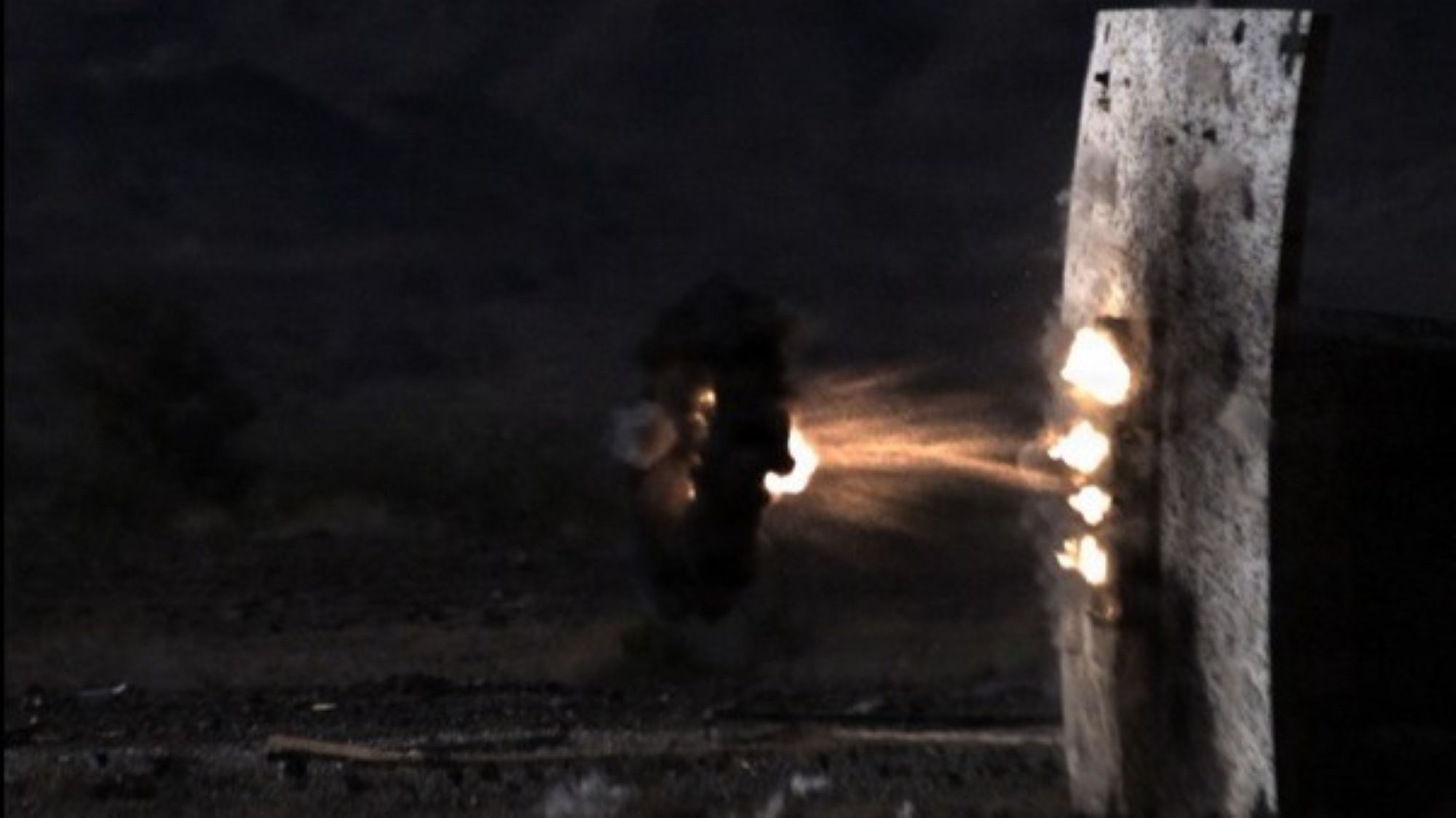
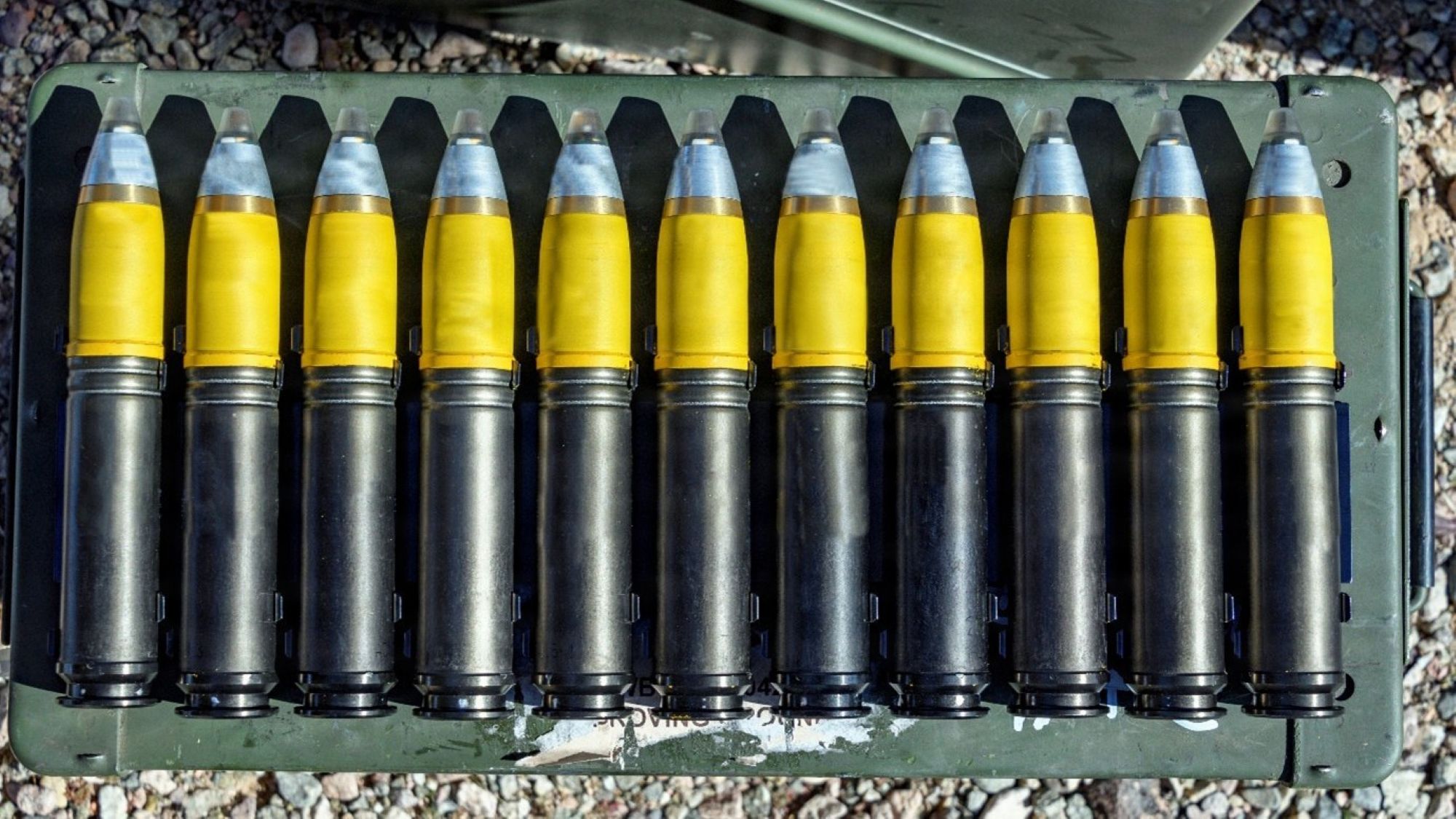
The U.S. Army’s release does not mention the type of target drones or the number of such aircraft shot down during the XM1225 testing from the AH-64 mounted M230 gun. The attached images showed an XM1225 exploding before a steel plate and a close up of the round, but did not capture the Apache firing the gun.
According to the statement, the cartridge does not require modifications to the Apache’s M230 Area Weapon System or fire control system, but had still “undergone extensive safety testing to ensure reliable performance” before being integrated with the Apache.
The XM1225 was used against several UAS targets at “various ranges,” proving “precision, versatility, and lethality.” The XM1225 APEX cartridge is “designed to counter modern threats, including UAS, exposed personnel, and small boats.”
Multiple agencies, including the Product Manager Medium Caliber Ammunition (PdM MCA) from Picatinny Arsenal, New Jersey; Project Manager Apache, Army Evaluation Center; U.S. Army Combat Capabilities Development Command’s (DEVCOM) Aviation and Missile Center; DEVCOM Armaments Center; Yuma Test Center; and the Redstone Test Center were involved in the XM1225’s development and the December 2025 trial.
Testing goals and results
The trial primarily evaluated the XM1225 APEX cartridge’s performance and accuracy against the legacy M789 High Explosive Dual Purpose (HEDP) cartridge under identical conditions. Personnel also gathered data on “mixed loads of XM1225 and M789 rounds against both ground and UAS targets,” that would possibly inform future developments.
This could also include the derivative of the M230 cannon used on the Maneuver Short-Range Air Defense System (M-SHORAD) based on the 8×8 Stryker wheeled armored personnel carrier (APC). This data will be shared with the M230’s developer Northrop Grumman to “set production, accelerate delivery and achieve an Urgent Materiel Release,” explained the service.
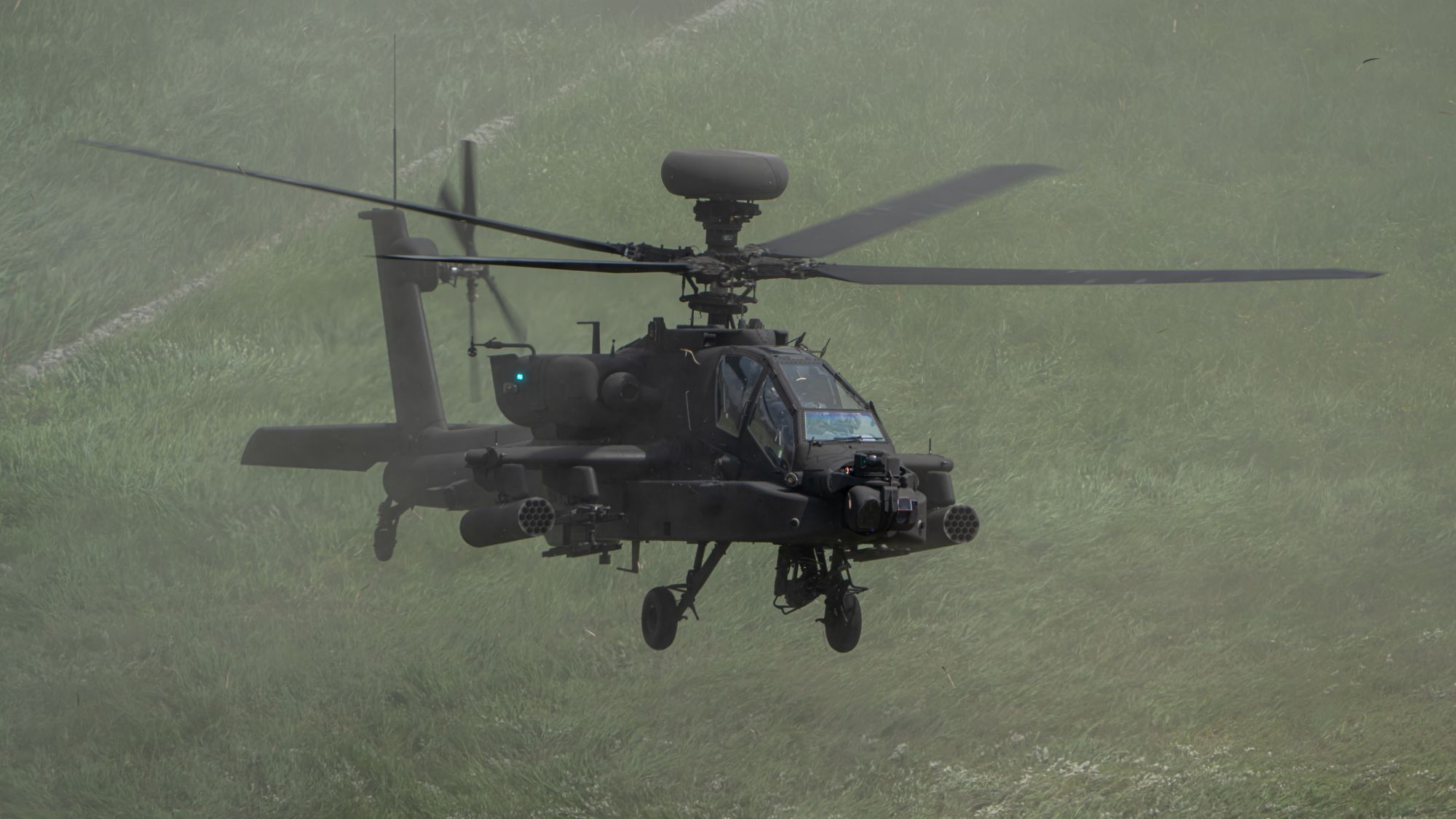
“Initial results were highly successful, with the XM1225 meeting all accuracy requirements and […] effectiveness against both ground and UAS targets,” the Army release said. Detonating near the target with its proximity-fuzed setting, the XM1225 creates a “larger lethal radius,” useful in both air-to-air and air-to-ground roles.
Maj. Vincent Franchino, test pilot and Attack Division chief at Redstone Test Center, praised the XM1225’s performance against “soft skinned ground and aerial” targets “so long as those targets are susceptible to detection, classification, and tracking.” This is a minor shortcoming, given the advent of dedicated smaller, ground-based anti-drone radars possibly networked with the AH-64 that could use its own Millimeter Wave Radar (MMR).
Lastly, Christopher Butts from the Project Manager Maneuver Ammunition Systems Warfighter Ammunition Information Program (WAIP) oversaw “ammunition loading at the refueling and rearming station and participating in all After Action Reviews.” His documentation and feedback from Army aviation master gunners and pilots will further inform the production, tactics and procedures of the XM1225 APEX rounds from the AH-64.
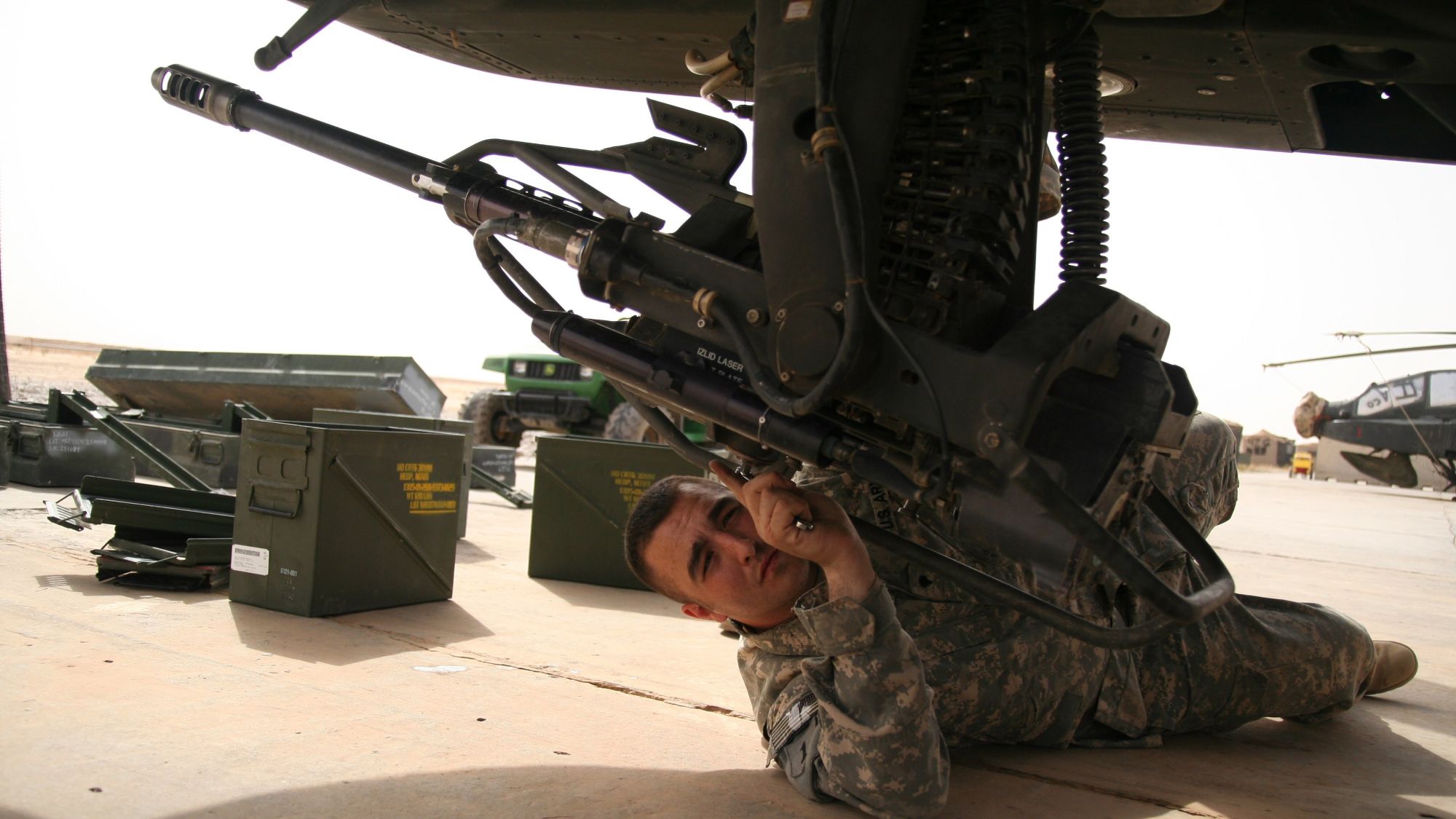
“[…] the XM1225 adds a new capability to the arsenal of 30mm proximity ammunition, giving the Apache Attack Helicopter another lethal option to defeat modernized threats,” the Army added in its release.
Ka-52 swatting down drones
The Ka-52M is the most modern version of the Alligator used by the Russian Aerospace Forces (RuAF), and has been known to use 2M39 Igla Man-Portable Air Defense (MANPAD) missiles, usually in quad-racks on both the outboard weapons stub wings. Videos from October 2024 and June 2025 show its use.
Exclusive footage of the objective control of the combat work of the Ka-52M crew, which destroyed 25 enemy UAVs in two combat sorties.
Undoubtedly, taking out 14 UAVs on the first sortie and landing another 11 on the second is a world record, and the crew deserves state awards,… https://t.co/ADbvuoJoaq pic.twitter.com/mPIeXh8WhO
— 𝐃𝐚𝐯𝐢𝐝 𝐙 🇷🇺 🇮🇪 (@SMO_VZ) February 20, 2026
The Alligator’s most notable use was thwarting Ukraine’s failed counter-offensive in mid-2023, using its 9-A-4172K Vikhr-1 Anti-Tank Guided Missile (ATGM) at standoff ranges to destroy Kyiv’s mostly Western-origin armor. We have previously covered the fundamentally different Russian and Western ground, armored, artillery and attack helicopter doctrines.
A ruSSian Ka-52 spends 3 Igla missiles to shot down a Ukrainian drone. pic.twitter.com/UhfxwMjG3H
— 𝔗𝔥𝔢 𝕯𝔢𝔞𝔡 𝕯𝔦𝔰𝔱𝔯𝔦𝔠𝔱△ 🇬🇪🇺🇦🇺🇲🇬🇷 (@TheDeadDistrict) June 9, 2025
For the concerned mission set claimed in the recent C-UAS video, the Ka-52 appears to have used its 30 mm Shipunov 2A42 automatic cannon installed on the starboard side of the fuselage in conjunction with the new round. The gun can fire both High-Explosive (HE) and Armor Piercing (AP) rounds, with an effective range of 1,500 meters on ground targets and a slant range of 2,500 meters for low flying targets.
Bekhan Ozdoev, Industrial Director of Weapons, Ammunition and Special Chemicals Cluster of Rostec, says the new “munition is designed to increase the likelihood of hitting small drones and loitering munitions.” He went on to explain that the helicopter’s “sighting system calculates the most advantageous detonation point according to the target flight path, allowing for reaching a drone with shrapnel. Time for detonation is input automatically via an optical line.”
Another similar photo posted on the same Telegram channel earlier today. Russian Mi-28 series and Ka-52 series attack helicopters have been employing the 9M39 to intercept Ukrainian drones over Russian and Russian-occupied territory. https://t.co/AuQg5x04wp pic.twitter.com/jQnCwXHShC
— Guy Plopsky (@GuyPlopsky) June 11, 2025
According to some sources, the 2A42 might require modifications before using this round as its standard configuration does not allow it to fully exploit the benefits of airburst munitions. It should be noted that it is not possible to independently verify if the helicopter in the video used the new airburst round.
Several stills from a newly released Russian MoD video showing a VKS Ka-52M, armed with two B8V20-A rocket pods and four 9-A-4172K Vikhr-1 ATGMs, departing on a combat sortie. The still image on the bottom right provides a closer look at its GOES-451M EO targeting system turret. pic.twitter.com/rJRhCtWQM3
— Guy Plopsky (@GuyPlopsky) January 28, 2026