Embraer and Northrop Grumman aim to offer advanced aerial refueling options amid a tanker capability gap in the U.S. and other Allied air forces.
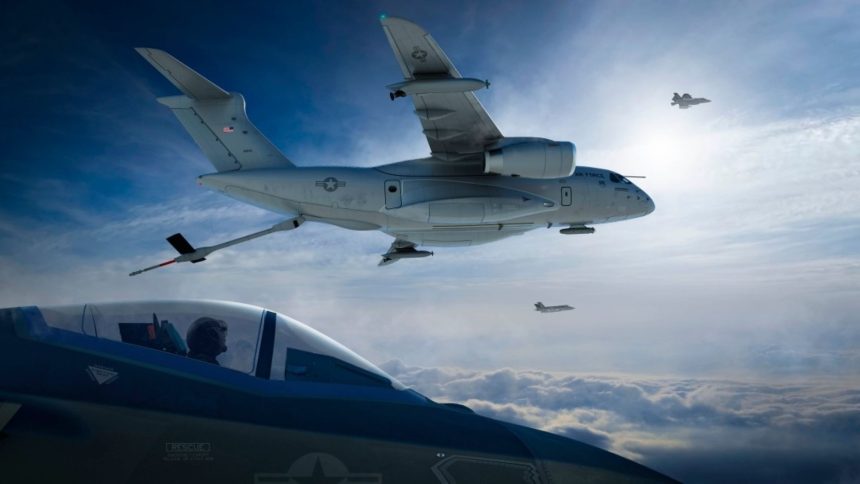
Brazilian aerospace major Embraer and Northrop Grumman announced on Feb. 19, 2026, a collaboration to further develop the KC-390 Millenium tanker-transport aircraft “to provide advanced tanking capabilities for the United States Air Force and allied nations.” The team-up will see a refueling boom being developed and installed on the centerline, adding to the two underwing hose-and-drogue refueling pods, as shown by the concept rendition released by Embraer.
The two firms will combine their technical expertise to develop what they have described as a KC-390 Multi-Mission Tanker. Beside an “autonomous” aerial refueling boom, they listed other features like “enhanced communications, situational awareness and survivability options, as well as adaptable mission systems.”
“These improvements will expand the range of aircraft supported by KC-390 refueling operations and broaden its mission scope in operational environments,” the joint release said.
The collaboration with Embraer is part of Northrop’s “three-pronged approach” to the U.S. Air Force’s pursuit of a “family of systems” for future refuelers, which goes from a large blended-wing body it is developing with JetZero, down to a small, uncrewed tanker, Aviation Week reported.
We’re jointly developing advanced air mobility capabilities with @Embraer for US and allied nations. https://t.co/7lZLxmtrrW pic.twitter.com/Ornk8djB5o
— Northrop Grumman (@NGCNews) February 19, 2026
Embraer is already steadily expanding its portfolio with the KC/C-390 Millenium following sales to Europe, conceptual electronic warfare and ISR variants, and foraying into the Indian market by responding to the Indian Air Force’s Medium Transport Aircraft (MTA) bid. It also announced the signing of an MoU with Indian company Hindalco to manufacture aerospace aluminum feedstocks to support its aircraft manufacturing and existing business in India, and plans with the Mahindra Group to establish a Maintenance Repair Overhaul (MRO) capability for the C-390 it has aggressively marketed to New Delhi.
Northrop – Embraer collaboration on KC-390
The release said the companies are “joining forces to combine their insights and experiences to rapidly advance the initiatives required to deliver a next generation air-refueling system.” Sharing respective expertise in “aircraft design, development and production with systems integration and industry-leading manufacturing capabilities,” the Northrop and Embraer collaboration “sets the stage for the development of the KC-390 Multi-Mission Tanker for US and allied air forces and shapes the requirements for future aerial logistics architectures.”
Northrop Grumman Aeronautics Systems’ President and Corporate Vice President Tom Jones called the collaboration a “strategic investment” to “address the gap in advanced air mobility solutions globally.” He further added “We’re listening to our customers, particularly in allied nations who seek greater operational autonomy and efficiency, and we’re exploring new technologies that will increase the versatility of the proven KC-390 platform and deliver that greater operational independence our customers need.”
NEWS | Embraer and @northropgrumman Jointly Developing Advanced Air Mobility Capabilities for US and Allied Nations. Read full news: https://t.co/yfXSU6Atv4 pic.twitter.com/8KStBia1PC
— Embraer (@embraer) February 19, 2026
Embraer’s President and CEO Bosco da Costa Junior said: “Together, we will leverage the strengths of two leaders in the defense industry, with a focus on developing a boom refueling system for the KC-390 Millennium so that we can bring the right capability to the U.S. Department of War and other allied nations. The KC-390 is an operationally proven and cost-effective platform that could quickly be added to the U.S. Air Force inventory.”
Current gaps in U.S. and Allied refueling capability
The U.S. Air Force has gone back and forth on its plans for the future refueling tanker program, the Next Generation Air-refueling System (NGAS), since the program’s inception in 2023. The service last released a “controlled unclassified information” Request for Information (RFI) in August 2025 for the NGAS but did not disclose any specific requirement.
美军部长弗兰克·肯德尔 宣布,加州初创公司 JetZero 已被选中在 2027 年之前建造一架具有BWB混合翼身 (翼身融合) 的XBW-1验证机。BWB 的主要优势是燃油效率,其翼型机身可以让整个飞机产生升力,减少至少30-40%燃油消耗。使用持续航空燃料 SAF,碳排放可下降 80% 以上。取消尾翼,顶部安装发动机 https://t.co/BF4YZp39GY pic.twitter.com/KTfQriGNql
— 极光 (@Aurora107E) August 17, 2023
Later, in September 2025, DefenseScoop quoted Air Mobility Command’s (AMC) chief Gen. John Lamontagne on the sidelines of the AFA Air, Space and Cyber conference, who said “Just about every option is on the table.”
“That was really a wide look at how we would do air-refueling in the future […] looking at conventional tankers we know of today – something like a [KC-135 Stratotanker] or a [KC-46 Pegasus] as is – or something with a bunch of mission systems added to it, with defense systems, connectivity, intelligence and more,” Lamontagne said. Other options include “a business jet, a blended-wing body or a signature-managed tanker,” he added.
As of December 2025, according to the World Air Forces 2026 report, the U.S. Air Force operates 376 older KC-135 Stratotankers and 95 Boeing KC-46A Pegasus aircraft, with the latter meant to replace the former. Boeing had previously said it delivered 14 KC-46s in 2025 and is now targeting to deliver 19 airframes in 2026.
The company is currently under contract to provide 183 tankers for U.S. and international customers, but the number might soon increase as the U.S. Air Force is planning to procure 75 additional aircraft to recapitalize the aging KC-135 Stratotanker fleet.
Some deliver flowers. We deliver tankers. 💌✈️
Today’s #KC46 delivery marks the 23rd delivery to @Travis60AMW and 103 total Pegasus aircraft ensuring the mission stays fueled and ready for the @USAirForce. pic.twitter.com/w7CplELfnm
— Boeing Defense (@BoeingDefense) February 13, 2026