The two new Kaan airframes are scheduled to begin testing in 2026, while Turkey is also developing its own engine to replace U.S.-made powerplants used by the prototypes.
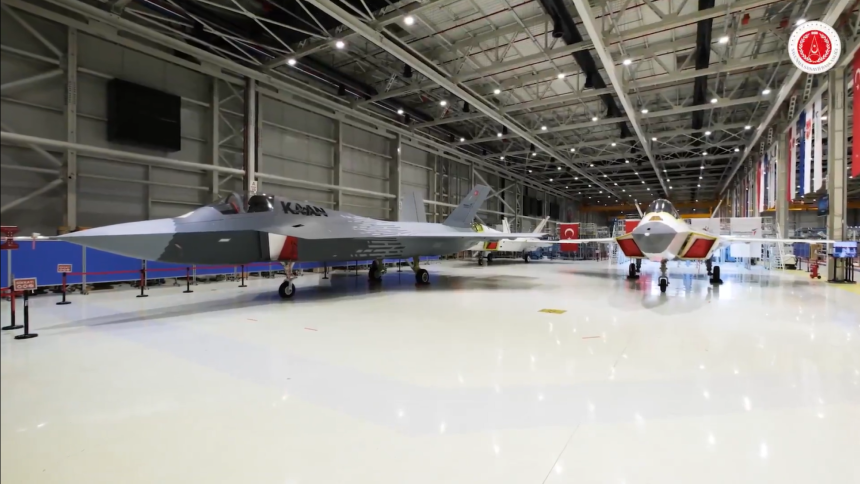
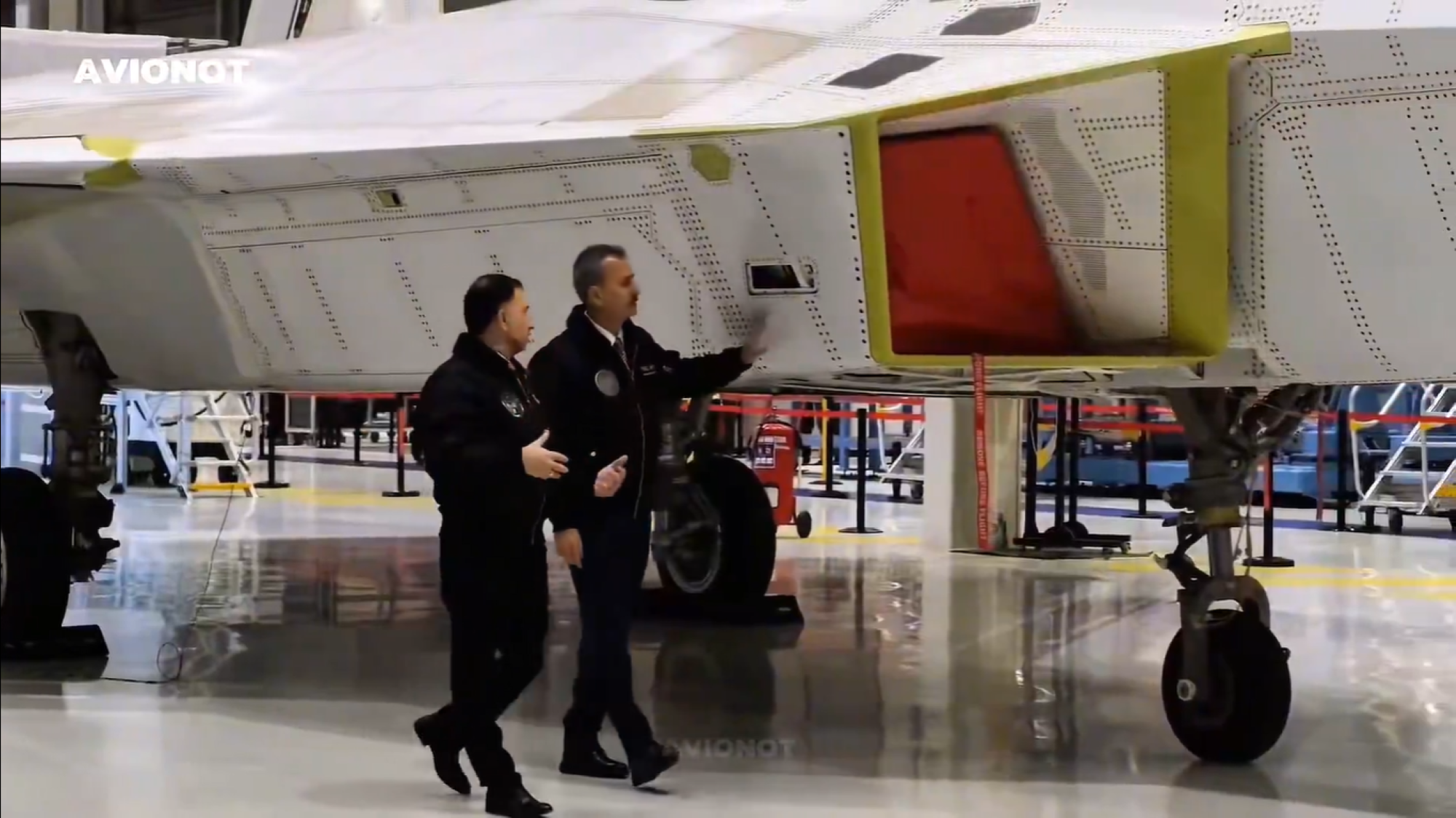
At least one of the new prototypes of Turkey’s Kaan fighter, named P1 and P2, can be spotted in a recent official video covering the visit of Dr. Haluk Görgün, president of the Defence Industry Agency (Savunma Sanayii Başkanlığı – SSB) to the facilities of Turkish Aerospace Industries (TAI/TUSAŞ).
We had previously reported in September 2025 that the second prototype, P1, had been captured in another official video of Turkey’s military veterans organization showing TAI. In that report we had also quoted Turkish defense media claims that P2 was already under construction at TAI, and that both airframes are slated to commence testing between April and June 2026.
On that occasion, the bare skeletal airframe of P1 was obscured behind the P0, which made it difficult to spot and analyze any significant design differences. In a split image shared by ‘Avionot’, we could see that the P1’s nose section appears to be wider, while the engine intake also appears to be taller, overshooting the chine line on the fuselage, and a little closer to the canopy.
📍 Ankara | TUSAŞ Tesisleri
✈️🇹🇷
Millî Muharip Uçak KAAN Projemiz kapsamında, KAAN hangarımızı ziyaret ederek tam boy statik test uçağımızda gelinen son aşamaya ilişkin kapsamlı bilgi aldık ve sahadaki çalışmaları yerinde inceledik.
2024 yılında ilk uçuşunu icra eden ve ilk… pic.twitter.com/mipIGkTtSs
— Prof. Dr. Haluk Görgün (@halukgorgun) February 13, 2026
While the new visuals now show progress on the manufacturing has been steady, key design changes show lessons are rapidly learnt from the experience on the P0 airframe.
New footage
The Kaan is being developed as Turkey’s cost effective Gen. 5 alternative and somewhat of a substitute to the F-35, after Turkey was removed from the program in 2020 and has been lobbying to be readmitted in. The new footage extensively captures P1, and shows a series of considerable design tweaks.
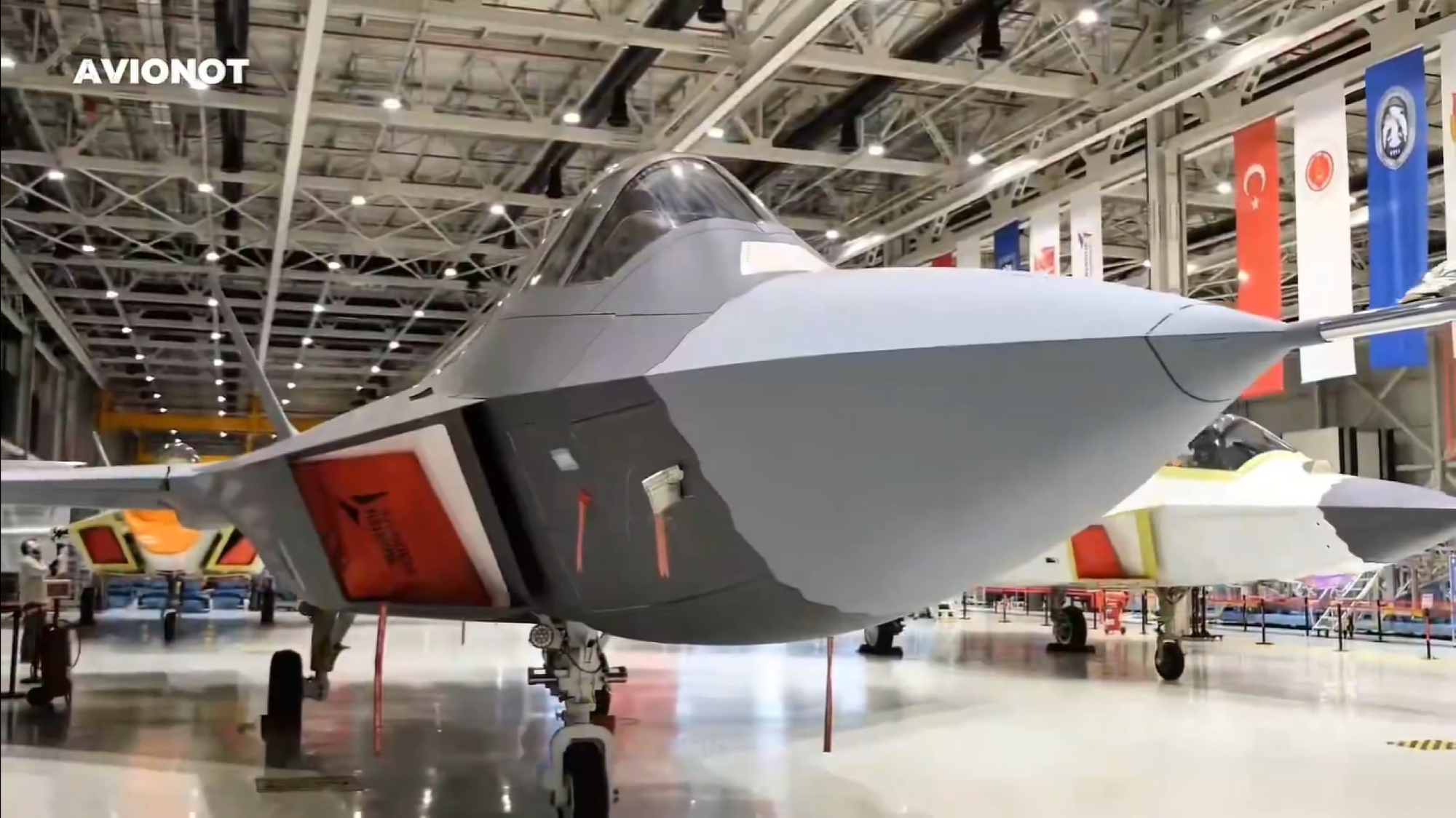
A major spot is the Tulgar Helmet-Mounted Display (HMD) fifth generation headgear, which has been seen in official renderings and exhibition displays for a few years now. The Tulgar helmet can be seen through the cockpit canopy on the seat, in the airframe that observers have identified as the P1, which is parked on the port (left) side of the P0 inside the hangar. The one on the starboard side is the Iron Bird ground prototype.
ASELSAN TULGAR Kaska Monteli Gösterge Sistemi.
🌐
ASELSAN TULGAR Helmet Mounted Display. pic.twitter.com/SzoB3ccrIO
— ASELSAN (@aselsan) January 13, 2026
— FlyHigh (@KAYALP777) April 18, 2024
One difference in the design between the P0 and P1 is that the engine intake has been moved much behind in the fuselage, and is exactly under the boundary line of the cockpit hinges. This creates more space for self-defensive sensors like missile proximity, radar warning, directional infrared countermeasures or other arrays concerned with giving all-round 360 degree visibility, like the F-35’s Distributed Aperture System (DAS).
🛩 Comparison of the KAAN P1 prototype with the P0
➡️There has been some change in the fuselage back geometry. You can see the changes in the slope lines. (Image-1)
➡️At P1, the air intake has been moved back towards the cockpit level. We have seen this before in the visuals… https://t.co/iAdNAJ9mnr pic.twitter.com/qwII1TW7Yl
— TR_tech (@T_Nblty) February 14, 2026
The main landing gears are also moved a little further to the side, now emerging only partly from the underbelly. This also provides some space for both external and internal ventral weapons stores. Most importantly, a top view shows that the distance between the both engines in the P1 has also increased.
KAAN’ın yerli ve milli motoru TF-35000’in geliştiricisi TR Motor’un genel müdürü Osman Saim Dinç:
“Motor projesini ülkemizin beka meselesi olarak görüyoruz.” pic.twitter.com/mlcUK36xGG
— Avionot (@avionot) February 17, 2026
Future
Turkish accounts quoted Görgün, who touched upon Turkish technical capabilities, and charted out the testing roadmap for the P1 and P2. “Our aircraft, which will be used in Full-Scale Static tests, will be in the same frame together with our second prototype, which will conduct its subsequent flight after the first prototype that performed its initial flights, upon exiting the hangar. This both signifies an important technical milestone and stands before us as a concrete indicator of the efforts of thousands of people,” he said.
You have my respect for this 🫡
Decisive political backing from Erdogan, industrial leadership from Temel Kotil, engineering drive from Ugur Zengin and Fahrettin Ozturk, and the state–industry bridge provided by Haluk Gorgun. pic.twitter.com/bl72LpY3yU
— Alpha Defense™🇮🇳 (@alpha_defense) February 15, 2026
Görgün added that the Kaan would have all Gen. 5 attributes like stealth technology, electronic warfare capabilities, internal weapons bays, advanced avionics architecture, enhanced situational awareness and sensor fusion. Most importantly, he touched upon how TAI is carrying out “development, test and production steps simultaneously,” an approach undertaken to shorten timelines. The U.S. Army too is adopting a similar route for its MV-75 tilt-rotor aircraft.
“Following our high-speed prototype that made its first flight in 2024, the development and production processes have continued without interruption. At the same time, we are also conducting operational capability development studies for manned-unmanned combat aircraft,” Görgün added. Turkey’s Anka 3 and Kizilelma UCAVs that are meant to fly alongside the Kaan have also witnessed notable successes.
SSB Başkanı Haluk Görgün:
“KAAN’ımızın teknik kabiliyetlerine baktığınızda; ulaşacağı hızdan görünmezlik teknolojisine, elektronik harp yeteneğinden çoklu görev kabiliyetlerine kadar, dünyada sayısı bir elin parmakları kadar olan seçkin muharip uçak sınıfının bir üyesi olacağını… pic.twitter.com/wMOTnVP66Z
— SAVTEK Dergi (@savtekdergi) February 13, 2026
Lastly, Görgün referred to the TF35000 engine: “[…] the development of our indigenous engine, is adding new ones to its capabilities and to our country’s defense and aviation industry infrastructure […].”
SSB Başkanı Haluk Görgün:
“Statik test prototipimizin üretiminin tamamlanmasıyla birlikte; tasarımdan üretime, üretimden doğrulamaya uzanan sürecin olgunlaşma yolunda nasıl ilerlediğini hep birlikte görmekteyiz.”
“Yerli motorumuzun geliştirilmesi başta olmak üzere kabiliyet… pic.twitter.com/3tfp5JtIim
— SAVTEK Dergi (@savtekdergi) February 13, 2026
Turkey is investing heavily in the TF35000 turbofan engine developed by Turkish Engine Industries (TEI) to power future production airframes of the Kaan and move away from the General Electric F110-GE-129E powerplants. Ankara therefore somewhere hopes that the indigenous program’s success changes its equations with Washington, with the reduced dependency leveraged to either secure the F-35 or other geopolitical concessions.