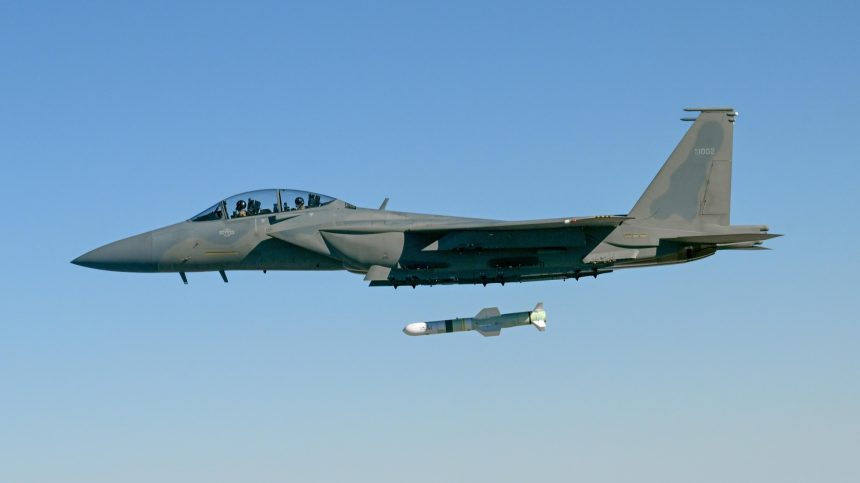
The U.S. Navy used one of Boeing’s F-15SA instrumented aircraft to conduct the final test flight of the AGM-84 Harpoon Block II Update at the Point Mugu Sea Range.
The U.S. Navy’s Naval Air Systems Command (NAVAIR) announced the successful completion of the third and final planned flight test of the Harpoon Block II Update (HIIU) Obsolescence Update program. The test, which saw Precision Strike Weapons (PMA-201) program office working together with Boeing, was conducted on Jan. 16, 2026, at Naval Air Weapons Station China Lake and the Point Mugu Sea Range in California.
Notably, the test saw the involvement of F-15 12-1002, which is one of the three instrumented F-15SAs (Saudi Advanced) operating from Boeing facilities in Palmdale, California. In fact, the Saudi F-15SA is one of the two variants (the other being the South Korean F-15K) that can employ the AGM-84 Harpoon anti-ship missile and its derivative AGM-84H/K Standoff Land Attack Missile-Extended Range (SLAM-ER).
Harpoon Block II Update
According to NAVAIR’s statement, the test of the Harpoon Block II Update (HIIU) “demonstrated a successful Coastal Target Suppression mission against a representative land target, with all test objectives met based on preliminary assessments.” While the Harpoon was designed as an anti-ship missile, with the Block II it later incorporated the capability to attack land targets, which was first demonstrated in 2001.
The weapon was launched by the F-15 at approximately 12,000 feet above ground level, descending to an initial waypoint altitude of 5,000 feet and proceeding to the target area with “multiple altitude changes to simulate a coastal engagement,” before a steep terminal dive prior to impact. Using the GPS-aided navigation introduced with the Block II, the Harpoon can navigate a number of pre-launch programmed waypoints, skimming across the sea and performing a terminal pop-up maneuver prior to making a steep dive angle attack.
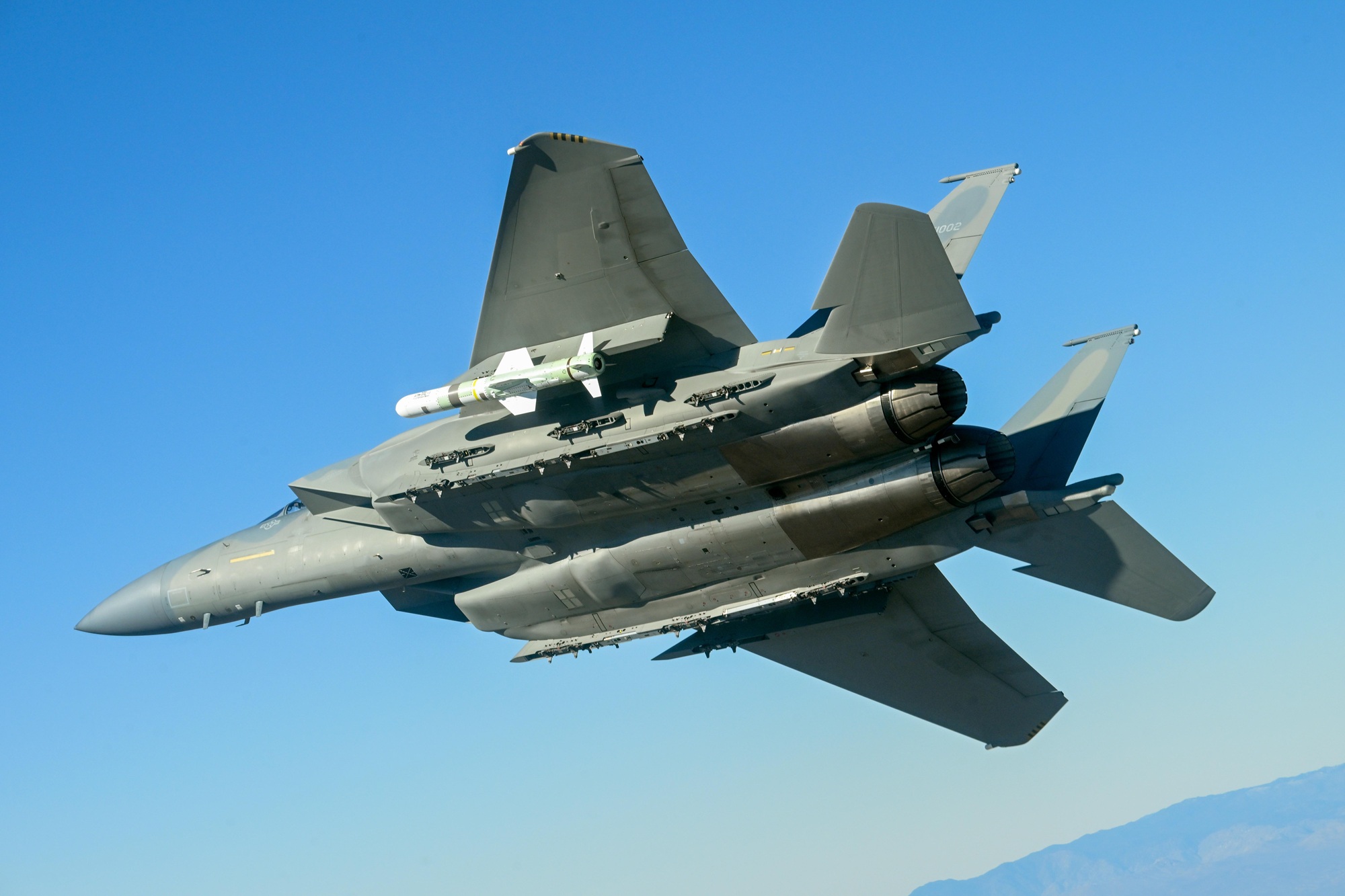
When this variant was first tested, Boeing explained the new capabilities were provided by incorporating the low-cost inertial measuring unit from the Joint Direct Attack Munition (JDAM) and the software, mission computer, integrated Global Positioning System/Inertial Navigation System and GPS antenna from the SLAM-ER. The coupling of GPS/INS with the existing radar seeker is said to improve guidance to the target search area, which can be set together with areas to avoid during the search.
The testing of the latest HIIU variant, defined as a near total redesign of the weapon with the refreshment of the internal components, started in 2025. The Navy planned a total of three events designed to progressively validate system performance across mission sets.
According to the statement, the first test, conducted in mid-2025, verified guidance and aerodynamic performance, the second demonstrated engagement of a moving maritime surface target, and the final event, conducted on Jan. 16, confirmed effectiveness against a land-based target. The service added that the system-level flight testing for the HIIU Obsolescence Update is nearly complete, with initial deliveries planned for later this year.
“This milestone reflects the strength of the integrated government and industry team and their commitment to delivering reliable, relevant capability to the fleet,” said Capt. Sarah Abbott, PMA-201 program manager.
F-15’s Anti-Ship Capabilities
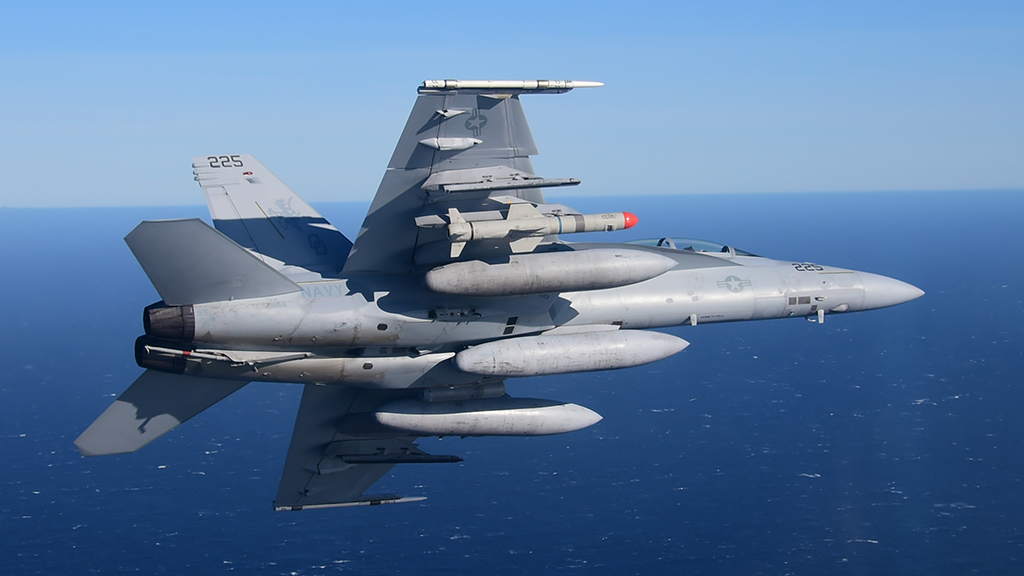
The F-15 Eagle was designed as an air superiority-focused platforms, although it later evolved into a multirole aircraft with the F-15E Strike Eagle and its derivates. Nevertheless, one of the capabilities of the newer variants is the anti-ship role, which is currently employed only by the Royal Saudi Air Force’s F-15SA fleet and the Republic of Korea Air Force’s F-15K fleet.
Specifically, Saudi Arabia employs the F-15SA and AGM-84L Harpoon Block II, and South Korea employs the F-15K and the AGM-84H Standoff Land Attack Missile Expanded Response (SLAM-ER). This capability stands them apart from the U.S. Air Force’s F-15E, as the two weapons are not part of the service’s inventory.
It is not very common to see the F-15 armed with these weapons. One of these instances was when the F-15SA employed the Harpoon during a Pakistani/Saudi Arabian exercise in 2021, with multiple weapons fired after a flight from Saudi Arabia to a location off the coast of Pakistan.
Qatar was reportedly working to acquire the AGM-84L Block II following the procurement of the F-15QA, however it is unclear it the weapon was acquired. The F-15QA was based on the F-15SA, and would thus include similar capabilities such as the anti-ship role.

Even without Harpoons, the U.S. Air Force’s F-15s might receive an anti-ship capability in the end. In fact, in 2025, NAVAIR announced its intention to negotiate a contract for the integration of the AGM-158C-1 LRASM (Long Range Anti-Ship Missile) on the F-15E Strike Eagle and the F-15EX Eagle II.
Compared to the Harpoon, the LRASM would provide the F-15 with a low-observable anti-ship weapon with a longer range, which the manufacturer Lockheed Martin states is in excess of 200 NM or 370 km. The new weapon is meant to provide the F-15 with a flexible, long-range, advanced, anti-surface capability against high-threat maritime targets.