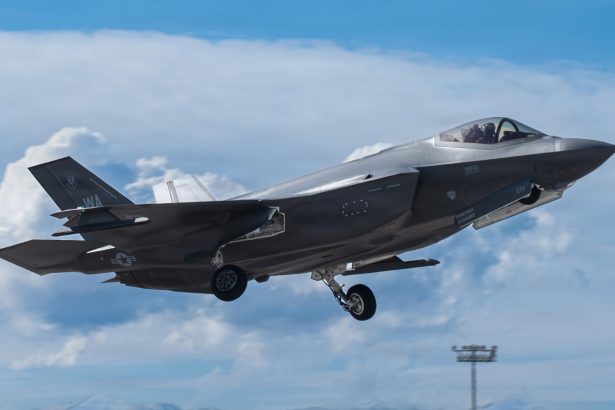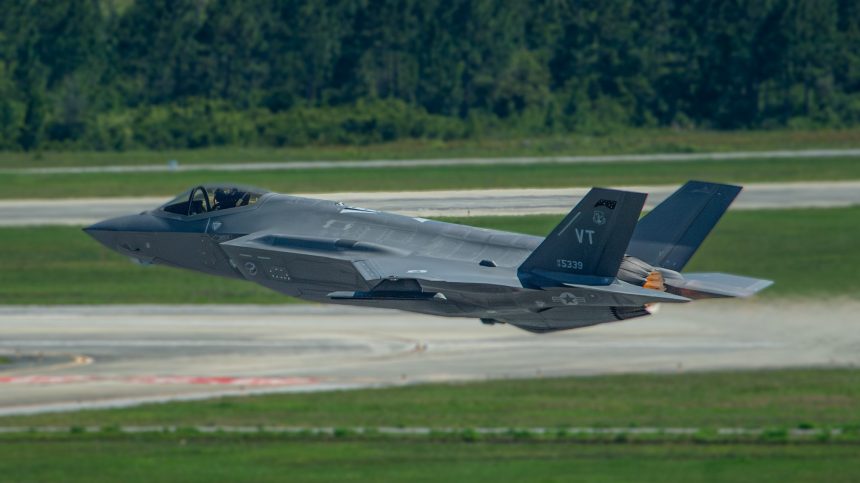
USAF F-35As deployed to Puerto Rico for the attack on Venezuela might now be part of what Trump called a ‘massive armada’ moving towards Iran.
In recent days, a series of U.S. military movements have drawn heightened attention across the Middle East. These developments have coincided with ongoing regional tensions following domestic unrest in Iran and threats of a new U.S. attack against the country.
Many assets were observed moving to the U.S. Central Command (CENTCOM) area of responsibility (AOR), although official details remain limited. However, publicly available information and press releases suggest a broader pattern of readiness activities and force rotations, which might not necessarily point towards an imminent attack.
Additional Assets Moving East
As of this writing, there is no official Department of Defense confirmation regarding the redeployment of specific tactical aircraft such as Air Force F-35A Lightning IIs or Navy EA-18G Growlers to bases within the CENTCOM AOR. However, open-source flight tracking noted tankers and fighter aircraft moving across the Atlantic Ocean, in addition to multiple cargo aircraft.
Notably, among these fighters being moved are the U.S. Air Force’s F-35A Lightning IIs that were previously deployed to Puerto Rico for the operations against Venezuela. Their redeployment was noted by tracking tanker aircraft supporting the movement, as well as radio communications on open frequencies.
Two KC-46 Pegasus tankers, with the callsigns GOLD 71 and GOLD 72 (standard callsign for CORONET missions), supported a flight of six F-35As, with the callsigns TABOR 31 through 36, flying from Puerto Rico to Lajes Air Base, in the Azores. Two more KC-46s, with the callsigns GOLD 81 and GOLD 82, might have supported the remaining six F-35s which were part of the deployment.
#USAF United States Air Force – Middle East Activity (CORONET)
29 January 2026 – 1420z
CORONET East 035 – Another four KC-46’s, as well as a KC-135, have departed Homestead Air Reserve Base and Roosevelt Roads Naval Air Station on a CORONET East 035 tasking. This is the second… https://t.co/jIGHqVRrSx pic.twitter.com/42a831ZEmW
— Armchair Admiral 🇬🇧 (@ArmchairAdml) January 29, 2026
The F-35s were captured in videos and images while landing at Lajes, a common stopover for oceanic crossings, while the tankers were tracked until they landed at Morón Air Base, Spain. At the time of writing, there are no indications that the fighters and the tankers departed again.
The same F-35s involved in the U.S. mission to capture Venezuelan President Maduro arrived in Lajes on their way to the Middle East this evening.
The fifth-generation fighters will bring additional capabilities as the U.S. prepares options to strike Iran. https://t.co/BwAwqDzJ1Z pic.twitter.com/8MslGBp1w7
— OSINTtechnical (@Osinttechnical) January 29, 2026
Four more KC-46s, with the callsigns GOLD 31, 32, 41 and 42, supported the transfer of six EA-18Gs from Naval Air Station Oceana, Virginia. Three Growlers were supported by each couple of tankers, and were assigned the callsigns TABOR 51 through 53 and TABOR 61 through 63, and landed at NAS Rota, Spain.
KC-46A #GOLD31-32 & #GOLD41-42 are taking EA-18Gs #TABOR51 (x3) & #TABOR61 (x3) out of NAS Oceana over to Naval Station Rota on Coronet East 037, likely to be deployed to the Middle East. https://t.co/dQfSXuZMBY pic.twitter.com/i6AZd24q2g
— EISNspotter (@EISNspotter) January 29, 2026
There are some reports about the six EA-18Gs possibly crossing the ocean to join the build up of U.S. forces. However, only six Growlers were observed arriving at NAS Rota, further pointing to the reports of the six aircraft which left Puerto Rico returning to their home base.
Two HC-130J Combat King IIs also reportedly arrived at Muwaffaq Salti Air Base in Jordan. The aircraft, callsigns KING 40 and KING 39, arrived on Jan. 29 and 30, respectively, after making stops at NAS Rota and Naval Support Activity (NSA) Souda Bay, Greece.
A C 130J Combat King has arrived at Al Muwaffaq in Jordan.
HC 130J deployments often signal preparation for high risk operations, as these combat search and rescue aircraft are positioned to recover downed pilots or crews if airstrikes or special operations unfold over hostile… pic.twitter.com/CdgYfGWoRm
— Open Source Intel (@Osint613) January 29, 2026
An E-11A Battlefield Airborne Communications Node (BACN) with the callsign BLKWF01 arrived at Souda Bay on Jan. 28, and later departed again to an unknown location in the Middle East. On the other hand, the EA-37A Compass Call which arrived few days earlier at Ramstein Airbase in Germany, which many said might have been involved in the buildup, has returned to the U.S.
BLKWF01, a Bombardier E-11A Battlefield Airborne Communications Node (BACN) with the U.S. Air Force’s 18th Airborne Command and Control Squadron, stationed at Robins Air Force Base in Georgia, is currently crossing the Atlantic bound for Souda Air Base in the Eastern… pic.twitter.com/NL2IPH5DZy
— OSINTdefender (@sentdefender) January 28, 2026
An RC-135V Rivet Joint, with the callsign OLIVE 48, was deployed to Al Udeid Air Base, Qatar, on Jan. 28. Completing the lineup are multiple C-17A Globemaster III and C-5M Super Galaxy moving cargo to the Middle East, reportedly including Terminal High Altitude Area Defense (THAAD) units.
Added C-5Ms.
23 airframes the past 24 hours. https://t.co/j2Eia967M7 pic.twitter.com/59nOBgg3ef
— Evergreen Intel (@vcdgf555) January 30, 2026
As mentioned earlier, this information comes from open source tracking which can be done with freely available tools. While the military would not comment on the movements and no specific official statements are currently available, the fact that they are clearly visible means that they are not hiding.
Recent operations like Midnight Hammer and the most recent Absolute Resolve were examples of the renewed emphasis of the U.S. military on the use of OSINT sources. In fact, during the former operations OSINT was used to attract attention away from the strike package by making clearly noticeable a second package used as bait, while during the latter OSINT channels were continuously monitored to check whether U.S. forces were spotted on their way into Caracas.
Previous Movements
On Jan. 25, 2026, U.S. Air Forces Central (AFCENT), also known as Ninth Air Force, publicly announced a multi-day operational readiness exercise across the CENTCOM AOR. According to the service’s press release, the exercise aims to demonstrate “the ability to deploy, disperse, and sustain combat airpower across the U.S. Central Command area of responsibility.”
U.S. Air Forces Central will be conducting a multi-day readiness exercise to demonstrate the ability to deploy, disperse, and sustain combat airpower across the U.S. Central Command area of responsibility.
Read more: https://t.co/F4rRENnVGD pic.twitter.com/ny80gdjuQU
— U.S. Central Command (@CENTCOM) January 27, 2026
The announcement described the exercise as consistent with components of the Agile Combat Employment concept, designed to enhance dispersion capability and logistical sustainment without specifying participating units or locations. However, as we noted in our previous reports here at The Aviationist, these exercise are now common, and stating the new exercise could be related to preparations for a possible attack on Iran would only be jumping to conclusions.
However, the timing is notable. Also, it must be remembered that training for such scenarios proved useful after Operation Midnight Hammer in June 2025, with aircraft dispersing to avoid retaliation strikes following the attack on the Iranian nuclear sites.
The disclosure of the exercise also followed the arrival in the AOR of a squadron of F-15E Strike Eagles, the 494th Fighter Squadron (FS) from RAF Lakenheath in the UK. The aircraft landed at an officially undisclosed Middle East base, which was assessed to be Muwaffaq Salti Air Base in Jordan, which periodically hosts deployments of U.S. aircraft, including F-15Es and currently also A-10Cs.
A U.S. Air Force F-15E Strike Eagle assigned to the 494th Expeditionary Fighter Squadron lands at a base in the Middle East, Jan. 18. The F-15’s presence enhances combat readiness and promotes regional security and stability. pic.twitter.com/QTXgOsOozV
— U.S. Central Command (@CENTCOM) January 20, 2026
Simultaneously, the U.S. Navy’s USS Abraham Lincoln (CVN 72) Carrier Strike Group (CSG) was confirmed to have arrived in the CENTCOM AOR. Official statements from the command described the CSG’s deployment being meant “to promote regional security and stability,” without specifying future operations or definitive tasking orders.
The carrier is escorted by destroyers USS Frank E. Petersen, Jr. (DDG-121), USS Spruance (DDG-111) and USS Michael Murphy (DDG-112). Carrier Air Wing (CVW) 9 is currently assigned to the USS Lincoln, and includes a mix of F-35C Lightning IIs, F/A-18E/F Super Hornets, EA-18G Growlers, E-2D Hawkeyes, CMV-22B Ospreys, and MH-60R/S Seahawks.
An F/A-18E Super Hornet, attached to Strike Fighter Squadron 151, launches from the flight deck of the USS Abraham Lincoln (CVN 72) while conducting routine flight operations in the Arabian Sea. Abraham Lincoln is deployed to support security and stability within the Middle East… pic.twitter.com/PiG8rmlWuo
— U.S. Central Command (@CENTCOM) January 30, 2026
These developments have drawn attention from analysts and observers due to their concurrence amid elevated regional tensions. However, while actions appear to be officially related to exercises or routine operational patterns, U.S. President Donald Trump wrote that a “massive armada” was heading towards Iran, led by the USS Lincoln, and “ready, willing and able to rapidly fulfill its mission, with speed and violence, if necessary.”
Strategic Implications
Taken together, the composition of assets moving into or toward the CENTCOM AOR suggests preparation for a broad range of contingencies. While U.S. officials say a decision have not yet been made, these contingencies might also include the possibility of a new attack on Iran.
For now, the deployment of a multitude of assets follows a pattern observed during previous periods of heightened tension in the region. Because of this, an attack might not be necessarily imminent, but the composition of the forces being assembled and political rhetoric about a “massive armada” inevitably draws comparisons with past buildups that preceded limited military actions.
— Rapid Response 47 (@RapidResponse47) January 28, 2026
Whether this posture ultimately serves as deterrence, preparation, or simply routine rotation will become clearer as additional assets arrive – or do not – over the coming days. For instance, a further indication might be the continuation of the deployment of F-35A Lightning IIs and EA-18G Growlers following their stop in the Azores and Spain, respectively.
The capabilities of the F-35A were already in the spotlight during Operation Midnight Hammer, pushing deep into Iran to escort the B-2A Spirit bombers. The Lightnings notably used their low observability, radar, sensors and targeting systems to detect and destroy surface-to-air threats.
The EA-18G also adds another specific set of capabilities, being able to provide electronic warfare support in addition to the Suppression/Destruction of Enemy Air Defenses (SEAD/DEAD). Notably, in addition to the ALQ-99 Tactical Jamming System (TJS), Growlers on the USS Lincoln were photographed with the new ALQ-249 Next Generation Jammer Mid-Band (NGJ-MB).
🇺🇸 Sailors prepare to taxi an EA-18G Growler, attached to VAQ-133, on the flight deck of the USS Abraham Lincoln (CVN 72), Jan. 21, 2026. Note the Tactical Jamming System (TJS) pod & Next Generation Jammer Mid-Band (NGJ-MB) pod under the fuselage & starboard wing, respectively.… pic.twitter.com/zbtk73yzu4
— Guy Plopsky (@GuyPlopsky) January 27, 2026
The RC-135V, returning in the area after months of absence, would potentiate electronic and signals intelligence-gathering (ELINT/SIGINT) both ahead and after possible operations in Iran. The E-11A, on the other hand, would enhance command-and-control and intelligence data dissemination thanks to its ability to relay communications and act as gateway between different systems.
The reported movement of THAAD units further points to the reinforcement of a defensive posture aimed at countering possible ballistic missile retaliation. These might also be joined by air assets to counter cruise missile and One Way Attack (OWA) drone attacks.
Other aircraft already deployed to the region, such as the F-15Es and A-10Cs, also factor into the overall posture. While it is unlikely the A-10C would be employed in an operation in Iranian airspace, the multirole F-15E could be easily employed to launch stand-off munitions such as the AGM-158 Joint Air-to-Surface Standoff Missile (JASSM).
The F-16 Fighting Falcon is one of the most iconic fighter jets that the U.S. Air Force operates. Now in operation for over 50 years, the F-16 remains one of the most widely flown fighters in the world, operated by more than 25 countries. pic.twitter.com/uY6IrWkvrB
— U.S. Central Command (@CENTCOM) January 14, 2026
A number of F-16 Fighting Falcons are also currently operating in the region, confirmed to be conducting patrols and participating in exercises. While the aircraft remains a highly capable multirole platform, it is more likely to be employed in supporting roles such as defensive counter-air missions and the protection of forward bases and high-value assets due to the lower payload and shorter range compared to other platforms.
Overall, this combination of platforms reflects a posture designed not only for deterrence and putting pressure on Iran, but also for enabling rapid execution of complex air operations in a highly contested environment, should the order come. This combination could be further reinforced by the arrival of F-22 Raptors and bomber aircraft, replicating a lineup already tested during previous operations.